ML Aggarwal: Rational Numbers - 6

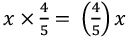
Q.1. In a bag, there are 20 kg of fruits. If  kg of these fruits be oranges and
  kg of these are apples and rest are grapes. Find the mass of the grapes in the bag.
Given
Total fruits in a bag = 20 kg
Oranges =kg i.e. 42/6 kg
Apples =kg i.e. 26/3 kg
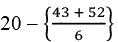
Remaining fruits in a bag =kg
=
On further calculation, we get
=
=
= 25/6
=kg
Therefore, the mass of the grapes in the bag is


Q.2. The population of a city is 6, 63,432. If 1/2 of the population are adult males and 1/3 of the population are adult females, then find the number of children in the city.
Given
Population of a city = 6, 63,432
Population of adult males = (1/2) f 6,63,432
= 3,31,716
Population of adult females = (1/3) f 6,63,432
= 2,21,144
Remaining population can be calculated as below
Remaining population = 6,63,432 - (3,31,716 + 2,21,144)
= 6,63,432 - 5,52,860
We get,
= 1,10,572
Therefore, number of children in a city are 1,10,572.
Q.3. In an election of housing society, there are 30 voters. Each of them gives the vote. Three persons X, Y and Z are standing for the post of Secretary. If Mr. X got 2/5 of the total votes and Mr. Z got 1/3 of the total votes, then find the number of votes which Mr. Y got.
Given
Number of votes = 3
Number of person for election = X, Y, Z
X got (2/5) of total votes = (2/5) of 30
=
= 12
Z got 1/3 of total votes = 1/3 of 30
=
= 10
Remaining votes can be calculated as below
= 30 - (12 + 10)
= 30 - 22
We get,
= 8
Therefore, Mr. Y got 8 votes


Q.4. A person earns Rs. 100 in a day. If he spent Rs.  on food and Rs.
  on petrol. How much did he save on that day?
Given
A person's earning in a day = Rs 100
Money spent on food = Rs.
Money spent on petrol = Rs.
The savings of a person is calculated as follows:
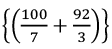
Savings = Rs. 100 -
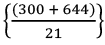
= Rs. 100 -
On further calculation, we get
= Rs. 100 -
=
= Rs.
= Rs.
Hence, a person saved Rs.on that day.


Q.5. In an examination, 400 students appeared. If 2/3 of the boys and all 130 girls passed in the examination, then find how many boys failed in an examination?
Given
Number of students appeared exams = 400
(2/3) of total boys and all 130 girls passed in the examination.
Hence,
Number of total boys = 400 - 130
= 270
Number of boys passed = (2/3) of 270
= (2/3) x 270
= 180
So, number of boys failed = 270 - 180
= 90
Hence, 90 boys failed in an examination.
Q.6. A car is moving at the speed of  km / h. Find how much distance will it cover in 9/10 hrs.
Given
Speed of a car =
Distance covered in 9/10 hours can be calculated as follows:
Distance = (122/3) x (9/10)
= 366/10
We get,
= 36.6 km
=
Therefore, the distance covered by the car in 9/10 hours is.

Q.7. Find the area of a square lawn whose one side is  long.
long.
Given
One side of a square lawn == 52/9m
The area of a square lawn can be calculated as follows:
Area = (side)2
= (52/9)2
We get,
=sq. m
=sq .m
Therefore, the area of a square lawn is
Q.8. Perimeter of a rectangle is  m. If the length is
  m, find its breadth.
Given
Perimeter of a rectangle =
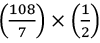
= 108/7 m
So,
Length + Breadth =
=
We get,
= 54/7m
Given length =
= 30/7m
Hence, breadth of a rectangle can be calculated as,
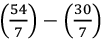
Breadth =
= 24/7
=m
Therefore, the breadth of a rectangle is

Q.9. Rahul had a rope of  m long. He cut off &
  m long piece, then he divided the rest of the rope into 3 parts of equal length. Find the length of each part.
Given
Length of a rope =m
Length of one piece of rope after cut off =m
Remaining length of a rope can be calculated as below
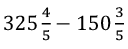
=
We get,
=m
=
This length divided into three equal parts
So, length of each part can be calculated as follows:
Length of each part =
=
We get,
=
=
Therefore, the length of each part of a rope is.


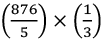


Q.10. If  litre of petrol costs Rs.
  then find the cost of 4 litre of petrol.
Given
Cost of
= Rs.
Hence, the cost of one litre can be calculated as below:
Cost of one litre = Rs.
The cost of 4 litre of petrol can be calculated as below
Cost of 4 litre = Rs.
We get,
= Rs 309
Therefore, the cost of 4 litre of petrol is Rs. 309.


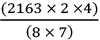
Q.11. Ramesh earns Rs 40,000 per month. He spends 3/8 of the income on food, 1/5 of the remaining on LIC premium and then 1/2 of the remaining on other expenses. Find how much money is left with him?
Ramesh earnings per month = Rs. 40,000
Expenditure on food = (3/8) of Rs. 40, 000 = Rs. 15,000
Remaining amount = 40,000 - 15,000 = Rs. 25,000
Expenditure on LIC premium = (1/5) of Rs. 25,000 = Rs 5000
Remaining amount = Rs. 25000 - Rs. 5000 = Rs. 20,000
Expenditure on other expenses = (1/2) of Rs. 20,000 = Rs. 10,000
Remaining amount left = Rs. 20,000 - Rs. 10,000 = Rs. 10,000
Therefore, the remaining amount left with Ramesh is Rs. 10,000
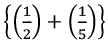
Q.12. A, B, C, D and E went to a restaurant for dinner. A paid 1/2 of the bill, B paid 1/5 of the bill and rest of the bill was shared equally by C, D and E. What fractions of the bill was paid by each?
Let us consider the total bill of the restaurant = 1
Bill paid by A = 1/2
Bill paid by B = 1/5
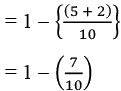
Remaining bill can be calculated as below:
Remaining bill = 1 -
We get,
= 3/10
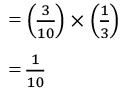
Shares of the three persons =
Therefore, each paid (1/10) of the bill.

Q.13. 2/5 of total number of students of a school come by car while 1/4 of students come by bus to school. All the other students walk to school of which 1/3 walk on their own and the rest are escorted by their parents. If 224 students come to school walking on their own, how many students study in the school?
Let total number of students be 1
Students who come by car = 2/5
Students who come by bus = 1/4
Students who come by walking = 1/3 of remaining
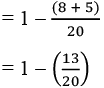
Rest students =
= 7/20
Number of students who come by walking can be calculated as below
Number of students who come by walking = 1/3 of 7/20 = 7/60
Now, 7/60 of total students = 224
Total students =
= 32 × 60
= 1920
Hence, 1920 students study in the school.


Q.14. A mother and her two sons got a room constructed for Rs. 60,000. The elder son contributes 3/8 of his mother's contribution while the younger son contributes 1/2 of his mother's share. How much do the three contribute individually?
The cost of a room = Rs 60,000
Elder son contribution = 3/8 of his mother's contribution.
Younger son contribution = 1/2 of his mother's share
Let the mother contribution be 1
Elder son's contribution = 3/8
Younger son's contribution = 1/2
Now,
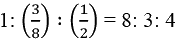
Ratios in their share =
Sum of ratios = 8 + 3 + 4 = 15
Therefore,
Mother's share == Rs. 32000
Elder son's share == Rs. 12000
Younger son's share == Rs. 16000
Q.15. In a class of 56 students, the number of boys is 2/5th of the number of girls. Find the number of boys and girls.
Total number of students in a class = 56
Let the number of girls be 1
Then number of boys will be = 2/5 of 1 = 2/5
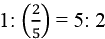
Ratios in girls and boys =
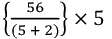
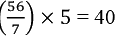
Number of girls =
=
And number of boys = (56/7) x 2 = 16
Therefore, number of boys = 16 and number of girls = 40
Q.16. A man donated 1/10 of his money to a school, 1/6th of the remaining to a church and the remaining money he distributed equally among his three children. If each child gets Rs. 50000, how much money did the man originally have?
Let the money of a man be 1
Money donated to a school = 1/10
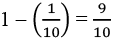
Remaining money =
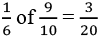
Money donated to a church =
Hence, remaining money =
=
A man divides equally to his three children
Hence,
Share of each child =
=
Here, each child gets Rs. 50000
Therefore, his total money = Rs. 50000 × (4/1) = Rs. 200000
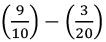


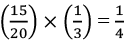
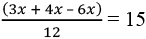
Q.17. If 1/4 of a number is added to 1/3 of that number, the result is 15 greater than half of that number. Find the number.
Let us consider the number as x
Then as per the condition,
(1/12) x of a number = 15
x = 15 x 12/1
x = 180
Therefore, the required number is 180.

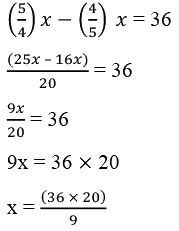
Q.18. A student was asked to multiply a given number by 4/5, By mistake, he divided the given number by 4/5. His answer was 36 more than the correct answer. What was the given number?
Let the given number be x
According to the condition,
But by mistake a student divides the given number
Then,
Hence,
We get,
x = 80
Theref