ML Aggarwal: Squares & Square Roots - 1

Q.1. Which of the following natural numbers are perfect squares? Give reasons in support of your answer.
(i) 729
(ii) 5488
(iii) 1024
(iv) 243
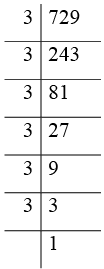
(i) 729
We know that
It can be written as
729 = 3 × 3 × 3 × 3 × 3 × 3
Here
729 is the product of pairs of equal prime factors
Therefore, 729 is a perfect square.
(ii) 5488
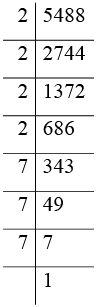
We know that
It can be written as
5488 = 2 × 2 × 2 × 2 × 7 × 7 × 7
Here
After pairing the same prime factors, one factor 7 is left unpaired.
Therefore, 5488 is not a perfect square.
(iii) 1024
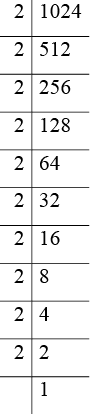
We know that
It can be written as
1024 = 2 × 2 × 2 × 2 × 2 × 2 × 2 × 2 × 2 × 2
Here
After pairing the same prime factors, there is no factor left. Therefore, 1024 is a perfect square.
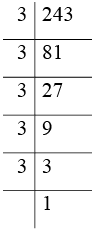
(iv) 243
We know that
It can be written as
243 = 3 × 3 × 3 × 3 × 3
Here
After pairing the same prime factors, factor 3 is left unpaired. Therefore, 243 is not a perfect square.
Q.2. Show that each of the following numbers is a perfect square. Also, find the number whose square is the given number.
(i) 1296
(ii) 1764
(iii) 3025
(iv) 3969
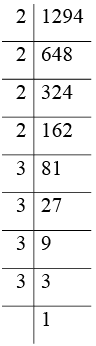
(i) 1296
We know that
It can be written as
1296 = 2 × 2 × 2 × 2 × 3 × 3 × 3 × 3
Here
After pairing the same prime factors, no factor is left.
Therefore, 1296 is a perfect square of 2 × 2 × 3 × 3 = 36.
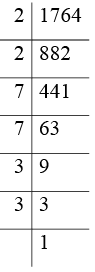
(ii) 1764
We know that
It can be written as
1764 = 2 × 2 × 3 × 3 × 7 × 7
Here
After pairing the same factors, no factor is left.
Therefore, 1764 is a perfect square of 2 × 3 × 7 = 42.
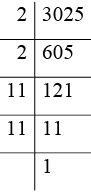
(iii) 3025
We know that
It can be written as
3025 = 5 × 5 × 11 × 11
Here
After pairing the same prime factors, no factor is left.
Therefore, 3025 is a perfect square of 5 × 11 = 55.
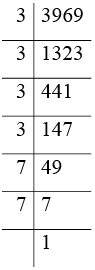
(iv) 3969
We know that
It can be written as
3969 = 3 × 3 × 3 × 3 × 7 × 7
Here
After pairing the same prime factors, no factor is left.
Therefore, 3969 is a perfect square of 3 × 3 × 7 = 63.
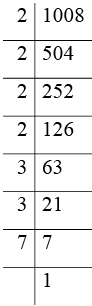
Q.3. Find the smallest natural number by which 1008 should be multiplied to make it a perfect square.
We know that
It can be written as
1008 = 2 × 2 × 2 × 2 × 3 × 3 × 7
Here
After pairing the same kind of prime factors, one factor 7 is left.
Now multiplying 1008 by 7
We get a perfect square.
Therefore, the required smallest number is 7.
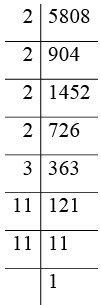
Q.4. Find the smallest natural number by which 5808 should be divided to make it a perfect square. Also, find the number whose square is the resulting number.
We know that
It can be written as 5808 = 2 × 2 × 2 × 2 × 3 × 11 × 11
Here
After pairing the same kind of prime factors, factor 3 is left.
Now dividing the number by 3, we get a perfect square.
Therefore, the square root of the resulting number is 2 × 2 × 11 = 44.