ML Aggarwal: Squares & Square Roots - 2

Q.1. Write five numbers which you can decide by looking at their one's digit that they are not square numbers.
We know that
A number which ends with the digits 2, 3, 7 or 8 at its unit places is not a perfect square.
Example: 111, 372, 563, 978, 1282 are not square numbers.
Q.2. What will be the unit digit of the squares of the following numbers?
(i) 951
(ii) 502
(iii) 329
(iv) 643
(v) 5124
(vi) 7625
(vii) 68327
(viii) 95628
(ix) 99880
(x) 12796
(i) 951
The unit digit of the square is 1.
(ii) 502
The unit digit of the square is 4.
(iii) 329
The unit digit of the square is 1.
(iv) 643
The unit digit of the square is 9.
(v) 5124
The unit digit of the square is 6.
(vi) 7625
The unit digit of the square is 5.
(vii) 68327
The unit digit of the square is 9.
(viii) 95628
The unit digit of the square is 4.
(ix) 99880
The unit digit of the square is 0.
(x) 12796
The unit digit of the square is 6.
Q.3. The following numbers are obviously not perfect. Give reason.
(i) 567
(ii) 2453
(iii) 5298
(iv) 46292
(v) 74000
In the given numbers
If the square of a number does not have 2, 3, 7, 8 or 0 as its unit digit, the squares 567, 2453, 5208, 46292 and 74000 cannot be the perfect squares as they have 7, 2, 8, 2 digits at the unit place.
Q.4. The square of which of the following numbers would be an odd number or an even number? Why?
(i) 573
(ii) 4096
(iii) 8267
(iv) 37916
We know that
The square of an odd number is odd and a square of an even number is even.
So 573 and 8262 are odd numbers and their squares will be an odd number.
4096 and 37916 are even numbers and their square will also be even number.
Q.5. How many natural numbers lie between square of the following numbers?
(i) 12 and 13
(ii) 90 and 91
(i) We know that No. of natural numbers between the squares of 12 and 13 = (132 - 122) - 1
By further calculation = (13 + 12 - 1)
So we get
= 25 - 1
= 24
(ii) We know that No. of natural numbers between the squares of 90 and 91 = (912 - 902) - 1
By further calculation
= (91 + 90 - 1)
So we get
= 181 - 1
= 180
Q.6. Without adding, find the sum.
(i) 1 + 3 + 5 + 7 + 9 + 11 + 13 + 15
(ii) 1 + 3 + 5 + 7 + 9 + 11 + 13 + 15 + 17 + 19 + 21 + 23 + 25 + 27 + 29
(i) 1 + 3 + 5 + 7 + 9 + 11 + 13 + 15
We know that
1 + 3 + 5 + 7 + 9 + 11 + 13 + 15 = n2
Here n = 8
So the sum = 82 = 64
(ii) 1 + 3 + 5 + 7 + 9 + 11 + 13 + 15 + 17 + 19 + 21 + 23 + 25 + 27 + 29
We know that
1 + 3 + 5 + 7 + 9 + 11 + 13 + 15 + 17 + 19 + 21 + 23 + 25 + 27 + 29 = n2
Here n = 15
So the sum = 152 = 225
Q.7. (i) Express 64 as the sum of 8 odd numbers.
(ii) 121 as the sum of 11 odd numbers.
(i) Express 64 as the sum of 8 odd numbers.
We know that
64 as the sum of 8 odd numbers = 82 = n2
Here n = 8
It can be written as
= 1 + 3 + 5 + 7 + 9 + 11 + 13 + 15
(ii) 121 as the sum of 11 odd numbers.
We know that
121 as the sum of 11 odd numbers = 112 = n2
Here n = 11
It can be written as
= 1 + 3 + 5 + 7 + 9 + 11 + 13 + 15 + 17 + 19 + 21
Q.8. Express the following as the sum of two consecutive integers.
(i) 192
(ii) 332
(iii) 472
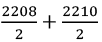
We know that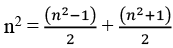 is the sum of two consecutive integers when n is odd.
(i) 192 =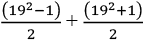
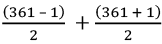
We know that 192 = 361
By further calculation
=
So we get
= 180 + 181
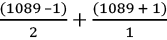
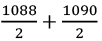
(ii) 332 =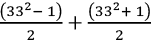
We know that
332 = 1089
By further calculation
=
So we get
=
= 544 + 545
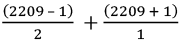
(iii) 472 =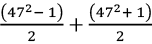
We know that
472 = 2209
By further calculation
=
So we get
=
= 1104 + 1105
Q.9. Find the squares of the following numbers without actual multiplication:
(i) 31
(ii) 42
(iii) 86
(iv) 94
We know that
(a + b)2 = a2 + 2ab + b2
(i) 312 = (30 + 1)2
We can write it as
= 302 + 2 × 30 × 1 + 12
By further calculation
= 900 + 60 + 1
= 961
(ii) 422 = (40 + 2)2
We can write it as
= 402 + 2 × 40 × 2 + 22
By further calculation
= 1600 + 160 + 4
= 1764
(iii) 862 = (80 + 6)2
We can write it as
= 802 + 2 × 80 × 6 + 62
By further calculation
= 6400 + 960 + 36
= 7396
(iv) 942 = (90 + 4)2
We can write it as
= 902 + 2 × 90 × 4 + 42
By further calculation
= 8100 + 720 + 16
= 8836
Q.10. Find the squares of the following numbers containing 5 in unit's place:
(i) 45
(ii) 305
(iii) 525
(i) 452 = n52
It can be written as
= n (n + 1) hundred + 52
Substituting the values
= 4 × 5 hundred + 25
By further calculation
= 2000 + 25
= 2025
(ii) 3052 = (30 × 31) hundred + 25
By further calculation
= 93000 + 25
= 93025
(iii) 5252 = (52 × 53) hundred + 25
By further calculation
= 275600 + 25
= 275625
11. Write a Pythagorean triplet whose one number is
(i) 8
(ii) 15
(iii) 63
(iv) 80
(i) 8
Take n = 8
So the triplet will be 2n, n2 - 1, n2 + 1
Here If 2n = 8, then n = 8/2 = 4
Substituting the values
n2 - 1 = 42 - 1 = 16 - 1 = 15
n2 + 1 = 42 + 1 = 16 + 1 = 17
Therefore, the triplets are 8, 15 and 17.
(ii) 15
Take 2n = 15
So n =n/2 is not possible
n2 - 1 = 15
By further calculation
n2 = 15 + 1 = 16 = 42
n = 4
So we get
2n = 2 × 4 = 8
n2 - 1 = 15
n2 + 1 = 42 + 1 = 16 + 1 = 17
Therefore, the triplets are 8, 15 and 17.
(iii) 63
Take n2 - 1 = 63
By further calculation
n2 = 63 + 1 = 64 = 82
So n = 8
Here
2n = 2 × 8 = 16
n2 - 1 = 63
n2 + 1 = 82 + 1 = 64 + 1 = 65
Therefore, the triplets are 16, 63 and 65.
(iv) 80
Take 2n = 80
n = 80/2 = 40
Here
n2 - 1 = 402 - 1 = 1600 - 1 = 1599
n2 + 1 = 402 + 1 = 1600 + 1 = 1601
Therefore, the triplets are 80, 1599 and 1601.
Q.12. Observe the following pattern and find the missing digits:
212 = 441
2012 = 40401
20012 = 4004001
200012 = 4 - 4 - 1
2000012 = _______
212 = 441
2012 = 40401
20012 = 4004001
200012 = 400040001
2000012 = 40000400001
Q.13. Observe the following pattern and find the missing digits:
92 = 81
992 = 9801
9992 = 998001
99992 = 99980001
999992 = 9-8-01
9999992 = 9-0-1
92 = 81
992 = 9801
9992 = 998001
99992 = 99980001
999992 = 9999800001
9999992 = 9999998000001
14. Observe the following pattern and find the missing digits:
72 = 49
672 = 4489
6672 = 444889
66672 = 44448889
666672 = 4--8--9
6666672 = 4--8--8
72 = 49
672 = 4489
6672 = 444889
66672 = 44448889
666672 = 4444488889
6666672 = 4444448888889
