ML Aggarwal: Squares & Square Roots - 4

Q.1. Find the square root of each of the following by division method:
(i) 2401
(ii) 4489
(iii) 106929
(iv) 167281
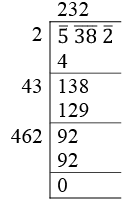
(v) 53824
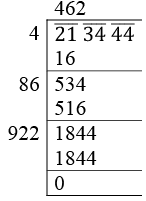
(vi) 213444
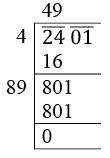
(i)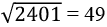
By division method
(ii) 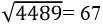
By division method
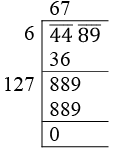
(iii) 
By division method
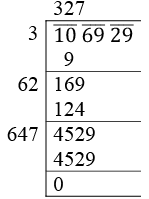
(iv) 
By division method
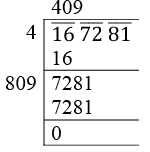
(v) 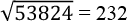
By division method
(vi) 
By division method
Q.2. Find the number of digits in the square root of each of the following (without any calculation):
(i) 81
(ii) 169
(iii) 4761
(iv) 27889
(v) 525625
(i) 81
We know that
In 81, a group of two's is 1
Therefore, its square root has one digit.
(ii) 169
We know that
In 169, group of two's are 2
Therefore, its square root has two digits.
(iii) 4761
We know that
In 4761, group of two's are 2
Therefore, its square root has two digits.
(iv) 27889
We know that
In 27889, groups of two's are 3
Therefore, its square root has three digits.
(v) 525625
We know that
In 525625, groups of two's are 3
Therefore, its square root has three digits.
Q.3. Find the square root of the following decimal numbers by division method:
(i) 51.84
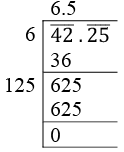
(ii) 42.25
(iii) 18.4041
(iv) 5.774409
(i) 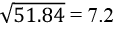
By division method
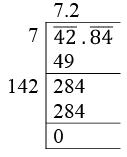
(ii) 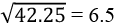
By division method
(iii) 
By division method
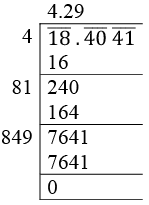
(iv) 
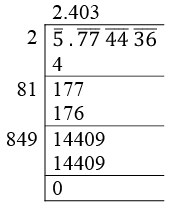
By division method
Q.4. Find the square root of the following numbers correct to two decimal places:
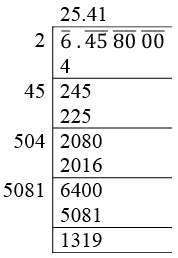
(i) 645.8
(ii) 107.45
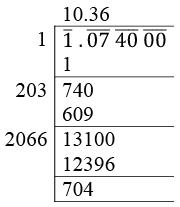
(iii) 5.462
(iv) 2
(v) 3
(i) 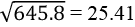
It can be written as
(ii) 
It can be written as
(iii) 
It can be written as
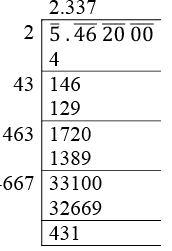
(iv) 
It can be written as
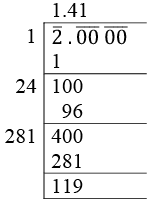
(v) 
It can be written as
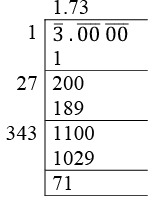
Q.5. Find the square root of the following fractions by division method:
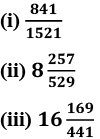
(i) 
By squaring
It can be written as
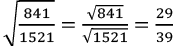
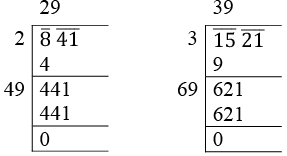
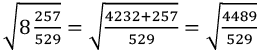
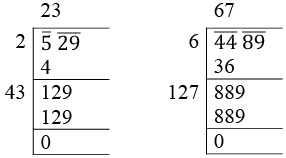
(ii) 
By squaring
So we get
=
It can be written as

(iii) 
By squaring
So we get
=
=
It can be written as



Q.6. Find the least number which must be subtracted from each of the following numbers to make them a perfect square. Also find the square root of the perfect square number so obtained:
(i) 2000
(ii) 984
(iii) 8934
(iv) 11021
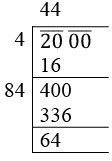
(i) 2000
We know that
By taking square root, 64 is left as remainder
Subtracting 64 from 2000
We get 1936 which is a perfect square and its square root is 44.
(ii) 984
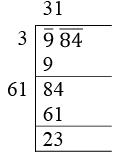
We know that
By taking square root, 23 is left as remainder
Subtracting 23 from 984
We get 961 which is a perfect square and its square root is 31.
(iii) 8934
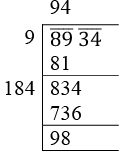
We know that
By taking square root, 98 is left as remainder
Subtracting 98 from 894
We get 8934 - 98 = 8836 which is a perfect square and its square root is 94.
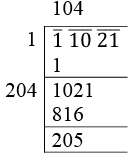
(iv) 11021
We know that
By taking square root, 205 is left as remainder
Subtracting 205 from 11021
We get 11021 - 205 = 10816 which is a perfect square and its square root is 104.
Q.7. Find the least number which must be added to each of the following numbers to make them a perfect square. Also, find the square root of the perfect square number so obtained:
(i) 1750
(ii) 6412
(iii) 6598
(iv) 8000
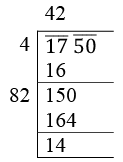
(i) 1750
We know that
By taking square root
412 is less than 1750
So by taking 422
164 - 150 = 14 less
Adding 14 we get a square of 42 which is 1764.
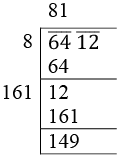
(ii) 6412
We know that
By taking square root 802 is less than 6412
So by taking 812
161 - 12 = 14 less
Adding 149 we get a square of 81 which is 6561.
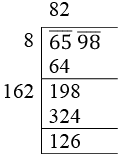
(iii) 6598
We know that
By taking square root 812 is less than 6598
So by taking 822
324 - 198 = 126 less
Adding 126 we get a square of 82 which is 6724.
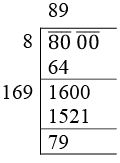
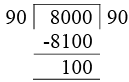
(iv) 8000
We know that
By taking square root 892 is less than 8000
So by taking 902
8100 - 8000 = 100 less
Adding 100 we get a square of 90 which is 8100.
Q.8. Find the smallest four-digit number which is a perfect square.
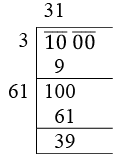
It is given that
Smallest four - digit number = 1000
We know that
By taking square root, we find that 39 is left.
If we subtract any number from 1000 we get 3 digit number
Take 322 = 1024
Here 1024 - 1000 = 24 is to be added to get a perfect square of least 4 digit number
Therefore, the required 4 digit smallest number is 1024.
Q.9. Find the greatest number of six digits which is a perfect square.
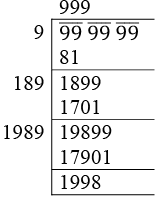
It is given that
Greatest six digit number = 999999
We know that
By taking square root, we find that 1998 is left
If we subtract 1998 from 999999 we get 998001 which is a perfect square.
Therefore, required six digit greatest number is 998001.
Q. 10. In a right triangle ABC, ∠B = 90o.
(i) If AB = 14 cm, BC = 48 cm, find AC.
(ii) If AC = 37 cm, BC = 35 cm, find AB.
(i) In a right angled triangle ABC
It is given that
AB = 14 cm and BC = 48 cmUsing Pythagoras theorem AC2 = AB2 + BC2
Substituting the values = 142 + 482
By further calculation = 196 + 2304
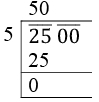
= 2500
So we get

(ii) In right triangle ABC
B = 90o, AC = 37 cm, BC = 35 cm
Using Pythagoras Theorem AC2 = AB2 + BC2
Substituting the values 372 = AB2 + 352
By further calculation 1369 = AB2 + 1225
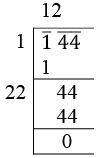
AB2 = 1369 - 1225 = 144
So we get

Q.11. A gardener has 1400 plants. He wants to plant these in such a way that the number of rows and number of columns remains same. Find the minimum number of plants he needs more for this.
It is given that
Total number of plants = 1400
We know that
Here
Number of columns = Number of rows
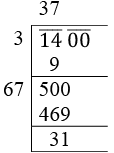
By taking the square root of 1400
372 < 1400
So take 382 = 1444
We need 1444 - 1400 = 44 plants more
Therefore, the minimum number of plants he needs more for this is 44.
Q.12. There are 1000 children in a school. For a P.T. drill they have to stand in such a way that the number of rows is equal to number of columns. How many children would be left out in this arrangement?
It is given that
No. of total children in a school = 1000
For a P.T. drill, children have to stand in such a way that
No. of rows = No. of columns
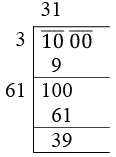
Take the square root of 1000 39 is left as remainder
Left out children = 39
Hence, 39 children would be left out in this arrangement.
Q.13. Amit walks 16 m south from his house and turns east to walk 63 m to reach his friend's house. While returning, he walks diagonally from his friend's house to reach back to his house. What distance did he walk while returning?
It is given that
Amit walks 16 m south from his house and turns east to walk 63 m to reach his friend's house
Consider O as the house and A and B as the places
OA = 16 m, AO = 63 mUsing Pythagoras theorem OB2 = OA2 + AB2
Substituting the values = 162 + 632
By further calculation = 256 + 3969
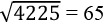
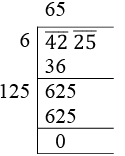
= 4225
So we get
OB =
Therefore, Amit has to walk 65 m to reach his house.
Q.14. A ladder 6 m long leaned against a wall. The ladder reaches the wall to a height of 4.8 m. Find the distance between the wall and the foot of the ladder.
It is given that
Length of ladder = 6 m
Ladder reaches the wall to a height of 4.8 m
Consider AB as the ladder and AC as the height of the wall
AB = 6 m and AC = 4.8 mDistance between the foot of ladder and wall is BC
Using Pythagoras theorem, AB2 = AC2 + BC2
Substituting the values 62 = 4.82 + BC2
By further calculation BC2 = 62 - 4.82
BC2 = 36 - 23.04 = 12.96
So we get
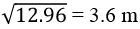
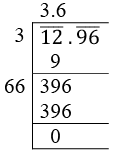
BC =
Hence, the distance between the wall and the foot of the ladder is 3.6 m.