Types of inheritance Python

Inheritance is defined as the capability of one class to derive or inherit the properties from some other class and use it whenever needed. Inheritance provides the following properties:
- It represents real-world relationships well.
- It provides reusability of code. We don't have to write the same code again and again. Also, it allows us to add more features to a class without modifying it.
- It is transitive in nature, which means that if class B inherits from another class A, then all the subclasses of B would automatically inherit from class A.
Example:
Python3
# A Python program to demonstrate
# inheritance
# Base class or Parent class
class Child:
# Constructor
def __init__(self, name):
self.name = name
# To get name
def getName(self):
return self.name
# To check if this person is student
def isStudent(self):
return False
# Derived class or Child class
class Student(Child):
# True is returned
def isStudent(self):
return True
# Driver code
# An Object of Child
std = Child("Ram")
print(std.getName(), std.isStudent())
# An Object of Student
std = Student("Shivam")
print(std.getName(), std.isStudent())
Output:
Ram False
Shivam True
Types of Inheritance in Python
Types of Inheritance depends upon the number of child and parent classes involved. There are four types of inheritance in Python:
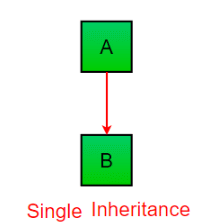
Single Inheritance: Single inheritance enables a derived class to inherit properties from a single parent class, thus enabling code reusability and the addition of new features to existing code.
Example:
Python3
# Python program to demonstrate
# single inheritance
# Base class
class Parent:
def func1(self):
print("This function is in parent class.")
# Derived class
class Child(Parent):
def func2(self):
print("This function is in child class.")
# Driver's code
object = Child()
object.func1()
object.func2()
Output:
This function is in parent class.
This function is in child class.
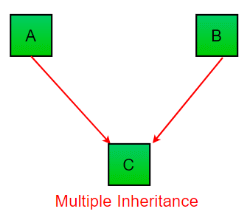
Multiple Inheritance: When a class can be derived from more than one base class this type of inheritance is called multiple inheritance. In multiple inheritance, all the features of the base classes are inherited into the derived class.
Example:
Python3
# Python program to demonstrate
# multiple inheritance
# Base class1
class Mother:
mothername = ""
def mother(self):
print(self.mothername)
# Base class2
class Father:
fathername = ""
def father(self):
print(self.fathername)
# Derived class
class Son(Mother, Father):
def parents(self):
print("Father :", self.fathername)
print("Mother :", self.mothername)
# Driver's code
s1 = Son()
s1.fathername = "RAM"
s1.mothername = "SITA"
s1.parents()
Output:
Father : RAM
Mother : SITA
Multilevel Inheritance
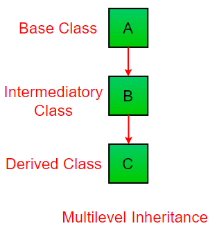
In multilevel inheritance, features of the base class and the derived class are further inherited into the new derived class. This is similar to a relationship representing a child and grandfather.
Example:
Python3
# Python program to demonstrate
# multilevel inheritance
# Base class
class Grandfather:
def __init__(self, grandfathername):
self.grandfathername = grandfathername
# Intermediate class
class Father(Grandfather):
def __init__(self, fathername, grandfathername):
self.fathername = fathername
# invoking constructor of Grandfather class
Grandfather.__init__(self, grandfathername)
# Derived class
class Son(Father):
def __init__(self,sonname, fathername, grandfathername):
self.sonname = sonname
# invoking constructor of Father class
Father.__init__(self, fathername, grandfathername)
def print_name(self):
print('Grandfather name :', self.grandfathername)
print("Father name :", self.fathername)
print("Son name :", self.sonname)
# Driver code
s1 = Son('Prince', 'Rampal', 'Lal mani')
print(s1.grandfathername)
s1.print_name()
Output:
Lal mani
Grandfather name : Lal mani
Father name : Rampal
Son name : Prince
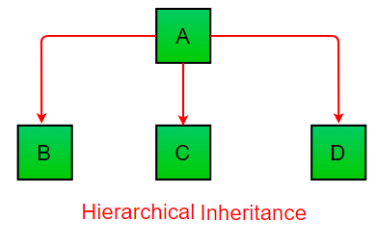
Hierarchical Inheritance: When more than one derived classes are created from a single base this type of inheritance is called hierarchical inheritance. In this program, we have a parent (base) class and two child (derived) classes.
Example:
Python3
# Python program to demonstrate
# Hierarchical inheritance
# Base class
class Parent:
def func1(self):
print("This function is in parent class.")
# Derived class1
class Child1(Parent):
def func2(self):
print("This function is in child 1.")
# Derivied class2
class Child2(Parent):
def func3(self):
print("This function is in child 2.")
# Driver's code
object1 = Child1()
object2 = Child2()
object1.func1()
object1.func2()
object2.func1()
object2.func3()
Output:
This function is in parent class.
This function is in child 1.
This function is in parent class.
This function is in child 2.
Hybrid Inheritance: Inheritance consisting of multiple types of inheritance is called hybrid inheritance.
Example:
Python3
# Python program to demonstrate
# hybrid inheritance
class School:
def func1(self):
print("This function is in school.")
class Student1(School):
def func2(self):
print("This function is in student 1. ")
class Student2(School):
def func3(self):
print("This function is in student 2.")
class Student3(Student1, School):
def func4(self):
print("This function is in student 3.")
# Driver's code
object = Student3()
object.func1()
object.func2()
Output:
This function is in school.
This function is in student 1.

