Who among the following rulers of medieval Gujarat surrendered Diu to Portuguese? (2023) (a) Ahmad Shah (b) Mahmud Begarha (c) Bahadur Shah (d) Muhammad Shah
Solution:
Ans: (c)
Early in the 16th century, the Sultan of Gujarat, Bahadur Shah, came under immense pressure when his kingdom was invaded by the second Mughal Emperor Humayun. At that juncture, he decided to remain on conciliatory terms with the Portuguese, who had arrived in India at the end of the 15th century, and were at the time an energetic and ambitious maritime power.
In 1534, the Shah signed the Treaty of Bassein with the Portuguese, ceding Diu to the latter, as well as other territories of his empire such as Vasai and the islands that today form Mumbai. The Portuguese obtained Daman from the Shah in 1559.
Hence, option (c) is correct.
Question 2:
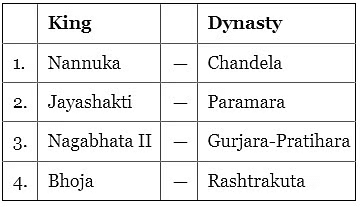
Consider the following pairs
How many pairs given above are correctly matched? (2022) (a) Only one pair (b) Only two pairs (c) Only three pairs (d) All four pairs
Solution:
Ans: (b)
The Chandela or Chandel was an Indian Rajput clan of Central India. They were popularly termed as Chandelas or Jejakabhukti dynasty in Indian history.
As per legends, contained in Mahoba Khanda, Chandela family was descended from the union of Moon (in Hindi called Chandra) and Hemavati.
As per A954 CE Khajuraho inscriptions, first king of Chandela dynasty i.e. Nannuka was descendant of sage Chandratreya who was son of famous Vedic sage Atri. Hence, Pair 1 is correctly matched.
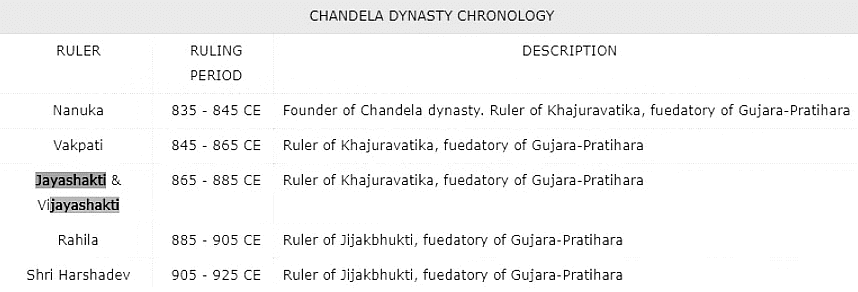
Jayashakti belonged to the Chandela dynasty and not the Paramara dynasty. Hence, Pair 2 is not correctly matched.
Gurjara-Pratihara dynasty, either of two dynasties of medieval Hindu India. The line of Harichandra ruled in Mandor, Marwar (Jodhpur, Rajasthan), during the 6th to 9th centuries CE, generally with feudatory status. The line of Nagabhata ruled first at Ujjain and later at Kannauj during the 8th to 11th centuries. Other Gurjara lines existed, but they did not take the surname Pratihara.
In the complicated and badly documented wars of the early 9th century- involving Pratiharas, Rashtrakutas, and Palas-Nagabhata II played an important part.
Nagabhata II became the most powerful ruler of northern India and established his new capital at Kannauj. Nagabhata II was succeeded by his son Ramabhadra in about 833. Hence, Pair 3 is correctly matched.
Mihir Bhoja belonged to the Paramara dynasty. Hence, Pair 4 is not correctly matched.
Therefore, option (b) is correct.
Question 3:
In medieval India, the term "Fanam" referred to: (2022) (a) Clothing (b) Coins (c) Ornaments (d) Weapons
Solution:
Ans: (b)
The Fanam and Chuckram coins were the regular unit of currency in medieval Travancore and were extensively used for trading.
Hence, option (b) is correct.
Question 4:
With reference to Indian history, consider the following statements:
The first Mongol invasion of India happened during the reign of Jalal-ud-din Khalji.
During the reign of Ala-ud-din Khalji, one Mongol assault marched up to Delhi and besieged the city.
Muhammad-bin-Tughlaq temporarily lost portions of north-west of his kingdom to Mongola.
Which of the statements given above is/are correct? (2022) (a) 1 and 2 (b) 2 only (c) 1 and 3 (d) 3 only
Solution:
Ans: (b)
Between 1240-66, the Mongols for the first time embarked upon the policy of annexation of India and the golden phase of mutual 'non-aggression pact with Delhi ended. In 1241, the Mongols under Tair Bahadur invaded Lahore and completely destroyed the city. Hence statement 1 is not correct.
In 1299, Mongols invaded India, headed by Outlugh Khan (Outlugh Khwaja), the son of the Mongol ruler, Dawa Khan. This was an attempt by the Mongols to ravage Delhi for the first time. Hearing of their approach, Alauddin quickly gathered an army, and took a position outside Siri. The Mongols entrenched themselves at Killi, six miles north of Delhi. Hence, statement 2 is correct.
The last significant Mongol invasion was under the leadership of Tarmashirin during the reign of Sultan Muhammad Tughluq. Ghiyasudclin Tughlaq marched against Tarmashirin, and pushed him back across the Indus and Indus which remained the frontier with the Mongols.
Hence statement 3 is not correct.
Question 5:
With reference to Indian history, which of the following were known as "Kulah- Daran"? (2022) (a) Arab merchants (b) Qalandars (c) Persian calligraphists (d) Sayyids
Solution:
Ans: (d)
The Sayyids claimed descent from the Prophet through his daughter Fatima. They commanded special respect in Muslim society. Evert Timur protected the lives of Sayyids during his in-vasion of India although his policy was one of general slaughter. A Sayyid accused of misappropriating state revenue was discharged by Sikandar Lodi and was allowed to keep to himself his dishonest gains. The Sayyids put on a pointed cap (Kulah) and they were known as Kulah-Daran.
Hence, option (d) is correct.
Question 6: According to Portuguese writer Nuniz, the women in Vijayanagara Empire were expert in which of the following areas? [2021]
Wrestling
Astrology
Accounting
Soothsaying
Select the correct answer using the codes given below. a) 1, 2 and 3 Only b) 1, 3 and 4 Only c) 2 and 4 Only d) 1, 2, 3 and 4
Solution:
Correct Answer is Option (d)
Fernao Nuniz (1534-37) was a Portuguese traveller to the court of Vijaynagar King- Achyut Raya
Question 7: Consider the following statements:
It was during the reign of Iltutmish that Chengiz Khan reached the Indus in pursuit of the fugitive Khawarezm prince.
It was during the reign of Muhammad bin Tughluq that Taimur occupied Multan and crossed the Indus.
It was during the reign of Deva Raya II of Vijayanagara Empire that Vasco da Gama reached the coast of Kerala.
Which of the statements given above is/are correct? [2021] a) 1 Only b) 1 and 2 c) 3 Only d) 2 and 3
Solution:
Correct Answer is Option (a)
Changez Khan attacked the Khwarizm Prince Jalaluddin Magbrani, who sought refuge to the court of Iltutmish. But Iltutmish decided not the give refuge to Jalauddin, and hence he avoided the invasion of Changez Khan to India → #1 is right.
Taimur invaded India in 1398- During this period, Nasiruddin Mohammed Tughlaq was the ruler and not Mohammed bin Tughlaq (1325-1350) → #2 is wrong.
Vasco de Gama came to India in 1498- was welcomed by the ruler of Calicut- Manna Vikrama- also called as Zamorin. Krishnadeva Raya, the Vijaynagar ruler came to power in 1509 onwards. → 3 also wrong.
Question 8: With reference to medieval India, which one of the following is the correct sequence in ascending order in terms of size? [2021] a) Paragana- Sarkar- Suba b) Sarkar-Paragana-Suba c) Suba-Sarkar-Paragana d) Paragana-Suba-Sarkar
Solution:
Correct Answer is Option (a)
Ascending order means- from smallest to largest
Pargana- group of villages
Sarkar- district unit during the Mughals
Subah- Province of Mughal Empire- where Subahdars were appointed.
Question 9: With reference to the history of India, consider the following pairs: [2020-I] 1. Aurang: In-charge of the treasury of the State 2. Banian: Indian agent of the East India Company 3. Mirasidar: Designated revenue payer to the State Which of the pairs given above is/are correctly matched? (a) 1 and 2 only (b) 2 and 3 only (c) 3 only (d) 1, 2 and 3
Solution:
Correct Answer is Option (b)
Aur ang-Persian term for Warehouse (given in NCERT class 8- Our Past- II, also covered in the Youtube Lecture). So, #1 is wrong, In both of this option (b & c) pair#3 (Mirasidar) isis common so we have to accept it as correct. Everything boils down to whether the second statement is correct or not.
Banian- Agent of East India Company, a term used for Bania (trader) So, #2 is correct- so the answer should be "b".
Just to crosscheck the validity of the third statement:
Mirasidar- Designated revenue payer to the State
Question 10: Who among the following Mughal Emperors shifted emphasis from illustrated manuscripts to the album and individual portrait? [2019-I] (a) Humayun (b) Akbar (c) Jahangir (d) Shah Jahan
Solution:
Correct Answer is Option (c) Under Akbar, the painting appears to have been confined only to manuscript illustration. So b is wrong. Portrait reached great heights during Jahangir's reign. The portrait was painted with great care of details and finesse of drawing and modeling.
Question 11: With reference to the Mian Tansen, which one of the following statements is not correct[2019-I] (a)Tansen was the title given to him by Emperor Akbar. (b)Tansen composed Dhrupads on Hindu gods and goddesses. (c)Tansen composed songs for his patrons. (d)Tansen invented many Ragas.
Solution:
Correct Answer is Option (a)
Tansen invented the night raga Darbari Kanhra, morning raga Mian Ki Todi, mid-day raga, Mian ki Sarang, seasonal raga Mian ki Malhar. So #d is right, therefore eliminated, because we've to find the wrong statement.
He composed much dhrupad on Ganesha, Shiva, Parvati, and Rama. He also composed songs for his patrons. Sob and c were also eliminated.
Tansen was the title given to him by Raja Vikramjit of Gwalior. So, a is wrong, and therefore it's the answer.
Question 12: Consider the following statements : [2019-I] 1. Saint Nimbarka was a contemporary of Akbar. 2. Saint Kabir was greatly influenced by Shaikh Ahmad Sirhindi. Which of the statements given above is/ are correct? (a) 1 only (b) 2 only (c) Both 1 and 2 (d) Neither 1 nor 2
Solution:
Correct Answer is Option (d)
In the 13th century, Nimbarka and Vallabhacharya were also other preachers of Vaishnavite Bhakti in the Telangana region. Akbar was 15th Century, so unlikely to be contemporaries. #1 is wrong.
"Naqshbandi school degraded Sufism to the status of a handmaid of orthodox Islam. Shaikh Ahmad Sirhindi (1563- 1624) became the leading spokesman of this school after Akbar's death. His teachings were not confined to the reform of Islam; he advocated a crusade against the Hindus." So, it's unlikely that Kabir would be 'greatly influenced' by such hardcore radical elements. #2 is wrong. Besides, Kabir Das timeline is (1398 or 1440-1518) so he was long dead before Sirhindi was even born.
Question 13: Consider the following statements: [2019-I] 1. In the revenue administration of Delhi Sultanate, the in-charge of revenue collection was known as 'Amil'. 2. The Iqta system of Sultans of Delhi was an ancient indigenous institution. 3. The office of' Mir Bakshi' came into existence during the reign of Khalji Sultans of Delhi. Which of the statements given above is/are correct? (a) 1 only (b) 1 and 2 only (c) 3 only (d) 1, 2 and 3
Solution:
Correct Answer is Option (a)
The first stage of the Iqta system started in 1206. The system started with the assignment of different regions as iqtas (territorial areas or units whose revenues were assigned to officials in lieu of salaries) to military commanders, out of whose revenues they could maintain themselves and their troops as well. So, it means Iqta started in 1206 itself and it was not an ancient indigenous Indian institution. #2 is wrong. b and d eliminated.
Mughal Central Administration: Mir Bakshi was Head of the military department. So, #3 is wrong. We are left with answer a:1 only.
Question 14: With reference to Mughal India, what is/are the difference/ differences between Jagirdar and Zamindar? [2019-I] 1. Jagirdars were holders of land assignments in lieu of judicial and police duties, whereas Zamindars were holders of revenue rights without obligation to perform any duty other than revenue collection. 2. Land assignments to Jagirdars were hereditary and revenue rights of Zamindars were not hereditary. Select the correct answer using the code given below. (a) 1 only (b) 2 only (c) Both 1 and 2 (d) Neither 1 nor 2
Solution:
Correct Answer is Option (d)
Two classes shared power of the State with the Mughal emperor: zamindars and the nobles. The zamindars were hereditary owners of their lands who enjoyed certain privileges on hereditary basis. They occupied an important place in the empire because they helped in the collection of revenue and in local administration, for which they maintained soldiers.
The nobility comprised people who were either assigned large jagirs / Mansabs or appointed Subahdars. Thus, both 1 and 2 are wrong
Question 15: The well-known painting "Bani Thani" belongs to the [2018-I] (a) Bundi school (b) Jaipur school (c) Kangra school (d) Kishangarh school
Solution:
Correct Answer is Option (d) Paintings at Kishangarh are associated with the most romantic legends - Sawant Singh and his beloved Bani Thani. and of the intertwining of lives and myths, romance and bhakti. It is sometimes argued that the women in 'bani are said to resemble the character of Radha.
FAQs on Medieval History- Solved Questions (2018-2024)
1. What are the key features of feudalism in medieval Europe?
Ans. Feudalism was a hierarchical system of land ownership and duties that characterized medieval Europe. Key features include the relationship between lords and vassals, where lords granted land (fiefs) to vassals in exchange for military service and loyalty. This system also involved a rigid class structure, with peasants working the land and providing goods to their lords in return for protection. Additionally, feudalism was marked by decentralized political power, as local lords held significant authority over their territories.
2. How did the Crusades impact medieval society?
Ans. The Crusades, a series of religious wars from the 11th to the 13th centuries, had profound impacts on medieval society. They stimulated trade between Europe and the East, leading to economic growth. The influx of new ideas and goods contributed to the Renaissance. Additionally, the Crusades altered the power dynamics in Europe, weakening feudal lords and strengthening monarchies. They also fostered religious intolerance and conflicts, notably between Christians and Muslims, which had long-term implications for interfaith relations.
3. What role did the Catholic Church play during the medieval period?
Ans. The Catholic Church was a dominant institution in medieval Europe, influencing all aspects of life. It served as the spiritual authority for Christians, offering guidance and maintaining religious practices. The Church also wielded significant political power, often mediating conflicts and influencing kings and rulers. Monasteries became centers of learning and culture, preserving knowledge through the Dark Ages. Additionally, the Church was responsible for the establishment of universities and the promotion of education.
4. What were the causes and consequences of the Black Death in the medieval period?
Ans. The Black Death, which struck Europe in the 14th century, was caused primarily by the bubonic plague, spread through fleas on rats and increased trade. Its consequences were devastating, leading to the death of an estimated one-third of Europe's population. This resulted in severe labor shortages, which shifted economic power towards the working class and increased wages. Socially, the plague fostered a sense of despair and questioning of traditional beliefs, contributing to the decline of feudalism and the eventual rise of the Renaissance.
5. How did the Magna Carta influence the development of constitutional law?
Ans. The Magna Carta, signed in 1215, was a landmark document that limited the powers of the English king and laid the groundwork for constitutional law. It established the principle that everyone, including the monarch, was subject to the law. Key provisions included the right to a fair trial and protection from illegal imprisonment. The Magna Carta inspired future democratic principles and documents, such as the United States Constitution and the Universal Declaration of Human Rights, shaping the evolution of governance and individual rights.
Medieval History- Solved Questions (2018-2024), Viva Questions, Medieval History- Solved Questions (2018-2024), ppt, MCQs, Summary, video lectures, Sample Paper, Objective type Questions, Extra Questions, mock tests for examination, past year papers, Previous Year Questions with Solutions, study material, Exam, Semester Notes, practice quizzes, pdf , shortcuts and tricks, Medieval History- Solved Questions (2018-2024), Free, Important questions;