UPSC Previous Year Questions (Prelims): Parliament

Q.1. Rajyasabha has equal powers with Loksabha in (2020-I)
(a) The matter of creating new all India services
(b) Amending the Constitution
(c) The removal of the government
(d) Making cut motions
Ans: (b)
Explanation: Article 368 permits a Constitution Amendment Bill to be introduced in either House of Parliament and requires both Houses to pass it by the specified majority; thus both Houses have equal legislative power in respect of constitutional amendments. By contrast:
- Article 312 gives Rajya Sabha a special role in creating All India Services by passing a resolution with a prescribed majority; therefore (a) is not an example of equal power in general.
- Article 75(3) establishes collective responsibility of the Council of Ministers to the Lok Sabha; matters of government removal (no-confidence) are therefore centred on the Lok Sabha, so (c) is incorrect.
- Cut motions relate to demands for grants and may be moved only in the Lok Sabha; Rajya Sabha can only make recommendations, so (d) is incorrect.
Q.2. Consider the following statements: (2019-I)
- The Parliament (Prevention of Disqualification) Act, 1959 exempts several posts from disqualification on the grounds of 'Office of Profit'.
- The above-mentioned Act was amended five times.
- The term 'Office of Profit' is well-defined in the Constitution of India.
Which of the following statements given above is/are correct?
(a) 1 and 2 only
(b) 3 only
(c) 2 and 3 only
(d) 1,2 and 3
Ans: (a)
Explanation: The Parliament (Prevention of Disqualification) Act, 1959 lists offices that will not disqualify MPs on grounds of holding an 'office of profit', so statement 1 is correct. The Act has been amended several times to add or remove exempted posts, so statement 2 is correct. The Constitution does not give a precise, exhaustive definition of 'office of profit'; controversies and litigation over what constitutes such an office show that statement 3 is incorrect. Therefore, only statements 1 and 2 are correct.
Q.3. Consider the following statements: (2018-I)
- The Parliament of India can place a particular law in the Ninth Schedule of the Constitution of India
- The validity of a law placed in the Ninth Schedule cannot be examined by any court and no judgement can be made on it.
Which of the statements given above is/are correct ?
(a) 1 only
(b) 2 only
(c) Both 1 and 2
(d) Neither 1 nor 2
Ans: (a)
Explanation: Parliament may place laws in the Ninth Schedule (originally by the First Amendment, 1951) to protect them from challenge on certain grounds. However, the Supreme Court in I.R. Coelho v. State of Tamil Nadu (2007) held that inclusion in the Ninth Schedule does not confer absolute immunity; laws placed there are subject to judicial review if they violate basic structure or fundamental rights. Thus statement 1 is correct and statement 2 is incorrect.
Q.4. Consider the following statements: (2018-I)
- In the first Lok Sabha, the single largest party in the opposition was the Swatantra Party.
- In the Lok Sabha, a "Leader of the Opposition" was recognized for the first time in 1969.
- In the Lok Sabha, if a party does not have a minimum of 75 members, its leader cannot be recognized as the Leader of the Opposition.
Which of the statements given above is/are correct?
(a) 1 and 3 only
(b) 2 only
(c) 2 and 3 only
(d) 1, 2 and 3
Ans: (b)
Explanation: In the first Lok Sabha (1952-57) the Congress dominated with 364 seats; no major single opposition party such as Swatantra held the position claimed in statement 1, so it is incorrect. Ram Subhag Singh became the first formally recognised Leader of the Opposition in the Lok Sabha in 1969, so statement 2 is correct. Recognition of the Leader of the Opposition is governed by convention and rules requiring a party to have a minimum proportion of seats (commonly taken as 10% of the strength of the House) - there is no fixed requirement of 75 members; statement 3 is therefore incorrect. Hence only statement 2 is correct.
Q.5. Regarding Money Bill, which of the following statements is not correct? (2018-I)
(a) A bill shall be deemed to be a Money Bill if it contains only provisions relating to imposition, abolition, remission, alteration or regulation of any tax.
(b) A Money Bill has provisions for the custody of the Consolidated Fund of India or the Contingency Fund of India
(c) A Money Bill is concerned with the appropriation of moneys out of the Contingency Fund of India
(d) A Money Bill deals with the regulation of borrowing of money or giving of any guarantee by the Government of India
Ans: (c)
Explanation: Article 110 lists matters that make a Bill a Money Bill. These include imposition, abolition, remission or regulation of taxes (sub-clause (a)), custody of the Consolidated Fund and Contingency Fund and withdrawals from them (sub-clause (c)), regulation of borrowing and guarantees (sub-clause (d)), and matters incidental to these clauses. The phrasing in option (c) is misleading: appropriation of moneys is normally from the Consolidated Fund (and demands for grants relate to appropriation), but appropriation out of the Contingency Fund is not the typical characterisation of a Money Bill. Given the standard interpretation and UPSC key, (c) is the incorrect statement.
Q.6. The Parliament of India exercises control over the functions of the Council of Ministers through. (2017-I)
- Adjournment motion
- Question hour
- Supplementary questions
Select the correct answer using the code given below:
(a) 1 only
(b) 2 and 3 only
(c) 1 and 3 only
(d) 1, 2 and 3
Ans: (d)
Explanation: Parliament supervises and controls the executive through several parliamentary devices. Question hour (including supplementary questions) allows members to seek information and hold ministers accountable; adjournment motions allow discussion of urgent public matters and censure the government. All three items listed enable parliamentary control over the Council of Ministers, so option (d) is correct.
Q.7. With reference to the Parliament of India, consider the following statements: (2017-I)
- A private member's bill is a bill presented by a Member of Parliament who is not elected but only nominated by the President of India.
- Recently, a private member's bill has been passed in the Parliament of India for the first time in its history.
Which of the statements given above is/are correct?
(a) 1 only
(b) 2 only
(c) Both 1 and 2
(d) Neither 1 nor 2
Ans: (d)
Explanation: A private member's bill is introduced by any MP who is not a minister; it is not restricted to nominated members, so statement 1 is incorrect. Private members' bills have been passed on occasion in India; they are not a recent first-time occurrence, so statement 2 is also incorrect. Therefore neither statement is correct.
Q.8. For election to the Lok Sabha, a nomination paper can be filed by (2017-I)
(a) anyone residing in India.
(b) a resident of the constituency from which the election is to be contested.
(c) any citizen of India whose name appears in the electoral roll of a constituency.
(d) any citizen of India.
Ans: (c)
Explanation: A candidate for election to the Lok Sabha must be a citizen of India and must file a nomination paper. Practically, nomination is filed by the candidate personally and a person is eligible only if their name appears on the electoral roll of some constituency; option (c) correctly captures this requirement.
Q.9. Consider the following statements: (2017-I)
- In the election for Lok Sabha or State Assembly, the winning candidate must get at least 50 per cent of the votes polled, to be declared elected.
- According to the provisions laid down in the Constitution of India, in Lok Sabha, the Speaker's post goes to the majority party and the Deputy Speaker's to the Opposition.
Which of the statements given above is/are correct?
(a) 1 only
(b) 2 only
(c) Both 1 and 2
(d) Neither 1 nor 2
Ans: (d)
Explanation: India follows the first-past-the-post system: the candidate with the highest number of votes is declared elected, even if that total is below 50%, so statement 1 is incorrect. The Constitution does not prescribe that the Speaker must be from the majority party or that the Deputy Speaker must be from the Opposition; such practices are conventions evolved over time but are not constitutional mandates. Therefore statement 2 is also incorrect.
Q.10. The Parliament of India acquires the power to legislate on any item in the State List in the national interest if a resolution to that effect is passed by the (2016-I)
(a) Lok Sabha by a simple majority of its total membership
(b) Lok Sabha by a majority of not less than two-thirds of its total membership
(c) Rajya Sabha by a simple majority of its total membership
(d) Rajya Sabha by a majority of not less than two-thirds of its members present and voting
Ans: (d)
Explanation: Article 249 allows Parliament to legislate on a State List matter if Rajya Sabha, by a resolution passed by not less than two-thirds of members present and voting, declares it necessary in the national interest. The resolution is to be passed by Rajya Sabha, not Lok Sabha, and requires the specified special majority of members present and voting.
Q.11. With reference to the Union Government, consider the following statements: (2015-I)
- The Department of Revenue is responsible for the preparation of Union Budget that is presented to the Parliament.
- No amount can be withdrawn from the Consolidated Fund of India without the authorization from the Parliament of India.
- All the disbursements made from Public Account also need the authorization from the Parliament of India.
Which of the statements given above is / are correct?
(a) 1 and 2 only
(b) 2 and 3 only
(c) 2 only
(d) 1, 2 and 3
Ans: (c)
Explanation: The Department of Economic Affairs in the Ministry of Finance prepares the Union Budget; the Department of Revenue is concerned with tax administration, so statement 1 is incorrect. No withdrawal from the Consolidated Fund of India can be made without Parliament's authorisation (appropriation), so statement 2 is correct. Disbursements from the Public Account are essentially transactions where Government acts as banker or trustee (for example, provident funds); such payments are made by executive action and do not require parliamentary appropriation in the same way as withdrawals from the Consolidated Fund, so statement 3 is incorrect.
Q.12. Consider the following statements: (2015-I)
- The Rajya Sabha has no power either to reject or to amend a Money Bill.
- The Rajya Sabha cannot vote on the Demands for Grants.
- The Rajya Sabha cannot discuss the Annual Financial Statement.
Which of the statements given above is / are correct?
(a) 1 only
(b) 1 and 2 only
(c) 2 and 3 only
(d) 1, 2 and 3
Ans: (b)
Explanation: Rajya Sabha cannot amend or reject a Money Bill; it may only make recommendations and must return the Bill within the time prescribed (statement 1 is correct). The Rajya Sabha cannot vote on Demands for Grants - that is the exclusive privilege of the Lok Sabha (statement 2 is correct). However, Rajya Sabha may discuss the Annual Financial Statement (budget) though it cannot vote on demands; hence statement 3 is incorrect.
Q.13. When a bill is referred to a joint sitting of both the Houses of the Parliament, it has to be passed by (2015-I)
(a) a simple majority of members present and voting
(b) three-fourths majority of members present and voting
(c) two-thirds majority of the Houses
(d) absolute majority of the Houses
Ans: (a)
Explanation: Article 108 provides for a joint sitting to resolve deadlocks between the two Houses on ordinary legislation. At a joint sitting the bill is passed by a simple majority of members present and voting. The Speaker of the Lok Sabha presides over the joint sitting.
Q.14. Consider the following statements regarding a No- Confidence Motion in India: (2014 - I)
- There is no mention of a No-Confidence Motion in the Constitution of India.
- A Motion of No-Confidence can be introduced in the Lok Sabha only.
Which of the statements given above is/are correct?
(a) 1 only
(b) 2 only
(c) Both 1 and 2
(d) Neither 1 nor 2
Ans: (c)
Explanation: The Constitution provides that the Council of Ministers is collectively responsible to the Lok Sabha (Article 75) but does not expressly mention a "no-confidence motion"; the procedure stems from parliamentary rules (Lok Sabha Rule 198), so statement 1 is correct. A no-confidence motion can only be moved in the Lok Sabha because the Council of Ministers is responsible to that House; Rajya Sabha cannot remove the Council by passing a no-confidence motion, so statement 2 is also correct.
Q.15. Consider the following statements: (2013 - I)
- An amendment to the Constitution of India can be initiated by an introduction of a bill in the Lok Sabha only.
- If such an amendment seeks to make changes in the federal character of the Constitution, the amendment also requires to be ratified by the legislature of all the States of India.
Which of the statements given above is/are correct?
(a) 1 only
(b) 2 only
(c) Both 1 and 2
(d) Neither 1 nor 2
Ans: (d)
Explanation: A Constitution Amendment Bill may be introduced in either House of Parliament, not only in the Lok Sabha, so statement 1 is incorrect. If an amendment seeks to affect certain provisions that relate to the federal structure (specified in Article 368), it must be ratified by the legislatures of not less than one half of the States, not by all State legislatures; thus statement 2 is also incorrect. Therefore neither statement is correct.
Q.16. Consider the following statements: (2013 - I)
- The Chairman and the Deputy Chairman of the Rajya Sabha are not the members of that House.
- While the nominated members of the two Houses of the Parliament have no voting right in the presidential election, they have the right to vote in the election of the Vice President.
Which of the statements given above is/are correct?
(a) 1 only
(b) 2 only
(c) Both 1 and 2
(d) Neither 1 nor 2
Ans: (b)
Explanation: The Chairman of the Rajya Sabha is the Vice-President of India and thus is ex officio the Chair; the Deputy Chairman is elected from among Rajya Sabha members - both are members of the House in their respective capacities, so statement 1 is incorrect. Nominated members of both Houses do not participate in the Presidential election (they do not have voting rights there), but nominated members are eligible to vote in the Vice-Presidential election because that election is by an electoral college consisting only of members of both Houses of Parliament; statement 2 is therefore correct.
Q.17. What will follow if a Money Bill is substantially amended by the Rajya Sabha? (2013 - I)
(a) The Lok Sabha may still proceed with the Bill, accepting or not accepting the recommendations of the Rajya Sabha
(b) The Lok Sabha cannot consider the bill further
(c) The Lok Sabha may send the Bill to the Rajya Sabha for reconsideration
(d) The President may call a joint sitting for passing the Bill
Ans: (a)
Explanation: When Rajya Sabha returns a Money Bill with recommendations, Lok Sabha may accept or reject any or all recommendations. Lok Sabha's decision is final; Money Bills cannot be the subject of a joint sitting. Therefore option (a) correctly describes the position.
Q.18. The Parliament can make any law for whole or any part of India for implementing international treaties (2013 - I)
(a) with the consent of all the States
(b) with the consent of the majority of States
(c) with the consent of the States concerned
(d) without the consent of any State
Ans: (d)
Explanation: Entry 14 of the Union List (Article 246 read with Schedule VII) confers upon Parliament the power to enact laws for implementing treaties, agreements and conventions with foreign countries; Article 253 reinforces Parliament's competence to implement international obligations without needing State consent. Hence Parliament may legislate for the whole or any part of India for this purpose without State consent.
Q.19. Which of the following special powers have been conferred on the Rajya Sabha by the Constitution of India? (2012 - I)
(a) To change the existing territory of a State and to change the name of a State
(b) To pass a resolution empowering the Parliament to make laws in the State List and to create one or more All India Services
(c) To amend the election procedure of the President and to determine the pension of the President after his/her retirement
(d) To determine the functions of the Election Commission and to determine the number of Election Commissioners
Ans: (b)
Explanation: The Rajya Sabha has two notable special powers: under Article 249 it may, by a resolution passed by the required majority, empower Parliament to make laws on matters in the State List in the national interest; under Article 312 it can by a special resolution allow Parliament to create All India Services. Options (a), (c) and (d) do not correctly state special powers uniquely conferred on Rajya Sabha.
Q.20. In the Parliament of India, the purpose of an adjournment motion is (2012 - I)
(a) to allow a discussion on a definite matter of urgent public importance
(b) to let opposition members collect information from the ministers
(c) to allow a reduction of specific amount in demand for grant
(d) to postpone the proceedings to check the inappropriate or violent behaviour on the part of some members
Ans: (a)
Explanation: An adjournment motion is moved to bring before the House a definite matter of urgent public importance; it interrupts normal business and often involves censure of the government. Adjournment motions may not be introduced in Rajya Sabha. The discussion on an admitted adjournment motion is allotted substantial time (not less than two hours thirty minutes).
Q.21. Regarding the office of the Lok Sabha Speaker, consider the following statements: (2012 - I)
- He/She holds the office during the pleasure of the President.
- He/She need not be a member of the House at the time of his/her election but has to become a member of the House within six months from the date of his/her election.
- If he/she intends to resign, the letter of his/her resignation has to be addressed to the Deputy Speaker.
Which of the statements given above is /are correct?
(a) 1 and 2 only
(b) 3 only
(c) 1, 2 and 3
(d) None
Ans: (b)
Explanation: The Speaker is elected by Lok Sabha from among its members and is normally in office for the life of that Lok Sabha; the Speaker does not hold office "during the pleasure of the President", so statement 1 is incorrect. The Speaker must be a member of the House at the time of election, so statement 2 is incorrect. If the Speaker wishes to resign, the resignation is addressed to the Deputy Speaker, so statement 3 is correct.
Q.22. A deadlock between the Lok Sabha and the Rajya Sabha calls for a joint sitting of the Parliament during the passage of (2012 - I)
- Ordinary Legislation
- Money Bill
- Constitution Amendment Bill
Select the correct answer using the codes given below :
(a) 1 only
(b) 2 and 3 only
(c) 1 and 3 only
(d) 1, 2 and 3
Ans: (a)
Explanation: The joint sitting mechanism under Article 108 is intended to resolve deadlocks on ordinary bills. Money Bills are excluded because Rajya Sabha has limited powers over them, and Constitution Amendment Bills require separate passage in each House by specified majorities and are not subject to joint sitting. Therefore only ordinary legislation (1) is covered.
Q.23. When the annual Union Budget is not passed by the Lok Sabha ? (2011 - I)
(a) The Budget is modified and presented again
(b) The Budget is referred to the Rajya Sabha for suggestions
(c) The Union Finance Minister is asked to resign
(d) The Prime Minister submits the resignation of Council of Ministers.
Ans: (d)
Explanation: Failure to pass the Budget in Lok Sabha is treated as loss of majority and is tantamount to a no-confidence situation. Conventionally, if the Budget (which includes demands for grants) is not passed, the Council of Ministers must resign; therefore the Prime Minister submits the resignation of the Council of Ministers.
Q.24. The authorization for the withdrawal of funds from the Consolidated Fund of India must come from (2011 - I)
(a) The President of India
(b) The Parliament of India
(c) The Prime Minister of India
(d) The Union Finance Minister
Ans: (b)
Explanation: The Constitution provides that no money shall be withdrawn from the Consolidated Fund of India except under appropriation made by law; hence Parliament must authorise withdrawals by passing appropriation and grant legislation. While the President formally makes payments, the authorisation comes from Parliament.
Q.25. With reference to the Union Government, consider the following statements: (2009)
- The Constitution of India provides that all Cabinet Ministers shall be compulsorily be a sitting members of Lok Sabha only.
- The Union Cabinet Secretariat operates under the direction of the Ministry of Parliamentary Affairs.
Which of the statements given above is/are correct?
(a) 1 only
(b) 2 only
(c) Both 1 and 2
(d) Neither 1 nor 2
Ans: (d)
Explanation: The Constitution does not restrict Cabinet ministers to being members of the Lok Sabha; members of Rajya Sabha may also be appointed as ministers (statement 1 is incorrect). The Cabinet Secretariat functions under the direct charge of the Prime Minister's Office to assist the Council of Ministers; it does not operate under the Ministry of Parliamentary Affairs (statement 2 is incorrect). Hence neither statement is correct.
Q.26. With reference to Union Government, consider the following statements: (2009)
- Number of Ministries at the Centre on 15th August 1947 was 18.
- Number of Ministries at the Centre at present is 36.
Which of the statements given above is/are correct?
(a) 1 only
(b) 2 only
(c) Both 1 and 2
(d) Neither 1 nor 2
Ans: (a)
Explanation: On 15 August 1947 there were 18 ministries at the Centre. The present number of ministries can vary with successive governments and reorganisations; the exact present number is not a constitutional fixed figure in this question, so the historically correct statement among the two is statement 1.
Q.27. With reference to Union Government, consider the following statements: (2009)
- Number of Ministries at the Centre on 15th August 1947 was 18.
- Number of Ministries at the Centre at present is 36.
Which of the statements given above is/are correct?
(a) 1 only
(b) 2 only
(c) Both 1 and 2
(d) Neither 1 nor 2
Ans: (a)
Explanation: This is a repeat of Q.26. As explained there, the number of ministries at independence was 18, so statement 1 is correct and statement 2 is not an assured constitutional fact for the time referred; therefore option (a) is correct.
Q.28. Consider the following statements: (2006)
- The Rajya Sabha alone has the power to declare that it would be in national interest for the Parliament to legislate with respect to a matter in the State List.
- Resolutions approving the proclamation of Emergency are passed only by the Lok Sabha.
Which of the statement(s) given above is/are correct?
(a) 1 only
(b) 2 only
(c) Both 1 and 2
(d) Neither 1 nor 2
Ans: (a)
Explanation: Under Article 249, Rajya Sabha may, by a resolution passed by the prescribed majority, declare it necessary in the national interest that Parliament legislate on a State List matter; this is a power exercisable by Rajya Sabha alone, so statement 1 is correct. Proclamations of emergency must be approved by both Houses of Parliament, not only Lok Sabha, so statement 2 is incorrect.
Q.29. Consider the following statements: (2004)
- The Speaker of Lok Sabha has the power to adjourn the House sine die but, on prorogation, it is only the President who can summon the House
- Unless sooner dissolved or there is an extension of the term, there is an automatic dissolution of the Lok Sabha by efflux of time, at the end of the period of five years, even if no formal order of dissolution is issued by the President
- The Speaker of Lok Sabha continues in office even after the dissolution of the House and until immediately before the first meeting of the House
Which of the statements given above are correct?
(a) 1 and 2
(b) 2 and 3
(c) 1 and 3
(d) 1, 2 and 3
Ans: (d)
Explanation: The Speaker may adjourn the House sine die (i.e., without fixing a date for resumption); prorogation and summoning are constitutional powers of the President exercised on advice, so the statement about summoning refers to the President (part of statement 1 is correct as framed). Lok Sabha automatically dissolves at the end of its five-year term unless earlier dissolved or extended during emergency; this effect occurs by efflux of time even without a formal dissolution order (statement 2 is correct). The Speaker and Deputy Speaker continue in office after dissolution until the new House meets and a new Speaker is elected (statement 3 is correct). Thus all three statements are correct.
Q.30. Which one of the following statements is not correct? (2004)
(a) In the Lok Sabha, a no-confidence motion has to set out the grounds on which it is based
(b) In the case of a no-confidence motion in Lok Sabha, no conditions of admissibility have been laid down in the Rules
(c) A motion of no-confidence once admitted, has to be taken up within ten days of the leave being granted
(d) Rajya Sabha is not empowered to entertain a motion of no-confidence
Ans: (a)
Explanation: A no-confidence motion does not need to set out detailed grounds when moved; Rule 198 of the Lok Sabha specifies the procedure for notice and admission. The Rules lay down admissibility procedures but do not require the mover to set out detailed grounds, so option (a) is the incorrect statement. A no-confidence motion is introduced in Lok Sabha and once admitted is required to be taken up within the time specified by the Speaker; Rajya Sabha cannot remove the Council of Ministers by a no-confidence motion, so the other options are consistent with parliamentary practice.
Q.31. Which one of the following statements is correct? (2003)
(a) Only the Rajya Sabha and not the Lok Sabha can have nominated members
(b) There is a constitutional provision for nominating two members belonging to the Anglo-Indian community to the Rajya Sabha
(c) There is no constitutional bar for a nominated member to be appointed as a Union minister
(d) A nominated member can vote both in the Presidential and Vice Presidential elections
Ans: (c)
Explanation: The President may nominate twelve members to the Rajya Sabha for their expertise in literature, science, art and social service; in the Lok Sabha, up to two members of the Anglo-Indian community could be nominated by the President (Article 331) when that community was not adequately represented - this applied to Lok Sabha, not Rajya Sabha, so option (b) is incorrect. There is no constitutional bar on a nominated member becoming a Union minister, so option (c) is correct. Nominated members cannot vote in Presidential elections but can vote in Vice-Presidential elections (so option (d) is incorrect because it claims they can vote in both).
Q.32. Consider the following statements: (2003)
- The joint sitting of the two houses of the Parliament in India is sanctioned under Article 108 of the Constitution
- The first joint sitting of Lok Sabha and Rajya Sabha was held in the year 1961
- The second joint sitting of the two Houses of Indian Parliament was held to pass the Banking Service Commission (Repeal) Bill
Which of these statements is correct?
(a) 1 and 2
(b) 2 and 3
(c) 1 and 3
(d) 1, 2 and 3
Ans: (d)
Explanation: Article 108 provides for joint sittings of both Houses to resolve deadlocks. Historically, three joint sittings have occurred: the first on the Dowry Prohibition Bill (1961), the second on the Banking Service Commission (Repeal) Bill (1978), and the third on the Prevention of Terrorism Bill (2002). Therefore all three statements are correct.
Q.33. Which one of the following Bills must be passed by each House of the Indian Parliamentary separately by special majority? (2003)
(a) Ordinary Bill
(b) Money Bill
(c) Finance Bill
(d) Constitution Amendment Bill
Ans: (d)
Explanation: A Constitution Amendment Bill requires passage in each House separately and, in many cases, must be passed by a special majority (a majority of the total membership of each House and by not less than two-thirds of members present and voting). Ordinary Bills and Finance Bills follow ordinary legislative procedures (Finance Bills have special procedures), and Money Bills are governed by Article 110 with Rajya Sabha having limited powers; constitutional amendments uniquely require separate special-majority approval in each House.
Q.34. In the case of election to the Lok Sabha, the amount of Security deposited for general category candidates and SC/ST category candidates respectively is: (2002)
(a) ₹ 5,000 and ₹ 2,500
(b) ₹ 10,000 and ₹ 2,500
(c) ₹ 10,000 and ₹ 5,000
(d) ₹ 15,000 and ₹ 7,500
Ans: (c)
Explanation: Among the options given, the correct historical figure for the period referred is option (c). Note that the amount for security deposit has changed over time; for example, in later years the deposit amounts were revised upward (for instance, by 2018 the figures were higher). A candidate who fails to secure more than one-sixth of the valid votes polled forfeits the security deposit.
Q.35. The term of the Lok Sabha: (2002)
(a) cannot be extended under any circumstances
(b) can be extended by six months at a time
(c) can be extended by one year at a time during the proclamation of emergency
(d) can be extended for two years at a time during the proclamation of emergency
Ans: (c)
Explanation: Under Article 83(2), the normal term of the Lok Sabha is five years. During a proclaimed national emergency under Article 352, Parliament may by law extend the term of the Lok Sabha by not more than one year at a time; thus option (c) is correct.
Q.36. The Speaker can ask a member of the House to stop speaking and let another member speak. This phenomenon is known as: (2000)
(a) decorum
(b) crossing the floor
(c) interpellation
(d) yielding the floor
Ans: (d)
Explanation: "Yielding the floor" refers to a member relinquishing speaking time so another may speak; it is the practice described. Decorum refers to maintaining proper behaviour; crossing the floor is voting against party lines; interpellation is the formal right of a legislature to question the government. Hence (d) is the correct choice.
Q.37. The Parliament can make any law for the whole or any part India for implementing international treaties: (2000)
(a) with the consent of all the State
(b) with the consent of the majority of States
(c) with the consent of the States concerned
(d) without the consent of any State
Ans: (d)
Explanation: Article 253 and Entry 14 of the Union List empower Parliament to make laws to implement international treaties and agreements without requiring consent of State legislatures; this is a Union competence and does not depend on State consent.
Q.38. Which one of the following will fit in the place marked 'X'? (1995)
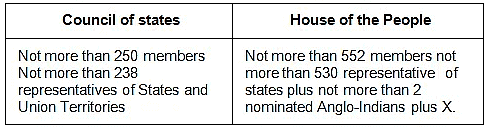
(b) Not more than 20 nominated members
(c) Not more than 20 representative of Union Territories
(d) The Attorney General who has the right to speak and take part in the proceedings of either House of the Parliament
Ans: (c)
Explanation: The maximum authorised strength of the Lok Sabha is 552: up to 530 members to represent States, up to 20 members to represent Union Territories, and up to two nominated Anglo-Indian members (when that provision was in force). Option (c) correctly identifies "not more than 20" as representatives of Union Territories in the composition envisaged by the Constitution.
Q.39. Who among the following have the right to vote in the elections to both the Lok Sabha and the Rajya Sabha? (1995)
(a) Elected members of the Lower House of the Parliament
(b) Elected members of the Upper House of the Parliament
(c) Elected members of the Upper House of the State Legislature
(d) Elected members of the Lower House of the State Legislature
Ans: (d)
Explanation: Members of State Legislative Assemblies (the lower houses of the state legislatures) participate in the election of Rajya Sabha members from their State as part of the electoral college, and they vote in Lok Sabha elections as ordinary citizens in their constituencies. Thus elected members of the State Legislative Assembly are the correct choice among the given options.
Q.40. Which one of the following States of India does not have a Legislative Council even though the Constitution? (Seventh Amendment) Act, 1956 provides for it? (1995)
(a) Maharashtra
(b) Bihar
(c) Karnataka
(d) Madhya Pradesh
Ans: (d)
Explanation: The Constitution allows states to have a bicameral legislature by creating a Legislative Council. As of the period referred, five states had Legislative Councils: Uttar Pradesh, Bihar, Maharashtra, Karnataka and Jammu & Kashmir; Madhya Pradesh did not have a Legislative Council despite the provisions, so option (d) is correct.
Q.41. If the number of seats allocated to a state in the Lok Sabha is 42, then the number of seats reserved for the Scheduled Castes in that state will be: (1995)
(a) 21
(b) 14
(c) 7
(d) 6
Ans: (*)
Explanation: Reservation of seats for Scheduled Castes (and Scheduled Tribes) is determined by the proportion of their population in the State relative to the State's total population, and the process of apportionment seeks to match, as nearly as may be, the proportion in the Legislative Assembly or Lok Sabha. Without data on the percentage of Scheduled Caste population in the State, the exact number of reserved seats cannot be determined from the information given. Therefore none of the numeric options can be validated without that demographic information.
- Article 330 deals with reservation of seats in the Lok Sabha for Scheduled Castes and Scheduled Tribes.
- Section 3 of the Representation of the People Act, 1950 governs allocation based on population ratios.
FAQs on UPSC Previous Year Questions (Prelims): Parliament
| 1. What are the most important Parliament questions asked in UPSC Prelims exams? |  |
| 2. How do I identify which Parliament topics actually appear in UPSC Prelims from previous years? | |
| 3. What's the difference between questions on Parliament's legislative powers versus constitutional authority in UPSC exams? | |
| 4. Why do UPSC Prelims questions often focus on Rajya Sabha's unique powers compared to Lok Sabha? | |
| 5. How should I practise answering actual Parliament questions from UPSC Prelims without getting confused between similar answer options? | |




