Summary: Lines & Angles

Recall
- Point: A point represents a position in space. It has no length, breadth or thickness and is usually named by a capital letter.
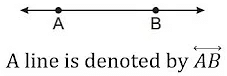
- Line: A line is a straight path that extends endlessly in both directions. It may be named by any two points on it or by a lowercase letter.
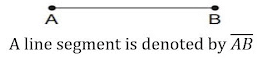
- Line segment: A line segment is the part of a line that lies between two distinct end points. It has fixed length and is named by its end points, for example AB.
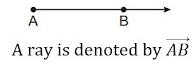
- Ray: A ray starts at a point (called its initial point) and extends infinitely in one direction. It is named by its initial point and another point on it, for example AB with A as the initial point.
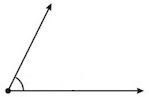
- Angle: An angle is formed by two rays or two line segments with a common end point called the vertex. An angle is measured in degrees (°).
Related Angles
- Complementary angles: Two angles whose measures add up to 90°. Each is the complement of the other.
Example: 30° and 60° are complementary.
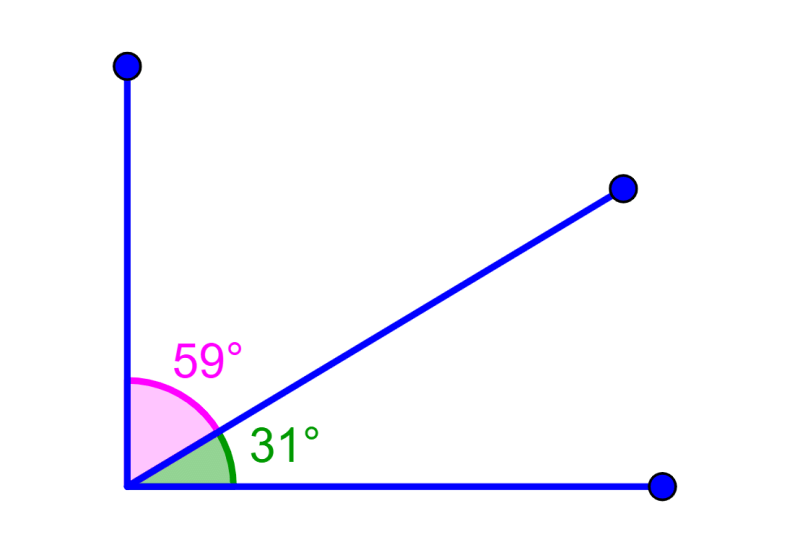 Complementary Angles
- Supplementary angles: Two angles whose measures add up to 180°. Each is the supplement of the other.
Example: 110° and 70° are supplementary.
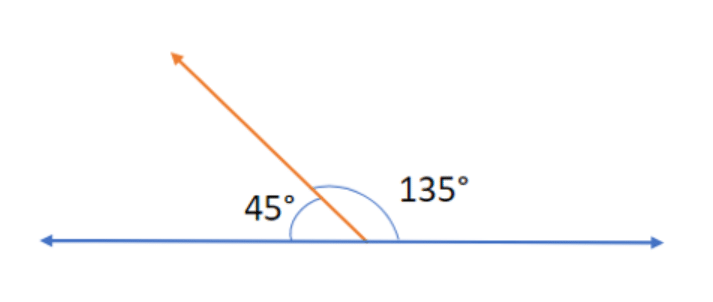 Supplementary Angles
- Adjacent angles: Two angles are adjacent if they share a common vertex, share one common arm (side) and their interiors do not overlap; the non-common arms lie on either side of the common arm.
- Linear pair: A pair of adjacent angles whose non-common sides are opposite rays (together they form a straight line). Every linear pair is supplementary.
- Vertically opposite angles: When two lines intersect, two pairs of opposite (vertical) angles are formed. These angles do not share an arm and each pair of vertically opposite angles are equal in measure.
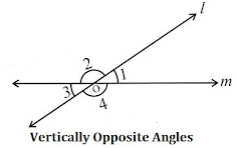
Example 1
Find the other angle when two angles form a linear pair and one angle measures 70°.
Let the given angle be 70°.
The sum of angles in a linear pair is 180°.
180° - 70° = 110°.
Hence the other angle measures 110°.
Pair of Lines
- Intersecting lines: Two lines that meet at exactly one point. The point where they meet is called the point of intersection.
- Transversal: A line that intersects two or more lines at distinct points is called a transversal.
- Parallel lines: Two lines in the same plane that remain at a constant distance from each other and never meet are called parallel lines. They are often denoted by the symbol ∥ (for example, l ∥ m).
- Alternate interior angles: When a transversal cuts two lines, the pair of angles that lie between the two lines and on opposite sides of the transversal are called alternate interior angles.
- Alternate exterior angles: When a transversal cuts two lines, the pair of angles that lie outside the two lines and on opposite sides of the transversal are called alternate exterior angles.
- When two lines are cut by a transversal, eight angles are formed in total.
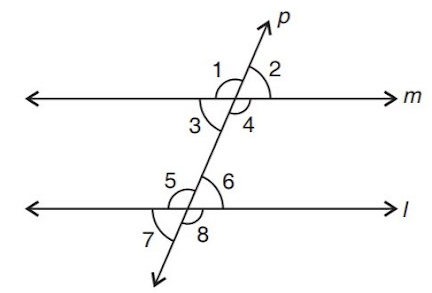
Interior angles: ∠3, ∠4, ∠5, ∠6
Exterior angles: ∠1, ∠2, ∠7, ∠8
Pairs of corresponding angles: ∠1 and ∠5, ∠2 and ∠6, ∠3 and ∠7, ∠4 and ∠8
Pairs of alternate interior angles: ∠3 and ∠6, ∠4 and ∠5
Pairs of alternate exterior angles: ∠1 and ∠8, ∠2 and ∠7
Pairs of interior angles on the same side of the transversal: ∠3 and ∠5, ∠4 and ∠6.
Transversal of Parallel Lines
If two lines are parallel and they are intersected by a transversal, the following angle relationships hold:
- Each pair of corresponding angles is equal.
- Each pair of alternate interior angles is equal.
- Each pair of alternate exterior angles is equal.
- Each pair of interior angles on the same side of the transversal is supplementary (their sum is 180°).
Example 2
A transversal cuts two parallel lines. If one corresponding angle measures 120°, find the measures of the other seven angles.
The given corresponding angle is 120°.
All corresponding angles are equal, so each corresponding angle = 120°.
An angle adjacent to a 120° angle along a straight line is supplementary to it.
180° - 120° = 60°.
All angles that are supplementary to corresponding angles are 60°.
Alternate interior/exterior angles equal their corresponding partners, so their measures are either 120° or 60° according to position.
Thus the eight angles are four of 120° and four of 60°, arranged according to the diagram positions.
Remarks and Uses
- Recognising these angle relationships helps to solve many geometry problems related to lines, polygons and parallelism.
- Properties of complementary and supplementary angles are frequently used to find unknown angle measures when given one or more angles in figures.
- Understanding transversal angle rules is essential for proving lines are parallel or for computing angles formed by intersections and transversals.
FAQs on Summary: Lines & Angles
| 1. What are lines and angles in mathematics? |  |
| 2. How do you classify angles based on their measures? | |
| 3. What is the sum of the angles of a triangle? | |
| 4. How can you determine if two lines are parallel? | |
| 5. Can a triangle have two right angles? | |




