Summary: Symmetry

Line Symmetry
A figure has line symmetry if there exists a straight line such that, when the figure is folded along that line, the two parts of the figure coincide exactly. The line about which the figure is folded is called the line of symmetry or axis of symmetry.
- A line of symmetry divides a figure into two mirror-image halves.
- Not every figure has a line of symmetry; some shapes have more than one line of symmetry and some have none.
- Mirror reflection across the line exchanges the two halves, reversing left and right orientation.
Lines of symmetry for regular polygons
A regular polygon is a polygon in which all sides are equal in length and all interior angles are equal in measure. Regular polygons have well-defined numbers of lines of symmetry.
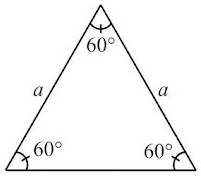
- An equilateral triangle has three equal sides and three equal angles of 60° each. It has three lines of symmetry, each passing through a vertex and the midpoint of the opposite side.
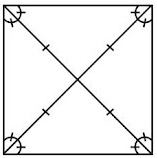
- A square has four equal sides and four right angles (90° each). A square has four lines of symmetry: two along its diagonals and two along the perpendicular bisectors of opposite sides (vertical and horizontal through the centre). Its diagonals are perpendicular bisectors of one another.
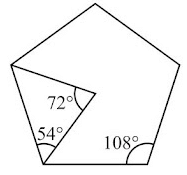
- A regular pentagon has five equal sides and each interior angle measures 108°. A regular pentagon has five lines of symmetry, each passing through a vertex and the midpoint of the opposite side.
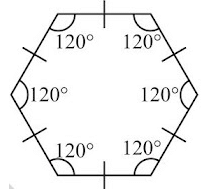
- A regular hexagon has six equal sides and each interior angle measures 120°. A regular hexagon has six lines of symmetry: three pass through opposite vertices and three pass through midpoints of opposite sides.
How to determine the number and position of lines of symmetry in regular polygons
- A regular polygon with n sides has exactly n lines of symmetry.
- If n is odd, every line of symmetry passes through one vertex and the midpoint of the opposite side.
- If n is even, half of the lines pass through opposite vertices and the other half pass through midpoints of opposite sides.
- Use symmetry of construction: joining centre to vertices helps visualise axes that map the polygon onto itself.
Rotational symmetry
Rotation turns an object about a fixed point called the centre of rotation. The angle by which the object is rotated is called the angle of rotation. Rotation may be clockwise or anticlockwise.
- A half-turn means rotation by 180°.
- A quarter-turn means rotation by 90°.
- If, after a rotation by some angle less than 360°, an object looks exactly the same as before the rotation, the object has rotational symmetry.
- The order of rotational symmetry is the number of distinct positions in a full 360° rotation in which the figure looks exactly the same.
- For a regular polygon with n sides, the order of rotational symmetry is n. The smallest angle of rotation that maps the polygon onto itself equals 360°/n.
- Examples: a square has order 4; an equilateral triangle has order 3; a regular hexagon has order 6.
Relationship between line symmetry and rotational symmetry
- Some shapes have only line symmetry, some have only rotational symmetry, and some have both.
- Examples from letters: the letter E has line symmetry (one vertical axis) but no rotational symmetry of order greater than 1; the letter S has rotational symmetry of order 2 (180°) but no line symmetry; the letter H has both line symmetry (vertical axis) and rotational symmetry of order 2.
- If a shape has multiple lines of symmetry arranged evenly around the centre, it typically has non-trivial rotational symmetry as well.
Line symmetry and mirror reflection
- A shape has line symmetry when one half of it is the mirror image of the other half across a line of symmetry.
- Mirror reflection reverses left-right orientation. When an object coincides with its mirror image across a line, that line is an axis of symmetry.
Worked examples
Example 1. Find the order of rotational symmetry of a regular hexagon.
Sol.
The number of sides of a regular hexagon is 6.
The order of rotational symmetry of a regular n-sided polygon is n.
Therefore, the order of rotational symmetry of a regular hexagon is 6.
Example 2. How many lines of symmetry does a regular pentagon have?
Sol.
A regular pentagon has 5 equal sides.
Every regular n-sided polygon has n lines of symmetry.
Therefore, a regular pentagon has 5 lines of symmetry.
Using symmetry to solve simple problems
- To check whether a given figure has line symmetry, try folding (mentally or on paper) along candidate lines and see if halves match.
- To find rotational symmetry, rotate the figure about its centre by common angles (90°, 120°, 180°, etc.) and check if it coincides with the original.
- Regular polygons give quick results: for a regular polygon with n sides, lines of symmetry = n and order of rotational symmetry = n.
Real-world examples and applications
- Many tiles and patterns use line and rotational symmetry to create repeating designs in art and architecture.
- Symmetry is used in logo design to produce pleasing, balanced shapes.
- Understanding symmetry helps in problem solving for geometry and pattern recognition in examinations and competitions.
Practice exercises
- State whether each English capital letter has line symmetry, rotational symmetry, both, or neither: A, B, C, D, H, I, M, N, S, Z.
- Draw a regular octagon. Mark all lines of symmetry and state its order of rotational symmetry.
- Identify the smallest angle of rotation that maps a regular 12-sided polygon onto itself.
Answers to practice (brief)
- A - line symmetry; B - vertical line symmetry (if drawn with straight strokes) and no non-trivial rotational symmetry; C - no symmetry in standard font; D - vertical line symmetry in standard font; H - both line and rotational (order 2); I - both (vertical line and order 2); M - vertical line symmetry; N - no symmetry in standard font; S - rotational order 2; Z - rotational order 2 and no line symmetry in standard font.
- A regular octagon has 8 lines of symmetry and order of rotational symmetry 8.
- Smallest angle of rotation for a regular 12-sided polygon is 30° because 360°/12 = 30°.
Summary
Line symmetry and rotational symmetry are two fundamental kinds of symmetry. Regular polygons offer clear examples: a regular n-sided polygon has n lines of symmetry and rotational symmetry of order n. Practice identifying axes and rotation angles to become comfortable with symmetry concepts and to apply them in geometry problems.
FAQs on Summary: Symmetry
| 1. What is line symmetry? |  |
| 2. How can you identify line symmetry in shapes? | |
| 3. What is rotational symmetry? | |
| 4. How do you determine the order of rotational symmetry? | |
| 5. Can a shape have both line and rotational symmetry? | |