CBSE Class 7 > Class 7 Notes > Mathematics Olympiad > Summary: Visualising Shapes
Summary: Visualising Shapes

Objects having different shapes (dimensions)
One Dimensional Objects- Objects having length only. For example, line.
Two Dimensional Objects
- Figures having both length and breadth. For example, Rectangle, triangle etc. These figures can be easily represented on a plane. So, they are called plane figures. Plane figures are of two dimensions (2-D) so, they are also called 2-dimensional figure.
Three Dimensional Objects
- Objects and shapes having length, breadth and height. Solid figures are of three dimensions (3-D).
Faces, Vertices and Edges of solid shapes
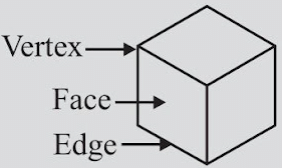
- The flat surfaces of a solid figure are called its faces. The top and bottom faces are called bases.
- The line segments where the adjacent faces of a solid meet are called edges.
- The point where the edges of a solid intersect is called vertex.
Nets for building 3D shapes
- A net is a skeleton-outline of a solid that can be folded to make the solid.
Drawing Solids on a Flat Surface
- Solid shapes can be drawn on a flat surface. This is called a 2-D representation of 3-D solid shape.
Two types of sketches of a solid are possible:
- An oblique sketch does not have proportional lengths. Still it conveys all important aspects of the appearance of the solid.
- An isometric sketch is drawn on an isometric dot paper, a sample of which is given at the end of this book. In an isometric sketch of the solid the measurements kept proportional.
Different sections of a solid can be viewed in many ways:
- One way is to view by cutting or slicing the shape, which would result in the cross-section of the solid.
- Another way is by observing a 2-D shadow of a 3-D shape.
- A third way is to look at the shape from different angles; the front-view, the side-view and the top-view can provide a lot of information about the shape observed.
The document Summary: Visualising Shapes is a part of the Class 7 Course Mathematics Olympiad Class 7.
All you need of Class 7 at this link: Class 7
FAQs on Summary: Visualising Shapes
| 1. What are the different types of shapes in geometry? |  |
Ans. In geometry, shapes can be classified into two main categories: two-dimensional (2D) shapes and three-dimensional (3D) shapes. 2D shapes include circles, squares, rectangles, and triangles, which have length and width but no depth. 3D shapes, such as cubes, spheres, cylinders, and pyramids, possess length, width, and height, giving them volume.
| 2. How can we visualise different shapes effectively? | |
Ans. Visualising different shapes can be achieved through various methods, such as drawing them on paper, using models made of clay or other materials, and employing digital tools like computer software. Each method helps in understanding the dimensions, properties, and spatial relationships of the shapes.
| 3. What are the properties of 2D shapes? | |
Ans. The properties of 2D shapes typically include the number of sides, angles, and symmetry. For example, a triangle has three sides and three angles that sum up to 180 degrees, while a rectangle has four sides with opposite sides equal and angles that are right angles. Additionally, shapes can be classified as regular, with all sides and angles equal, or irregular.
| 4. What are the characteristics of 3D shapes? | |
Ans. 3D shapes are characterised by their volume, surface area, and the number of faces, edges, and vertices. For instance, a cube has six square faces, twelve edges, and eight vertices. Understanding these characteristics helps in calculating measurements and visualising the objects in real-world applications.
| 5. Why is understanding shapes important in everyday life? | |
Ans. Understanding shapes is crucial in everyday life as it aids in various practical applications, including architecture, engineering, art, and design. Recognising and working with shapes can enhance spatial awareness, improve problem-solving skills, and facilitate better communication of ideas in both professional and personal contexts.
About this Document

4.96/5 Rating

Apr 26, 2026 Last updated
Document Description: Summary: Visualising Shapes for Class 7 2026 is part of Mathematics Olympiad Class 7 preparation. The notes and questions for Summary: Visualising Shapes have been prepared according to the Class 7 exam syllabus. Information about Summary: Visualising Shapes covers topics like and Summary: Visualising Shapes Example, for Class 7 2026 Exam. Find important definitions, questions, notes, meanings, examples, exercises and tests below for Summary: Visualising Shapes.
Introduction of Summary: Visualising Shapes in English is available as part of our Mathematics Olympiad Class 7 for Class 7 & Summary: Visualising Shapes in Hindi for Mathematics Olympiad Class 7 course. Download more important topics related with notes, lectures and mock test series for Class 7 Exam by signing up for free. Class 7: Summary: Visualising Shapes
Description
Summary: Visualising Shapes of Mathematics Olympiad Class 7 - covers all the important topics from the book, explained in easy language for better understanding. Free PDF available for download.
Information about Summary: Visualising Shapes
In this doc you can find the meaning of Summary: Visualising Shapes defined & explained in the simplest way possible. Besides explaining types of Summary: Visualising Shapes theory, EduRev gives you an ample number of questions to practice Summary: Visualising Shapes tests, examples and also practice Class 7 tests



Related Searches
Objective type Questions, Summary: Visualising Shapes, ppt, Previous Year Questions with Solutions, Summary, shortcuts and tricks, past year papers, Extra Questions, practice quizzes, pdf , Summary: Visualising Shapes, study material, MCQs, Important questions, Viva Questions, video lectures, Exam, Semester Notes, Sample Paper, Summary: Visualising Shapes, Free, mock tests for examination;