CBSE Class 7 > Class 7 Notes > Science Olympiad > NCERT Summary: Acids, Base & Salts
NCERT Summary: Acids, Base & Salts

Acids and Bases
What are Acids?
- Acids are substances that taste sour and change the colour of certain indicators.
- Common natural examples include curd, lemon juice, orange juice and vinegar.
- Many acids produce hydrogen ions (H+) when dissolved in water; this is the chemical basis for their acidic behaviour.
What are Bases?
- Bases are substances that often taste bitter and feel soapy to touch.
- Common examples include baking soda (sodium hydrogen carbonate), antacids, and caustic lime (calcium oxide).
- Bases usually produce hydroxide ions (OH-) when dissolved in water; this is the chemical basis for their basic (alkaline) behaviour.
Properties Commonly Used to Identify Acids and Bases
- Acids taste sour; bases taste bitter and may feel slippery or soapy.
- Acids and bases can be corrosive; strong acids/bases can harm skin and materials, so handle with care.
- Both acids and bases conduct electricity in aqueous solution because of the presence of ions.
- The strength of an acid or base depends on how fully it ionises in water; concentration depends on how much of the substance is dissolved.
Indicators
- Chemicals that show whether a solution is acidic or basic by changing colour are called indicators.
- Natural indicators include litmus, turmeric and petals of the china rose (gudhal).
- Litmus is one of the most commonly used indicators: acids turn blue litmus to red, and bases turn red litmus to blue.
- China rose (hibiscus) petals show dark pink in acidic solutions and green in basic solutions.
- Turmeric remains yellow in acidic solutions and turns red (or reddish) in basic (alkaline) solutions.
- There are also synthetic indicators such as phenolphthalein and methyl orange, used in experiments and titrations.
Neutral Substances
- Substances that are neither acidic nor basic are called neutral.
- Neutral substances do not change the colour of indicators (for example, pure water usually does not change litmus colour).
Neutralization
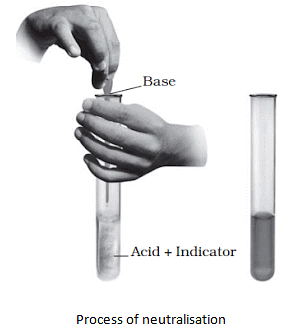
- A neutralization reaction occurs when an acid reacts with a base and both lose their characteristic properties.
- The general result of a neutralization reaction is the formation of a salt and water, and usually heat is released (the reaction is exothermic).
- General word equation: Acid + Base → Salt + Water + Heat
- Example chemical equations: HCl + NaOH → NaCl + H₂O
- Another example: H₂SO₄ + 2 NaOH → Na₂SO₄ + 2 H₂O
- The salt formed by neutralization can be acidic, basic or neutral depending on the strength of the acid and base that react.
Everyday Uses and Applications of Neutralization
- Ant sting: Ants inject formic acid. The sting can be neutralised by rubbing moist baking soda (sodium hydrogen carbonate, NaHCO₃) or applying calamine lotion which contains zinc carbonate (ZnCO₃).
- Indigestion: Excess stomach acid can cause discomfort. Antacids such as Milk of Magnesia (magnesium hydroxide, Mg(OH)₂) neutralise stomach acid and relieve indigestion.
- Soil treatment: Overuse of chemical fertilisers may make soil acidic. Acidic soil is made less acidic by adding bases such as quicklime (calcium oxide, CaO) or slaked lime (calcium hydroxide, Ca(OH)₂). If soil is too alkaline, the condition can be corrected by adding organic matter which helps lower the pH.
- Factory wastes: Industrial effluents that contain acids are often neutralised by adding basic substances before disposal to prevent environmental damage.
pH Scale - A Simple Measure of Acidity and Basicity
- The pH scale measures how acidic or basic a solution is and usually ranges from 0 to 14.
- On this scale, solutions with pH < 7 are acidic, a solution with pH = 7 is neutral, and solutions with pH > 7 are basic (alkaline).
- pH is a useful way to describe the strength of acids and bases in everyday contexts such as soil testing, pool water, and agriculture.
Safety and Precautions
- Strong acids and bases can harm skin and eyes. Always handle them with care, use protective gloves and goggles when required, and wash hands after experiments.
- Never taste or directly smell chemicals to identify them.
- If an acid or base splashes into the eyes, rinse immediately with plenty of water and seek medical help.
Summary
- Acids are sour, produce H⁺ ions in water and turn blue litmus red.
- Bases are bitter and slippery, produce OH⁻ ions in water and turn red litmus blue.
- Indicators such as litmus, turmeric and china rose petals help identify acidic or basic nature by colour change.
- Neutralization between an acid and a base yields a salt and water and often releases heat; this reaction has many practical uses from treating ant stings to correcting soil pH.
The document NCERT Summary: Acids, Base & Salts is a part of the Class 7 Course Science Olympiad Class 7.
All you need of Class 7 at this link: Class 7
FAQs on NCERT Summary: Acids, Base & Salts
| 1. What is the difference between acids and bases? |  |
Ans. Acids and bases are two types of chemical substances with different properties. Acids are substances that release hydrogen ions (H+) when dissolved in water, while bases are substances that release hydroxide ions (OH-) when dissolved in water. Acids have a sour taste, turn blue litmus paper red, and have a pH value less than 7. Bases have a bitter taste, turn red litmus paper blue, and have a pH value greater than 7.
| 2. How do acids and bases react with each other? | |
Ans. Acids and bases can react with each other in a chemical reaction called neutralization. In this reaction, the hydrogen ions from the acid combine with the hydroxide ions from the base to form water. The remaining ions form a salt. For example, when hydrochloric acid (HCl) reacts with sodium hydroxide (NaOH), water (H2O) and sodium chloride (NaCl) are formed.
| 3. What are the uses of acids and bases? | |
Ans. Acids and bases have various uses in everyday life. Some common uses of acids include: - Vinegar, which contains acetic acid, is used for cooking and preserving food. - Lemon juice, which contains citric acid, is used for flavoring food and beverages. - Sulfuric acid is used in car batteries and as a laboratory reagent. Some common uses of bases include: - Sodium hydroxide is used in the production of soap and detergents. - Calcium hydroxide is used in agriculture to neutralize acidic soils. - Ammonia is used in household cleaning products.
| 4. How can the strength of acids and bases be determined? | |
Ans. The strength of an acid or base can be determined by its pH value. pH is a measure of the concentration of hydrogen ions in a solution. The pH scale ranges from 0 to 14, with 7 being neutral. Acids have a pH value less than 7, with lower values indicating stronger acids. Bases have a pH value greater than 7, with higher values indicating stronger bases.
| 5. Are there any natural sources of acids and bases? | |
Ans. Yes, there are natural sources of acids and bases. Some examples include: - Citrus fruits, such as lemons and oranges, contain citric acid. - Milk contains lactic acid. - Vinegar is produced by the fermentation of ethanol by acetic acid bacteria. - Bases can be found in substances like baking soda (sodium bicarbonate) and limestone (calcium carbonate).
About this Document

4.72/5 Rating

Apr 19, 2026 Last updated
Related Exams
Document Description: NCERT Summary: Acids, Base & Salts for Class 7 2026 is part of Science Olympiad Class 7 preparation. The notes and questions for NCERT Summary: Acids, Base & Salts have been prepared according to the Class 7 exam syllabus. Information about NCERT Summary: Acids, Base & Salts covers topics like and NCERT Summary: Acids, Base & Salts Example, for Class 7 2026 Exam. Find important definitions, questions, notes, meanings, examples, exercises and tests below for NCERT Summary: Acids, Base & Salts.
Introduction of NCERT Summary: Acids, Base & Salts in English is available as part of our Science Olympiad Class 7 for Class 7 & NCERT Summary: Acids, Base & Salts in Hindi for Science Olympiad Class 7 course. Download more important topics related with notes, lectures and mock test series for Class 7 Exam by signing up for free. Class 7: NCERT Summary: Acids, Base & Salts
Description
NCERT Summary: Acids, Base & Salts of Science Olympiad Class 7 - covers all the important topics from the book, explained in easy language for better understanding. Free PDF available for download.
Information about NCERT Summary: Acids, Base & Salts
In this doc you can find the meaning of NCERT Summary: Acids, Base & Salts defined & explained in the simplest way possible. Besides explaining types of NCERT Summary: Acids, Base & Salts theory, EduRev gives you an ample number of questions to practice NCERT Summary: Acids, Base & Salts tests, examples and also practice Class 7 tests



Related Searches
Exam, ppt, Base & Salts, NCERT Summary: Acids, Viva Questions, NCERT Summary: Acids, video lectures, shortcuts and tricks, NCERT Summary: Acids, practice quizzes, Extra Questions, Free, study material, Base & Salts, Objective type Questions, MCQs, Important questions, Semester Notes, Base & Salts, Previous Year Questions with Solutions, Sample Paper, mock tests for examination, Summary, pdf , past year papers;