Securities & Exchange Board Of India (SEBI)


Introduction
Securities and Exchange Board of India (SEBI) is the statutory regulator for the securities market in India. It was given statutory status by the SEBI Act, 1992, which came into effect on 12 April 1992. SEBI's primary responsibility is to protect the interests of investors in securities, to promote and regulate the securities market, and to prevent fraudulent and unfair trade practices in the market.
Headquarters: Mumbai
Regional offices: Delhi, Kolkata, Chennai, Ahmedabad
Jurisdiction: Government of India
Agency Executive / Chairman: Upendra Kumar Sinha (appointed in 2011, replacing C.B. Bhave)

Establishment and Legal Basis
SEBI began as a non-statutory regulatory agency for the securities market and was later given statutory powers by Parliament through the SEBI Act, 1992. The Act defines SEBI's composition, powers and functions and provides the legal framework for regulation, investigation and enforcement in India's capital markets.
Objectives of SEBI
- Protect the interests of investors in securities and provide a fair marketplace.
- Promote the development of a healthy and orderly securities market.
- Regulate the securities market by framing rules and ensuring compliance.
- Prevent market malpractices such as insider trading, price manipulation and fraudulent schemes.
- Promote transparency and timely disclosure of information by market participants.
- Encourage investor education and grievance redressal mechanisms.
Functions of SEBI
- Regulatory functions: Framing rules, regulations and guidelines for intermediaries, listed companies, stock exchanges and other market participants.
- Developmental functions: Facilitating the growth of the securities market by introducing new products, improving market infrastructure and encouraging best practices.
- Protective functions: Safeguarding investors' interests through surveillance, disclosure standards, investor education and compensation mechanisms where applicable.
- Registration and oversight: Registering and regulating market intermediaries such as brokers, merchant bankers, registrars, investment advisers and mutual funds.
- Inspection and enforcement: Conducting inspections, investigations and enforcing compliance, including imposing penalties and ordering remedial measures.
- Market regulation: Regulating trading, settlement and other operational aspects of primary and secondary markets.
- Corporate governance and disclosures: Issuing norms for listed companies, ensuring adequate disclosure and protecting minority investors.
Organisation and Board Composition
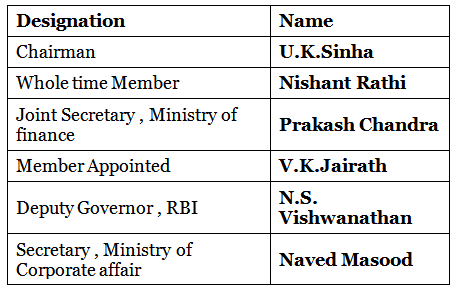
The Board of SEBI consists of a Chairman and members appointed by the Government of India. The composition and appointment provisions include:
- The Chairman - nominated by the Government of India.
- Members from the Ministry of Finance - two officers appointed by the Government of India.
- Member from the Reserve Bank of India (RBI) - one member nominated by the RBI.
- Other members - additional members appointed by the Government of India; of these, a minimum of three shall be Whole-time Members.
History and Milestones
- SEBI started as a non-statutory body to provide immediate oversight to the securities market.
- The SEBI Act, 1992 provided statutory powers and an institutional framework for regulation and enforcement; SEBI's role was strengthened to act as the principal regulator of the capital market.
- Over time SEBI's remit expanded to include regulation of mutual funds, intermediaries, takeovers, depositories, and derivative products, and to improve market infrastructure and investor protections.
Powers: Quasi-Legislative, Quasi-Judicial and Quasi-Executive
- Quasi-legislative: SEBI frames regulations, rules and guidelines for the securities market and its participants. These regulations carry the force of law and set market standards.
- Quasi-judicial: SEBI conducts enquiries and adjudication, hears cases of alleged violations of securities laws and can impose penalties, suspend or cancel registrations and order remedial actions.
- Quasi-executive: SEBI enforces its regulations, conducts inspections, investigations and surveillance, and coordinates with other agencies and law enforcement to implement orders.
Role of SEBI in Public Issues (IPO)
- Regulation of public issues: SEBI prescribes the rules and disclosure requirements for initial public offerings and follow-on public issues.
- Prospectus review: Companies proposing an IPO file offer documents and prospectuses that must meet SEBI's disclosure norms; SEBI reviews these documents and may seek clarifications or additional disclosures to protect investors.
- Investor protection: SEBI ensures that all material information is disclosed so that investors can make informed decisions and it takes action against misleading statements or concealment.
- Allotment and listing norms: SEBI sets procedures and timelines for allotment of shares, listing on recognised stock exchanges and compliance after listing.
Markets and Instruments Regulated by SEBI
- Primary market (public issues and rights issues).
- Secondary market (stock exchanges, trading, settlement and intermediary activities).
- Mutual funds (registration, governance, disclosure and investor protection).
- Foreign institutional investment (FII) / foreign portfolio investment (regulation of foreign investors and their participation in Indian securities).
- Derivatives and new products (introduction, regulation and risk management norms).
SEBI and Mutual Funds
- SEBI notified the first comprehensive regulations for mutual funds in 1993 and has updated rules and guidelines periodically to strengthen oversight and protect unit holders.
- SEBI registers mutual fund houses, prescribes governance standards for trustees and asset management companies, and publishes norms for disclosures, fund valuations and investor redressal.
- SEBI issues guidelines for marketing practices, expense ratios and fair treatment of investors.
SEBI and Foreign Institutional Investors
- SEBI regulates the entry, reporting and conduct of foreign institutional investors and foreign portfolio investors in India's securities market.
- It issues guidelines for investments by such entities to ensure transparency, orderly flows and compliance with Indian laws.
Investor Protection, Surveillance and Enforcement
- Surveillance: Continuous monitoring of trading activity to detect manipulation, abnormal trades and insider trading.
- Insider trading: SEBI prohibits trading on unpublished price-sensitive information and enforces action against violators.
- Investigations and penalties: SEBI has power to investigate suspected violations, impose monetary penalties, suspend market participants and refer cases for criminal prosecution when warranted.
- Investor education: SEBI runs programmes and issues publications to increase financial literacy and awareness among retail investors.
Major Departments of SEBI
- MIRSD: Market Intermediaries Regulation and Supervision Department - oversees registration, conduct and supervision of market intermediaries.
- DNPD: Derivatives and New Products Department - regulates derivatives markets and evaluates new financial products.
- IVD: Investigation Department - conducts investigations into suspected market irregularities and frauds.
- LAD: Legal Affairs Department - advises on legal matters and manages prosecution and adjudication processes.
- IMD: Investment Management Department - regulates mutual funds and collective investment schemes.
- ISD: Integrated Surveillance Department - monitors market activity and trading patterns across exchanges.
- MRD: Market Regulation Department - frames and enforces trading, listing and market conduct rules.
- CFD: Corporate Finance Department - regulates corporate disclosures, public issues and takeovers.
SEBI is the statutory regulator of India's securities market with the mandate to protect investors, promote market development and enforce regulations. It exercises legislative, judicial and executive functions; supervises primary and secondary markets, mutual funds and foreign investment; and operates through specialised departments to monitor, investigate and regulate market participants. Understanding SEBI's role, powers and organisational structure is essential for anyone preparing for competitive examinations or seeking a practical knowledge of India's capital markets.
FAQs on Securities & Exchange Board Of India (SEBI)
| 1. What is the primary role of the Securities and Exchange Board of India (SEBI)? |  |
| 2. What are the key objectives of SEBI? | |
| 3. What powers does SEBI possess in its functioning? | |
| 4. How does SEBI influence public issues such as Initial Public Offerings (IPOs)? | |
| 5. What markets and instruments are regulated by SEBI? | |