Study Notes: Deductive and Inductive Reasoning - 2


Reasoning is the cognitive process of deriving conclusions from premises or evidence. Common forms of reasoning are deductive, inductive and abductive reasoning. Each form has a different aim and standard of justification. Understanding their differences is essential for evaluating arguments in everyday life, scientific work and tests of logical aptitude.
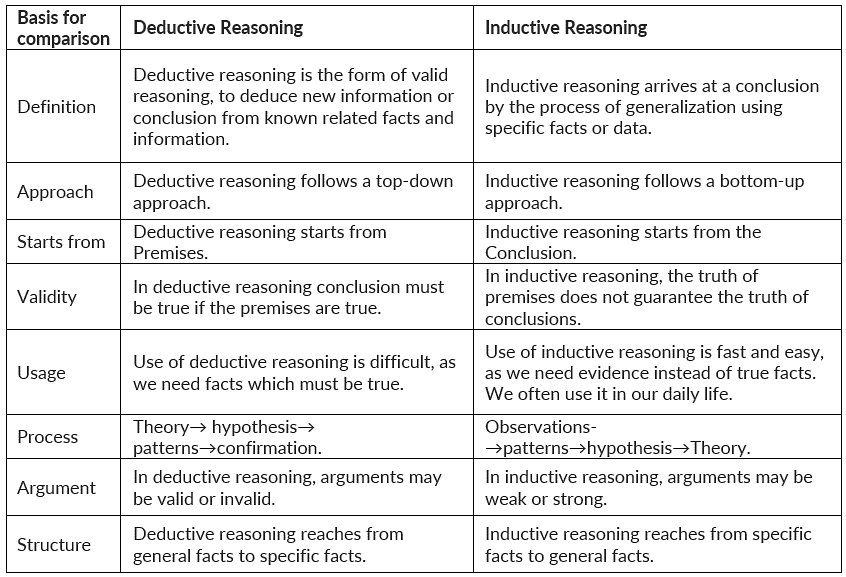
Difference between deductive and inductive reasoning
Informal reasoning
- Informal reasoning refers to using logical thought and principles of logic outside a formal symbolic system; it relies on everyday knowledge, background information and ordinary language rather than on formal proofs.
- It is used to evaluate and interpret communications encountered in newspapers, social media, conversations, advertisements and other ordinary contexts.
- Two central activities in informal reasoning are analysis (examining details and relationships to form a coherent picture) and evaluation (judging the merit, credibility or strength of a claim or argument).
- Common everyday examples include a doctor choosing the best treatment and a manager deciding how to increase factory output.
Deductive reasoning
Deduction proceeds from general premises to a logically certain conclusion about a particular case. If the premises are true and the argument is valid, the conclusion must be true. Deduction aims at necessity rather than probability.
- Structure: general rule → particular instance → conclusion.
- Validity: an argument is valid when the conclusion follows necessarily from the premises; validity is a feature of form, not truth.
- Soundness: an argument is sound when it is both valid and its premises are true.
- Classical example: All men are mortal. Socrates is a man. Therefore, Socrates is mortal.
- Limitations: a valid deductive argument can still have false premises and hence a false conclusion; validity alone does not guarantee truth of conclusions unless premises are true.
Inductive reasoning
Induction proceeds from particular observations to broader generalisations or probabilistic conclusions. Inductive reasoning supports conclusions with varying degrees of strength but does not guarantee them with absolute certainty.
- Structure: particular observations → general conclusion.
- Strength: an inductive argument is strong when the premises make the conclusion highly probable.
- Cogency: an inductive argument is cogent when it is strong and its premises are true or well supported by evidence.
- Example: Observing many white swans in a region and concluding that probably all swans are white (subject to possible counterexamples).
- Limitations: inductive generalisations may be weakened or refuted by new observations; they are ampliative (they add information beyond the premises).
Abductive reasoning
Abduction is reasoning to the best explanation. Given a set of observations, abduction chooses a hypothesis that, if true, would best explain those observations. It is widely used in diagnosis, scientific hypothesis formation and everyday inference when multiple explanations are possible.
- Structure: observed facts → hypothesis that best explains them.
- Example: The grass is wet. A plausible abductive inference is that it rained; other explanations (sprinklers, watering) remain possible.
- Characteristic: abductive conclusions are tentative and selected for explanatory power, simplicity, coherence or likelihood, not for deductive certainty.
Comparative features: deductive, inductive and abductive reasoning
- Direction: deduction: general → particular; induction: particular → general; abduction: facts → best explanatory hypothesis.
- Certainty vs probability: deduction aims for certainty (when valid and premises are true); induction and abduction aim for probability or plausibility.
- Role in science: induction suggests general laws from data; abduction generates hypotheses; deduction derives testable consequences from hypotheses.
- Evaluation standards: deductive arguments: judged by validity and soundness; inductive arguments: judged by strength and cogency; abductive arguments: judged by explanatory merit, simplicity and coherence with background knowledge.
Validity and common fallacies
- Validity concerns whether the conclusion follows from the premises.
- Soundness requires an argument to be valid and have true premises.
- Common informal fallacies include hasty generalisation (weak induction), false causation (confusing correlation with causation), affirming the consequent (an invalid deductive form) and post hoc ergo propter hoc (assuming sequence implies causation).
Solved Example
- Premises: All cats have long tails. John is a dog.
- Conclusion: Therefore, John has tails.
- Analysis: This argument attempts deduction (moving from general statements to a particular conclusion). The premises do not entail the conclusion because the major premise concerns cats while John is identified as a dog. The conclusion that John has a tail does not follow necessarily from the premises provided. Therefore, the argument is invalid. It is also unsound because the conclusion does not logically follow from the premises.
Practice Questions
Q. Which type of arguments is considered as particular to general?
(a) Deductive arguments
(b) Inductive arguments
(c) Informal arguments
(d) Abductive arguments
Correct Answer is Option (b)
Inductive arguments are that argument which takes specific information and makes broader generalised arguments. It is considered as particular to general.
Premises: All cats have long tails.
John is a dog.
Conclusion: Therefore, John has tails.
Q. What type of argument is it?
(a) Deductive arguments
(b) Inductive arguments
(c) Informal arguments
(d) Abductive arguments
Correct Answer is Option (a)
Deductive arguments are that argument which starts from general statements and check the possibilities to reach a specific, logical conclusion. It is considered as general to particular.
Premises: Australia has won 5 cricket World Cups
Conclusion: Therefore, Australia will win the upcoming cricket World Cup.
Q. What type of argument is it?
(a) Deductive arguments
(b) Inductive arguments
(c) Informal arguments
(d) Abductive arguments
Correct Answer is Option (b)
Inductive arguments are that argument which take specific information and make broader generalised arguments. It is considered as particular to the general. Here, specific information (Australia has won 5 world cups) is taken to conclude that Australia will [win the] upcoming cricket world cup.
Practical Tips: How to Approach and Evaluate Arguments
- Identify whether the argument is deductive, inductive or abductive by examining its direction and goal.
- For deductive arguments, check the logical form for validity and then assess the truth of premises for soundness.
- For inductive arguments, assess the representativeness and number of observations and whether alternative cases counter the generalisation.
- For abductive arguments, compare competing hypotheses for explanatory scope, simplicity, coherence with background knowledge and predictive power.
- Watch for common fallacies such as hasty generalisation, false cause, equivocation and non sequitur.
FAQs on Study Notes: Deductive and Inductive Reasoning - 2
| 1. What is the main difference between deductive and inductive reasoning? |  |
| 2. Can you explain what informal reasoning is? | |
| 3. What is an example of deductive reasoning? | |
| 4. How does inductive reasoning work? | |
| 5. What is abductive reasoning and how does it differ from deductive and inductive reasoning? | |