JEE Exam  >  JEE Notes  >  Chapter-wise Tests Main & Advanced  >  JEE Advanced (One or More Correct Option): Mathematical induction & Binomial Theorem

JEE Advanced (One or More Correct Option): Mathematical induction & Binomial Theorem

Q.1. Given that the 4th term in the expression of JEE Advanced (One or More Correct Option): Mathematical induction & Binomial Theorem has the maximum numerical value, then x can lie in the interval(s)
(a) JEE Advanced (One or More Correct Option): Mathematical induction & Binomial Theorem
(b) ( -2,- 2)
(c) JEE Advanced (One or More Correct Option): Mathematical induction & Binomial Theorem
(d) JEE Advanced (One or More Correct Option): Mathematical induction & Binomial Theorem

Correct Answer is options (a, c)
Since t4 is numerically the greatest term,
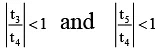
| t3 |<| t4| and  | t5 |<| t4 |
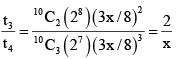
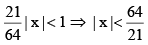
JEE Advanced (One or More Correct Option): Mathematical induction & Binomial Theorem
But JEE Advanced (One or More Correct Option): Mathematical induction & Binomial Theorem
JEE Advanced (One or More Correct Option): Mathematical induction & Binomial Theorem
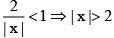
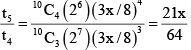
and JEE Advanced (One or More Correct Option): Mathematical induction & Binomial Theorem
JEE Advanced (One or More Correct Option): Mathematical induction & Binomial Theorem

Q.2. For a positive integer n, if the expansion of JEE Advanced (One or More Correct Option): Mathematical induction & Binomial Theorem has a term independent of x, then n can be
(a) 18
(b) 21
(c) 27
(d) 99 

Correct Answer is options (a, b, c, d)
Let (r + 1)th term of JEE Advanced (One or More Correct Option): Mathematical induction & Binomial Theorem be independent of x, we have
JEE Advanced (One or More Correct Option): Mathematical induction & Binomial Theorem
For this term to be independent of x, 6r - 2n = 0 or  n = 3r
∴ Each of 18, 21, 27, 99 is divisible by 3.

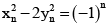
Q.3. Let JEE Advanced (One or More Correct Option): Mathematical induction & Binomial Theorem , where xn, yn are integers, then
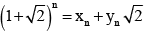
(a) JEE Advanced (One or More Correct Option): Mathematical induction & Binomial Theorem
(b) JEE Advanced (One or More Correct Option): Mathematical induction & Binomial Theorem
(c) JEE Advanced (One or More Correct Option): Mathematical induction & Binomial Theorem
(d) JEE Advanced (One or More Correct Option): Mathematical induction & Binomial Theorem

Correct Answer is options (a, b, d)
We have JEE Advanced (One or More Correct Option): Mathematical induction & Binomial Theorem (1)
JEE Advanced (One or More Correct Option): Mathematical induction & Binomial Theorem (2)
From (1) and (2), we get
JEE Advanced (One or More Correct Option): Mathematical induction & Binomial Theorem
Next, JEE Advanced (One or More Correct Option): Mathematical induction & Binomial Theorem
= JEE Advanced (One or More Correct Option): Mathematical induction & Binomial Theorem
Thus, JEE Advanced (One or More Correct Option): Mathematical induction & Binomial Theorem and JEE Advanced (One or More Correct Option): Mathematical induction & Binomial Theorem

Q.4. Which of the following is/are true
(a) JEE Advanced (One or More Correct Option): Mathematical induction & Binomial Theorem

(b) JEE Advanced (One or More Correct Option): Mathematical induction & Binomial Theorem
(c) JEE Advanced (One or More Correct Option): Mathematical induction & Binomial Theorem
(d) JEE Advanced (One or More Correct Option): Mathematical induction & Binomial Theorem

Correct Answer is options (a, b, c)
(A) No. of onto functions from a set containing 6 elements to a set containing 5 elements
=6C2 L5
(B) No .of onto functions from a set containing 5 elements to a set containing 6 elements = 0
(C) No. of onto function from a set containing 6 elements to a set containing 6 elements
= L6 = 720.

Q.5. If (1 + x + x2)n = a0 + a1x + a2x2 + ...... + a2nx2n, then
(a) a0 - a2 + a4 - a6 + ...... = 0, if n is odd
(b) a1 - a3 + a5 - a7 + ...... = 0, if n is even
(c) a0 - a2 + a4 - a6 + ...... = 0, if n = 4p, p ∈ I+
(d) a1 - a3 + a5 - a7 + ...... = 0, if n = 4p + 1, p ∈ I+

Correct Answer is options (a, b)
JEE Advanced (One or More Correct Option): Mathematical induction & Binomial Theorem
Putting JEE Advanced (One or More Correct Option): Mathematical induction & Binomial Theorem. Then, we get
JEE Advanced (One or More Correct Option): Mathematical induction & Binomial Theorem
If n is odd, then Re(in) = 0
⇒ a0 - a2 + a4 - a6 + ...... = 0
If n is even, then Im(in) = 0
⇒ a1 - a3 + a5 - a7 + ...... = 0


Q.6. The value of the expression JEE Advanced (One or More Correct Option): Mathematical induction & Binomial Theorem is   (Here Ck = nCk)

(a) 0, if n is odd
(b) (-1)n, if n is odd
(c) (-1)n/2 Cn/2, if n is even
(d) (-1)n-1Cn-1, if n is even

Correct Answer is options (a, c)
When n is odd, taken n = 2m + 1, so that
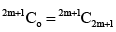
JEE Advanced (One or More Correct Option): Mathematical induction & Binomial Theorem
= JEE Advanced (One or More Correct Option): Mathematical induction & Binomial Theorem
But JEE Advanced (One or More Correct Option): Mathematical induction & Binomial Theorem
JEE Advanced (One or More Correct Option): Mathematical induction & Binomial Theorem etc.
Therefore S = 0
When n is even, we take n = 2m. In this case
JEE Advanced (One or More Correct Option): Mathematical induction & Binomial Theorem
= Coefficient of constant term in
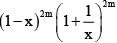
JEE Advanced (One or More Correct Option): Mathematical induction & Binomial Theorem
= Coefficient of constant term in JEE Advanced (One or More Correct Option): Mathematical induction & Binomial Theorem
= Coefficient of x2m in (1 - x)2m(1 + x)2m = Coefficient of x2m in (1 - x2)2m
= JEE Advanced (One or More Correct Option): Mathematical induction & Binomial Theorem

Q.7. Let an expression E be given by E = (1 + x)n (1 + y)n (1 + z)n then
(a) number of dissimilar terms in E will be (n + 1)3
(b) number of dissimilar terms in E will be n3
(c) coefficient of n r in E is ( nCr )3 
(d) Sum of coefficient in E is 23n

Correct Answer is options (a, d)
Each individual expansion will have n +1 terms.
Put x = y = z = 1

Q.8. The cube of any whole number when divided by 9 may yield the reminder
(a) 0
(b) 2
(c) 1
(d) 8

Correct Answer is options (a, c, d)
Any whole number is either 9K, 9K+1, ......, 9K+8 When we cube them reminder will be 0, 1 or 8 only

Q.9. In the expansion of JEE Advanced (One or More Correct Option): Mathematical induction & Binomial Theorem
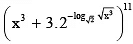
(a) there appears a term with the power  x2
(b) there does not appear a term with the power  x2
(c) there appears a term with the power  x-3
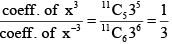
(d) the ratio of the co-efficient of xto that of  x-3 is

Correct Answer is options (b, c, d)
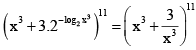
JEE Advanced (One or More Correct Option): Mathematical induction & Binomial Theorem
Now 33 - 6r = 2 ⇒ 6r = 31 (not possible)
33 - 6r = -3 ⇒ r = 6
33 - 6r = 3 ⇒ r = 5
JEE Advanced (One or More Correct Option): Mathematical induction & Binomial Theorem

Q.10. 1 + x)n - nx - 1 is divisible by (where n∈N)
(a) 2x
(b) x2
(c) 2x3
(d) All of these

Correct Answer is option (b)
(1 + x)= 1 + nx + ([n (n - 1)] / [2!]) * x+ ([n (n - 1) (n - 2)] / [3!]) * x+ . . . . .
(1 + x)- nx - 1 = x2 [([n (n - 1)] / [2!]) + ([n (n - 1) (n - 3)] / [3!]) * x + . . . . .]
From above it is clear that (1 + x)- nx - 1 is divisible by x2.
Trick: (1 + x)- nx - 1, put n = 2 and x = 3;
Then 4- 2 * 3 - 1 = 9 is not divisible by 6, 54 but divisible by 9, which is given by option (b) i.e., x= 9.

The document JEE Advanced (One or More Correct Option): Mathematical induction & Binomial Theorem is a part of the JEE Course Chapter-wise Tests for JEE Main & Advanced.
All you need of JEE at this link: JEE
Explore Courses for JEE exam
Get EduRev Notes directly in your Google search
Related Searches
ppt, Important questions, JEE Advanced (One or More Correct Option): Mathematical induction & Binomial Theorem, JEE Advanced (One or More Correct Option): Mathematical induction & Binomial Theorem, mock tests for examination, shortcuts and tricks, study material, Viva Questions, MCQs, Extra Questions, practice quizzes, Semester Notes, Exam, Previous Year Questions with Solutions, Free, Summary, pdf , video lectures, Objective type Questions, JEE Advanced (One or More Correct Option): Mathematical induction & Binomial Theorem, past year papers, Sample Paper;