JEE Advanced (Assertion-Reason Type): Quadratic Equation & Inequalities

Directions: Each question contains Statement - 1 (Assertion) and Statement - 2 (Reason). Each question has 4 choices (A), (B), (C) and (D) out of which ONLY ONE is correct. So select the correct choice.
Q.1. Consider the equation (a + 2)x2 + (a - 3) x = 2a - 1
Statement-1 : Roots of above equation are rational if 'a' is rational and not equal to -2.
Statement-2 : Roots of above equation are rational for all rational values of 'a'.
(a) Statement-1 is True, Statement-2 is True; Statement-2 is a correct explanation for Statement -1.
(b) Statement-1 is True, Statement-2 is True; Statement-2 is NOT a correct explanation for Statement-1.
(c) Statement-1 is True, Statement-2 is False.
(d) Statement-1 is False, Statement-2 is True.
Correct Answer is option (c)
Obviously x = 1 is one of the root
∴ Other root == rational for all rational a ≠ -2.
(C) is correct option.
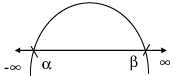
Q.2. Let f(x) = x2 = -x2 + (a + 1) x + 5
Statement-1 : f(x) is positive for same α < x < β and for all a∈R
Statement-2 : f(x) is always positive for all x∈R and for same real 'a'.
(a) Statement-1 is True, Statement-2 is True; Statement-2 is a correct explanation for Statement -1.
(b) Statement-1 is True, Statement-2 is True; Statement-2 is NOT a correct explanation for Statement-1.
(c) Statement-1 is True, Statement-2 is False.
(d) Statement-1 is False, Statement-2 is True.
Correct Answer is option (c)
Here f(x) is a downward parabola
D = (a + 1)2 + 20 > 0
From the graph clearly st (1) is true but st (2) is false
Q.3. Consider f(x) = (x2 + x + 1) a2 - (x2 + 2) a -3 (2x2 + 3x + 1) = 0
Statement-1 : Number of values of 'a' for which f(x) = 0 will be an identity in x is 1.
Statement-2 : a = 3 the only value for which f(x) = 0 will represent an identity.
(a) Statement-1 is True, Statement-2 is True; Statement-2 is a correct explanation for Statement -1.
(b) Statement-1 is True, Statement-2 is True; Statement-2 is NOT a correct explanation for Statement-1.
(c) Statement-1 is True, Statement-2 is False.
(d) Statement-1 is False, Statement-2 is True.
Correct Answer is option (d)
f(x) = 0 represents an identity if a2 - a - 6 = 0 ⇒ a = 3, -2
⇒ a2 - a - 6 = 0 ⇒ a = 3, -2
⇒ a2 - a = 0 ⇒ a = 3, -3
⇒ a2 - 2a -3 =0 ⇒ a = 3, -1 ⇒ a = 3 is the only values.
Q.4. Let a, b, c be real such that ax2 + bx + c = 0 and x2 + x + 1= 0 have a common root
Statement-1 : a = b = c
Statement-2 : Two quadratic equations with real coefficients can not have only one imaginary root common.
(a) Statement-1 is True, Statement-2 is True; Statement-2 is a correct explanation for Statement -1.
(b) Statement-1 is True, Statement-2 is True; Statement-2 is NOT a correct explanation for Statement-1.
(c) Statement-1 is True, Statement-2 is False.
(d) Statement-1 is False, Statement-2 is True.
Correct Answer is option (a)
x2 + x + 1 = 0
D = - 3 < 0
∴ x2 + x + 1 = 0 and ax2 + bx + c = 0 have both the roots common
⇒ a = b = c.
Q.5. Statement-1 : The number of values of a for which (a2 - 3a + 2) x2 + (a2 - 5a + b) x + a2 - 4 = 0 is an identity in x is 1.
Statement-2 : If ax2 + bx + c = 0 is an identity in x then a = b = c = 0.
(a) Statement-1 is True, Statement-2 is True; Statement-2 is a correct explanation for Statement -1.
(b) Statement-1 is True, Statement-2 is True; Statement-2 is NOT a correct explanation for Statement-1.
(c) Statement-1 is True, Statement-2 is False.
(d) Statement-1 is False, Statement-2 is True.
Correct Answer is option (a)
(a2 - 3a + 2) x2 + (a2 - 5a + 6) x + a2 - 4 = 0
Clearly only for a = 2, it is an identify.
Q.6. Let a ∈ (- ∞, 0).
Statement-1 : ax2 - x + 4 < 0 for all x ∈ R
Statement-2 : If roots of ax2 + bx + c = 0, b, c ∈ R are imaginary then signs of ax2 + bx + c and a are same for all x ∈ R.
(a) Statement-1 is True, Statement-2 is True; Statement-2 is a correct explanation for Statement -1.
(b) Statement-1 is True, Statement-2 is True; Statement-2 is NOT a correct explanation for Statement-1.
(c) Statement-1 is True, Statement-2 is False.
(d) Statement-1 is False, Statement-2 is True.
Correct Answer is option (d)
Statement - II is true as if ax2 + bx + c = 0 has imaginary roots, then for no real x, ax2 + bx + c is zero, meaning thereby ax2 + bx + c is always of one sign. Further
Statement - I is false, because roots of ax2 - x + 4 = 0 are real for any a ∈(- ∞, 0) and hence ax2 - x + 4 takes zero, positive and negative values. Hence (d) is the correct answer.

Q.7. Let a, b, c ∈ R, a ≠ 0.
Statement-1 : Difference of the roots of the equation ax2 + bx + c = 0
= Difference of the roots of the equation - ax2 + bx - c = 0
Statement-2 : The two quadratic equations over reals have the same difference of roots if product of the coefficient of the two equations are the same.
(a) Statement-1 is True, Statement-2 is True; Statement-2 is a correct explanation for Statement -1.
(b) Statement-1 is True, Statement-2 is True; Statement-2 is NOT a correct explanation for Statement-1.
(c) Statement-1 is True, Statement-2 is False.
(d) Statement-1 is False, Statement-2 is True.
Correct Answer is option (c)
Statement-I is true, as Difference of the roots of a quadratic equation is always √D , D being the discriminant of the quadratic equation and the two given equations have the same discriminant.
Statement - II is false as if two quadratic equations over reals have the same product of the coefficients, their discriminents need not be same.
Hence (c) is the correct answer.
Q.8. Statement-1 : If the roots of x5 - 40x4 + Px3 + Qx2 + Rx + S = 0 are in G.P. and sum of their reciprocal is 10, then | S |= 32.
Statement-2 : x1. x2. x3.x4.x5 = S, where x1, x2, x3, x4, x5 are the roots of given equation.
(a) Statement-1 is True, Statement-2 is True; Statement-2 is a correct explanation for Statement -1.
(b) Statement-1 is True, Statement-2 is True; Statement-2 is NOT a correct explanation for Statement-1.
(c) Statement-1 is True, Statement-2 is False.
(d) Statement-1 is False, Statement-2 is True.
Correct Answer is option (c)
Roots of the equation x5 - 40x4 + px3 + qx2 + rx + s = 0 are in G.P., let roots be a, ar, ar2, ar3, ar4
∴ a + ar + ar2 + ar3 + ar4 = 40 . . . (i)
and
rom (i) and (ii); ar2 = ± 2 . . . (iii)
Now, - S = product of roots = a5r10 = (ar2)5 = ± 32.
∴ | s |= 32 .
∴ Hence (c) is the correct answer.

Q.9. Statement-1 : If a ≥ 1/2 then α < 1 < p where α , β are roots of equation -x2 + ax + a = 0
Statement-2 : Roots of quadratic equation are rational if discriminant is perfect square.
(a) Statement-1 is True, Statement-2 is True; Statement-2 is a correct explanation for Statement -1.
(b) Statement-1 is True, Statement-2 is True; Statement-2 is NOT a correct explanation for Statement-1.
(c) Statement-1 is True, Statement-2 is False.
(d) Statement-1 is False, Statement-2 is True.
Correct Answer is option (b)
x2 - ax - a = 0
g(1) < 0
⇒ a > 1/2
Q.10. Statement-1 : The number of real roots of |x|2 + |x| + 2 = 0 is zero.
Statement-2 : ∀x∈R, |x| ≥ 0.
(a) Statement-1 is True, Statement-2 is True; Statement-2 is a correct explanation for Statement -1.
(b) Statement-1 is True, Statement-2 is True; Statement-2 is NOT a correct explanation for Statement-1.
(c) Statement-1 is True, Statement-2 is False.
(d) Statement-1 is False, Statement-2 is True.
Correct Answer is option (b)
equation can be written as (2x)2 - (a - 4) 2x - (a - 4) = 0
⇒ 2x = 1 & 2x = a - 4
Since x ≤ 0 and 2x = a - 4 [∵ x is non positive]
∴ 0 < a - 4 ≤ 1
⇒ 4 < a ≤ 5 i.e., a∈ (4, 5]




