Cauchy-Euler Equation


Introduction
The Cauchy-Euler equation (also called the Euler equation or equidimensional equation) is an important class of linear ordinary differential equations whose coefficients are powers of the independent variable. It arises frequently when using separation of variables or Fourier methods to reduce partial differential equations to ordinary differential equations. This chapter explains the general form, common solution methods, characteristic cases, worked examples and brief applications relevant to engineering students.
Cauchy-Euler Equation - General Form
The Cauchy-Euler differential equation of order n has the form

where ai (i = 0, 1, 2, ..., n) are constants and an ≠ 0. The coefficients multiply derivatives by powers of x so that each term is of the same total degree in x and derivatives - hence the name equidimensional.
Second-Order Cauchy-Euler Equation
The most commonly used case is the second-order Cauchy-Euler equation. Its general form is

or, equivalently,
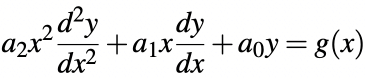
where a, b, c are constants and g(x) is a given function. When g(x) = 0 the equation is called the homogeneous Cauchy-Euler equation. In this chapter we focus on methods for solving the homogeneous and some standard approaches for the non-homogeneous case.
Common Examples
- x2 y′′ - 9x y′ + 25 y = 0
- y′′ + 9 y = sec 3x
- x2 y′′ + 4 y = 0
- x3 y′′′ - 6 x2 y′′ + 19 x y′ - 27 y = 0
Methods for Solving the Second-Order Cauchy-Euler Equation
Ansatz y = xr (Indicial or Characteristic Equation)
Assume a solution of the form y = xr, where r is a constant to be determined. Substitute into the homogeneous equation
a x2 y′′ + b x y′ + c y = 0.
Compute derivatives for y = xr:
y = xr
y′ = r xr-1
y′′ = r(r - 1) xr-2
Substituting gives a polynomial in x whose factor xr can be divided out (for x ≠ 0). The resulting algebraic equation in r is the indicial (characteristic) equation:
a r(r - 1) + b r + c = 0.
Solving this quadratic gives the values of r; the form of the general solution depends on the nature of the roots:
- If the roots r1 and r2 are real and distinct then the general solution is y(x) = C1 xr1 + C2 xr2.
- If the roots are real and equal (r1 = r2 = r), then the general solution is y(x) = (C1 + C2 ln|x|) xr.
- If the roots are complex conjugates r = α ± iβ, then the general real solution is y(x) = xα [C1 cos(β ln|x|) + C2 sin(β ln|x|)].
Change of Variable to Convert to Constant-Coefficient ODE
A standard alternative method uses the substitution x = et (so t = ln x, defined for x>0). Define Y(t) = y(et). Then derivatives transform as follows:
dy/dx = (1/x) dY/dt
d2y/dx2 = (1/x2) (d2Y/dt2 - dY/dt)
Substituting into the Cauchy-Euler equation yields a linear equation with constant coefficients in t. This reduction is especially useful when applying methods for non-homogeneous equations or when initial/boundary conditions are given at x>0.
Reduction of Order (Repeated Root)
If the indicial equation has a repeated root r, one solution is y1(x) = xr. A second, linearly independent, solution can be obtained by seeking y = u(x) xr and using reduction of order. For the second solution one obtains y2(x) = xr ln|x| (up to constant multiple), giving the general form (C1 + C2 ln|x|) xr.
Non-homogeneous Equations
For a non-homogeneous Cauchy-Euler equation one can use:
- Method of variation of parameters after transforming to constant coefficients using t = ln x.
- Method of undetermined coefficients when the right-hand side g(x) is of a form compatible with xr, powers of ln x times powers of x, or when transform leads to simple forcing in t.
Worked Examples and Solved Problems
Q.1. Solve: x2 y′′ - 6 x y′ - 18 y = 0
Given second order Cauchy-Euler equation:
x2 y′′ - 6 x y′ - 18 y = 0
Assume y = xr and substitute.
y = xr
y′ = r xr-1
y′′ = r(r - 1) xr-2
Substitute into the differential equation:
x2·r(r - 1)xr-2 - 6 x·r xr-1 - 18 xr = 0
Divide by xr (x ≠ 0):
r(r - 1) - 6 r - 18 = 0
Expand and simplify:
r2 - r - 6 r - 18 = 0
r2 - 7 r - 18 = 0
Factorise:
(r + 2)(r - 9) = 0
Thus r = -2 and r = 9.
Therefore the fundamental solutions are x-2 and x9.
The general solution is:
y(x) = C1 x-2 + C2 x9
Q.2. Solve the differential equation x2 y′′ - 7 x y′ + 16 y = 0 for x > 0.
Given second order Cauchy-Euler equation:
x2 y′′ - 7 x y′ + 16 y = 0
Assume y = xr and substitute.
y = xr
y′ = r xr-1
y′′ = r(r - 1) xr-2
Substitute into the equation and divide by xr:
r(r - 1) - 7 r + 16 = 0
Simplify:
r2 - r - 7 r + 16 = 0
r2 - 8 r + 16 = 0
Recognise a perfect square:
(r - 4)2 = 0
Hence r = 4 is a repeated root.
One solution is y1(x) = x4.
To find a second independent solution use reduction of order; seek y(x) = x4 u(x).
Differentiate:
y = x4 u
y′ = 4 x3 u + x4 u′
y′′ = 12 x2 u + 8 x3 u′ + x4 u′′
Substitute into the original equation:
x2[12 x2 u + 8 x3 u′ + x4 u′′] - 7 x[4 x3 u + x4 u′] + 16 x4 u = 0
Simplify term by term:
12 x4 u + 8 x5 u′ + x6 u′′ - 28 x4 u - 7 x5 u′ + 16 x4 u = 0
Combine like terms:
x6 u′′ + x5 u′ + 0·u = 0
Let v = u′. Then
x6 v′ + x5 v = 0
Divide by x6:
v′ + (1/x) v = 0
Rewrite as a first-order linear ODE:
(1/v) dv/dx = -1/x
Integrate both sides:
ln|v| = - ln|x| + C0
Hence v = u′ = C2 / x.
Integrate to obtain u(x):
u(x) = C2 ln|x| + C1.
Therefore the general solution is:
y(x) = x4 u(x) = C1 x4 + C2 x4 ln|x|
Remarks, Applications and Tips
- The Cauchy-Euler equation is algebraically simpler than a general variable-coefficient ODE because the ansatz xr converts the differential equation to an algebraic equation for r.
- For engineering problems (mechanics, vibration, heat conduction in power-law media) the Euler equation often appears after separation of variables when geometry or material properties scale with x.
- When working on x > 0 use the substitution t = ln x to convert to constant-coefficient ODEs and apply well-known solution techniques; this also clarifies the complex-root case where solutions involve cos(β ln x) and sin(β ln x).
- Carefully handle the domain: solutions involving ln|x| require x ≠ 0; initial conditions at x = 0 are not generally admissible for Euler equations unless interpreted by limits or special methods.
- For non-homogeneous problems use variation of parameters after transforming to t = ln x, or construct particular solutions compatible with the form of g(x).
Summary
The Cauchy-Euler equation is solved principally by assuming power-law solutions y = xr, leading to an indicial polynomial for r. The three characteristic cases of distinct real roots, repeated root and complex conjugate roots produce the standard families of solutions: power laws, power law times ln|x|, and power law times sinusoidal functions of ln|x| respectively. Transformation x = et converts the equation to one with constant coefficients and is useful for non-homogeneous problems and applying standard methods.