Improper Integrals

Definite integrals

- finite domain of integration [a, b]
- finite integrand f(x) < ±∞ for x in [a, b]
Improper integrals
- Infinite limits of integration, for example integrals over [a, ∞), (-∞, b], or (-∞, ∞).
- Integrals with vertical asymptotes, i.e. integrands having infinite discontinuities at some point(s) in the interval of integration.
Improper integrals are defined as limits of ordinary (definite) integrals. If the relevant limit exists and is finite the improper integral is said to converge; if the limit fails to exist or is infinite the improper integral diverges. Convergence means the integral has a finite value and can be evaluated; divergence means it does not.
Formal definitions
Integrals over infinite intervals are defined by limits of definite integrals:
- For a ≤ ∞: ∫a∞ f(x) dx = limR→∞ ∫aR f(x) dx, provided the limit exists.
- For -∞ ≤ b: ∫-∞b f(x) dx = limR→-∞ ∫Rb f(x) dx, provided the limit exists.
- Over (-∞, ∞): ∫-∞∞ f(x) dx is defined as ∫-∞c f(x) dx + ∫c∞ f(x) dx, and both integrals must converge (the value does not depend on the choice of c).
- When the integrand has an infinite discontinuity at an interior point c in [a, b], split the integral and take one-sided limits: ∫ab f(x) dx = limt→c- ∫at f(x) dx + limt→c+ ∫tb f(x) dx, provided both limits exist.
Tests for convergence
- Comparison test: If 0 ≤ f(x) ≤ g(x) for x in [A, ∞) and ∫A∞ g(x) dx converges, then ∫A∞ f(x) dx also converges. If ∫A∞ f(x) dx diverges and g(x) ≥ f(x) ≥ 0, then ∫A∞ g(x) dx diverges.
- Limit comparison test: If f(x), g(x) > 0 and limx→∞ f(x)/g(x) = L with 0 < L < ∞, then f and g either both converge or both diverge over the same infinite interval.
- p-test: For integrals of the form ∫1∞ 1/xp dx, the integral converges if p > 1 and diverges if p ≤ 1. For integrals of the form ∫01 1/xp dx, the integral converges if p < 1 and diverges if p ≥ 1.
- Absolute and conditional convergence: If ∫ |f(x)| converges then ∫ f(x) converges (absolute convergence). If ∫ f(x) converges but ∫ |f(x)| diverges, we say the integral is conditionally convergent.
Convergence vs. divergence
- In each case, if the defining limit exists and is finite (or if both limits exist when the integral is split), the improper integral converges.
- If the defining limit fails to exist or is infinite, the integral diverges. When an integral is split at a point of discontinuity, divergence of either piece makes the whole integral divergent.
Examples
Example 1: Find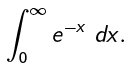 (if it even converges)
So the integral converges and equals 1.
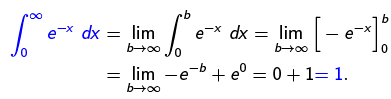
Solution (outline)
The integral is interpreted as the appropriate limit of definite integrals.
Evaluate the definite integral in closed form (expression shown in image).
Take the limit indicated by the improper definition (limit is shown in image).
Conclude that the limit is finite and equals 1, so the integral converges to 1.
Example 2: Find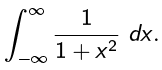 (if it even converges)
By definition,
where we get to pick whatever c we want. Let's pick c = 0.
Similarly,
Therefore,


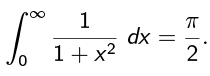
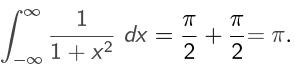
Solution (explanation)
Interpret the improper integral by splitting the interval at a convenient point c (here c = 0) so that each piece avoids the singularity or infinite limit.
Compute each definite integral on the split intervals (expressions shown in the images).
Take the limit for each piece as required by the improper-integral definition (limits shown in the images).
Combine the finite limits to obtain the value of the original improper integral; if any of the limits is infinite or does not exist the integral diverges.
Example 3: the p-test
The integral
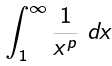
Converges if p > 1; Diverges if p ≤ 1.
For example:

while

and

Commentary
The images give illustrative integrals showing convergence for p > 1 and divergence otherwise. Use direct integration for simple p-values or comparison/limit comparison with 1/xp in more complicated cases.
Example 4: Find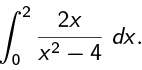 (if it converges)
The denominator of 2x/x2 - 4 is 0 when x = 2, so the function is not even defined when x = 2. So
so the integral diverges.

Solution (explanation)
Identify the point of discontinuity (x = 2) where the integrand is undefined.
Split the integral at x = 2 and interpret each piece as a one-sided limit approaching 2.
Evaluate the behaviour of each one-sided integral; if either one is infinite the integral diverges.
Conclude divergence because the integral near the singularity does not produce a finite limit (details shown in the image).
Example 5: Find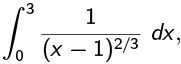 if it converges.
We might think just to do

but this is not okay: The function
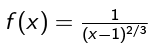

The two integrals on the right hand side both converge and add up to 3[1 + 21/3],
so

Solution (explanation)
Recognise the integrand has an interior singularity at x = 1 and split the integral into two improper integrals that approach x = 1 from the left and from the right respectively.
Evaluate each integral (calculations and antiderivatives are shown in the images).
Take the appropriate one-sided limits for each split integral and verify both limits are finite.
Sum the two finite values to obtain the value 3[1 + 21/3], therefore the original integral converges to that value.
Practical remarks and applications
- Improper integrals occur frequently in engineering applications such as load distributions over infinite domains, evaluation of Fourier transforms, and in probability when defining distributions over unbounded domains.
- Always check the domain for singularities before integrating; if the integrand is undefined at interior points split the integral and use one-sided limits.
- Choose comparison functions (often simple powers 1/xp or exponential functions) to apply comparison tests effectively.
- When integrating numerically, beware that improper behaviour at endpoints or infinite domains must be handled by transformation (e.g., change of variable) or by truncation with error estimation.
Final summary
Improper integrals extend the notion of definite integrals to infinite intervals and to integrands with infinite discontinuities. They are defined by limits of definite integrals. Convergence tests such as the comparison test, limit comparison, and the p-test are essential tools. When the defining limits exist and are finite the integral converges; otherwise it diverges. For engineering problems one must identify singularities, split integrals where necessary, and use comparison or exact evaluation to determine convergence and compute values.