CAT Exam  >  CAT Notes  >  Practice Questions Level 1: Percentage - 1

Practice Questions Level 1: Percentage - 1

This EduRev document offers 10 Multiple Choice Questions (MCQs) from the topic Percentage (Level - 1). These questions are of Level - 1 difficulty and will assist you in the preparation of CAT & other MBA exams. You can practice/attempt these CAT Multiple Choice Questions (MCQs) and check the explanations for a better understanding of the topic. 


MULTIPLE CHOICE QUESTION

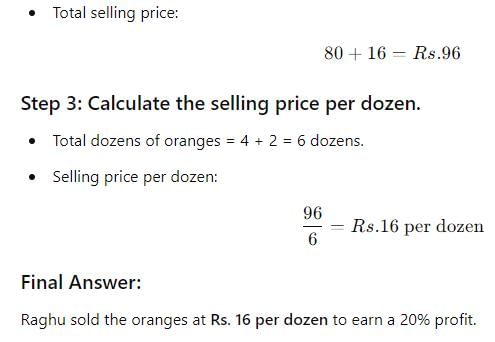
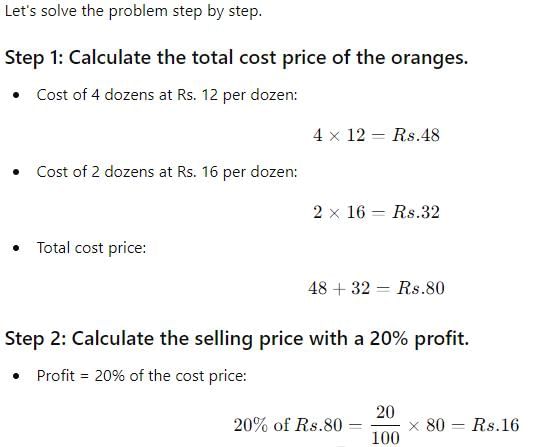
Try yourself: Raghu bought 4 dozens of oranges at Rs. 12 per dozen and 2 dozens of oranges at Rs. 16 per dozen. He sold them all and earned a profit of 20%. At what price per dozen did he sell the oranges?  
A

Rs. 18

B

Rs. 16

C

Rs. 14

D

Rs. 10

MULTIPLE CHOICE QUESTION

Try yourself: If A is 1.5 times B, then B is what percent of A + B?

A

33.3%

B

40%

C

75%

D

80%

MULTIPLE CHOICE QUESTION

Try yourself: A man buys a mobile phone at Rs. 5436 including 12.5% tax. How much money could he have saved by not paying the tax?

A

Rs. 483

B

Rs. 475

C

Rs. 604

D

Rs. 679

MULTIPLE CHOICE QUESTION

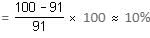
Try yourself: B is 30% taller than A, and C is 30% shorter than B. By approximate how much percentage is A taller than C?  
A

1%

B

10%

C

6.66%

D

20%

MULTIPLE CHOICE QUESTION

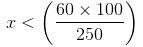
Try yourself: x is a positive integer. How many values can 'x' take such that x% of 250 is less than 60?  
A

29

B

22

C

23

D

24

MULTIPLE CHOICE QUESTION

Try yourself: In an election, there are two candidates A and B. Candidate A gets 40% of the total votes and loses the election by 9800 votes. Find the total number of votes.  

A

36,200

B

49,000

C

29,400

D

39,200

MULTIPLE CHOICE QUESTION

Try yourself: The length of a cuboid is doubled, the breadth is tripled and the height is halved. Find the percentage increase in its volume.  

A

100%

B

200%

C

300%

D

3%

MULTIPLE CHOICE QUESTION

Try yourself: In a test, Ram got 40 marks and failed by 40 marks. If the pass percentage was 40%, then find the maximum marks.  

A

180

B

200

C

220

D

260

MULTIPLE CHOICE QUESTION

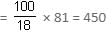
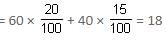
Try yourself: At Infosys, 60% of the employees are males and the rest are females. Further, 20% of the males and 15% of the females are getting bonus. If the number of employees getting bonus is 81, then find the total number of employees who are not getting bonus.  
A

369

B

379

C

387

D

367

MULTIPLE CHOICE QUESTION

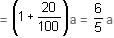
Try yourself: It costs Rs. 5,000 to paint the total surface of a cube. But in summers, each side of the cube expands by 20%. What will be the cost of painting the cube in summers?  
A

Rs. 6,400

B

Rs. 6,000

C

Rs. 7,250

D

Rs. 7,200

The document Practice Questions Level 1: Percentage - 1 is a part of CAT category.
All you need of CAT at this link: CAT

FAQs on Practice Questions Level 1: Percentage - 1

1. How do I calculate percentage increase and decrease in CAT-level problems?
Ans. Percentage increase equals (New Value - Old Value) / Old Value × 100, while percentage decrease follows the same formula with the new value being smaller. For CAT quantitative aptitude, mastering these formulas helps solve profit-loss and population growth problems quickly. Practice with real exam scenarios to build speed and accuracy in percentage calculations.
2. What's the difference between percentage change and percentage point change?
Ans. Percentage change measures the relative shift from an original value using the percentage formula, while percentage point change shows the absolute numerical difference between two percentages. If profit margins rise from 20% to 25%, that's a 5 percentage point increase but a 25% relative increase. Understanding this distinction prevents common CAT exam mistakes.
3. How do I solve compound percentage problems where multiple percentage changes happen one after another?
Ans. Apply successive percentage changes by multiplying the multipliers rather than adding percentages. If a quantity increases by 10% then 20%, the overall change is 1.10 × 1.20 = 1.32, representing a 32% total increase. This method eliminates calculation errors in layered percentage problems common in CAT quantitative reasoning sections.
4. Why do I keep getting wrong answers when solving percentage-based profit and loss problems?
Ans. Most students calculate percentages on the wrong base-always identify whether the base is cost price, selling price, or marked price before computing. A 20% profit on cost price isn't the same as a 20% discount on marked price. Clarifying the reference value upfront prevents this frequent error in competitive exam percentage applications.
5. What percentage shortcuts should I memorise for faster CAT problem-solving?
Ans. Learn key conversions: 50% = 1/2, 25% = 1/4, 33.33% = 1/3, and 20% = 1/5 for instant fraction-percentage switching. Memorise multipliers like 1.2 for 20% increase and 0.8 for 20% decrease to skip mental division during exams. These mental maths tricks dramatically accelerate percentage calculations in time-constrained CAT sections.
Download as PDF

Top Courses for CAT

Related Searches
Exam, Extra Questions, Practice Questions Level 1: Percentage - 1, Viva Questions, video lectures, Practice Questions Level 1: Percentage - 1, pdf , Objective type Questions, Summary, past year papers, mock tests for examination, ppt, Practice Questions Level 1: Percentage - 1, shortcuts and tricks, practice quizzes, Sample Paper, Semester Notes, study material, MCQs, Previous Year Questions with Solutions, Free, Important questions;