CBSE Class 9 > Class 9 Notes > Mathematics (Maths) > Important Formulas: Number System
Important Formulas: Number System

Law of Exponents
Basic statement: Exponents (indices) describe repeated multiplication of a base number. The following are the standard laws of exponents used throughout Number System topics.
- ap · aq = ap+q - product of powers with same base adds the exponents.
- ap / aq = ap-q (a = 0) - quotient of powers with same base subtracts the exponents.
- (ap)q = apq - power of a power multiplies the exponents.
- (ab)p = ap · bp - power of a product equals product of powers.
- a-p = 1 / ap (a = 0) - negative exponent gives reciprocal.
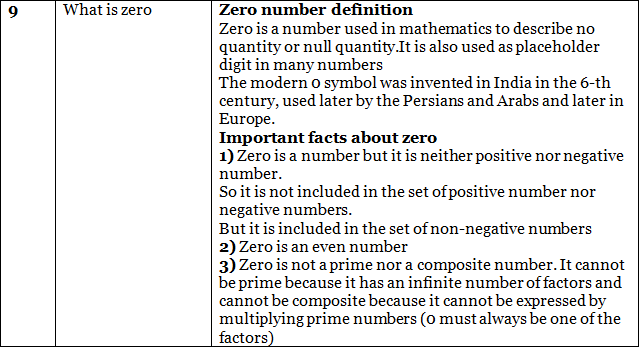
- a0 = 1 (a = 0) - zero exponent equals one.
- a1 = a - power one is the base itself.
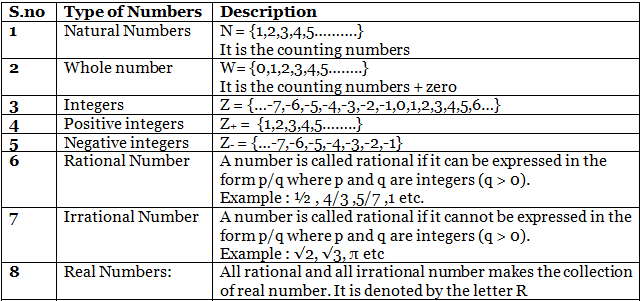
Number System - Basic Definitions and Classification
- Natural numbers (N): 1, 2, 3, ...
- Whole numbers (W): 0, 1, 2, 3, ...
- Integers (Z): ..., -3, -2, -1, 0, 1, 2, 3, ...
- Rational numbers (Q): numbers expressible as p/q where p and q are integers and q = 0. Decimal expansion is either terminating or repeating.
- Irrational numbers: numbers not expressible as p/q. Their decimal expansions are non‐terminating and non‐repeating (for example, √2, π).
- Real numbers (R): union of rational and irrational numbers; representable on the number line.
Closure and basic properties
- Closure under addition and multiplication: Natural numbers are closed under addition and multiplication. Integers are closed under addition, subtraction and multiplication. Rational numbers are closed under addition, subtraction, multiplication and division (except division by zero).
- Density: Between any two distinct real numbers there exists a rational number and also an irrational number.
Useful Formulas and Short Tricks
- Converting recurring decimals to fractions: Use multiplication to align repeating parts, subtract, solve for the variable.
- HCF × LCM = product of the two numbers when numbers are positive integers.
- To compare large numbers: Express in prime factor form or scientific notation before comparing.
- To check if a number is a perfect square: All prime exponents in its prime factorisation must be even.
- Negative bases with fractional exponents: Avoid non-integer fractional exponents of negative numbers in real numbers; consider complex numbers only when required.
Common Mistakes to Avoid
- Confusing (ap)q with ap+q; remember exponents multiply for power of a power.
- Using (a + b)p = ap + bp - this is false except for special cases (p = 1).
- For rationalising denominators with sums/differences of surds always use the conjugate.
- When converting repeating decimals, ensure you multiply by the correct power of 10 to align the repeating block.
Summary
This document collects the essential formulas and methods from the Number System topic useful for Class 8/9 level mathematics: definitions of number types, laws of exponents, prime factorisation, HCF and LCM (including Euclid's algorithm), divisibility tests, decimal ↔ fraction conversions, surds and rationalisation, fractional exponents, and scientific notation. Practise these methods through examples to build fluency and avoid the common mistakes listed above.
The document Important Formulas: Number System is a part of the Class 9 Course Mathematics (Maths) Class 9.
All you need of Class 9 at this link: Class 9
FAQs on Important Formulas: Number System
| 1. What are the important formulas in the number system for Class 9? |  |
Ans. The important formulas in the number system for Class 9 include: - Place value formula: The value of a digit in a number is determined by its position or place value. For example, in the number 352, the place value of 5 is 50. - Addition formula: The sum of two numbers is obtained by adding the digits at each place value. For example, 35 + 17 = 52. - Subtraction formula: The difference between two numbers is obtained by subtracting the digits at each place value. For example, 45 - 23 = 22. - Multiplication formula: The product of two numbers is obtained by multiplying the digits at each place value. For example, 23 x 4 = 92. - Division formula: The quotient of two numbers is obtained by dividing the digits at each place value. For example, 56 ÷ 8 = 7.
| 2. How do I calculate the place value of a digit in a number? | |
Ans. To calculate the place value of a digit in a number, you need to identify its position. The place value of a digit depends on its position from the right-hand side, starting with the units place as the first position. Each subsequent position is ten times the value of the previous position. For example, in the number 352, the place value of 5 is 50 because it is in the tens place (10 x 5 = 50).
| 3. What is the formula for addition in the number system? | |
Ans. The formula for addition in the number system is to add the digits at each place value. Start from the rightmost position and add the digits vertically. If the sum at any position is greater than 9, carry over the tens place to the next position. For example, to add 35 and 17: 35 +17 ------ 52 So, 35 + 17 = 52.
| 4. How do I calculate the product of two numbers in the number system? | |
Ans. To calculate the product of two numbers in the number system, you need to multiply the digits at each place value. Start from the rightmost position and multiply the digits vertically. If the product at any position is greater than 9, carry over the tens place to the next position. For example, to multiply 23 and 4: 23 x 4 ------ 92 So, 23 x 4 = 92.
| 5. What is the formula for division in the number system? | |
Ans. The formula for division in the number system is to divide the digits at each place value. Start from the leftmost position and divide the digits vertically. If the quotient at any position is greater than 9, carry over the tens place to the next position. For example, to divide 56 by 8: 7 ------ 8 ) 56 So, 56 ÷ 8 = 7.
About this Document

11.9K Views

4.66/5 Rating

Apr 22, 2026 Last updated
Related Exams
Document Description: Important Formulas: Number System for Class 9 2026 is part of Mathematics (Maths) Class 9 preparation. The notes and questions for Important Formulas: Number System have been prepared according to the Class 9 exam syllabus. Information about Important Formulas: Number System covers topics like and Important Formulas: Number System Example, for Class 9 2026 Exam. Find important definitions, questions, notes, meanings, examples, exercises and tests below for Important Formulas: Number System.
Introduction of Important Formulas: Number System in English is available as part of our Mathematics (Maths) Class 9 for Class 9 & Important Formulas: Number System in Hindi for Mathematics (Maths) Class 9 course. Download more important topics related with notes, lectures and mock test series for Class 9 Exam by signing up for free. Class 9: Important Formulas: Number System
Description
Important Formulas: Number System of Maths Class 9 on EduRev - covers all the formulas compiled in a single place. Download free PDF for last-minute revision.
Information about Important Formulas: Number System
In this doc you can find the meaning of Important Formulas: Number System defined & explained in the simplest way possible. Besides explaining types of Important Formulas: Number System theory, EduRev gives you an ample number of questions to practice Important Formulas: Number System tests, examples and also practice Class 9 tests



Related Searches
past year papers, Free, Important questions, shortcuts and tricks, MCQs, video lectures, mock tests for examination, pdf , Objective type Questions, Important Formulas: Number System, Extra Questions, Sample Paper, Previous Year Questions with Solutions, Viva Questions, Important Formulas: Number System, Semester Notes, practice quizzes, Summary, Important Formulas: Number System, Exam, study material, ppt;