Important Formulas: Linear Equations in One Variable

Algebraic Equation
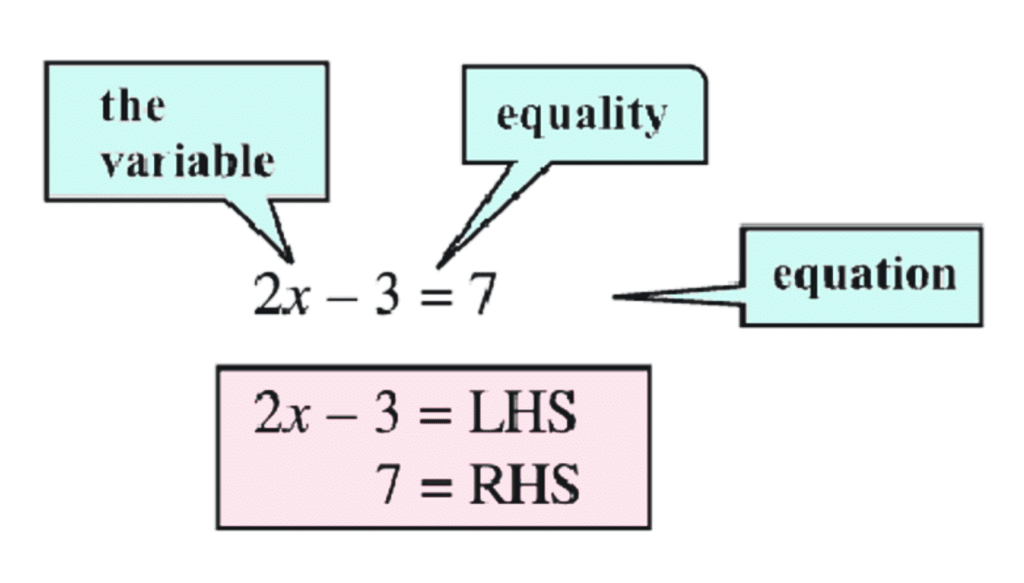
An algebraic equation is an equality that contains one or more variables. It states that the value of the expression on the left of the equality sign is equal to the value of the expression on the right for some value(s) of the variable(s).
- Expressions: \(5x\), \(2x - 3\), \(x^2 + 1\), \(y + y^2\), etc.
- Equations: \(5x = 25\), \(2x - 3 = 9\), \(6z + 10 = -2\), etc.
What is a Linear Equation in One Variable
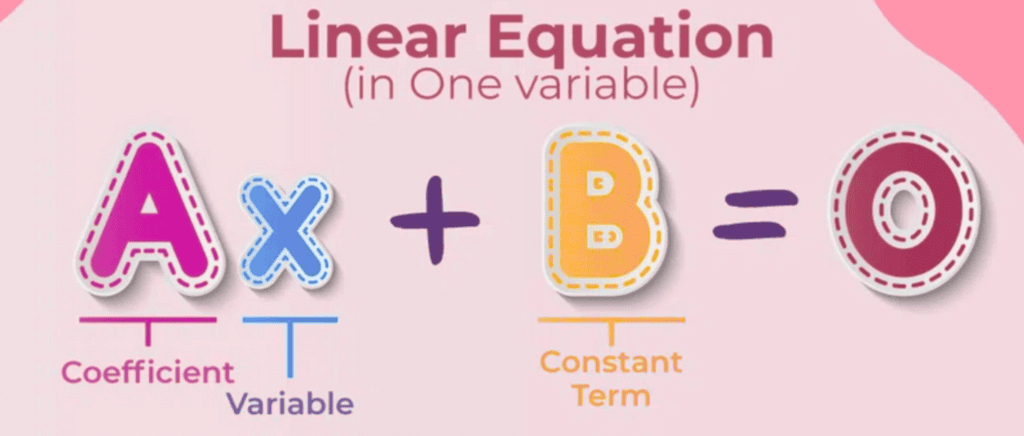
- A linear equation in one variable is an equation in which the highest power of the variable is 1.
- Such an equation usually has the variable appearing only to the first power and not multiplied by itself or another variable.
- Typical examples of linear expressions: \(2x\), \(3y - 7\), \(12 - 5z\).
Non-linear expressions
- Expressions in which the variable has powers greater than 1 or where variables are multiplied together are not linear. Examples: \(x^2 + 1\), \(y^3 + y\).
Important points to Note
- Every equation contains the equality sign (=).
- The expression on the left of the equality sign is called the Left Hand Side (LHS).
- The expression on the right of the equality sign is called the Right Hand Side (RHS).
- The values of the variable that make the LHS and RHS equal are called the solutions of the equation.
- When solving an equation we perform the same mathematical operations on both sides so the equality remains true (we keep the two sides balanced).
- A linear equation in one variable usually has exactly one solution, but special cases may occur:
- If both sides reduce to the same identity (for example \(0 = 0\)), there are infinitely many solutions.
- If both sides reduce to a contradiction (for example \(0 = 5\)), there is no solution.
How to solve Linear Equations in One Variable
General strategies used while solving linear equations are: collect like terms, transpose terms from one side to the other (change side), and divide or multiply to isolate the variable. The sign of a term changes when it is transposed across the equality sign. The following methods cover common cases.
Solving equations with linear expressions on one side and numbers on the other
- Transpose numbers so that all variable terms appear on one side and numerical terms on the other side.
- Perform addition or subtraction on both sides to combine like terms.
- Divide or multiply on both sides to get the variable alone and thus find its value.
Example: Solve \(2x - 3 = 7\)
Sol.\(2x - 3 = 7\)
\(2x = 7 + 3\)
\(2x = 10\)
\(x = \dfrac{10}{2}\)
\(x = 5\)
Solving equations having the variable on both sides
- Transpose variable terms so that variable terms are on one side and constants on the other side.
- Add or subtract to combine like terms.
- Divide or multiply to isolate the variable and obtain its value.
Example: Solve \(3x - 4 = 2x + 6\)
Sol. \(3x - 4 = 2x + 6\)
\(3x - 2x = 6 + 4\)
\(x = 10\)
Solving equations with variables in denominators (remove denominators first)
- Find the LCM of denominators present on both sides.
- Multiply both sides of the equation by this LCM to remove denominators and obtain an equation without fractions.
- Solve the resulting linear equation by the methods above.
Example: Solve \(\dfrac{4x + 5}{2} + 2 = \dfrac{x - 2}{4}\)
Sol. \(\dfrac{4x + 5}{2} + 2 = \dfrac{x - 2}{4}\)
LCM of denominators \(2\) and \(4\) is \(4\).
Multiply both sides by \(4\):
\(4\cdot\dfrac{4x + 5}{2} + 4\cdot 2 = 4\cdot\dfrac{x - 2}{4}\)
\(2(4x + 5) + 8 = x - 2\)
\(8x + 10 + 8 = x - 2\)
\(8x + 18 = x - 2\)
\(8x - x = -2 - 18\)
\(7x = -20\)
\(x = \dfrac{-20}{7}\)
Try yourself: What is a linear equation in one variable?
Equations reducible to linear form
- Equations in which both sides are rational expressions whose numerators are linear expressions and denominators are constants can be reduced to a linear equation by cross-multiplying.
- After cross-multiplication, expand and collect like terms to get a linear equation of the form \((x + a)d = c(x + b)\) and solve as above.
Example: Solve \(\dfrac{2x - 4}{7} = \dfrac{x + 6}{4}\)
Sol. \(\dfrac{2x - 4}{7} = \dfrac{x + 6}{4}\)
Cross-multiply:
\(4(2x - 4) = 7(x + 6)\)
\(8x - 16 = 7x + 42\)
\(8x - 7x = 42 + 16\)
\(x = 58\)
Short summary
A linear equation in one variable is an equality where the variable has power one. To solve such equations: collect like terms, transpose terms while keeping the balance (perform same operation on both sides), remove denominators if any by multiplying with the LCM, and finally divide or multiply to isolate the variable. Check special cases where an equation may have no solution or infinitely many solutions.
FAQs on Important Formulas: Linear Equations in One Variable
| 1. What are the basic formulas I need to know for solving linear equations in one variable for Class 8 CBSE? |  |
| 2. How do I know which formula to use when solving linear equations with fractions and decimals? | |
| 3. What's the difference between solving linear equations using transposition versus balancing method? | |
| 4. Why do my answers sometimes not satisfy the original linear equation even though I followed the formula correctly? | |
| 5. What formulas do I need to remember for solving word problems that involve linear equations in one variable? | |