UPSC Exam > UPSC Notes > The Fifteenth and Early Sixteenth Century‐Political Developments and -IV
The Fifteenth and Early Sixteenth Century‐Political Developments and -IV

HUMAYUN (1530-40 & 1555-56)
- The first Mughal emperor Babur was succeeded by his son Humayun, whose real name was Nasir-ud-din Muhammad.
- Humayun succeeded his father to the throne of Delhi as ruler of the Mughal lands in the Indian subcontinent in December 1530. When Humayun came to power at the age of 22, he was an inexperienced emperor.
- Humayun's return from Persia was accompanied by a huge retinue of Persian noblemen, heralding a significant shift in Mughal court culture.
Humayun: The Second Mughal Ruler
- Babar's son was Nasiruddin Humayun.
- He was a member of the Mughal dynasty and reigned over Afghanistan, Pakistan, and the northeastern part of India from 1530 to 1540 and 1555 to 1556.
- In 1530, he succeeded his father, Babur, as king of India, with the lands of Kabul and Lahore going to his half brother Kamran Mirza. Humayun had two main competitors upon his arrival to the throne: Sultan Bahadur of the East and Sher Shah Suri.
- Six months after his succession, Humayun besieged the fort of Kalinjar in Bundelkhand and achieved a decisive victory over the Afghans at Dahua and also defeated Sultan Mahmud Lodhi from Jaunpur and Bahadur Shah of Gujarat. However, his victory was short-lived due to the weakness of his character.
- Humayun captured Gujarat from Bahadur Shah and appointed Askari as his governor.
- In 1555, the year before his death, he took refuge with Persia's Safavid monarch, who aided him in reclaiming Delhi.
- From 1562 until 1572, Hamida Begum, Humayun's Persian wife, directed the construction of her husband's mausoleum in Delhi.
- Mirak Mirza Ghiyuath is a Persian architect who has worked on projects in Herat (now northwest Afghanistan), Bukhara (now Uzbekistan) etc.
- The shrine of Nizam al-Din Awliya, a notable Sufi Chistiyya order saint, is adjacent to the building's location on the Yamuna river bank.
Life of Humayun
- Sultan Bahadur was attacked by Humayun, who quickly captured the forts of Mandu and Champaner, while Bahadur retreated and sought asylum with the Portuguese.
- In this venture, Humayun was successful, but Sher Shah sensed an opportunity and attacked Agra, the Mughal capital.
- Though Humayun was able to save Agra, he was forced to cede Gaur to Sher Shah Suri in Bengal. Sher Shah was then able to take control of Agra as well, using a variety of combat methods.
- Humayun was a voracious reader who carried his books with him wherever he went. He was also interested in astronomy and researched how the stars moved.
- He was a very creative person who did intriguing things to fill his days with enjoyment. For example, he assigned a distinct colour to each day of the week and wore the robe of that colour on that specific day.
- Humayun's brother Kamran, the ruler of Kandhar, refused to support him and allied with Sher Shah instead. Humayun ran away from India and sought sanctuary in Lahore.
- When Sher Shah arrived in Lahore, Humayun sent him a note saying, "I have left you the entire Hindustan." Leave Lahore alone and make Sirhind your dividing line between you and me." Sher Shah responded by sending him the message, "I have left you the Kabul, you should go there." Humayun was forced to flee Lahore and sought sanctuary in Persia.
- He attempted to recover his lost military might with the assistance of Persia's ruler. Kandahar was taken by him. Humayun's brother Kamran, on the other hand, attempted to assassinate him, yet he continually forgave all of his brothers for their flaws.
- Sher Shah ruled India from 1540 to 1545, dying in 1545. His son succeeded him as king, but he was a weak ruler, and he died in 1554 as well.
- The empire began to crumble after his death, and Humayun, perceiving an opportunity, dispatched an army led by his capable General Bairam Khan.
- Bairam Khan was successful in gaining control of Delhi and other parts of the country.
- On July 23, 1555, Humayun reclaimed the throne of Delhi. However, Humayun's euphoria was short-lived; barely six months after his formal succession to the throne of Delhi, he was involved in an accident in his library and died three days later on February 25th, 1556. His son Akbar took over as his successor.
- Gulbadan, Humayun's sister, wrote a novel called Humayun-Nama about his life. His name lives on in India and around the world thanks to his famous tomb, which was built by his widow after his death.
- Battle Fought by Humayun
- Humayun was obliged to face Sher Khan alone in the Battle of Bilgram or Ganges, also known as the Battle of Kanauj, in 1540, and after losing his country, Humayun was exiled for the next fifteen years.
- Humayun married Hamida Banu Begum, daughter of Sheikh Ali Amber Jaini, who had been a preceptor of Humayun's brother Hindal, in the deserts of Sindh in 1952.
- Humayun's wife gave birth to Rana Prasad on November 23, 1542 who further became Amarkot's Hindu chief and promised Humayun that he would aid him conquer Thatta.
- Humayun, on the other hand, was unable to conquer Bhakker or protect the city. As a result, he fled India and resided in Persia, thanks to ShahTahmashp's generosity.
- The Shah of Persia agreed to assist Humayun and lend him an army of 14,000 troops on the condition that he convert to Shia Islam, have the Shah's name declared in his Khutba, and grant him Kandhar if he succeeds.
- Humayun seized Kandahar and Kabul with Persian assistance in 1545, but refused to submit Kandhar to Persia.
- Humayun approached the Safavid ruler for assistance.
- He went on to overcome his brothers Kamran and Askari afterwards.
Humayun's Tomb
- Humayun's Tomb was built in 1570 under Mughal architecture. After Humayun's death in 1556, his wife Bega Begum started construction on Humayun's tomb.
- His tomb has special cultural significance as it was the first garden-tomb of the Indian subcontinent. It inspired several major architectural innovations, culminating in the construction of the Taj Mahal.
- Humayun's Tomb is famous for its proportions and for being the first Indian edifice to use the Persian double dome.
- The tomb established a number of important precedents for later Mughal mausolea. It's in a geometrically organised garden with multiple water channels crisscrossing it, and it's most likely to symbolise a paradise setting.
- Babur introduced distinctive Persian gardens to India, which can today be seen in the Red Fort in Delhi and the Taj Mahal in Agra. The architectural style of the structure is Persian.
- It's one of numerous Mughal constructions of Timurid-style architecture.
- Timur's tomb in Samarkand is one of numerous Mughal constructions influenced by Timurid architecture.
- Babur was a proud Timurid who grieved his failure to conquer Samarkand. His successors fantasised about retaking Samarkand and questioned tourists about Timur's tomb.
- The mausoleum is located on a very important archaeological site centered on the pilgrimage site of the 14th century Sufi saint Hazrat Nizamuddin Auliya.
- It was designated as a World Heritage Site by the United Nations Educational, Scientific, and Cultural Organization (UNESCO) in 1993.
United Nations Educational, Scientific, and Cultural Organization-UNESCO
- UNESCO is a specialized agency of the United Nations that works for world peace through global cooperation in the fields of education, culture and science.
- Through its programs, it strives to achieve the Sustainable Development Goals (SDGs).
- UNESCO develops educational systems to help humanity live in a world free of intolerance and hatred.
- It works to preserve the cultural heritage of many cultures of the world and also promotes equal dignity of all cultures.
- It also engages in advancing scientific programs and policies as a platform for cooperation and development.
- It is also known for advocating for freedom of expression and standing against the killing of journalists.
- UNESCO was officially established in 1945, with its origins in the League of Nations. The Constitution of UNESCO came into force in 1946.
- Its headquarter is in Paris.
- India is its founding member. UNESCO has played an important role in the development of human rights education in India. It encourages education among children, as it considers education a basic human right. It has provided assistance and international collaboration among artists, scientists and scholars in India.
- Sher Shah
- Sher Shah, an Afghan King, was the founder of the Sur Empire in India who seized control of the Mughal Empire in 1540. Sher Shah Suri was born in Jaunpur, the son of a minor Afghan Jagirdar. His sponsor bestowed the title 'Sher Khan' on him in exchange for killing a tiger. He joined Babur's army and learned Mughal military techniques. He overthrew Humayun and ascended to power.
About Sur Dynasty
- Sher Shah Suri, a Pashtun dynasty from Afghanistan established the Sur dynasty, which ruled over northern India from 1540 to 1556. Sher Shah Sur succeeded the Mughal Dynasty during Humayun's reign.
- India was ruled by the Sur dynasty from 1540 until 1555. Sher Shah Suri, formerly known as Farid, the son of an Afghan landowner named Hasan Khan Suri, developed it. The entire number of rulers remained at seven, with just one, Sher Khan or Sher Shah Suri, ruling effectively.
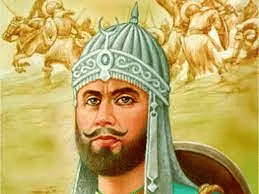 Sher Shah Suri
- Sher Shah Suri founded the Sur dynasty in India. In 1486, he was born in Sasaram, Bihar, the son of a Jagirdar. His given name was Farid. At the age of 15, he left his home and moved to Jaunpur.
- There he learned Arabic and Persian. He showed exceptional administrative abilities, and as a result, his father entrusted him with the administration of his jagir.
- But, for unknown reasons, he departed and entered the service of Mughal Emperor Babar.
- Although Sher Shah reigned for only five years, his reforms were so successful that Mughals and British alike emulated his techniques.
- Sher Shah departed his home at a young age due to his stepmother's harshness. He was a fantastic administrator.
- When Babur defeated Ibrahim Lodhi and became King of India, Sher Shah joined him and impressed him with his cunning. Babur named him governor of Bihar.
- After Babur's death, the Mughal administration became unstable, and Sher Shah took advantage of the situation and declared independence.
Sur Dynasty: Rise to Power
- Sher Shah Suri defeated Humayun twice at the Battle of Chausa and Bilgram. Humayun, Babur's son, gave up hope and fled to Persia. Sher Shah ruled over Delhi for only five years, yet his reign was a watershed moment in the Subcontinent.
- Sher Khan had grown to prominence, but he still had a long way to go before becoming Afghanistan's national leader.
- After a year, with the entrance of Ibrahim Lodi's younger brother, Mahmood Lodi, in Bihar, his stars began to wane.
- He was a genuine contender for the throne of Delhi. Despite being defeated twice, he never gave up hope.
- He sought to unify all Afghans under his flag once he arrived in Bihar in order to reestablish Afghan sovereignty in India.
- Sher Khan was forced to fight beside him at the Battle of Ghagra in 1529. Sher Khan surrendered to Babur shortly after the Afghans were defeated.
- He was returned to his previous position, but he was compelled to pay Mughal Emperor yearly tribute.
- Sher Khan returned to administration and restored law and order in his territory.
- After the death of Dadu Bibi, the newborn monarch's mother and regent, Sher Khan became the regent and de facto ruler of south Bihar.
Facts about Sher Shah Suri
- Sher Shah Suri established the Pashtun Suri, or Sur, monarchy in the Indian subcontinent, with its capital in Delhi. The Sur Dynasty governed Delhi for around 17 years. Adil Shah, Sikandar Shah Suri's brother, was the final emperor of the Sur Dynasty. The following table shows the other important facts of Sher Shah Suri:
|
|
|
|
|
|
|
|
|
|
|
|
|
|
|
|
|
|
|
|
|
|
|
|
|
|
|
|
|
|
|
|
|
|
Wars and Conquests
- The following table describes the series of wars and conquests undertaken by Sher Shah Suri during his lifetime:
|
|
|
|
|
|
|
|
|
|
|
|
|
|
|
|
|
|
Achievements of Sher Shah Suri
- Sher Shah Suri instituted the Dagh method, sometimes known as "branding the horses" to discourage fraudulent musters. Shershah resurrected the Dak-chaukl, an espionage system that let him gather intelligence from all around his domain.
- He created four important roadways to connect his kingdom's four corners. He did away with both old and mixed currencies. He established the ratio of copper to silver coinage. He also created gold and silver coins, which were utilized to enhance the nation's overall economic situation.
Reforms in Administration
- Sher Shah commanded a large army that included 150,000 horses, 250,000-foot men, and 5,000 elephants. He personally examined, appointed, and paid the soldiers, making him the focus of allegiance and subduing clan and tribal jealousies.
- He established a solid imperial administration influenced by Iran's Safavid Empire.
- During his brief rule, several civic works were completed, including the planting of trees, the construction of wells, and the construction of Sarai (inns) for travelers. Roads were developed under his reign, including the Grand Trunk Road from Delhi to Kabul.
Trade and Commerce
- He used to rotate officers every two to three years to keep them from having too much power.
- The emperor oversaw all branches of government. From the most senior to the most junior officials, he meticulously monitored their job.
- This fostered the development of trade and commerce while also functioning as dak chowks.
Justice
- To combat fraud, he resumed the Alauddin Khalji-era practice of branding horses. The ordinary man received justice.
- Sher Shah Suri was kept informed of what was going on in various parts of the country.
- He implemented the concept of local responsibility and administered justice with sternness and impartiality.
- He established the foundation for an administrative framework that was continued on after his death, albeit with slight changes.
Revenue Policy
- The main improvements associated with tax management are those for which Sher Shah is renowned. He established a revenue-collecting system based on land measuring.
- Because of Sher Shah Suri's weak successors, Humayun was able to recapture the final empire. Sher Shah Suri held a liberal religious perspective.
- Not only Akbar, but even the British, supported his income plan.
Farmers and Land Reforms
- Sher Shah was one of India's few farmers-friendly monarchs. He had every piece of agriculture in his domain measured and assessed for quality.
- Farmers were given a title deed known as a patta, which is still legally used in India for comparable documents.
- They agreed to the qabuliyat in return, which specified the annual contribution payable to the state.
- This amounted to 33% of anticipated production in most places and 25% in others, far less than the hefty 50% expropriated by Allaudin Khilji and the East India Company.
- While few farmers understood the patta and qabuliyat, Sher Shah had the documentation translated into local languages to facilitate the process.
- He established a bureaucracy comprised of muqaddams and patwaris in each village, district and state officials, and, finally, four central ministers who reported directly to him
Currency System and Demonetization
- Sher Shah's second major accomplishment was the establishment of a new monetary system.
- He developed a fixed-weight silver rupiya that remained in use until the twentieth century.
- His mints also created gold mohurs and copper paisas that could be exchanged for rupiyas at a predetermined rate.
- Many of these coins have the Devanagari legend "Sri Sersahi" as well as Arabic interpretations of his name.
- His new trimetallic currency boosted trade and aided farmers who had previously been compelled to compensate for debased coins by paying extra.
- The currency was also changed to finely minted silver coins called Dam.
Rah-e-Azam
- The Rah-e-Azam, or Great Road, is Sher Shah's most well-known infrastructure project, connecting Chittagong and Kabul.
- He planted trees on both sides of the road and constructed caravanserais at regular intervals to provide shelter and nutrition to travelers, traders, and their animals.
- Muslims and Hindus alike found food and lodging customized to their specific needs and taboos.
- The Mughal emperor Akbar recognized Sher Shah's talent while ensuring that his historian Abul Fazl despised the man who had vanquished his father.
- On the basis of Sher Shah's ecumenical, multicultural administration, Akbar developed a complex political theory, adopted and polished his land tax and currency systems, and expanded the Rah-e-Azam.
Sur Dynasty Administration
- Sher Shah maintained central administration of the Delhi Sultanate. The Empire was split into Sarkars by him.
- Each Sarkar had three significant officers:
- Chief Shiqdar or Shiqdar-i-Shiqdaran (in charge of Police administration or Law and Order),
- Chief Munsif or Munsif-i-Munsifan (in charge of Revenue administration),
- Poddar (Treasurer).
- Sarkars were subdivided further into
- Parganas. Shiqdar (sub-district Police officer),
- Munsif (sub-district Revenue officer),
- and Khazanadar (sub-district Revenue officer) were also there.
- The village is the final administrative unit. The village administration was overseen by Patwari.
- He integrated the Patta System into the income stream. He was India's first monarch to extend property rights to peasants. He was awarded the title Nyaya Simha after serving the people with fair justice.
- He built a highway network and upgraded transportation and communication infrastructure. Along roads, saris (guest homes) were built.
- Some Sarais have been transformed into DakChowkis (Post Offices). He introduced new coins called Gold Mohar and Silver Rupaiya. The British and Mughals carried out the Rupaiya.
Sur Dynasty: The Fall
- During his lifetime, Sher Shah had graves built for both his father, Hasan Khan Suri, and himself. A third one was started for his son Islam, but it was never finished owing to the dynasty's demise. Sher Shah died in 1545 as a result of a gunpowder accident, leaving his empire to his two sons and grandchildren. Unfortunately, his successors were inept and fell victim to traditional Afghan rivalries. This culminated in the Suri Dynasty's demise.
Caues of Downfall of Sur Empire
- The following factors contributed to the Sur regime's demise within a few years of Sher Shah's death, the founder of the Sur Dynasty:
- Sher Shah, without a doubt, efficiently established the Sur Dynasty, but because he was granted kingship at the end of his life, he was unable to arrange it properly. His untimely and unexpected demise damaged the empire much further.
- He was a very good administrator and organizer, and if he had lived a little longer, he would have greatly organized and reinforced the empire.
- Sher Shah's successors were ineffective and unworthy of the throne. It also gave birth to conspiracies and intrigues that broke the empire's basic structure and control. He also abused the royal coffers, inviting difficulty as a result of his own failings.
- Islam Shah had converted his merit into a liability by adopting a harsh and oppressive stance with the ancient nobility, which irritated them.
- He didn't comprehend the Afghans' personalities. He criticized the feudalistic form of kingship, which scared the entire Afghan population and set them against the empire.
- Following Islam Shah's death, his young son Firoz Shah was slain, and Mubariz Khan, who seized the throne and took the name Mahmood Shah Adil, was an incompetent and ineffective monarch.
- He squandered the royal wealth unnecessarily, and his rash actions aided the empire's insurgents. He assigned his favorites to all of the empire's high and wealthy positions, causing chaos and disarray.
- Protests erupted against Muhammad Adil Shah. Ibrahim Sur conquered Delhi and Agra, and Ahmad Shah took control of Punjab. Following this, Ibrahim Sur and Sikandar Sur battled each other, with Sikandar Sur eventually triumphing, but the Afghans' rivalry and hatred dissolved their authority.
- As a result, Humayun went to India in order to reclaim his lost dominion. Sher Shah's weak heirs failed to meet him and surrendered before him.
- Sher Shah's successors paid scant attention to public benefit initiatives. They also did not worry about agricultural progress, which led to decreased productivity and famine. It exacerbated the plight of the cultivators.
- The continuation of battles contributed to the emergence of chaotic conditions, which irritated the populace, and they chose to assist the Mughals in the restoration of their empire rather than support the Afghans.
Death of Sher Shah
- In 1545, Sher Shah Suri was killed by a gunpowder explosion while laying siege to Kalinjar fort.
- Sher Shah Suri died in 1545 after a five-year reign, yet he constructed a massive empire and a magnificent and powerful government.
- The mausoleum he erected for himself in Sasaram is an architectural wonder.
Sher Shah Suri Tomb
- Sher Shah Suri's tomb is located in the town of Sasaram in the Indian state of Bihar.
- The mausoleum was constructed in honor of Emperor Sher Shah Suri, a Pathan from Bihar who fought the Mughal Empire and established the Suri Empire in northern India.
- On 13 May 1545 AD, he was killed by an accidental gunpowder explosion at the fort of Kalinjar.
- Mir Muhammad Aliwal Khan, the architect, created this museum between 1540 and 1545 as an example of Indo-Islamic architecture.
- It is a red sandstone tomb in the center of an artificial lake, and it is known as India's second Taj Mahal.
- The monument is situated in the lake's center on a square stone platform with domed kiosks and chhatris at each corner.
- The main tomb is built on an octagonal design and is crowned by a dome that spans 22 meters.
- It is encircled by decorative domed kiosks that were previously covered in colored glazed tile work.
- The tomb was constructed during the reigns of Sher Shah and his son Islam Shah. It was completed on August 16, 1545, three months after Sher Shah's death, according to an inscription.
Conclusion
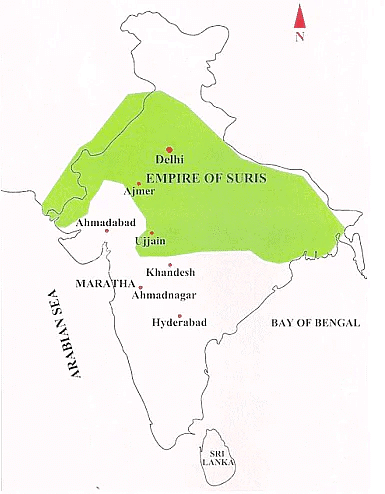
- The Sur dynasty ruled practically all Mughal territory, from what is now Khyber Pakhtunkhwa in Pakistan to the Bengals in what is now Bangladesh. The Mughals fled west to Persia, while the Suri Empire included much of what is now eastern Afghanistan, all of Pakistan, and northern India. During the Sur dynasty's almost 15-year reign, the Indian subcontinent saw significant economic progress and administrative improvements.
- A systematized connection was established between the people and the monarch, limiting corruption and public tyranny. Their reign was brought to an end by a loss that resulted in the restoration of the Mughal Empire. The Sur is now part of the Pashtun tribal structure and is a sub-groups of the Ghilzais.
Portuguese Colonial Enterprise
- In 1498, Vasco da Gama of Portugal discovered a new and all-sea route from Europe to India. He sailed around Africa via the Cape of Good Hope (South Africa) and reached Calicut (as shown in the map given below).
- Vasco da Gama returned with a cargo, which sold for 60 times the cost of his voyage.
- Columbus and Vasco da Gama's sea routes along with other navigational discoveries opened a new chapter in the history of the world.
- Adam Smith wrote later that the discovery of America and the Cape route to India were "the two greatest and most important events recorded in the history of mankind."
- The new continent was rich in precious metals. Its gold and silver poured into Europe where they powerfully stimulated trade and provided some of the capital, which was soon to make European nations the most advanced in trade, industry, and science.
- America became a new and inexhaustible market for European manufacturers.
- Some other source of early capital accumulation or enrichment for European countries was their penetration into African land in the middle of the 15thcentury.
- In the beginning, gold and ivory of Africa had attracted the foreigner. Very soon, however, trade with Africa concentrated on the slave trade.
- In the 16th century, this trade was a monopoly of Spain and Portugal; later it was dominated by Dutch, French, and British merchants.
- Year after year (particularly after 1650), thousands of Africans were sold as slaves in the West Indies and in North and South America.
- The slave ships carried manufactured goods from Europe to Africa, exchanged them on the coast of Africa for Negroes, took these slaves across the Atlantic and exchanged them for the colonial produce of plantations or mines, and finally brought back and sold this produce in Europe.
- While no exact record of the number of Africans sold into slavery exists, historians' estimate, ranged between 15 and 50 million.
- Slavery was later abolished in the 19th century after it had ceased to play an important economic role, but it was openly defended and praised as long as it was profitable.
- Monarchs, ministers, members of Parliament, dignitaries of the church, leaders of public opinion, and merchants and industrialists supported the slave trade.
- On the other hand, in Britain, Queen Elizabeth, George III, Edmund Burke, Nelson, Gladstone, Disraeli, and Carlyle were some of the defenders and apologists of slavery.
- Portugal had a monopoly of the highly profitable Eastern trade for nearly a century. In India, Portugal established her trading settlements at Cochin, Goa, Diu, and Daman.
- From the beginning, the Portuguese combined the use of force with trade and they were helped by the superiority of their armed ships which enabled them to dominate the seas.
- Portuguese also saw that they could take advantage of the mutual rivalries of the Indian princes to strengthen their position.
- Portuguese intervened in the conflict between the rulers of Calicut and Cochin to establish their trading centers and forts on the Malabar Coast. Likewise, they attacked and destroyed Arab shipping, brutally killing hundreds of Arab merchants and seamen. By threatening Mughal shipping, they also succeeded in securing many trading concessions from the Mughal Emperors.
- Under the viceroyalty of Alfanso d' Albuquerque, who captured Goa in 1510, the Portuguese established their domination over the entire Asian land from Hormuz in the Persian Gulf to Malacca in Malaya and the Spice Islands in Indonesia.
- Portuguese seized Indian territories on the coast and waged constant war to expand their trade and dominions and safeguard their trade monopoly from their European rivals.
- In the words of James Mill (the famous British historian of the 19thcentury): "The Portuguese followed their merchandise as their chief occupation, but like the English and the Dutch of the same period, had no objection to plunder, when it fell in their way."
- The Portuguese were intolerant and fanatical in religious matters. They indulged in forcible conversion offering people the alternative of Christianity or sword.
- Portuguese approach was particularly hateful to people of India (where the religious tolerance was the rule). They also indulged in inhuman cruelties and lawlessness.
- In spite of their barbaric behavior, Portuguese possessions in India survived for a century because -
- They (Portuguese) enjoyed control over the high seas;
- Their soldiers and administrators maintained strict discipline; and
- They did not have to face the fight of the Mughal Empire as South India was outside Mughal influence.
- Portuguese clashed with the Mughal power in Bengal in 1631 and were driven out of their settlement at Hugli.
- The Portuguese and the Spanish had left the English and the Dutch far behind during the 15th century and the first half of the 16th century. But, in the latter half of the 16th century, England and Holland, and later France, all growing commercial and naval, powers, waged a fierce struggle against the Spanish and Portuguese monopoly of world trade.
- Portuguese hold over the Arabian Sea had been weakened by the English and their influence in Gujarat had become negligible.
Decline of Portuguese
- Portugal was, however, incapable of maintaining for long its trade monopoly or its dominion in the East because of -
- Its population was less than a million;
- Its Court was autocratic and decadent;
- Its merchants enjoyed much less power and prestige than its landed aristocrats;
- It lagged behind in the development of shipping, and
- It followed a polity of religious intolerance.
- It became a Spanish dependency in 1530.
- In 1588, the English defeated the Spanish fleet called the Armada and shattered Spanish naval supremacy forever.
About this Document

Apr 19, 2026 Last updated
Related Exams
Document Description: The Fifteenth and Early Sixteenth Century‐Political Developments and -IV for UPSC 2026 is part of UPSC preparation. The notes and questions for The Fifteenth and Early Sixteenth Century‐Political Developments and -IV have been prepared according to the UPSC exam syllabus. Information about The Fifteenth and Early Sixteenth Century‐Political Developments and -IV covers topics like and The Fifteenth and Early Sixteenth Century‐Political Developments and -IV Example, for UPSC 2026 Exam. Find important definitions, questions, notes, meanings, examples, exercises and tests below for The Fifteenth and Early Sixteenth Century‐Political Developments and -IV.
Introduction of The Fifteenth and Early Sixteenth Century‐Political Developments and -IV in English is available as part of our UPSC preparation & The Fifteenth and Early Sixteenth Century‐Political Developments and -IV in Hindi for UPSC courses. Download more important topics, notes, lectures and mock test series for UPSC Exam by signing up for free. UPSC: The Fifteenth and Early Sixteenth Century‐Political Developments and -IV
Description
The Fifteenth & Early Sixteenth Century‐Political Developments & of covers all the important topics, helping you prepare for the UPSC exam on EduRev. Start for free!
Information about The Fifteenth and Early Sixteenth Century‐Political Developments and -IV
In this doc you can find the meaning of The Fifteenth and Early Sixteenth Century‐Political Developments and -IV defined & explained in the simplest way possible. Besides explaining types of The Fifteenth and Early Sixteenth Century‐Political Developments and -IV theory, EduRev gives you an ample number of questions to practice The Fifteenth and Early Sixteenth Century‐Political Developments and -IV tests, examples and also practice UPSC tests.
Related Searches
mock tests for examination, Sample Paper, Extra Questions, Previous Year Questions with Solutions, Important questions, Summary, practice quizzes, ppt, pdf , Semester Notes, The Fifteenth and Early Sixteenth Century‐Political Developments and -IV, The Fifteenth and Early Sixteenth Century‐Political Developments and -IV, study material, Objective type Questions, shortcuts and tricks, Viva Questions, The Fifteenth and Early Sixteenth Century‐Political Developments and -IV, MCQs, past year papers, Exam, Free, video lectures;