How to Master Biological Classification for NEET?

Biological Classification is an important chapter for NEET Biology, it helps students understand the diversity of living organisms and their relationships with each other. Having an understanding of question papers from previous years and solving the questions from this chapter is an essential part of the proper preparation for NEET.
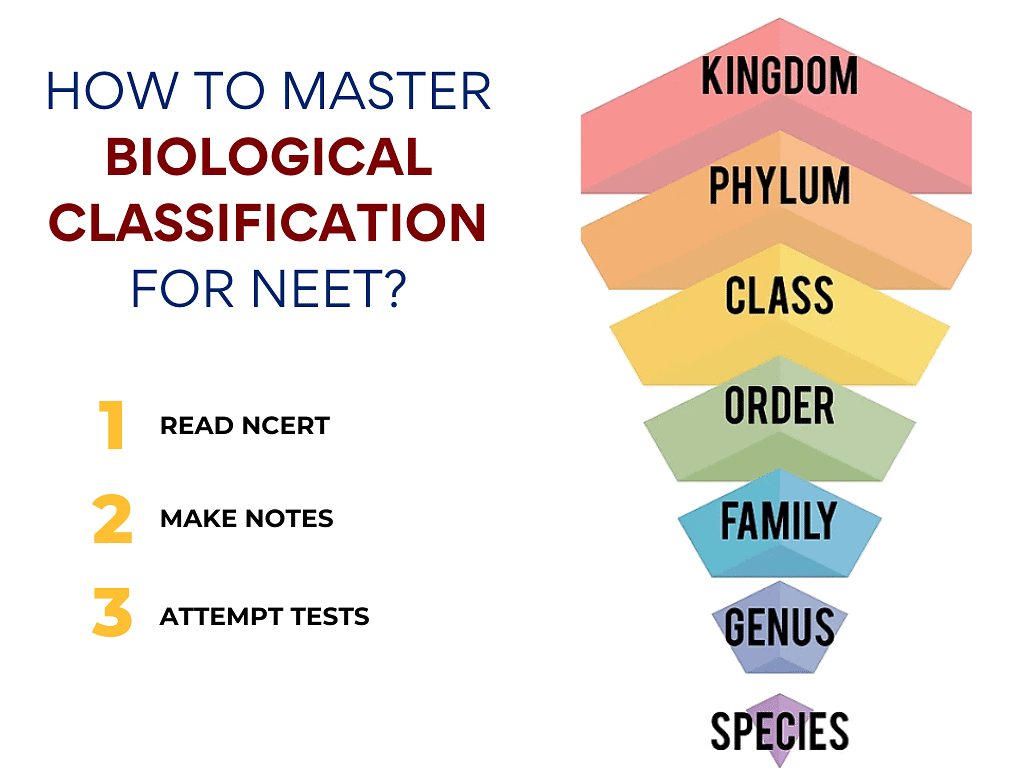
Here are some tips that you can follow to master the Biological Classification Chapter for NEET Biology:
- NCERTs: As per previous trends, it has been noted that questions that are asked from this topic in NEET are picked directly from the NCERT Biology textbook. Hence, referring from NCERT only for this chapter in particular is highly recommended.
So, Stick to NCERT only for this chapter. Study it line by line - Make Notes: This chapter is vast so, it typically requires students to read and note down the names of scientists, categorize examples from each kingdom, and note salient features from each kingdom.
So, Make notes of important points to remember and revisit often - Revise & Solve Questions: The chapter is so large and time-consuming that it needs to be reviewed every 10 days.
Go ahead and solve as many practice questions as you can after reading the chapter at least 6-8 times. - Practice Questions in a Strategic Manner: While preparing for NEET, you get a limited time and you need to prepare effectively in that limited time. Students are advised not to waste their precious time by practicing questions of this chapter from many different sources.
- Use Mnemonics and Visual Aids: Mnemonics and visual aids can be helpful in memorizing the different taxonomic categories and their characteristics. For example, you could use the mnemonic "Kings Play Chess On Fine Green Silk" to remember the order of the taxonomic categories (Kingdom, Phylum, Class, Order, Family, Genus, Species).
What to Read in the Chapter of Biological Classification?
- Understand the Basics: Start by understanding the basic concepts of Biological Classification. Learn about the characteristics that are used to classify organisms, such as cell structure, mode of nutrition, and body organization. Biological classification is a method used by scientists to organize and group living things based on their similarities. This makes it easier to study and identify different species. It helps in recognizing and understanding various types of organisms, tracing their evolutionary history, and discovering their relationships.
- Memorize the Important Terms: There are many terms associated with Biological Classification, such as binomial nomenclature, taxonomy, and phylogeny. Make sure you understand the meanings of these terms and can use them correctly.
- Learn the Classification Systems: There are two main classification systems - the traditional five-kingdom system and the more recent three-domain system. You should be familiar with both systems and understand their differences.
- Study the Different Kingdoms: Learn about the five kingdoms - Monera, Protista, Fungi, Plantae, and Animalia. Understand the characteristics of each kingdom and the organisms that belong to it.
To better understand the topic, it is recommended that you refer to the notes specific to particular topics. These notes can help you clear any doubts and gain a deeper understanding of the subject matter:
- Important Notes for NEET: Biological Classification
- Kingdom Protista: Euglenoids, Slime Moulds & Protozoans
- Kingdom Protista: Chrysophytes and Dinoflagellates
- Kingdom Monera: Archaebacteria & Eubacteria
- Kingdom Fungi
- Viruses, Viroid, Prions & Lichens
Here's how you can practice questions of the chapter "Biological Classification" in a strategic manner for NEET.
Topic Wise Tests
After covering the topics thoroughly from NCERT. You should practice topic-wise questions from the chapter, which will help you to retain the concepts for a longer period of time.
Here are the topic-wise tests of Biological Classification Chapter which you can attempt for a stronger understanding:
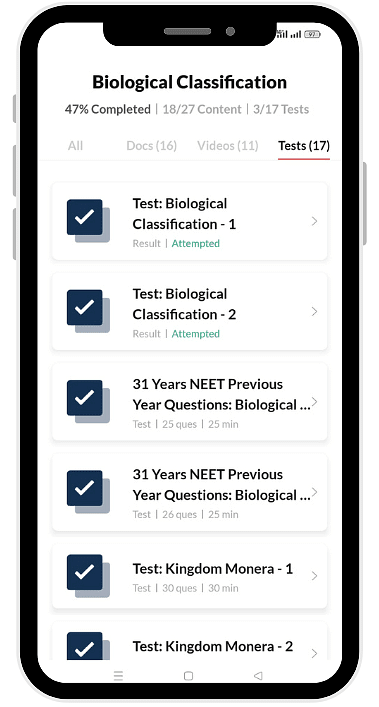 Chapter-wise tests, topic-wise tests & PYQs of the chapter Biological Classification
OneTime: Test: Kingdom Monera & Protista (NCERT)
OneTime: Test: Kingdom Monera - 1
OneTime: Test: Kingdom Monera - 2
OneTime: Test: Virus - 1
OneTime: Test: Virus - 2
OneTime: Test: Kingdom Fungi
OneTime: Test: Kingdom Protista- 1
OneTime: Test: Kingdom Protista- 2
OneTime: Test: Kingdom Monera (NCERT)
OneTime: Test: Kingdom Protista (NCERT)
Chapter Wise Tests and PYQs
After strengthening your topics make sure you practice the questions of entire chapter well enough. Solving chapterwise previous year questions is the most important part during NEET preparation. Many questions in NEET Exam are repeated from previous years questions only. PYQs make you aware of the important topics and their weightage and give you immense confidence.
Here are the chapter-wise tests and chapter-wise NEET PYQs which you can attempt for this chapter:
OneTime: Test: Biological Classification - 1
OneTime: Test: Biological Classification - 2
OneTime: 31 Years NEET Previous Year Questions: Biological Classification - 1
OneTime: 31 Years NEET Previous Year Questions: Biological Classification - 2
OneTime: 31 Year NEET Previous Year Questions: Biological Classification - 3
OneTime: Assertion & Reason Test: Biological Classification
FAQs on How to Master Biological Classification for NEET?
| 1. How do I memorise the taxonomic ranks in biological classification without getting confused? |  |
| 2. What's the difference between genus and species in NEET biological classification questions? | |
| 3. How can I quickly identify which kingdom an organism belongs to during the exam? | |
| 4. Why do some organisms have different scientific names, and how should I handle this for NEET? | |
| 5. What's the fastest way to memorise characteristics of major phyla and classes for NEET? | |





