Chapter Notes: Election & Representation


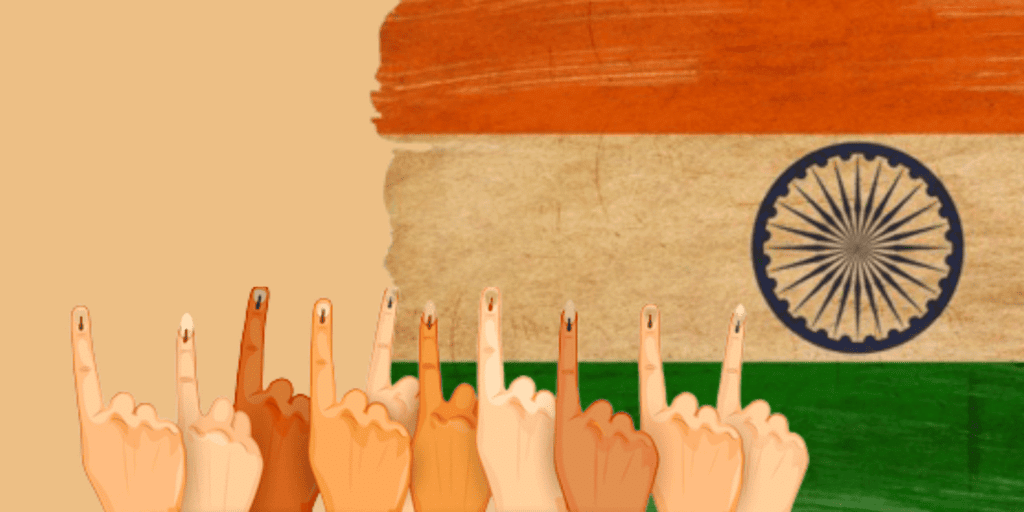
Elections and Democracy
- Elections are essential to democracy because large societies cannot make every decision directly; citizens therefore elect representatives who govern on their behalf.
- Not every election is democratic, so constitutional rules are needed to prevent manipulation and ensure legitimacy.
- The Constitution specifies five basics: who can vote, who can contest, who supervises, how choices are expressed, and how winners are declared.
- Direct democracy means citizens decide policies themselves (rare today; gram sabhas are the closest examples), while modern democracies work indirectly through elected representatives.
- The aim is twofold: free and fair competition (procedural integrity) and fair representation (credible translation of votes into seats).
Election System in India?
- Different election systems exist, involving varied methods of campaigning and vote counting.
- Elections follow specific rules and authorities, not just simple voting.
- The Constitution outlines the vote counting and representative election processes.
- Democratic elections reflect voter preferences, but rules shape outcomes.
- Rules can favour big parties, small players, majorities, or protect minorities.
- Vote counting and preference methods vary, impacting election results.
First Past the Post
The 'First-Past-The-Post' is an electoral system also known as a simple majority system. In this system, the candidate with the highest number of votes is the winner.
- In the 1984 Lok Sabha elections, Congress won 415 of 543 seats (over 80%) with only 48% of the votes.
- BJP got 7.4% votes but fewer than 1% seats, showing a vote-seat disparity.
- India uses the First Past the Post (FPTP) system:
1. Country is divided into 543 constituencies.
2. Each constituency elects one representative.
3. Candidate with the highest votes wins, no majority needed. - FPTP, also called the Plurality System, is mandated by the Constitution.
- Congress won more seats than votes due to candidates securing less than 50% votes in many constituencies.
- Votes for losing candidates are "wasted," as they don't translate to seats.
- A party can win all seats with as few as 25% votes if others get fewer votes per constituency.
Try yourself: When did the Election Commission of India got two more Election Commissioners?
Proportional Representation
- Israel uses the Proportional Representation (PR) system: parties get seats in proportion to their vote share.
- Each party fills seats from a pre-declared preference list of nominees.
- Two PR variations:
1. Entire country as one constituency (e.g., Israel, Netherlands), seats allocated by national vote share.
2. Country divided into multi-member constituencies (e.g., Argentina, Portugal), seats based on party votes in each constituency. - Voters choose a party, not a candidate; seats are distributed based on party vote share.
- In India, PR is used on a limited scale for indirect elections (President, Vice President, Rajya Sabha, Vidhan Parishads) with a complex variation.
Why did India adopt the FPTP system?
- India adopted the First Past the Post (FPTP) system due to its simplicity, making it easy for voters with no specialised knowledge to understand and participate.
- Voters choose specific candidates or parties, offering a clear choice between individuals, unlike Proportional Representation (PR) where voters select parties and seats are based on party lists.
- FPTP ensures voters have an identifiable local representative accountable to them, unlike PR systems, where representatives may not be tied to specific localities.
- Constitution makers favoured FPTP to ensure a stable government in a parliamentary system, as PR might not produce clear majorities, while FPTP often gives the largest party or coalition bonus seats for stability.
- FPTP encourages diverse social groups to unite for electoral success, avoiding community-specific parties that a PR system might promote in diverse India.
- Experience confirms FPTP's simplicity and familiarity, enabling larger parties to secure clear majorities and discouraging caste/community-based parties.
- Unlike typical FPTP systems fostering a two-party system, India saw one-party dominance post-independence, followed by multi-party coalitions since 1989, allowing smaller parties to compete despite FPTP.
Reservation of Constituencies
Need for Reservation
- FPTP disadvantages smaller social groups, especially in India's context of caste-based discrimination.
- Reserved constituencies ensure fair representation for oppressed groups like the Scheduled Castes (SC) and the Scheduled Tribes (ST).
Rejection of Separate Electorates
- British-era "separate electorates" (only community members vote for their candidates) were rejected.
- Instead, reserved constituencies allow all voters to vote, but candidates must belong to the reserved community (SC/ST).
Reservation for SC/ST
- Reservation ensures representation for SC/ST, significant nationwide, despite low numbers in specific constituencies.
- Lok Sabha reserves 84 seats for SC, 47 for ST (as of 2019), proportional to their population share, extended to 2030.
Delimitation Commission
- The Delimitation Commission, appointed by the President, collaborates with the Election Commission to decide reserved constituencies.
- ST constituencies are chosen for the highest ST population; SC constituencies are selected for high SC population and spread across regions.
- Reserved constituencies can be rotated during delimitation.
Women and Other Groups
- No reservations for other disadvantaged groups exist yet, but there is a demand for women's reservation (one-third seats in Lok Sabha and State Assemblies).
- Women's reservation exists for local bodies; the Nari Shakti Vandan Adhiniyam (2023) extends it to Lok Sabha and Vidhan Sabhas.
Free and Fair Elections
- The success of an election system lies in ensuring a free, fair, impartial, and transparent process.
- The system must allow voters' aspirations to be legitimately expressed through electoral results.
Universal Franchise & Right to Contest
- The Constitution establishes universal adult franchise, granting all Indian citizens above 18 (reduced from 21 in 1989) the right to vote, ensuring equality and non-discrimination.
- This right reflects the belief in the equal worth of all adult citizens to decide what is best for society, despite debates about educational qualifications.
- All citizens can contest elections, with a minimum age of 25 for Lok Sabha or Assembly elections.
- Restrictions include disqualification for those imprisoned for two or more years for certain offences.
- No restrictions based on income, education, class, or gender, making the election system open to all citizens.
Independent Election Commission
Role and Constitutional Basis
- Article 324 establishes an independent Election Commission for superintendence, direction, and control of elections and electoral rolls.
- The Supreme Court supports the Commission's decisive role in all election-related matters.
- Chief Electoral Officers in each state assist the Commission, but local body elections are managed by independent State Election Commissioners.
Structure and Evolution
- The Election Commission can be single or multi-member; it was single-member until 1989, became multi-member before the 1989 elections, reverted briefly, and has been multi-member since 1993.
- Multi-member structure ensures shared power and greater accountability, despite initial disputes settled by the Supreme Court.
- The Chief Election Commissioner (CEC) and Election Commissioners have equal powers, appointed by the President on the Council of Ministers' advice.
- Suggestions exist for involving the opposition leader and the Chief Justice in appointments to prevent partisan bias.
Tenure and Removal
- CEC and Commissioners serve a six-year term or until age 65, whichever is earlier.
- CEC can only be removed by the President with a special majority from both Houses of Parliament, ensuring independence.
- Election Commissioners can be removed by the President.
Functions
- Supervises the preparation of accurate voters' lists, ensuring no errors or ineligible entries.
- Determines election timing and schedules, including nomination, scrutiny, withdrawal, polling, and result declaration dates.
- Ensures free and fair elections by postponing or cancelling polls if the atmosphere is vitiated, implementing a model code of conduct, ordering re-polls, or recounts.
- Recognises political parties and allots symbols.
- Controls administrative machinery during elections, with authority to transfer officers or act against non-partisan behaviour.
Independence and Impact
- The Election Commission has become more assertive and independent over time, effectively using its constitutional powers without needing legal changes.
- It has successfully conducted 17 Lok Sabha elections, numerous state and by-elections, and managed challenges like militancy in Assam, Punjab, and Jammu & Kashmir.
- Handled critical situations, e.g., postponing elections in 1991 after Rajiv Gandhi's assassination and in 2002 in Gujarat due to violence, with the Supreme Court upholding its decisions.
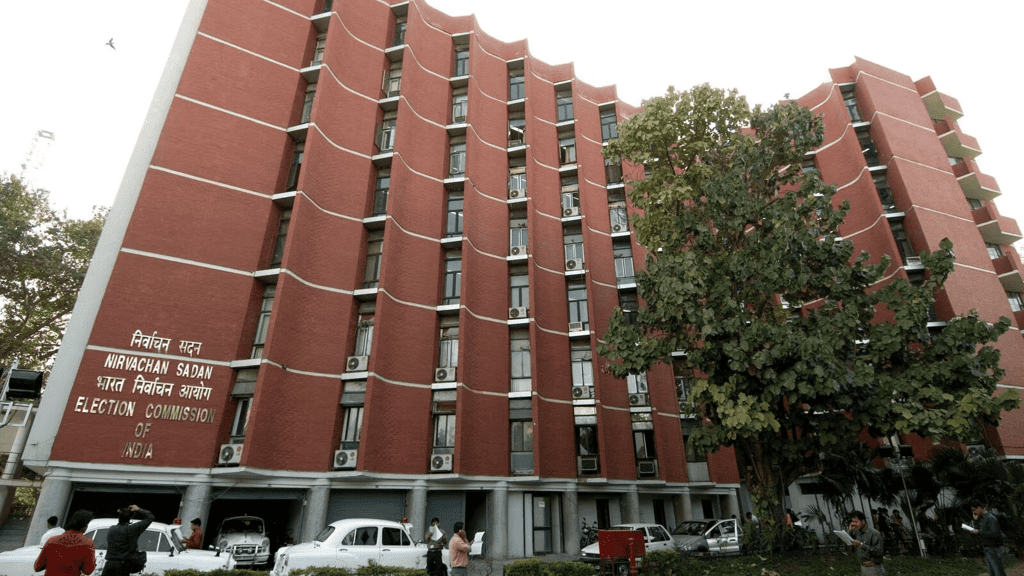 Election Commission of India
Electoral Reforms
- No election system is perfect; flaws require ongoing reforms for free and fair elections.
- India's adult suffrage, open contestation, and independent Election Commission aim for fairness, but improvements are needed.
- Proposals:
1. Shift from FPTP to PR for proportional seat allocation
2. Reserve one-third seats for women in Parliament and Assemblies
3. Fund elections publicly to curb money's role
4. Bar candidates with pending criminal cases
5. Ban caste/religious campaign appeals
6. Regulate political parties for transparency. - No consensus on proposals; laws alone aren't enough without democratic commitment.
- Citizens' vigilance and active political institutions and voluntary organisations are key to fair elections.
Try yourself: After the polling has finished, the votes are counted under the supervision of
Conclusion
- Elections are key to effective representative democracy.
- India's election system:
- Allows free choice of representatives and peaceful government changes.
- Sees high voter participation and rising candidate/party numbers.
- It is inclusive, with diverse representatives, though women's representation lags.
- Largely free from rigging, despite minor issues like violence or voter list errors.
- Integral to democracy, with regular polls ensuring legitimate governance.
- Globally respected, it boosts voter confidence and Election Commission legitimacy.
- Improved processes will enhance democratic participation.
Competency-Based Questions
Q1: In India, SCs and STs have reserved constituencies, but all voters in the constituency can vote. Explain how this differs from the British-era "separate electorates" and why this system is considered fairer.
Ans:
- Separate electorates allowed only community members to vote for their candidates.
- Reserved constituencies allow all voters to vote, but candidates must belong to the SC/ST.
- Fairer because it ensures representation without segregating voters.
Q2: During an election in a state, a popular regional party wins 40% of the votes but gets only 10% of the seats, while a national party with 35% votes wins 55% of the seats.
- Identify which system is likely being used.
- Explain why this happens and suggest one way to reduce such disparities.
Ans:
- System: First Past the Post (FPTP)
- Cause: Candidate with the highest votes in each constituency wins, even if the party has fewer overall votes.
- Solution: Consider proportional representation or adjusting constituency boundaries carefully.
Q3: In the last Panchayat elections, some polling booths reported a sudden delay in polling due to heavy rainfall. The Election Commission decided to extend polling hours to ensure everyone could vote.
- Explain why such decisions are necessary.
- How do they strengthen democracy?
Ans:
- Necessary to ensure all eligible voters can exercise their right to vote.
- Strengthens democracy by making elections free, fair, and inclusive.
Q4: A political party in India wanted to contest elections, but several candidates had pending criminal cases. Proposals exist to bar such candidates from contesting.
- Discuss how implementing this could improve election fairness.
- What challenges might arise in enforcing this rule?
Ans:
- Improves fairness by reducing criminal influence and promoting clean politics.
- Challenges: Legal hurdles, proving cases before convictions, and ensuring due process.
Q5: The Election Commission has the power to postpone elections in case of violence or natural disasters. Why is such independence important for democracy, and how does it affect citizens' trust in elections?
Ans:
- Independence ensures elections are free, fair, and impartial.
- Citizens trust that their votes are meaningful and outcomes reflect their choice.
- Helps maintain the stability and legitimacy of the government.
For more such Questions, Visit:
FAQs on Chapter Notes: Election & Representation
| 1. What is the difference between first-past-the-post and proportional representation systems? |  |
| 2. How does the electoral process work in India for general elections? | |
| 3. Why do some constituencies have more voters than others in CBSE political science? | |
| 4. What makes representation truly democratic in elections? | |
| 5. How do political parties influence electoral outcomes and voter behaviour? | |