Important Questions & Answers: Social Institutions - Continuity & Change - 2

Short Answer Type Question
Q.29. What is meant by hierarchy in the caste system?
Ans: Hierarchy in the caste system refers to the ranking of castes in an ordered structure from higher to lower status. Each caste occupies a specific position in this order based on the concept of ritual purity and pollution. Castes considered more pure are placed higher in the hierarchy, while those regarded as less pure or impure are placed lower. This hierarchical order determines social status and relations among castes.
Q.30. Restrictions regarding castes. Explain.
Or
What was the restriction related to caste?
Ans: There were various social restrictions attached to each caste which regulated personal behaviour and social relations. These included:
- Every person was expected to follow the traditional occupation of his or her caste and pass it on to the next generation.
- Rules governed food habits and food-sharing; commensality was restricted and eating with members of other castes was often forbidden.
- Marriage was to take place only within the same caste (endogamy), limiting social ties across castes.
- Lower castes were frequently barred from formal education and from entering temples or other places of worship reserved for higher castes.
- Lower castes were often prohibited from physical contact with higher-caste people and sometimes denied access to public wells or other shared resources owned by higher castes.
Q.31. What is meant by the term Untouchability?
Or
Caste gives rise to untouchability. How?
Or
How did the caste system give rise to untouchability?
Ans: Untouchability was a practice of social exclusion in which certain castes were treated as impure and were kept away from the rest of society. People regarded as 'untouchable' were denied physical contact, barred from entering temples, often forced to live outside the village, and deprived of many civic rights. This practice arose because higher castes considered certain occupations and groups to be ritually impure, creating deep social inequality and segregation.
Q.32. What are the main features of the caste system?
Ans: The caste system has several important features:
Birth-based membership: A person is born into a caste and cannot change it.
Endogamy: Marriage is usually restricted within the same caste.
Restrictions on food and social interaction: Rules govern food habits and social contact with members of other castes.
Hierarchy: Castes are arranged in a ranked order based on purity and pollution.
Segmental organisation: Each caste is divided into smaller sub-castes.
Hereditary occupations: Traditionally, each caste was associated with specific occupations.
Q.33. How does the caste system operate in modern Indian society?
Ans: The caste system has undergone significant changes in modern India due to industrialisation, urbanisation, education and democratic politics. Many traditional restrictions related to occupation and social interaction have weakened. However, caste continues to influence areas such as marriage, politics and social identity. Caste-based political mobilisation and reservation policies have also increased the visibility of caste in public life.
Q.34. What are the main forms of family?
Ans: Families are commonly classified into two main forms:
Nuclear Family: A nuclear family consists of parents and their children living together as a single household.
Extended Family (Joint Family): An extended family includes more than one generation or more than one married couple living together. It may consist of grandparents, parents, children and other relatives sharing a common household.
Q.35. Explain the types of the family on the basis of residence.
Ans: On the basis of post-marital residence, families are commonly classified as:
- Patrilocal Family: The wife moves to live in her husband's household after marriage; the married couple resides with or near the husband's kin.
- Matrilocal Family: The husband moves to live in his wife's household after marriage; the couple resides with or near the wife's kin.
- Neolocal Family: The married couple establishes a new and independent household of their own, separate from both parents.
Q.36. What is the role of kinship in society?
Ans: Kinship refers to the network of social relationships based on blood ties, marriage and adoption. It plays an important role in organising social life. Kinship determines family relationships, patterns of residence, inheritance and social obligations among relatives. It also helps maintain social bonds and cooperation among members of the family and extended relatives.
Q.37. Explain the role of the caste system in the modern age.
Ans: The caste system has weakened considerably in modern times. Its rigid structural features - such as fixed occupations, strict social restrictions and ritual disabilities - have declined. Caste no longer directly determines most people's occupation, and practices like caste-based untouchability have been legally and socially challenged. Traditional village systems such as jajmani have also declined, and larger social groups or classes often play a greater role in village life. However, caste continues to influence marriage choices and local politics to varying degrees. Processes such as industrialisation, urbanisation, Sanskritisation and westernisation have been important in reducing the caste system's rigidity.
Q.38. What is meant by kinship?
Ans: Kinship refers to the system of social relationships derived from blood ties (descent) and marriage. It includes relations such as parents, children, siblings and relatives through marriage. Kinship relations help organise family life and define roles, responsibilities and social interactions within society.
Q.39. What is meant by segmental organisation of caste?
Ans: Segmental organisation refers to the division of society into many distinct caste groups. Each caste functions as a separate social unit with its own customs, rules and traditions. Members of a caste share common social practices and usually interact mainly within their own group.
Q.40. Restrictions on social relations. Explain.
Or
What were the restrictions regarding social relations?
Ans: Social relations were tightly controlled by caste rules. Higher-caste people usually lived inside the village while lower castes lived outside and had to keep their distance. Lower castes were often denied education alongside higher castes, barred from entering temples, and prevented from using wells owned by higher castes. They were also not permitted to perform certain rituals such as Upanayana Samskara. These restrictions limited social interaction and reinforced inequality.
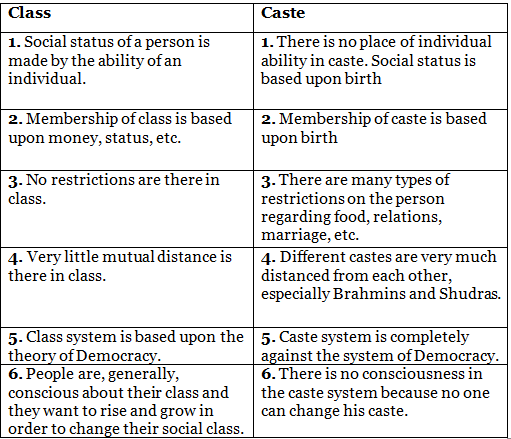
Q.41. Give differences between caste and class as a form of social stratification.
Ans:
Q.42. What are the main characteristics of the caste system?
Ans: The caste system is characterised by:
Membership determined by birth
Hierarchical ranking of castes
Endogamy (marriage within caste)
Restrictions on food and social relations
Hereditary occupations
Division into numerous castes and sub-castes
These characteristics together form the structure of the traditional caste system in Indian society.
Q.43. Why is the caste system considered unequal?
Ans: The caste system is considered unequal because it ranks groups of people in a hierarchical order based on ideas of purity and pollution. Higher castes enjoy greater status and privileges, while lower castes historically faced discrimination, social exclusion and limited opportunities. This unequal arrangement created significant social and economic inequalities.
Q.44. How has industrialization affected the caste system?
Ans:
- Industrialisation brought people of different castes together in urban workplaces, reducing everyday social distance.
- It encouraged the rise of wealth and class-based distinctions, weakening the direct link between caste and occupation.
- Industrialisation and migration promoted wider social contacts, including international connections, as people left ancestral homes for work.
- Movements against untouchability and legal reforms gained traction, giving rights and opportunities to lower sections of society.
- Greater access to education changed social attitudes and opened new avenues for social mobility.
Q.45. What is the importance of family in society?
Ans: The family is one of the most important social institutions. It provides emotional support, care and security to its members. Families play a key role in the socialisation of children by teaching them values, norms and cultural traditions. The family also connects individuals to larger social networks through kinship relations.
Q.46. What are the two main types of kinship relations?
Ans: There are two main types of kinship relations:
Consanguineal kinship: Relations based on blood ties, such as parents, children and siblings.
Affinal kinship: Relations formed through marriage, such as husband, wife, in-laws and other relatives by marriage.
Q.47. What is Tribal society?
Ans: A tribal society consists of people who traditionally live in relatively isolated areas such as forests, hills or valleys and maintain distinct cultural practices. Tribal societies are often described as less stratified and more self-reliant, with strong community bonds. They are socially and culturally different from typical rural or urban societies, with unique social structures and ways of life.
Q.48. What do you know about the concept of Tribal Identity'?
Ans: Tribal identity refers to efforts to preserve the social and cultural heritage of tribal groups, including their language, religion and traditions. As tribes come into contact with other cultures through missions, education and modernisation, there is a risk of cultural loss. The assertion of tribal identity seeks to protect these distinctive practices and to resist marginalisation by ensuring that tribal peoples retain their cultural rights and social recognition.
Q.49. In what ways can changes in social structure lead to changes in family structure?
Ans: Changes in the wider social structure often bring changes in family forms. For example, the growth of industries during colonial and later periods led many rural people to migrate to towns and cities for work. Such migration weakened extended joint-family ties common in villages and encouraged the formation of smaller nuclear families. Urbanisation, new occupations and the requirement for mobility thus contributed to the decline of joint families and the rise of independent households.
FAQs on Important Questions & Answers: Social Institutions - Continuity & Change - 2
| 1. What are social institutions and why are they important? |  |
| 2. How do social institutions experience continuity and change? | |
| 3. Can you provide examples of recent changes in social institutions? | |
| 4. What role does culture play in the continuity and change of social institutions? | |
| 5. How do social institutions interact with individuals in society? | |