Computer Science Engineering (CSE) Exam > Computer Science Engineering (CSE) Notes > Compiler Design > Basic Blocks & Flow Graphs
Basic Blocks & Flow Graphs

Basic Blocks
The characteristics of basic blocks are-
- They do not contain any kind of jump statements in them.
- There is no possibility of branching or getting halt in the middle.
- All the statements execute in the same order they appear.
- They do not lose lose the flow control of the program.
Example of Basic Block
Three Address Code for the expression a = b + c + d is-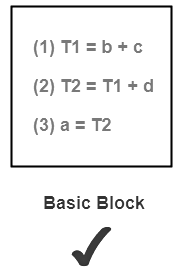
Here,
- All the statements execute in a sequence one after the other.
- Thus, they form a basic block.
Example of Not a Basic Block
Three Address Code for the expression If A<B then 1 else 0 is-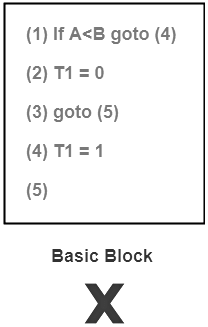
Here,
- The statements do not execute in a sequence one after the other.
- Thus, they do not form a basic block.
Partitioning Intermediate Code Into Basic Blocks
Any given code can be partitioned into basic blocks using the following rules-
Rule 1: Determining Leaders
Following statements of the code are called as Leaders
- First statement of the code.
- Statement that is a target of the conditional or unconditional goto statement.
- Statement that appears immediately after a goto statement.
Rule 2: Determining Basic Blocks
- All the statements that follow the leader (including the leader) till the next leader appears form one basic block.
- The first statement of the code is called as the first leader.
- The block containing the first leader is called as Initial block.
Flow Graphs
A flow graph is a directed graph with flow control information added to the basic blocks.
- The basic blocks serve as nodes of the flow graph.
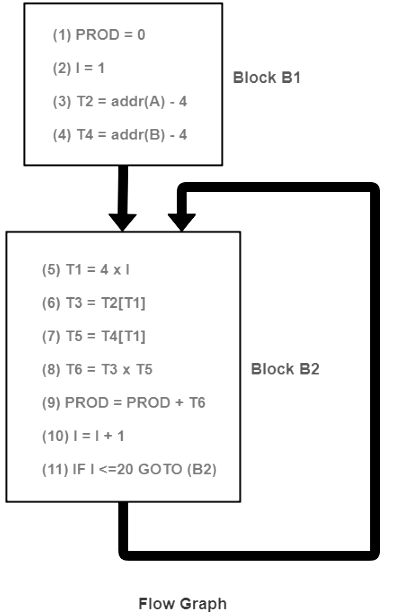
- There is a directed edge from block B1 to block B2 if B2 appears immediately after B1 in the code.
Problems Based on Basic Blocks & Flow Graphs
Problem 1: Compute the basic blocks for the given three address statements-
- PROD = 0
- I = 1
- T2 = addr(A) - 4
- T4 = addr(B) - 4
- T1 = 4 x I
- T3 = T2[T1]
- T5 = T4[T1]
- T6 = T3 x T5
- PROD = PROD + T6
- I = I + 1
- IF I <=20 GOTO (5)
We have-
- PROD = 0 is a leader since first statement of the code is a leader.
- T1 = 4 x I is a leader since target of the conditional goto statement is a leader.
Now, the given code can be partitioned into two basic blocks as-
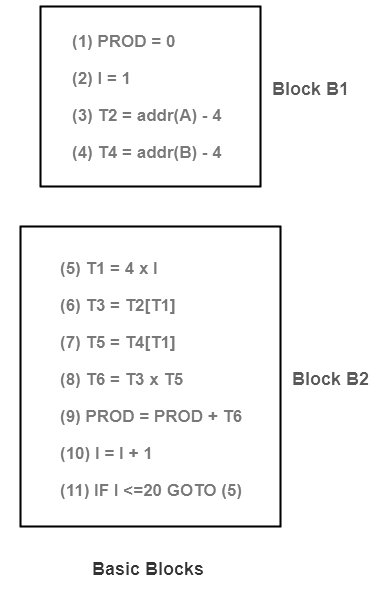
Problem 2: Draw a flow graph for the three address statements given in problem-01.
- Firstly, we compute the basic blocks (already done above).
- Secondly, we assign the flow control information.
The required flow graph is
The document Basic Blocks & Flow Graphs is a part of the Computer Science Engineering (CSE) Course Compiler Design.
All you need of Computer Science Engineering (CSE) at this link: Computer Science Engineering (CSE)
About this Document

4.75/5 Rating

Apr 30, 2026 Last updated
Related Exams
Document Description: Basic Blocks & Flow Graphs for Computer Science Engineering (CSE) 2026 is part of Compiler Design preparation. The notes and questions for Basic Blocks & Flow Graphs have been prepared according to the Computer Science Engineering (CSE) exam syllabus. Information about Basic Blocks & Flow Graphs covers topics like and Basic Blocks & Flow Graphs Example, for Computer Science Engineering (CSE) 2026 Exam. Find important definitions, questions, notes, meanings, examples, exercises and tests below for Basic Blocks & Flow Graphs.
Introduction of Basic Blocks & Flow Graphs in English is available as part of our Compiler Design for Computer Science Engineering (CSE) & Basic Blocks & Flow Graphs in Hindi for Compiler Design course. Download more important topics related with notes, lectures and mock test series for Computer Science Engineering (CSE) Exam by signing up for free. Computer Science Engineering (CSE): Basic Blocks & Flow Graphs
Description
Basic Blocks & Flow Graphs of Compiler Design covers all the important topics, helping you prepare for the Computer Science Engineering (CSE) exam on EduRev.
Information about Basic Blocks & Flow Graphs
In this doc you can find the meaning of Basic Blocks & Flow Graphs defined & explained in the simplest way possible. Besides explaining types of Basic Blocks & Flow Graphs theory, EduRev gives you an ample number of questions to practice Basic Blocks & Flow Graphs tests, examples and also practice Computer Science Engineering (CSE) tests
 | Explore Courses for Computer Science Engineering (CSE) exam |  |
 | Get EduRev Notes directly in your Google search | |
Related Searches
shortcuts and tricks, Free, Extra Questions, Basic Blocks & Flow Graphs, ppt, Previous Year Questions with Solutions, study material, Sample Paper, Semester Notes, past year papers, Important questions, practice quizzes, Basic Blocks & Flow Graphs, Exam, Viva Questions, pdf , Summary, mock tests for examination, video lectures, Basic Blocks & Flow Graphs, Objective type Questions, MCQs;