How to Prepare for Quantitative Aptitude for SSC CGL | SSC CGL Tier 1 Mock Test Series 2024 PDF Download
The QA section requires a lot of practice, so in order to free up more time for practising, you should use all small, straightforward techniques to increase speed and decrease errors.

Step 0: Go through the syllabus for Quantitative section for SSC CGL
In SSC CGL preparation, what and how much to learn is equally important. You can work hard, hustle, and put in the hours but the magic happens when you aim to perfect your skills beforehand.
Therefore, take a quick diagnosis of the syllabus to figure out how much you have to do and in how much time.
The syllabus for Quantitative in SSC CGL is as follows:
Arithmetic: Number System, Permutation and Combination, Probability, Simple Interest & Compound Interest, Mixture and Alligation, Pipes and Cisterns, Time and Work, Average, Ratio & Proportion, Time and Distance, Partnership Business, Profit, Loss and Discount, Percentage, Square roots, Fractions and Decimals.
Algebra: Basic algebraic identities of School Algebra & Elementary surds
Geometry: Graphs of Linear Equations, Quadrilaterals, Triangle and its various kinds of centres, Congruence and similarity of triangles, Regular Polygon, Right Prism & Hemispheres, Circle and its chords, tangents, Angles subtended by chords of a circle, Common tangents to two or more circles, Right Circular Cone, Sphere, Cylinder, Right Circular Cylinder, Rectangular Parallelepiped, Regular Right Pyramid with Triangular base or Square base.
Mensuration: Two-dimensional (2D) and Three-dimensional (3D) Mensuration
Trigonometry: Degree and Radian Measures, Trigonometric Ratios, Complementary Angles, Height and Distance, Standard Identities
Data Interpretation: Frequency Polygon, Histogram, Pie-Chart, Bar Diagram
Step 1: Emphasise Important Topics
- This section can be the trickiest yet is the most important section in SSC CGL Exam.
- Therefore, list down important topics and make sure you study those topics and practise a lot of questions.
- Important topics of the section include Algebra, Trigonometry, Geometry and Profit and Loss.
Step 2: Work on your Weak areas

It is very easy to go along well with your strong areas, but it is best to work on your weaker areas and give them your best shot. Practice on the weak areas so that it is possible in the examination to solve them more easily.
You can analyze your strengths and weak areas by attempting a mock test at the EduRev app and analyzing the detailed analysis given after the test.
Step 3: Go Through the Previous Year's Question Papers
This will help you to have an idea of the examination pattern. You should practise the papers during the revision time so that you know the time limit and can practise weak areas.
Solving question papers will provide you with the following:
- An understanding of how the paper is structured.
- For checking the level of your preparation you should start attempting mock tests, even if your preparation is completed just for one subject, you should start attempting subject mocks. EduRev provides you with Quantitative aptitude mocks for your excellent practice in this section.
- When you are attempting complete mocks, you will start learning management of time as well as the discipline to sit straight for 2 hours. For complete mocks Click here.
- As Quant is a scoring section and by the good attempt, you will get a good score without a doubt, for which it is a must practise more and more mocks and that will give you familiarity with the questions in quant.
- You must mark the important and tricky questions while attempting the mocks and go back to them from time to time.
- You must give lots of previous year's question papers so that you get yourself inlined with the pattern and type of questions coming in the SSC CGL exam. You can find previous years' questions papers on the EduRev platform, Click here.
Step 4: Practice is the ultimate way to succeed
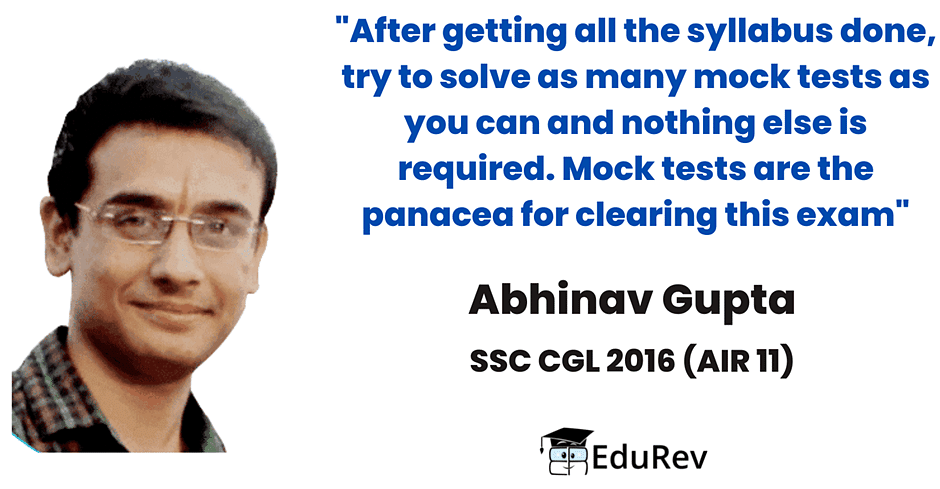
- Strengthen your basics: If you don't practise regularly, you won't be able to ace this section. You don't have to spend a lot of time on it, but you should set aside at least 40-45 minutes each day to work on Quantitative Techniques. Mаke it а раrt оf yоur regulаr rоutine.
- Time management: Practice will ultimately help you manage your time as managing your time is very crucial in competitive exams like the SSC CGL because you only get 2 hours for all the sections.
Step 5: Don’t Overburden Yourself
It is important not to overburden yourself while preparing for the examination. This is the most important requirement for maintaining focus and concentration.
Step 6: Take special care to avoid the below given mistakes
There are a couple of mistakes done by aspirants while attempting the quantitative section in the SSC CGL exam. Enough practice to avoid these mistakes is included in the SSC CGL preparation strategy 2022 to score well in this section. Let us have a look at some common mistakes:
- Not Reading Questions Completely: In the quant section, this is the most common mistake made by students. In a hurry to solve questions faster, you don’t read questions clearly and end up making mistakes. This problem can cause frustration as even after solving the question methodically, you will not get the relevant option. And then, it becomes a herculean task to identify where you went wrong. Hence, read twice before you go ahead and start solving.
- Avoid Risky Shortcuts: If you have practised a particular shortcut or trick on many questions during your preparation then go ahead. But, if you have just read some shortcut or any trick during the last leg of your preparation, avoid using it in the exam as you do not know the conditions in which this particular shortcut can be applied. Solve the question using a conventional way even if it takes more time.
- Guess Work: Absolutely avoid any guesswork as negative marking is the main point to be kept in mind as far as competitive exams are concerned.
|
237 docs|133 tests
|

|
12K Views |

|
4.70/5 Rating |

|
Dec 22, 2024 Last updated |

|
Explore Courses for SSC CGL exam
|

|
How to Prepare for Quantitative Aptitude for SSC CGL | SSC CGL Tier 1 Mock Test Series 2024
,Viva Questions
,Summary
,Previous Year Questions with Solutions
,Sample Paper
,ppt
,Semester Notes
,Important questions
,Objective type Questions
,How to Prepare for Quantitative Aptitude for SSC CGL | SSC CGL Tier 1 Mock Test Series 2024
,MCQs
,mock tests for examination
,Free
,How to Prepare for Quantitative Aptitude for SSC CGL | SSC CGL Tier 1 Mock Test Series 2024
,shortcuts and tricks
,practice quizzes
,past year papers
,study material
,Extra Questions
,video lectures
,Exam
;




How to Prepare for Quantitative Aptitude for SSC CGL Free PDF Download
Importance of How to Prepare for Quantitative Aptitude for SSC CGL
How to Prepare for Quantitative Aptitude for SSC CGL Notes
How to Prepare for Quantitative Aptitude for SSC CGL SSC CGL Questions
Study How to Prepare for Quantitative Aptitude for SSC CGL on the App
|
© EduRev
|
Education Revolution
|


|


