CAT Exam > CAT Notes > Verbal Ability & Reading Comprehension (VARC) > Word List - 1
Word List - 1 | Verbal Ability & Reading Comprehension (VARC) - CAT PDF Download

The CAT is one of the most highly competitive exam that requires extensive preparation and practice. In order to ace the CAT, one needs to be familiar with the key concepts, words and phrases used in the exam. To help you in this preparation, we have compiled a comprehensive list of words and phrases commonly used in the CAT exam. In addition to building strong vocabulary, it will also give you a better understanding of the level of language tested in the exam.
So, let's get started!
Level 1
Level 2
Level 3
Level 1
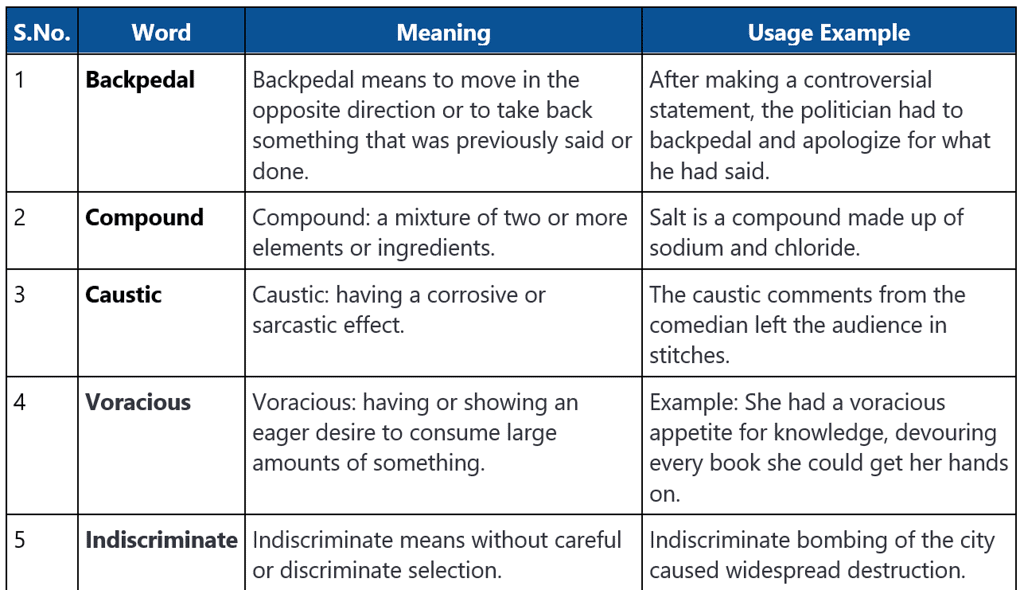
Backpedal
- Backpedal means to move in the opposite direction or to take back something that was previously said or done.
- Example: After making a controversial statement, the politician had to backpedal and apologize for what he had said.
Compound
- Compound: a mixture of two or more elements or ingredients.
- Example: Salt is a compound made up of sodium and chloride.
Caustic
- Caustic: having a corrosive or sarcastic effect.
- Example: The caustic comments from the comedian left the audience in stitches.
Voracious
- Voracious: having or showing an eager desire to consume large amounts of something.
- Example: She had a voracious appetite for knowledge, devouring every book she could get her hands on.
Indiscriminate
- Indiscriminate means without careful or discriminate selection.
- Example: Indiscriminate bombing of the city caused widespread destruction.
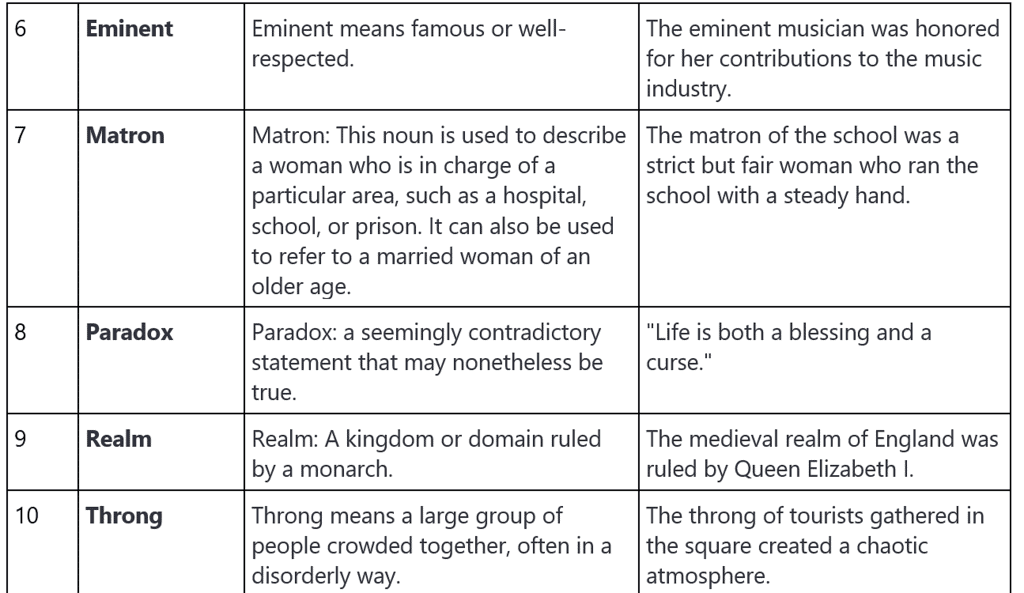
Eminent
- Eminent means famous or well-respected.
- Example: The eminent musician was honored for her contributions to the music industry.
Matron
- Matron: This noun is used to describe a woman who is in charge of a particular area, such as a hospital, school, or prison. It can also be used to refer to a married woman of an older age.
- Example: The matron of the school was a strict but fair woman who ran the school with a steady hand.
Paradox
- Paradox: a seemingly contradictory statement that may nonetheless be true.
- Example: "Life is both a blessing and a curse."
Realm
- Realm: A kingdom or domain ruled by a monarch.
- Example: The medieval realm of England was ruled by Queen Elizabeth I.
Throng
- Throng means a large group of people crowded together, often in a disorderly way.
- Example: The throng of tourists gathered in the square created a chaotic atmosphere.
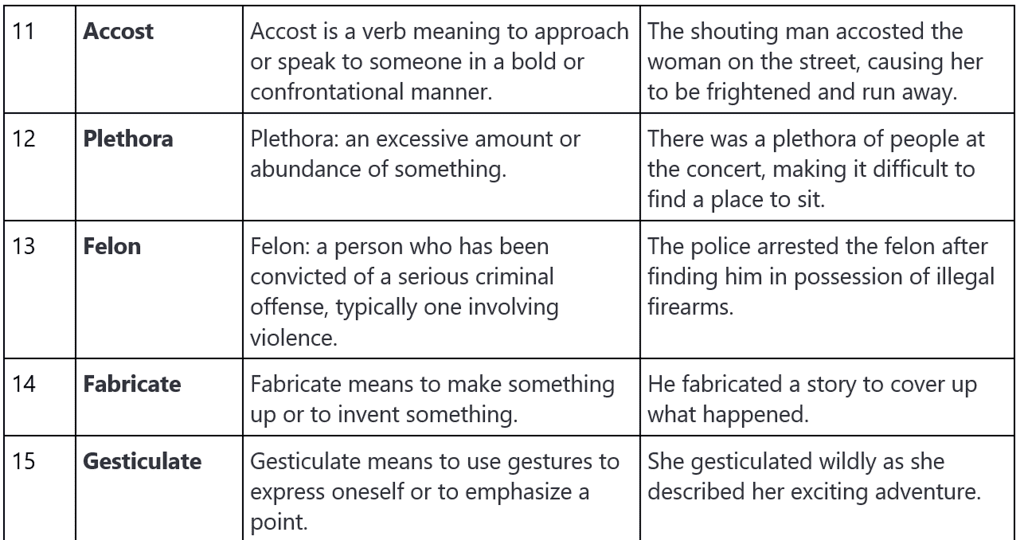
Accost
- Accost is a verb meaning to approach or speak to someone in a bold or confrontational manner.
- Example: The shouting man accosted the woman on the street, causing her to be frightened and run away.
Plethora
- Plethora: an excessive amount or abundance of something.
- Example: There was a plethora of people at the concert, making it difficult to find a place to sit.
Felon
- Felon: a person who has been convicted of a serious criminal offense, typically one involving violence.
- Example: The police arrested the felon after finding him in possession of illegal firearms.
Fabricate
- Fabricate means to make something up or to invent something.
- Example: He fabricated a story to cover up what happened.
Gesticulate
- Gesticulate means to use gestures to express oneself or to emphasize a point.
- Example: She gesticulated wildly as she described her exciting adventure.
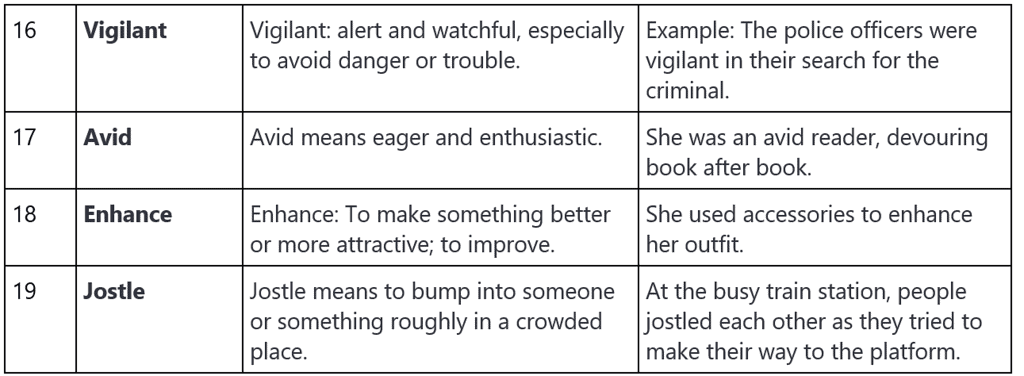
Vigilant
- Vigilant: alert and watchful, especially to avoid danger or trouble.
- Example: The police officers were vigilant in their search for the criminal.
Avid
- Avid means eager and enthusiastic.
- Example: She was an avid reader, devouring book after book.
Enhance
- Enhance: To make something better or more attractive; to improve.
- Example: She used accessories to enhance her outfit.
Jostle
- Jostle means to bump into someone or something roughly in a crowded place.
- Example: At the busy train station, people jostled each other as they tried to make their way to the platform.
Level 2
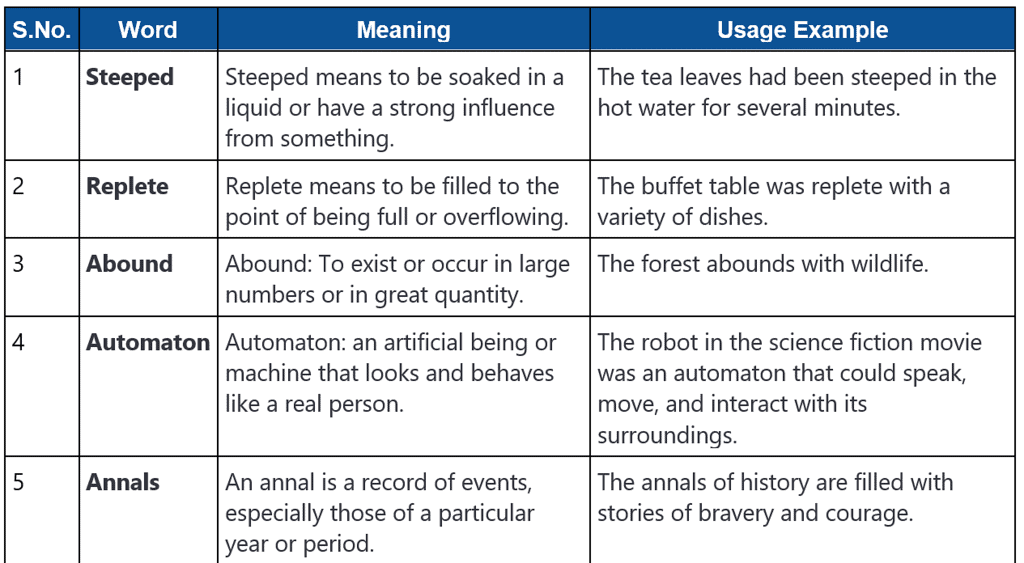
Steeped
- Steeped means to be soaked in a liquid or have a strong influence from something.
- Example: The tea leaves had been steeped in the hot water for several minutes.
Replete
- Replete means to be filled to the point of being full or overflowing.
- Example: The buffet table was replete with a variety of dishes.
Abound
- Abound: To exist or occur in large numbers or in great quantity.
- Example: The forest abounds with wildlife.
Automaton
- Automaton: an artificial being or machine that looks and behaves like a real person.
- Example: The robot in the science fiction movie was an automaton that could speak, move, and interact with its surroundings.
Annals
- An annal is a record of events, especially those of a particular year or period.
- Example: The annals of history are filled with stories of bravery and courage.
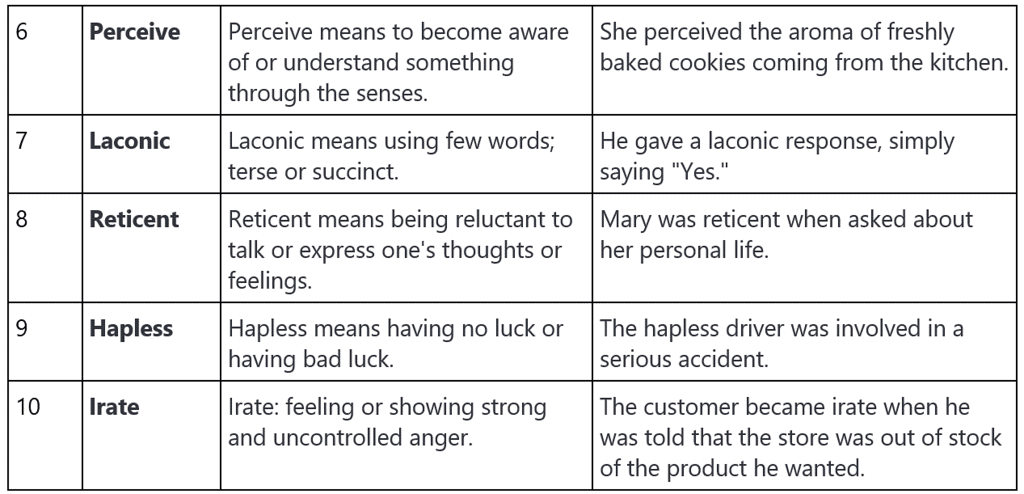
Perceive
- Perceive means to become aware of or understand something through the senses.
- Example: She perceived the aroma of freshly baked cookies coming from the kitchen.
Laconic
- Laconic means using few words; terse or succinct.
- Example: He gave a laconic response, simply saying "Yes."
Reticent
- Reticent means being reluctant to talk or express one's thoughts or feelings.
- Example: Mary was reticent when asked about her personal life.
Hapless
- Hapless means having no luck or having bad luck.
- Example: The hapless driver was involved in a serious accident.
Irate
- Irate: feeling or showing strong and uncontrolled anger.
- Example: The customer became irate when he was told that the store was out of stock of the product he wanted.
Level 3
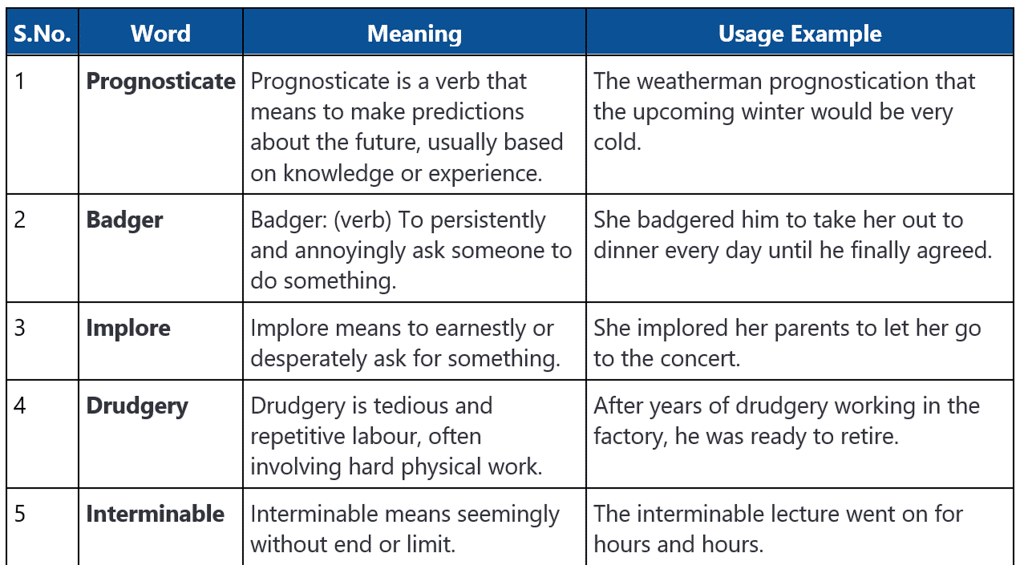
Prognosticate
- Prognosticate is a verb that means to make predictions about the future, usually based on knowledge or experience.
- Example: The weatherman prognostication that the upcoming winter would be very cold.
Badger
- Badger: (verb) To persistently and annoyingly ask someone to do something.
- Example: She badgered him to take her out to dinner every day until he finally agreed.
Implore
- Implore means to earnestly or desperately ask for something.
- Example: She implored her parents to let her go to the concert.
Drudgery
- Drudgery is tedious and repetitive labor, often involving hard physical work.
- Example: After years of drudgery working in the factory, he was ready to retire.
Interminable
- Interminable means seemingly without end or limit.
- Example: The interminable lecture went on for hours and hours.
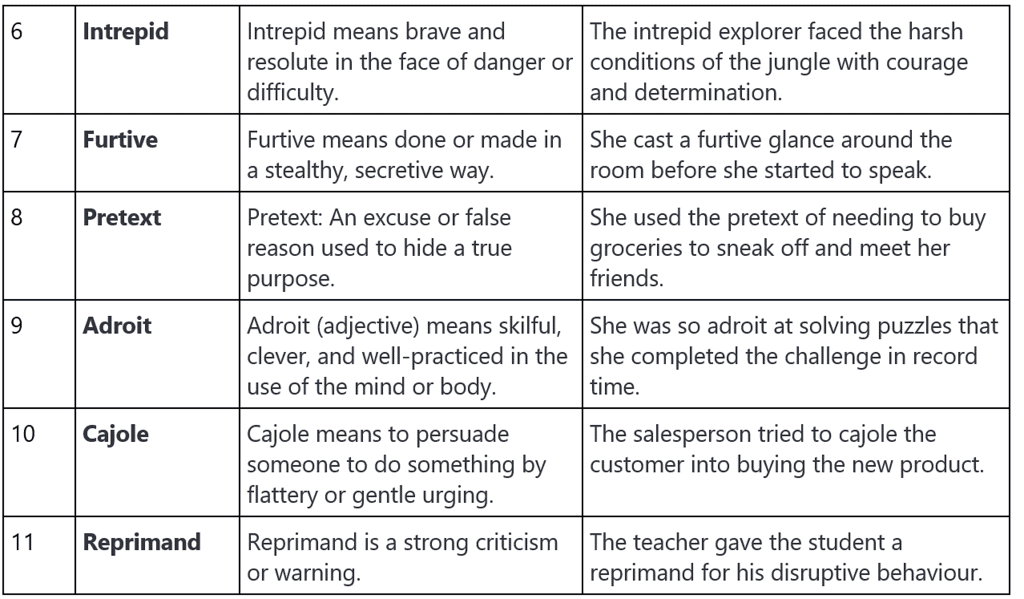
Intrepid
- Intrepid means brave and resolute in the face of danger or difficulty.
- Example: The intrepid explorer faced the harsh conditions of the jungle with courage and determination.
Furtive
- Furtive means done or made in a stealthy, secretive way.
- Example: She cast a furtive glance around the room before she started to speak.
Pretext
- Pretext: An excuse or false reason used to hide a true purpose.
- Example: She used the pretext of needing to buy groceries to sneak off and meet her friends.
Adroit
- Adroit (adjective) means skillful, clever, and well-practiced in the use of the mind or body.
- Example: She was so adroit at solving puzzles that she completed the challenge in record time.
Cajole
- Cajole means to persuade someone to do something by flattery or gentle urging.
- Example: The salesperson tried to cajole the customer into buying the new product.
Reprimand
- Reprimand is a strong criticism or warning.
- Example: The teacher gave the student a reprimand for his disruptive behavior.
The document Word List - 1 | Verbal Ability & Reading Comprehension (VARC) - CAT is a part of the CAT Course Verbal Ability & Reading Comprehension (VARC).
All you need of CAT at this link: CAT
|
111 videos|452 docs|90 tests
|
About this Document

3.1K Views

4.64/5
Rating

Oct 21, 2025
Last updated
Document Description: Word List - 1 for CAT 2025 is part of Verbal Ability & Reading Comprehension (VARC) preparation.
The notes and questions for Word List - 1 have been prepared according to the CAT exam syllabus. Information about Word List - 1 covers topics
like Level 1 and Word List - 1 Example, for CAT 2025 Exam. Find important definitions, questions, notes, meanings, examples, exercises and tests below for Word List - 1.
Introduction of Word List - 1 in English is available as part of our Verbal Ability & Reading Comprehension (VARC)
for CAT & Word List - 1 in Hindi for Verbal Ability & Reading Comprehension (VARC) course.
Download more important topics related with notes, lectures and mock test series for CAT
Exam by signing up for free. CAT: Word List - 1 | Verbal Ability & Reading Comprehension (VARC) - CAT
Description
Full syllabus notes, lecture & questions for Word List - 1 | Verbal Ability & Reading Comprehension (VARC) - CAT - CAT | Plus excerises question with solution to help you revise complete syllabus for Verbal Ability & Reading Comprehension (VARC) | Best notes, free PDF download
Information about Word List - 1
In this doc you can find the meaning of Word List - 1 defined & explained in the simplest way possible. Besides explaining types of
Word List - 1 theory, EduRev gives you an ample number of questions to practice Word List - 1 tests, examples and also practice CAT
tests


Related Searches
MCQs
,Exam
,Sample Paper
,practice quizzes
,video lectures
,shortcuts and tricks
,Objective type Questions
,mock tests for examination
,past year papers
,Important questions
,Previous Year Questions with Solutions
,Word List - 1 | Verbal Ability & Reading Comprehension (VARC) - CAT
,Extra Questions
,study material
,ppt
,Free
,Summary
,Word List - 1 | Verbal Ability & Reading Comprehension (VARC) - CAT
,Semester Notes
,Word List - 1 | Verbal Ability & Reading Comprehension (VARC) - CAT
,Viva Questions
;



Additional Information about Word List - 1 for CAT Preparation
Word List - 1 Free PDF Download
The Word List - 1 is an invaluable resource that delves deep into the core of the CAT exam.
These study notes are curated by experts and cover all the essential topics and concepts, making your preparation more efficient and effective.
With the help of these notes, you can grasp complex subjects quickly, revise important points easily,
and reinforce your understanding of key concepts. The study notes are presented in a concise and easy-to-understand manner,
allowing you to optimize your learning process. Whether you're looking for best-recommended books, sample papers, study material,
or toppers' notes, this PDF has got you covered. Download the Word List - 1 now and kickstart your journey towards success in the CAT exam.
Importance of Word List - 1
The importance of Word List - 1 cannot be overstated, especially for CAT aspirants.
This document holds the key to success in the CAT exam.
It offers a detailed understanding of the concept, providing invaluable insights into the topic.
By knowing the concepts well in advance, students can plan their preparation effectively.
Utilize this indispensable guide for a well-rounded preparation and achieve your desired results.
Word List - 1 Notes
Word List - 1 Notes offer in-depth insights into the specific topic to help you master it with ease.
This comprehensive document covers all aspects related to Word List - 1.
It includes detailed information about the exam syllabus, recommended books, and study materials for a well-rounded preparation.
Practice papers and question papers enable you to assess your progress effectively.
Additionally, the paper analysis provides valuable tips for tackling the exam strategically.
Access to Toppers' notes gives you an edge in understanding complex concepts.
Whether you're a beginner or aiming for advanced proficiency, Word List - 1 Notes on EduRev are your ultimate resource for success.
Word List - 1 CAT Questions
The "Word List - 1 CAT Questions" guide is a valuable resource for all aspiring students preparing for the
CAT exam. It focuses on providing a wide range of practice questions to help students gauge
their understanding of the exam topics. These questions cover the entire syllabus, ensuring comprehensive preparation.
The guide includes previous years' question papers for students to familiarize themselves with the exam's format and difficulty level.
Additionally, it offers subject-specific question banks, allowing students to focus on weak areas and improve their performance.
Study Word List - 1 on the App
Students of CAT can study Word List - 1 alongwith tests & analysis from the EduRev app,
which will help them while preparing for their exam. Apart from the Word List - 1,
students can also utilize the EduRev App for other study materials such as previous year question papers, syllabus, important questions, etc.
The EduRev App will make your learning easier as you can access it from anywhere you want.
The content of Word List - 1 is prepared as per the latest CAT syllabus.
|
© EduRev
|
Education Revolution
|


|




Signup to see your scores
go up
within 7 days!
within 7 days!
Takes less than 10 seconds to signup