Contingency & Satisfiable

Tautology Contradiction Contingency
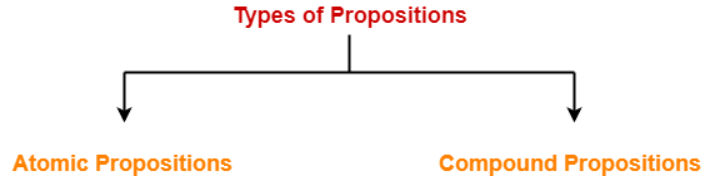
- Propositions are declarative statements that are either true or false but not both.
- Connectives are used to combine propositions (for example ∧, ∨, →, ↔, ∼).
Determining the Nature of a Compound Proposition
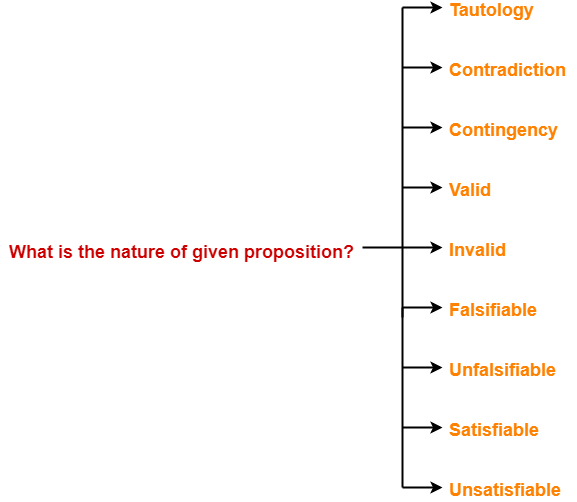
Typically you are given a compound proposition and asked to determine whether it is a tautology, contradiction or contingency. The usual methods are:
- Construct a truth table and inspect the final column.
- Simplify the proposition using propositional algebra (identities, De Morgan, distributive, etc.).
- Interpret the proposition using Boolean algebra or digital-logic notation (useful for quick reasoning).
Definitions and Relationships
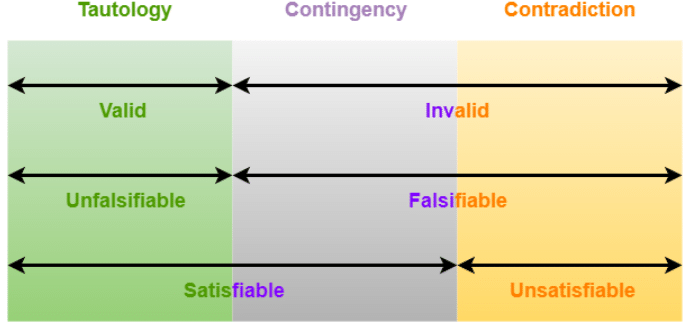
Tautology
- A compound proposition is a tautology if and only if it is true for all possible truth assignments to its propositional variables.
- In a truth table the last column contains only T (True).
Contradiction
- A compound proposition is a contradiction if and only if it is false for all possible truth assignments to its propositional variables.
- In a truth table the last column contains only F (False).
Contingency
- A compound proposition is a contingency if and only if it is neither a tautology nor a contradiction.
- In a truth table the last column contains both T and F.
Valid and Invalid
- A compound proposition is called valid precisely when it is a tautology.
- A compound proposition is called invalid when it is not a tautology (it may be a contradiction or a contingency).
Falsifiable and Unfalsifiable
- A compound proposition is falsifiable if there exists some assignment of truth values that makes it false.
- A compound proposition is unfalsifiable if it can never be made false (i.e., it is a tautology).
Satisfiable and Unsatisfiable
- A compound proposition is satisfiable if there exists some assignment of truth values that makes it true.
- A compound proposition is unsatisfiable if it cannot be made true under any assignment (i.e., it is a contradiction).
Important relationships (summary)
- All contradictions are invalid, falsifiable and unsatisfiable.
- All contingencies are invalid, falsifiable and satisfiable.
- All tautologies are valid, unfalsifiable and satisfiable.
- Not every satisfiable proposition is a tautology.
Example : Determine the nature of following propositions-
Example : Determine the nature of following propositions-
- p ∧ ∼p
- (p ∧ (p → q)) → ∼q
- [ (p → q) ∧ (q → r) ] ∧ ( p ∧ ∼r)
- ∼(p → q) ∨ (∼p ∨ (p ∧ q))
- (p ↔ r) → (∼q → (p ∧ r))
Solution:
We solve each part by one or more methods: truth table, propositional algebra and (where helpful) digital-logic interpretation.
Part 1: p ∧ ∼p
Method-1: Using Truth Table

The last column of the truth table contains only F.
- Contradiction
- Invalid
- Falsifiable
- Unsatisfiable
Method-2: Using Algebra of Propositions
The proposition is
p ∧ ∼p
By the complement law
p ∧ ∼p = F
Thus the proposition is a contradiction, invalid, falsifiable and unsatisfiable.
Method-3: Using Digital Electronics
Interpret p as a Boolean variable; p' denotes ∼p.
The expression becomes p.p'.
p.p' = 0
Therefore it is a contradiction, invalid, falsifiable and unsatisfiable.
Part 2: (p ∧ (p → q)) → ∼q
Method-01: Using Truth Table
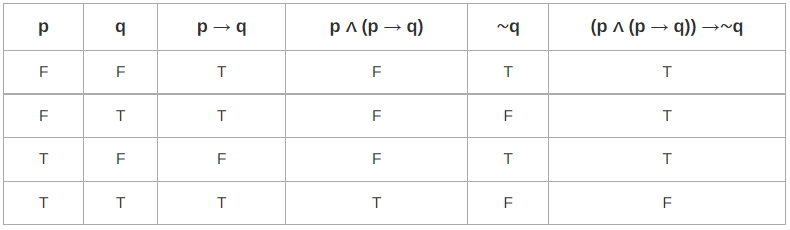
The last column contains both T and F.
- Contingency
- Invalid
- Falsifiable
- Satisfiable
Method-02: Using Algebra of Propositions
Start with the proposition
(p ∧ (p → q)) → ∼q
Replace implication by its equivalent
p → q = ∼p ∨ q
Hence
(p ∧ (∼p ∨ q)) → ∼q
Use implication identity: A → B ≡ ∼A ∨ B
So
∼(p ∧ (∼p ∨ q)) ∨ ∼q
Distribute inside the negation
∼((p ∧ ∼p) ∨ (p ∧ q)) ∨ ∼q
Use complement law p ∧ ∼p = F
So
∼(F ∨ (p ∧ q)) ∨ ∼q
Identity law gives
∼(p ∧ q) ∨ ∼q
Apply De Morgan to ∼(p ∧ q)
∼p ∨ ∼q ∨ ∼q
Simplify duplicate ∼q
∼p ∨ ∼q
The result is neither universally true nor universally false.
Therefore it is a contingency, invalid, falsifiable and satisfiable.
Method-03: Using Digital Electronics
Translate to Boolean symbols: p' for ∼p and q' for ∼q.
The expression becomes
(p.(p' + q))' + q'
Expand p.(p' + q) = p.p' + p.q
Since p.p' = 0, this simplifies to p.q
So we have (p.q)' + q'
Apply De Morgan: (p.q)' = p' + q'
Thus
p' + q' + q'
Simplify duplicate q'
p' + q'
Not identically 0 or 1, hence contingency, invalid, falsifiable and satisfiable.
Part 3: [ (p → q) ∧ (q → r) ] ∧ ( p ∧ ∼r)
Method-01: Using Truth Table
Let R denote the expression.
![Part 3: [ (p → q) ∧ (q → r) ] ∧ ( p ∧ ∼r)](https://cn.edurev.in/ApplicationImages/Temp/1611942_81352585-bd30-4384-8b92-3ec9eef1c398_lg.png)
The last column contains only F.
- Contradiction
- Invalid
- Falsifiable
- Unsatisfiable
Method-02: Using Algebra of Propositions
Start with
[ (p → q) ∧ (q → r) ] ∧ ( p ∧ ∼r)
Replace implications: p → q = ∼p ∨ q and q → r = ∼q ∨ r
So
[ (∼p ∨ q) ∧ (∼q ∨ r) ] ∧ ( p ∧ ∼r)
Distribute to combine the first two terms
[ ((∼p ∨ q) ∧ ∼q) ∨ ((∼p ∨ q) ∧ r) ] ∧ ( p ∧ ∼r)
Distribute within each bracket
[ ((∼p ∧ ∼q) ∨ (q ∧ ∼q)) ∨ ((∼p ∧ r) ∨ (q ∧ r)) ] ∧ ( p ∧ ∼r)
Use q ∧ ∼q = F
[ (∼p ∧ ∼q) ∨ (∼p ∧ r) ∨ (q ∧ r) ] ∧ ( p ∧ ∼r)
Distribute across the conjunction with (p ∧ ∼r)
((∼p ∧ ∼q) ∧ ( p ∧ ∼r)) ∨ ((∼p ∧ r) ∧ ( p ∧ ∼r)) ∨ ((q ∧ r) ∧ ( p ∧ ∼r))
Each clause contains a pair of complementary literals (for example ∼p ∧ p or r ∧ ∼r)
Thus each clause simplifies to F
F ∨ F ∨ F = F
Therefore the whole expression is F (contradiction), hence invalid, falsifiable and unsatisfiable.
Method-03: Using Digital Electronics
Replace variables by Boolean symbols and implications similarly.
The expression becomes
[ (p' + q).(q' + r) ] . (p.r')
Expand the product: (p' + q).(q' + r) = p'.q' + p'.r + q.q' + q.r
Since q.q' = 0 this is p'.q' + p'.r + q.r
Multiply by (p.r')
p'.q'.p.r' + p'.r.p.r' + q.r.p.r'
Each product contains complementary pairs (for example p' and p, or r and r')
Each term simplifies to 0
Sum is 0
Thus the expression is 0 (contradiction), so invalid, falsifiable and unsatisfiable.
Part 4: ∼(p → q) ∨ (∼p ∨ (p ∧ q))
Method-01: Using Truth Table
Let R denote the expression.
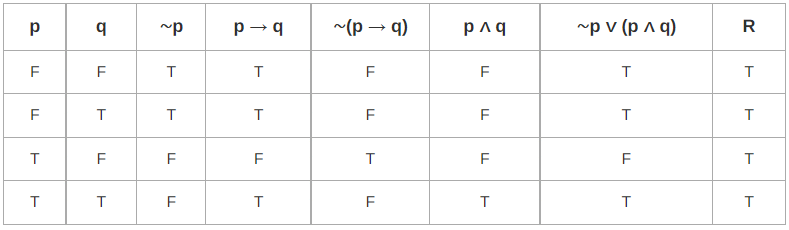
The last column contains only T.
- Tautology
- Valid
- Unfalsifiable
- Satisfiable
Method-02: Using Algebra of Propositions
Start with
∼(p → q) ∨ (∼p ∨ (p ∧ q))
Replace implication p → q by ∼p ∨ q
So
∼(∼p ∨ q) ∨ (∼p ∨ (p ∧ q))
Apply De Morgan to the first term
(p ∧ ∼q) ∨ (∼p ∨ (p ∧ q))
Use distributive law on the second part: ∼p ∨ (p ∧ q) = (∼p ∨ p) ∧ (∼p ∨ q)
Thus
(p ∧ ∼q) ∨ ( (∼p ∨ p) ∧ (∼p ∨ q) )
Since (∼p ∨ p) = T, simplify
(p ∧ ∼q) ∨ (∼p ∨ q)
Rearrange using associativity
((p ∧ ∼q) ∨ ∼p) ∨ q
Distribute inside the first bracket
((p ∨ ∼p) ∧ (∼q ∨ ∼p)) ∨ q
(T ∧ (∼q ∨ ∼p)) ∨ q
(∼q ∨ ∼p) ∨ q
Rearrange
∼p ∨ (q ∨ ∼q)
q ∨ ∼q = T
So ∼p ∨ T = T
Hence the expression is identically T.
Therefore it is a tautology, valid, unfalsifiable and satisfiable.
Method-03: Using Digital Electronics
Use Boolean notation: p' for ∼p and q' for ∼q.
The expression becomes
(p' + q)' + (p' + p.q)
Use the transposition theorem or distributive expansions to simplify the second term
(p' + p.q) = (p' + p).(p' + q) = 1.(p' + q) = p' + q
So the whole expression is
(p' + q)' + (p' + q)
By Boolean identity A' + A = 1
Therefore the expression equals 1
Hence it is a tautology, valid, unfalsifiable and satisfiable.
Part 5: (p ↔ r) → (∼q → (p ∧ r))
Method-01: Using Truth Table
Let R denote the expression.
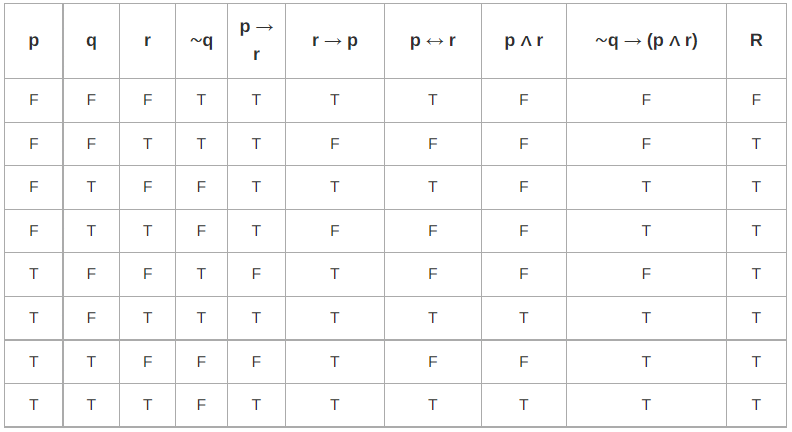
The last column contains both T and F.
- Contingency
- Invalid
- Falsifiable
- Satisfiable
Method-02: Using Algebra of Propositions
Start with
(p ↔ r) → (∼q → (p ∧ r))
Rewrite the right implication: ∼q → (p ∧ r) = q ∨ (p ∧ r)
Thus the expression becomes
(p ↔ r) → (q ∨ (p ∧ r))
Apply implication identity: A → B ≡ ∼A ∨ B
So
∼(p ↔ r) ∨ q ∨ (p ∧ r)
Replace biconditional p ↔ r by (p → r) ∧ (r → p)
Thus ∼((p → r) ∧ (r → p)) ∨ q ∨ (p ∧ r)
Replace implications inside
∼((∼p ∨ r) ∧ (∼r ∨ p)) ∨ q ∨ (p ∧ r)
Distribute to simplify the inner conjunction
∼[ ((∼p ∨ r) ∧ ∼r) ∨ ((∼p ∨ r) ∧ p) ] ∨ q ∨ (p ∧ r)
Distribute within each part and eliminate contradictions such as r ∧ ∼r or p ∧ ∼p
After simplification the inside becomes (∼p ∧ ∼r) ∨ (r ∧ p)
Apply De Morgan to the negation
∼(∼p ∧ ∼r) ∧ ∼(r ∧ p)
Which is
(p ∨ r) ∧ (∼r ∨ ∼p)
Distribute this with the remaining disjunction q ∨ (p ∧ r)
Carry out distributive and identity simplifications
Reduce to
(p ∧ ∼r) ∨ q ∨ (∼p ∧ r) ∨ (p ∧ r)
Group terms and simplify using (∼p ∨ p) = T
Finally this reduces to
p ∨ q ∨ r
The result is neither identically T nor identically F under all assignments.
Therefore the given proposition is a contingency, invalid, falsifiable and satisfiable.
Method-03: Using Digital Electronics
Translate the biconditional and implications and apply De Morgan where needed.
One convenient simplification leads to
p'.r + r'.p + q + p.r
Group terms where possible
(p' + p).r + r'.p + q
Which yields
r + r'.p + q
Further simplification leads to
p + q + r
Therefore expression is neither 0 nor 1 for all assignments and is a contingency, invalid, falsifiable and satisfiable.
Concluding Remarks
To identify the nature of a compound proposition use truth tables for certainty, algebraic simplification for compact proofs, and Boolean/digital-logic interpretation for intuition and quick checks. Keep the standard equivalences at hand: De Morgan, distributive, associative, identity and complement laws, and the translation p → q ≡ ∼p ∨ q and p ↔ q ≡ (p → q) ∧ (q → p).
Summary of key tests:
- Truth table last column all T → tautology (valid, unfalsifiable, satisfiable).
- Truth table last column all F → contradiction (invalid, falsifiable, unsatisfiable).
- Truth table last column mixed T and F → contingency (invalid, falsifiable, satisfiable).