Recurrence Relations

Introduction
A recurrence relation is an equation that recursively defines a sequence where the next term is a function of the previous terms (Expressing Fn as some combination of Fi with i < n).
Example - Fibonacci series - Fn = Fn-1 + Fn-2, Tower of Hanoi - Fn = 2Fn-1 + 1
Linear Recurrence Relations
A linear recurrence equation of degree k or order k is a recurrence equation which is in the format xn = A1xn-1 + A2xn-1 + A3xn-1 +...Akxn-k (An is a constant and Ak ≠ 0) on a sequence of numbers as a first-degree polynomial.
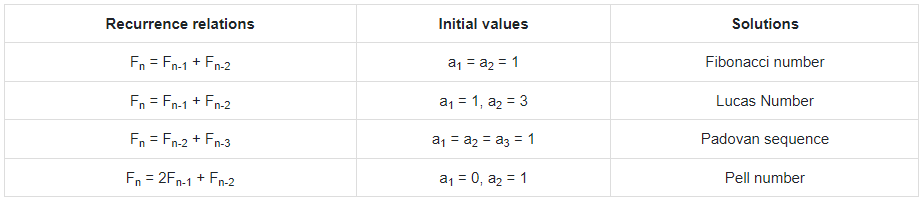
These are some examples of linear recurrence equations -
 How to solve linear recurrence relation
Suppose, a two ordered linear recurrence relation is - Fn = AFn-1 + BFn-2 where A and B are real numbers.
The characteristic equation for the above recurrence relation is -
x2 - Ax - B = 0
Three cases may occur while finding the roots -
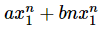
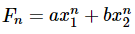
- Case 1 - If this equation factors as (x - x1)(x - x1) = 0 and it produces two distinct real roots x1 and x2, then Fn =
 is the solution. [Here, a and b are constants]
 - Case 2 - If this equation factors as (x - x1)2 = 0 and it produces single real root x1, then Fn =
 is the solution.
 - Case 3 - If the equation produces two distinct complex roots, x1 and x2 in polar form x1 = r ∠ θ and x2 = r∠(-θ), then Fn = rn(acos(nθ) + bsin(nθ)) is the solution.
Problem 1: Solve the recurrence relation Fn = 5Fn-1 - 6Fn-2 where F0 = 1 and F1 = 4
The characteristic equation of the recurrence relation is -
x2 - 5x + 6 = 0,
So, (x-3)(x-2)=0
Hence, the roots are -
x1 = 3 and x2 = 2
The roots are real and distinct. So, this is in the form of case 1
Hence, the solution is -
Here, Fn = a3n + b2n (As x1 = 3 and x2 = 2)Therefore,
1 = F0 = a30 + b20 = a + b
4 = F1 = a31 + b21 = 3a + 2bSolving these two equations, we get a = 2 and b = -1
Hence, the final solution is -
Fn = 2.3n + (-1).2n = 2.3n - 2n
Problem 2: Solve the recurrence relation - Fn = 10Fn-1-25Fn-2 where F0 = 3 and F1 = 17
The characteristic equation of the recurrence relation is -
x2 - 10x - 25 = 0
So (x-5)2 = 0Hence, there is single real root x1 = 5
As there is single real valued root, this is in the form of case 2
Hence, the solution is -
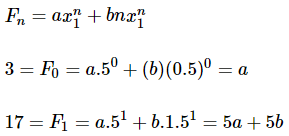
Solving these two equations, we get a = 3 and b = 2/5
Hence, the final solution is - Fn = 3.5n + (2/5).n.2n
Problem 3: Solve the recurrence relation Fn = 2Fn-1-2Fn-2 where F0 = 1 and F1 = 3
The characteristic equation of the recurrence relation is -
x2 - 2x - 2 = 0Hence, the roots are -
x1 = 1 + i and x2 = 1 - i
In polar form,
x1 = r∠θ and x2 = r∠(-θ), where r = √2 and θ = π/4
The roots are imaginary. So, this is in the form of case 3.
Hence, the solution is -
Fn = (2-√)n(acos(n.⊓/4) + bsin(n.⊓/4))1 = F0 = (2-√)0(acos(0.⊓/4)+bsin(0.⊓/4)) = a
3 = F1 = (2-√)1(acos(1.⊓/4) + bsin(1.⊓/4)) = 2-√(a/2-√ + b/2-√)
Solving these two equations we get a=1 and b=2
Hence, the final solution is -
Fn = (√2)n(cos(n.π/4)+2sin(n.π/4))
Non-Homogeneous Recurrence Relation and Particular Solutions
A recurrence relation is called non-homogeneous if it is in the form
Fn = AFn-1 + BFn-2 + f(n) where f(n) ≠ 0
Its associated homogeneous recurrence relation is Fn = AFn-1 + BFn-2
The solution (an) of a non-homogeneous recurrence relation has two parts.
First part is the solution (ah) of the associated homogeneous recurrence relation and the second part is the particular solution (at).
an = ah + at
Solution to the first part is done using the procedures discussed in the previous section.
To find the particular solution, we find an appropriate trial solution.
Let f(n) = cxn ; let x2 = Ax+B be the characteristic equation of the associated homogeneous recurrence relation and let x1 and x2 be its roots.
If x ≠ x1 and x ≠ x2, then at = Axn
If x = x1, x ≠ x2, then at = Anxn
If x = x1 = x2, then at = An2xn
Example
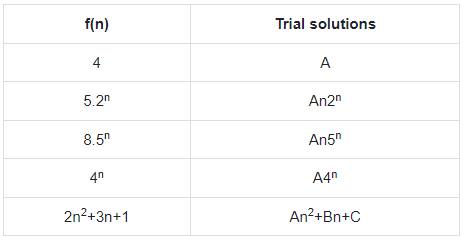
Let a non-homogeneous recurrence relation be Fn = AFn-1 + BFn-2 + f(n) with characteristic roots x1 = 2 and x2 = 5. Trial solutions for different possible values of f(n) are as follows -
Problem: Solve the recurrence relation Fn = 3Fn-1 + 10Fn-2 + 7.5n where F0 = 4 and F1 = 3
This is a linear non-homogeneous relation, where the associated homogeneous equation is Fn = 3Fn-1 + 10Fn-2 and f(n) = 7.5n
The characteristic equation of its associated homogeneous relation is -
x2 - 3x - 10 = 0
Or, (x - 5)(x + 2) = 0
Or, x1 = 5 and x2 = -2
Hence ah = a.5n + b.(-2)n , where a and b are constants.
Since f(n) = 7.5n, i.e. of the form c.xn, a reasonable trial solution of at will be Anxn
at = Anxn = An5n
After putting the solution in the recurrence relation, we get -
An5n = 3A(n-1)5n-1 + 10A(n-2)5n-2 + 7.5nDividing both sides by 5n-2, we get
An52 = 3A(n-1)5 + 10A(n-2)50 + 7.52Or, 25An = 15An - 15A + 10An - 20A + 175
Or, 35A = 175
Or, A = 5
So, Fn = An5n = 5n5n = n5n+1
The solution of the recurrence relation can be written as -
Fn = ah + at
= a.5n + b.(-2)n + n5n + 1Putting values of F0 = 4 and F1 = 3, in the above equation, we get a = -2 and b = 6
Hence, the solution is -
Fn = n5n+1 + 6.(-2)n-2.5n
Generating Functions
Generating Functions represents sequences where each term of a sequence is expressed as a coefficient of a variable x in a formal power series.
Mathematically, for an infinite sequence, say a0, a1, a2,...,ak,..., the generating function will be -

Some Areas of Application
Generating functions can be used for the following purposes -
- For solving a variety of counting problems. For example, the number of ways to make change for a Rs. 100 note with the notes of denominations Rs.1, Rs.2, Rs.5, Rs.10, Rs.20 and Rs.50
- For solving recurrence relations
- For proving some of the combinatorial identities
- For finding asymptotic formulae for terms of sequences
Problem 1: What are the generating functions for the sequences {ak} with ak = 2 and ak = 3k?
When ak = 2, generating function,
When


Problem 2: What is the generating function of the infinite series; 1,1,1,1,...?
Here, ak = 1, for 0 ≤ k ≤ ∞
Hence, G(x) = 1 + x + x2 + x3 +...⋯ = 1/(1-x)Some Useful Generating Functions
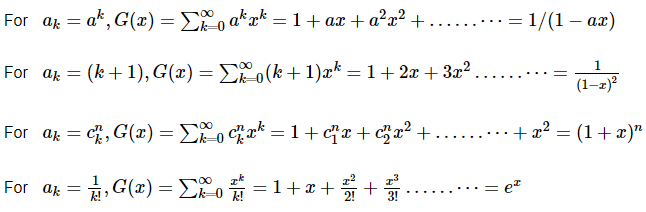
For ak=ak,G(x)=∑∞k=0akxk=1+ax+a2x2+......⋯=1/(1-ax)
For ak=(k+1),G(x)=∑∞k=0(k+1)xk=1+2x+3x2......⋯=1(1-x)2
For ak=cnk,G(x)=∑∞k=0cnkxk=1+cn1x+cn2x2+......⋯+x2=(1+x)n
For ak=1k!,G(x)=∑∞k=0xkk!=1+x+x22!+x33!......⋯=ex