Cheat Sheet: Profit & Loss

Introduction
Profit & Loss is an easy topic in the quantitative section. Every year, a small number of questions from this section appear, and students should aim to get all the questions from this topic right. The number of concepts in these topics is limited, and most of the problems can be solved by applying the formulae directly.

Some Important Definitions
Cost Price (C.P.) - Price at which an item is purchased.
Selling Price (S.P.) - Price at which an item is sold.
Profit (Gain) - Amount by which S.P. exceeds C.P.
Profit = S.P. - C.P.Loss - Amount by which C.P. exceeds S.P.
Loss = C.P. - S.P.Marked Price (MP) - Price marked on an item before discount.
Discount - Reduction from M.P.
Discount = M.P. - S.P.Profit and Loss Statement: A summary showing revenue, expenses, and net result over a given period.
Formulae
(i) Profit per cent

(ii) Similarly, loss per cent

(iii) If an article is sold for two different prices (S.P1 and S.P2), there will be two profit percentages (P1 and P2) respectively.
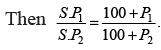
Note: In case of loss, treat that loss as negative profit.
(iv) If the Cost price of M articles is equal to the selling price of N articles, then the profit percentage is given by
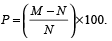
If (M-N) is negative, then treat profit as a loss.
(v) If an article is sold after allowing a certain discount (d%) on the marked price (M.P.) then the selling price (S.P.) is given by S.P. = (100 - d)% × M.P
(vi) If the marked price of an article is a% above the cost price and a discount d% is allowed, then the profit per cent (p) would be
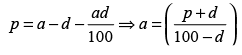
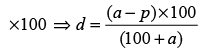
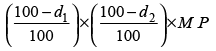
(vii) If an article is sold after allowing two successive discounts of d1% and d2% then the selling price (S.P.) is given by S.P. =
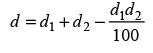
(viii) Two successive discounts of d1 and d2 are equivalent to a single discount of
Tips
Find CP and SP first: Always check which is the Cost Price and which is the Selling Price. Mixing them up is a common mistake.
Use multipliers for quick work: Example: 20% profit means SP = 1.2 × CP, 15% loss means SP = 0.85 × CP.
Be careful with multiple changes: If there are two profits or losses in a row, use:
Net% = x + y + (x × y / 100)
(Here, x and y are the percentages.)Apply a discount on the Marked Price: A discount is always calculated on the Marked Price unless the question says otherwise.
Look for hidden clues: Sometimes the question says things like "profit is 1/5 of CP." Turn this into numbers before solving.
Do a quick check: Estimate your answer to see if it looks right before finalising it.
Solved Example
Try yourself: A retailer sold 12 notes at a profit of 20% and 8 notes at a profit of 10%. If he had sold all the 20 notes at a profit of 15%, then his profit would have been reduced by Rs.36. What is the cost price of each note?
Try yourself: The profit Percentage on 3 bikes are 15%, 35% and 10% and the ratio of CP is 5:3:1. Also the ratio of the Bike sold of P, Q and R is 2:3:5. Then the overall approximate Profit Percentage is?
Try yourself: When a shopkeeper reduces the selling price of an article from 1180 to 1126 his loss increases by 5% . What is the cost price of article?
Try yourself: A and B, there are two companies, selling the packs of cold-drinks. For the same selling price A gives two successive discounts of 10% and 25%. While B sells it by giving two successive discounts of 15% and 20%. What is the ratio of their marked price?
Try yourself: A reputed company sells a wrist watch to a wholesaler making a profit of 10%. The wholesaler, in turn, sells it to the retailer making a profit of 10%. A customer purchases it by paying Rs. 990. Thus the profit of retailer is 2(3/11)% What is the cost incurred by the the company to produce it?
FAQs on Cheat Sheet: Profit & Loss
| 1. How do I calculate profit percentage when cost price and selling price are given? |  |
| 2. What's the difference between profit margin and markup in business mathematics? | |
| 3. How do discount and profit work together in the same problem? | |
| 4. Can I lose money even if I give a discount on cost price? | |
| 5. What's the quickest way to solve successive discount problems for GATE exams? | |