Cheatsheet: Speed Time & Distance

Theory
The questions in this section can vary from being very easy to surprisingly difficult. This is a conceptual section and some of the questions can consume a lot of time. While solving, write down the equations as far as possible to avoid mistakes. The few extra seconds can help you avoid silly mistakes. Also, check if the units of distance, speed and time match up. So if you see yourself adding a unit of distance like m to a unit of speed m/s, you would realize you have missed a term. Choose to apply the concept of relative speed wherever possible as it can greatly reduce the complexity of the problem. Like speed and distance, in time and work while working with terms ensure that you convert all terms to consistent units like man-hours.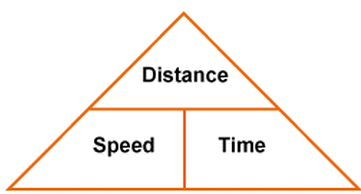
Formula
(i) Two objects travel the same distance (D) with different spee ds of S1 and S2. If the difference between the journey times is t then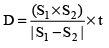
(ii) If an object travels a distance of D with a speed of S1 and returns with a speed of S2 taking a total time of 't', then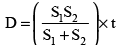
(iii) If two objects travel the same distance with speeds of S1 and S2 taking the journey times of t1 and t2 respectively, then S1: S2 = t2 : t1 OR t1 : t2 = S2 : S1
(iv) Walking at p/qth of usual speed a man reaches his destination t-hours late (or early) then usual time to reach the office is given by
(v) If a person walks a distance D with a speed of S1 kmph then he will be late (early) by t1 hours. If he walks at S2 kmph he will be late (early) by t2 hours. Then the distance travelled by the person is 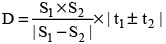
Note: Use (+) sign if the person is late in one case and early in the other case. Use (-) sign if he is late in both the cases or early in both the cases.
(vi) If an object travels different distances with different speeds during a journey then the entire journey can be represented by a single equivalent speed called Average Speed (SA)
(vii) If an object travels a distance of D1-km with S1-kmph another D2-km with a speed of S2-kmph and D3-km with a speed of S3-kmph, then the average speed of the journey is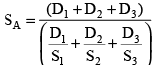
(viii) If an object travels with a speed of S1-kmph for t1-hours, next wi-th a speed of S2 kmph for t2-hours and with a speed of S3-kmph for t3-hours, then the average speed (SA) for the whole journey is 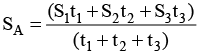
Tips
- In a journey travelled with different speeds, if the distance covered in each stage is constant, the average speed is the harmonic mean of the different speeds.
- In a journey travelled with different speeds, if the time travelled in each stage is constant, the average speed is the arithmetic mean of the different speeds.
Solved Example
A car started from Indore to Bhopal at a certain speed. The Car missed an accident at 40Kms away from Indore, then the driver decided to reduce Car speed to 4/5 of the original speed. Due to this, he reached Bhopal by a late of 1hr 15min.Suppose if he missed an accident at 80Km away from Indore and from then he maintained 4/5 of original speed then he would reach Bhopal by a late of 1hour. Then what is the original speed of the Car?
Two places A and B are at a certain distance. Ramu started from A towards B at a speed of 40 kmph. After 2 hours Raju started from B towards A at a speed of 60 kmph. If they meet at a place C then ratio of ratio of time taken by Raju to Ramu to reach Place C is 2:3. Then what is the distance between A and B?
Ramu started from A towards B at a speed of 20Km/hr and Raju started from B towards A. They crossed each other after one hour. Raju reached his destination 5/6 hour earlier than Ramu reached his destination.Then what is the distance between A and B?
Two Cars started at same time, same place and towards same direction. First Car goes at uniform speed of 12Km/hr. Second Car goes at speed of 4 Km/hr in first hour and increases it speed by 1 Km/hr for every hour. Then what is the distance traveled by car B when the both the Cars meet for the first time?
A man traveled 100 km by Bike in 2 hours. He then traveled in Bus for 8 hrs and then Train in 9 hrs. Ratio of Speeds of Bus to Train is 4:5. If speed of train is 4/5 of Bike speed then the entire journey covered by him in Km is?
FAQs on Cheatsheet: Speed Time & Distance
| 1. How do I calculate speed when distance and time are given in different units? |  |
| 2. What's the difference between average speed and instantaneous speed for GATE problems? | |
| 3. Why do I get wrong answers when solving relative speed problems with trains and boats? | |
| 4. How can I solve problems where someone travels at different speeds for different portions of the journey? | |
| 5. What tricks help me quickly solve speed, time, and distance problems in the exam without a calculator? | |