Tips & Tricks: Coding-Decoding

Coding Decoding Shortcut Tricks
Coding-decoding questions test your ability to find and apply a consistent rule that converts letters or words into other letters, numbers or symbols. Such questions frequently appear in logical reasoning sections of government and banking examinations. The common goals when solving them are to identify the exact rule, verify it against all given examples, and then apply the same rule to the new word or letter string.
Basic mappings to memorise
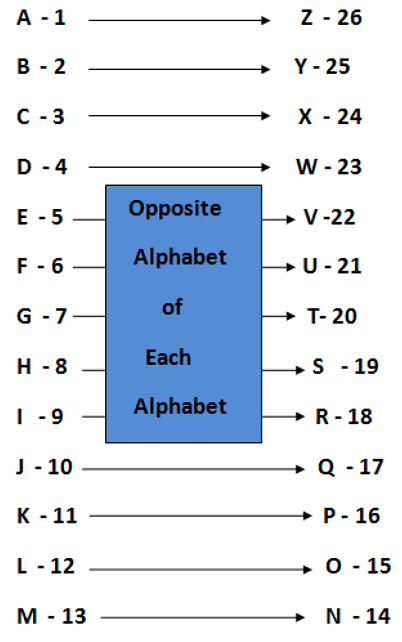
- Alphabet positions: A = 1, B = 2, C = 3, ..., Z = 26. Many codes use these numeric values directly or by combining them.
- Opposite alphabets: A ↔ Z, B ↔ Y, C ↔ X, ..., M ↔ N. This "mirror" mapping is widely used; opposite of a letter L is O, opposite of S is H, etc.
- Immediate left and right letters: For any letter X, its left letter (previous in alphabet) and right letter (next in alphabet) are often used as pair-codes. Example: for N, left = M and right = O.
- Concatenation rules: Codes may concatenate single-digit or multi-digit numbers (e.g., 20 9 7 5 18 → 2097518).
- Reverse-order or re-grouping: After converting letters individually, the resulting blocks may be written in forward or reversed order; watch carefully for reversed-sequence patterns.
Examples
Example 1: If in a certain language "NIL" is written as "MOHJKM", then how will "BOND" be written in that language?
(a) ACNPOMCE
(b) ANCPMOCE
(c) ACNPMOCE
(d) ACNPMEOC
(e) None of The Above
Ans: (c)
Solution:
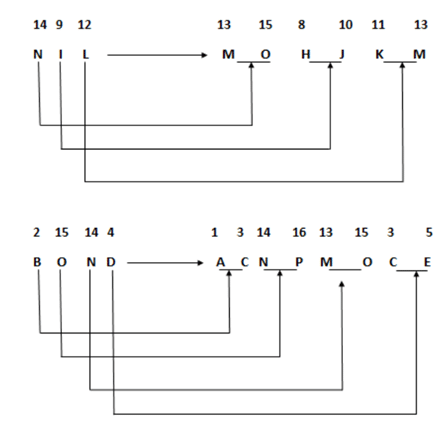
Trick: Each letter is coded with its left and right letters in English alphabet manner.
Example 2: If in a certain language, "TOP" is written as "OQNPSU", then how will "SUN" be coded in that language?
(a) MOVTRT
(b) MOTVRT
(c) MOVTTR
(d) MOVRTT
(e) None of The Above
Ans: (b)
Solution:
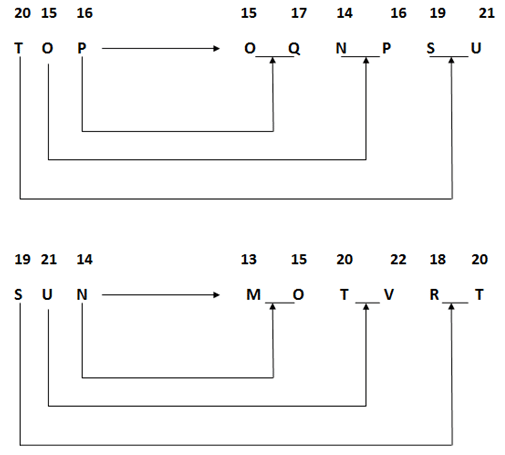
Trick: Each letter is coded with its left and right letters; the coded blocks are written in reverse order of the original letters.
Example 3: If "PKROK" is coded as 72962 and KRRPK as "29972", then how can "QLSAZ" be coded?
(a) 45716
(b) 74315
(c) 91523
(d) 51430
(e) None of The Above
Ans: (d)
Solution:
From PKROK → 7 2 9 6 2, map letters to digits:
P → 7
K → 2
R → 9
O → 6
Check with KRRPK → 2 9 9 7 2, which is consistent with K = 2, R = 9, P = 7.
The given options for QLSAZ must be compared. None of the examples give digit assignments for Q, L, S, A, Z, so elimination is required.
Options containing any of the already known digits 7, 2, 9, 6 can be discarded because that would force use of letters P, K, R or O, which are not present in QLSAZ.
Only option (d) 51430 contains none of the digits 7, 2, 9, 6.
Therefore the required code is 51430.
Trick: Deduce known letter→digit mappings from examples and use elimination among options for letters not yet assigned.
Example 4: If in a certain code language "SIMILAR" is written as "IZORNRH", then how will "BECTOR" be written in that language?
(a) ILGXYV
(b) ILGXVY
(c) ILXGYV
(d) ILXYVG
(e) None of The Above
Ans: (b)
Solution:
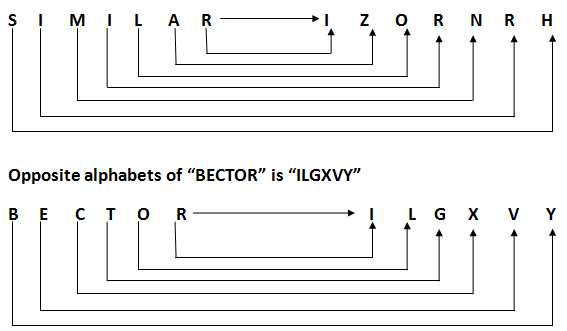
Trick: Use opposite alphabets and then reverse the result.
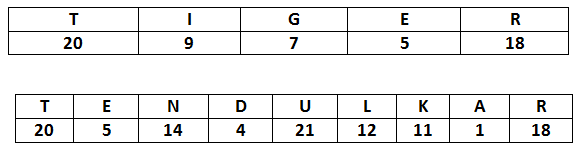
Example 5: In a certain code language "TIGER" is written as "2097518", then how will "TENDULKAR" be written in that language?
(a) 205144212156212
(b) 205144221111182
(c) 205144211211118
(d) 205144211532522
(e) None of The Above
Ans: (c)
Solution:
Solution:
Trick: Use alphabet numeric values and concatenate; two-digit positions remain two digits in the final string.
General strategy and tips
- Always write down the mapping you infer from the given examples; cross-check on every sample pair before using it for the question word.
- Look for patterns: single-letter substitution, pair substitution, reversal of order, use of opposite alphabets, numeric concatenation. Small differences (like reversing block order) make a big difference-test both normal and reversed orders.
- Use elimination among options when mapping is partial (some letters appear in samples, others do not).
- Memorise the A↔Z mirror and alphabet positions 1-26 to save time in numeric or opposite-alphabet problems.
- Practice varied examples: mapping rules can combine two or more basic tricks (e.g., opposite + reverse, or left-right pair + reverse block order).
Careful observation, systematic mapping and verification are the keys to solve coding-decoding problems quickly and accurately.
FAQs on Tips & Tricks: Coding-Decoding
| 1. What is coding-decoding in exams? |  |
| 2. How can one improve their coding-decoding skills? | |
| 3. Are there any specific strategies for solving coding-decoding questions? | |
| 4. What are the common types of coding-decoding patterns in exams? | |
| 5. How can one approach complex coding-decoding questions in exams? | |