Tips & Tricks: Syllogism

Introduction
This guide explains basic syllogism terminology, common patterns, and fast shortcuts useful for logical reasoning sections in competitive and recruitment exams. Each concept is followed by clear explanation, diagrams (preserved as image placeholders), and worked examples. Read the examples carefully and practise by drawing simple Venn-type or box diagrams to visualise relationships.
Syllogism Shortcuts
1. All (Universal affirmative)
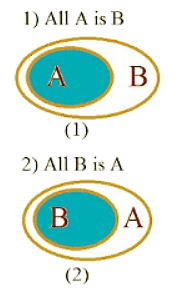
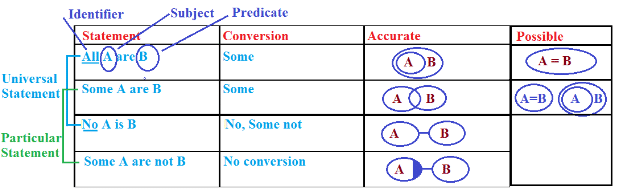
Meaning: A statement of the form All A are B (universal affirmative) means every member of class A is contained within class B. In set terms, A ⊆ B.
2. Some (Particular affirmative)
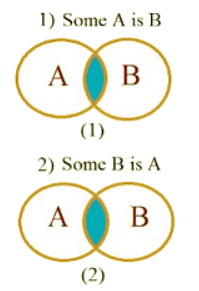
Meaning: A statement of the form Some A are B means there exists at least one element that is both in A and in B. It does not specify how many - only that the intersection A ∩ B is non-empty.
3. No (Universal negative)
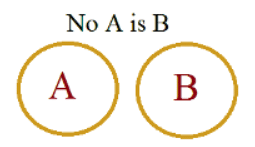
Meaning: A statement of the form No A is B (universal negative) means A and B are mutually exclusive: A ∩ B = ∅.
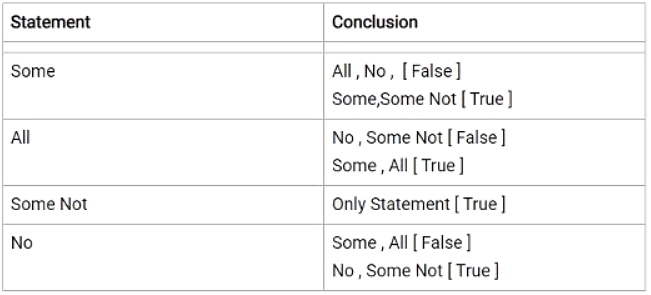
Case - All → Some

Let!
You have 1000 $ in your pocket.One of your friend needs 600 $ to pay his Bill.He wants to borrow money from you.He comes to you and say,"Do you have 600 $ ?.What would you say,"Afcoss Yes!".Even if He ask for 1 $, or 999 $ .Your answer will always "Yes!".
So Overall you had 1000 $ which is called "All " or All of the money you had & What is your friend want some of the money like here 600 or it could be 1$ or 999 $ and what we call that some portion of money out of it.or " Some".
That's why In " All " Case, "Some" is always true.
Example: Statement: All A are B.
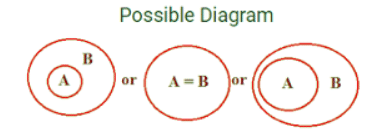
Conclusions
- All A are B - ✓ (given true)
- Some A are B - ✓ (valid if A is non-empty)
- Some B are A - ✓ (possible only if B has elements that belong to A; when diagram shows A inside B, some B are A is true if A is non-empty)
- Some A are not B - ✗ (contradicts All A are B)
- Some B are not A - ✗ (not necessarily true from All A are B)
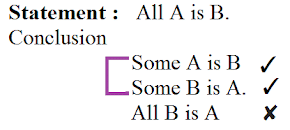
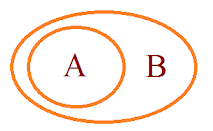
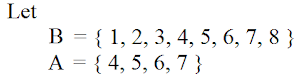
If A is entirely contained inside B (A ⊆ B), then every element of A belongs to B. That makes All A are B true. The converse All B are A is not necessarily true, because B may contain elements outside A.
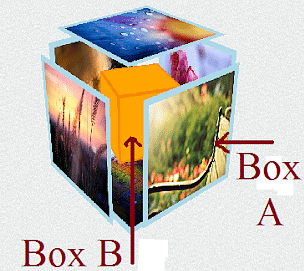
Visualise with boxes: if Box A is inside Box B then Box B cannot fit inside Box A; A ⊆ B does not imply B ⊆ A.
Case - Some ↔ Some Not

Example with exam marks: You passed an exam and got some marks. Even if you scored 99%, you missed 1%. That means there are parts you did and parts you did not. Thus, when a statement says Some A are B, it is possible to have Some A are not B simultaneously (unless more information contradicts it).
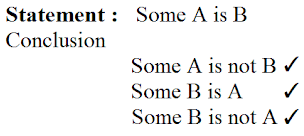
Statement: Some A are B
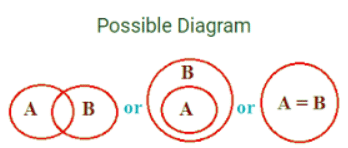
Conclusions (validity):
- All B are A - ✗
- Some B are A - ✓
- No A is B - ✗
Statement: Some A are not B

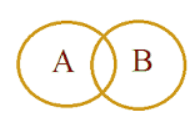
Explanation:
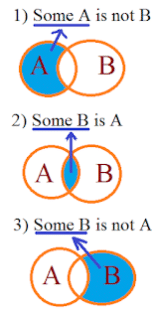
When sets A and B overlap partially, there are elements common to both (so Some A are B and Some B are A are true), and there are elements exclusive to each set (so Some A are not B and Some B are not A can also be true).
Case - No → Some Not
Example: If you have no money in your pocket, then it is true that some money is not in your pocket. A universal negative implies that some elements of the excluded class are not in the given class (provided the excluded class is non-empty).
Points to remember while solving syllogisms
- Statements may be unusual; they can state any logical relation (e.g., Some pens are fans, No fan is heater). Accept the statement as given and work only with the logical relations it asserts.
- Do not assume existence where the problem forbids it. However, in most competitive questions, particular statements (Some) imply existence of at least one element.
- Negative answers are not used to overturn a direct universal relation. Always check whether a conclusion contradicts a given universal statement.
Simple case
Examples
Example 1: Statement: Some A are B, Some B are C, All C are D

Conclusion (validity):
- Some A are not D - ✗
- Some B are D - ✓
- Some A are C - ✗
Example 2: Statement: Some A are B, Some B are C, No C is D

Conclusion (validity):
- Some B are not D - ✗
- Some D are not B - ✗
- Some A are C - ✗
Example 3: Statement: All A are B, All A are C, All A are D, No D is E
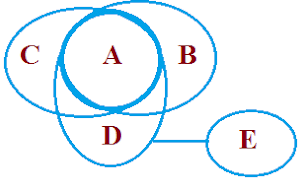
Conclusion (validity):
- Some B are not E - ✓
- Some A are not E - ✓
- No C is E - ✓
- No A is E - ✓
- No E is A - ✓
Example 4: Statement: Some A are B, Some B are C, Some C are D, Some D are E

Conclusion (validity):
- Some C are not A - ✗
- Some B are not D - ✗
- Some A are E - ✗
- All B are D - ✗
- No A is E - ✗
- Some C are A - ✗
- All B are E - ✗
- No B is E - ✗
'Either-Or' and 'Neither-Nor'
Complementary pair
- If one conclusion is positive and the other is negative, common complementary pairs are:
- No - Some
- Some - Some Not
- All - Some Not
- The two conclusions must refer to the same subject and the same predicate (or be directly complementary) for the complementary pair method to apply.
- If you cannot definitively draw either of the complementary conclusions, the correct answer is often Either Or (one of them could be true but you cannot be sure which).
Examples
Example 1: Statement: All A are B, All A are C, All A are D, No D is E, Some F is C
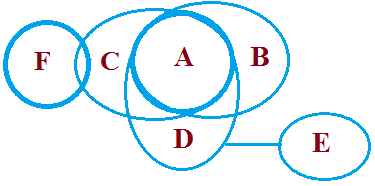
Conclusion
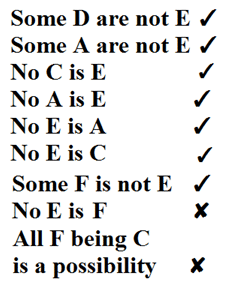
Example 2: Statement: Some A are B, Some B are C, Some C are D, Some D are E

Conclusion
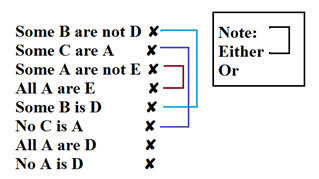
Exception:
- For universal statements (All or No), the complementary pair method may not apply directly; universals often give stronger information that changes complementary possibilities.
- Sometimes conclusions pair as Neither Nor when both complementary statements are definitely false under the given premises.
Example 3: Statement: Some A are B, All B are C, No C is D

Conclusion (validity):
- Some A are not D - ✗
- No B is D - ✗
- Some A are C - ✗
- Some D are B - ✗
Example 4: Statement: All A are B, No B is C, All C are D

Conclusion (validity):
- Some A are not D - ✗
- No D is B - ✗
- No A is C - ✓
- No A is D - ✓
- No D is A - ✗
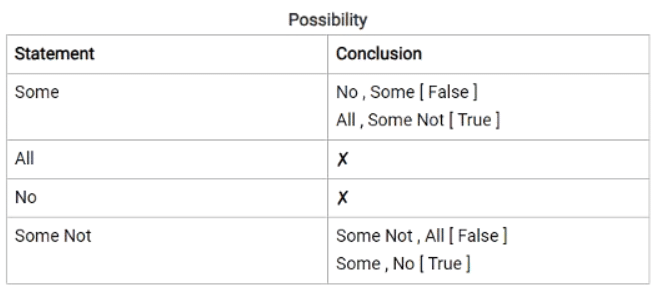
Possibility

Some conclusions use words that express possibility rather than definite truth. Words such as can be, possible, may be, might be, chances, occurs, or phrases like is a possibility indicate possibility. Conclusions phrased as possibilities are weaker than categorical conclusions and are treated differently in evaluation: if a conclusion is merely possible and not contradicted by premises, it may be considered acceptable in certain question formats that allow 'Possibility'.
Solved Examples
Example: Statement: Some A are B, Some B are C

Conclusion
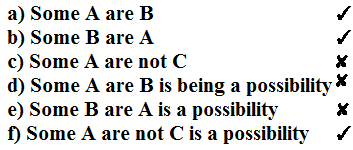
Explanation (simple case with A, B & C): Suppose A, B and C represent three people. A knows B and B knows C. A and C may not know each other. From the statements, a direct conclusion that A knows C is not supported. The conclusion about A and C would be neither positively provable nor definitely false from the given premises; it is simply not determined.
Possibility case (conclusions D, E & F): When a conclusion is phrased as a possibility (for example, "It is possible that ..."), you must check whether the premise contradicts the possibility. If the possibility does not contradict premises, it may be acceptable as a possible conclusion. For instance, seeing cloudy skies and saying "There is a possibility of rain" is acceptable because the premises do not contradict rain occurring. Therefore, a conclusion stated as a possibility can be true even when a definite conclusion cannot be drawn.
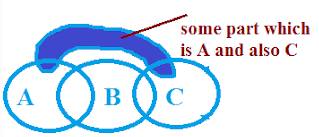
Possibility conclusions do not assert certainty; they only assert that the premise does not rule out the conclusion. Thus, a statement that is false as a definite conclusion can be true as a possibility if the premises do not contradict it.

Words indicating possibilities
- Can be
- Possible
- May be / Might be
- Chances
- Occurs
- Is a possibility
- Is possible
Words indicating surety or impossibility
- Can never be
- Can
FAQs on Tips & Tricks: Syllogism
| 1. What is syllogism in logic? |  |
| 2. How many types of syllogism are there? | |
| 3. What is the major premise in a syllogism? | |
| 4. Can you give an example of a syllogism? | |
| 5. How can I improve my syllogism skills for exams? | |