Humanities/Arts Exam > Humanities/Arts Notes > History Class 12 > Mind Map: Kings, Farmers & Town-1
Mind Map: Kings, Farmers & Town-1

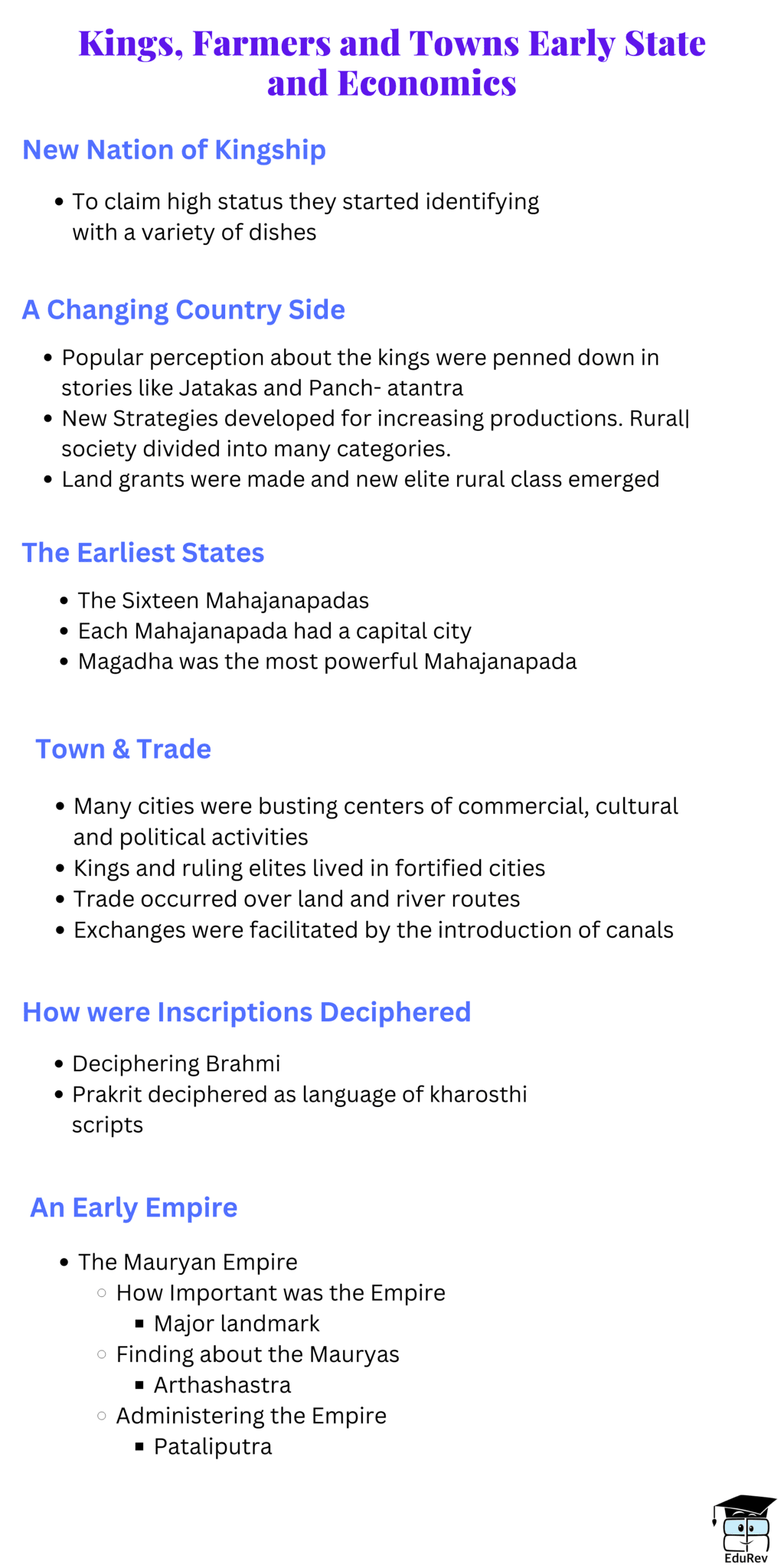
The document Mind Map: Kings, Farmers & Town-1 is a part of the Humanities/Arts Course History Class 12.
All you need of Humanities/Arts at this link: Humanities/Arts
FAQs on Mind Map: Kings, Farmers & Town-1
| 1. What are the main differences between kings, farmers, and townspeople in medieval India according to CBSE history? |  |
Ans. Kings held political and military power, controlling territories and collecting taxes. Farmers formed the agrarian backbone, producing crops and paying tributes to rulers. Townspeople engaged in trade, crafts, and commerce, creating urban economies. These three groups formed an interdependent social structure where each played distinct economic and administrative roles in early medieval society.
| 2. How did the feudal system connect kings and farmers in Class 12 history? | |
Ans. The feudal hierarchy bound kings and farmers through land-based relationships. Kings granted land to nobles in exchange for military service, while farmers worked those lands and paid agricultural taxes or produce to support the feudal order. This vertical chain of loyalty and obligation sustained medieval economies, with farmers providing essential resources that funded royal courts and military campaigns throughout kingdoms.
| 3. What role did towns and markets play in medieval Indian economy for early kingdoms? | |
Ans. Towns functioned as commercial hubs where merchants, artisans, and traders exchanged goods produced by farmers and manufactured items. Markets stimulated economic growth beyond agriculture, enabling currency circulation and craft specialisation. Towns also served administrative purposes, hosting royal courts and tax collection centres that connected rural agricultural zones with urban centres, facilitating wealth distribution across medieval kingdoms.
| 4. Why did conflict arise between kings, farmers, and townspeople in ancient Indian history? | |
Ans. Kings imposed heavy taxation on farmers to fund military expansion and court maintenance, creating resource strain. Townspeople sometimes resisted royal monopolies on trade and taxation policies. Competing land claims between rulers and agricultural communities sparked disputes. These tensions reflected competing economic interests: rulers sought revenue maximisation, farmers needed survival security, and merchants demanded trade freedom in developing medieval societies.
| 5. How do mind maps help understand the Kings, Farmers & Town relationships in CBSE history revision? | |
Ans. Mind maps visually organise hierarchical connections between social groups, showing how economic, political, and administrative networks interlinked. They highlight taxation flows, trade routes, and power dependencies at a glance, making complex feudal structures easier to grasp during Class 12 exam preparation. Refer to EduRev's detailed mind maps, flashcards, and visual worksheets for systematic understanding of medieval Indian social organisations and their interconnections.
About this Document

6.1K Views

4.85/5 Rating

Apr 29, 2026 Last updated
Related Exams
Document Description: Mind Map: Kings, Farmers & Town-1 for Humanities/Arts 2026 is part of History Class 12 preparation. The notes and questions for Mind Map: Kings, Farmers & Town-1 have been prepared according to the Humanities/Arts exam syllabus. Information about Mind Map: Kings, Farmers & Town-1 covers topics like and Mind Map: Kings, Farmers & Town-1 Example, for Humanities/Arts 2026 Exam. Find important definitions, questions, notes, meanings, examples, exercises and tests below for Mind Map: Kings, Farmers & Town-1.
Introduction of Mind Map: Kings, Farmers & Town-1 in English is available as part of our History Class 12 for Humanities/Arts & Mind Map: Kings, Farmers & Town-1 in Hindi for History Class 12 course. Download more important topics related with notes, lectures and mock test series for Humanities/Arts Exam by signing up for free. Humanities/Arts: Mind Map: Kings, Farmers & Town-1
Description
Mind Map: Kings, Farmers & Town of History Class 12 provides you one-page visual summary of the chapter covering all the important topics. Download the PDF from EduRev.
Information about Mind Map: Kings, Farmers & Town-1
In this doc you can find the meaning of Mind Map: Kings, Farmers & Town-1 defined & explained in the simplest way possible. Besides explaining types of Mind Map: Kings, Farmers & Town-1 theory, EduRev gives you an ample number of questions to practice Mind Map: Kings, Farmers & Town-1 tests, examples and also practice Humanities/Arts tests



Related Searches
Previous Year Questions with Solutions, Farmers & Town-1, Viva Questions, Mind Map: Kings, mock tests for examination, Sample Paper, pdf , ppt, Summary, MCQs, Objective type Questions, study material, Important questions, past year papers, Mind Map: Kings, Mind Map: Kings, Extra Questions, Farmers & Town-1, Exam, Free, video lectures, Semester Notes, Farmers & Town-1, shortcuts and tricks, practice quizzes;