Humanities/Arts Exam > Humanities/Arts Notes > Political Science Class 11 > Mind Map: Nationalism
Mind Map: Nationalism

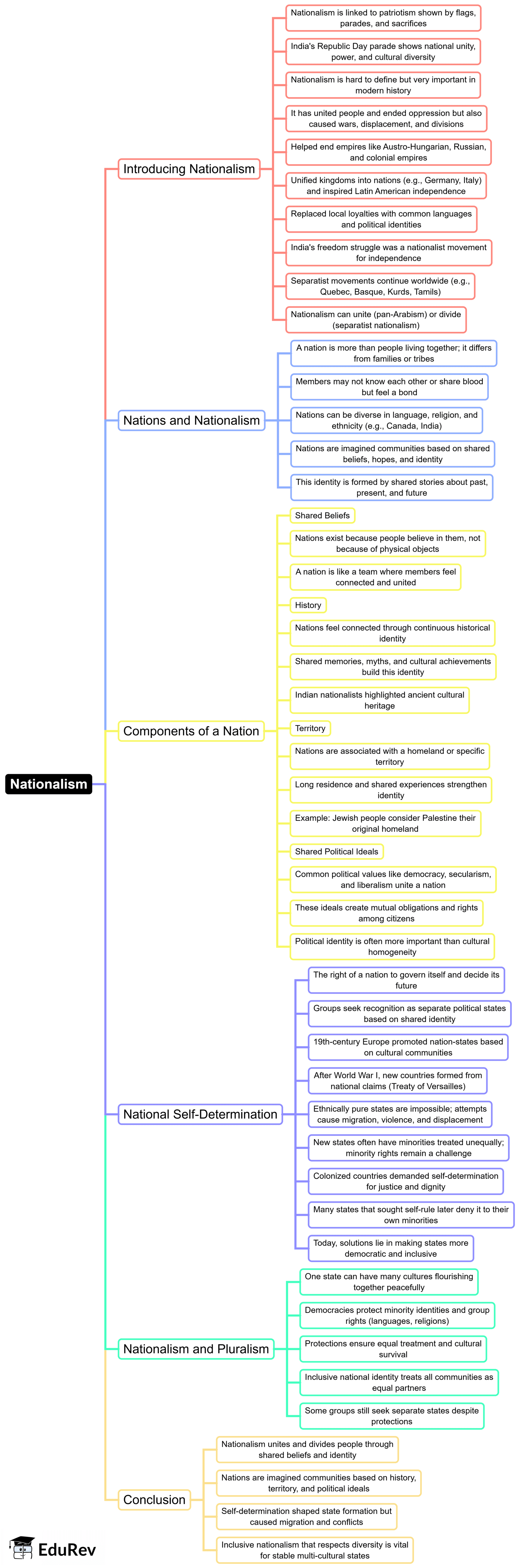
The document Mind Map: Nationalism is a part of the Humanities/Arts Course Political Science Class 11.
All you need of Humanities/Arts at this link: Humanities/Arts
FAQs on Mind Map: Nationalism
| 1. What is nationalism? |  |
Ans. Nationalism is a political ideology that emphasises the interests and culture of a particular nation, advocating for self-governance and the unification of people under a common national identity. It often involves a strong sense of pride in one's nation and can manifest in various forms, from cultural nationalism to political movements seeking independence or autonomy.
| 2. What are the key features of nationalism? | |
Ans. The key features of nationalism include a shared sense of identity among members of a nation, a common language or culture, a collective history, and the aspiration for self-determination. Nationalism often promotes the idea that the nation should be governed by its own people and can lead to movements for independence, national unification, or the preservation of national heritage.
| 3. How has nationalism influenced historical events? | |
Ans. Nationalism has significantly influenced historical events by motivating independence movements, shaping national boundaries, and fostering conflicts. For instance, the rise of nationalism in the 19th century contributed to the unification of countries like Germany and Italy and played a critical role in decolonisation efforts in the 20th century, as colonies sought self-rule and independence from imperial powers.
| 4. What are the different types of nationalism? | |
Ans. There are several types of nationalism, including civic nationalism, which focuses on shared citizenship and political values; ethnic nationalism, which is based on common ancestry and cultural identity; and religious nationalism, which intertwines national identity with a particular religion. Each type shapes the political landscape and influences how nations define their identities and policies.
| 5. What are the potential positive and negative effects of nationalism? | |
Ans. The potential positive effects of nationalism include the promotion of social cohesion, cultural pride, and political unity, which can lead to national development and self-determination. However, nationalism can also have negative effects, such as fostering exclusionary practices, ethnic conflicts, and xenophobia, as it may prioritise the interests of one group over others and create divisions within and between nations.
About this Document

4.71/5 Rating

Apr 30, 2026 Last updated
Related Exams
Document Description: Mind Map: Nationalism for Humanities/Arts 2026 is part of Political Science Class 11 preparation. The notes and questions for Mind Map: Nationalism have been prepared according to the Humanities/Arts exam syllabus. Information about Mind Map: Nationalism covers topics like and Mind Map: Nationalism Example, for Humanities/Arts 2026 Exam. Find important definitions, questions, notes, meanings, examples, exercises and tests below for Mind Map: Nationalism.
Introduction of Mind Map: Nationalism in English is available as part of our Political Science Class 11 for Humanities/Arts & Mind Map: Nationalism in Hindi for Political Science Class 11 course. Download more important topics related with notes, lectures and mock test series for Humanities/Arts Exam by signing up for free. Humanities/Arts: Mind Map: Nationalism
Description
Mind Map: Nationalism of Political Science Class 11 provides you one-page visual summary of the chapter covering all the important topics. Download the PDF from EduRev.
Information about Mind Map: Nationalism
In this doc you can find the meaning of Mind Map: Nationalism defined & explained in the simplest way possible. Besides explaining types of Mind Map: Nationalism theory, EduRev gives you an ample number of questions to practice Mind Map: Nationalism tests, examples and also practice Humanities/Arts tests



Related Searches
Extra Questions, Previous Year Questions with Solutions, MCQs, Mind Map: Nationalism, Mind Map: Nationalism, Exam, ppt, Sample Paper, Mind Map: Nationalism, Summary, study material, video lectures, Free, practice quizzes, Objective type Questions, pdf , past year papers, Important questions, mock tests for examination, Viva Questions, shortcuts and tricks, Semester Notes;