Humanities/Arts Exam > Humanities/Arts Notes > Political Science Class 12 > Mind Map: Contemporary Centres of Power
Mind Map: Contemporary Centres of Power

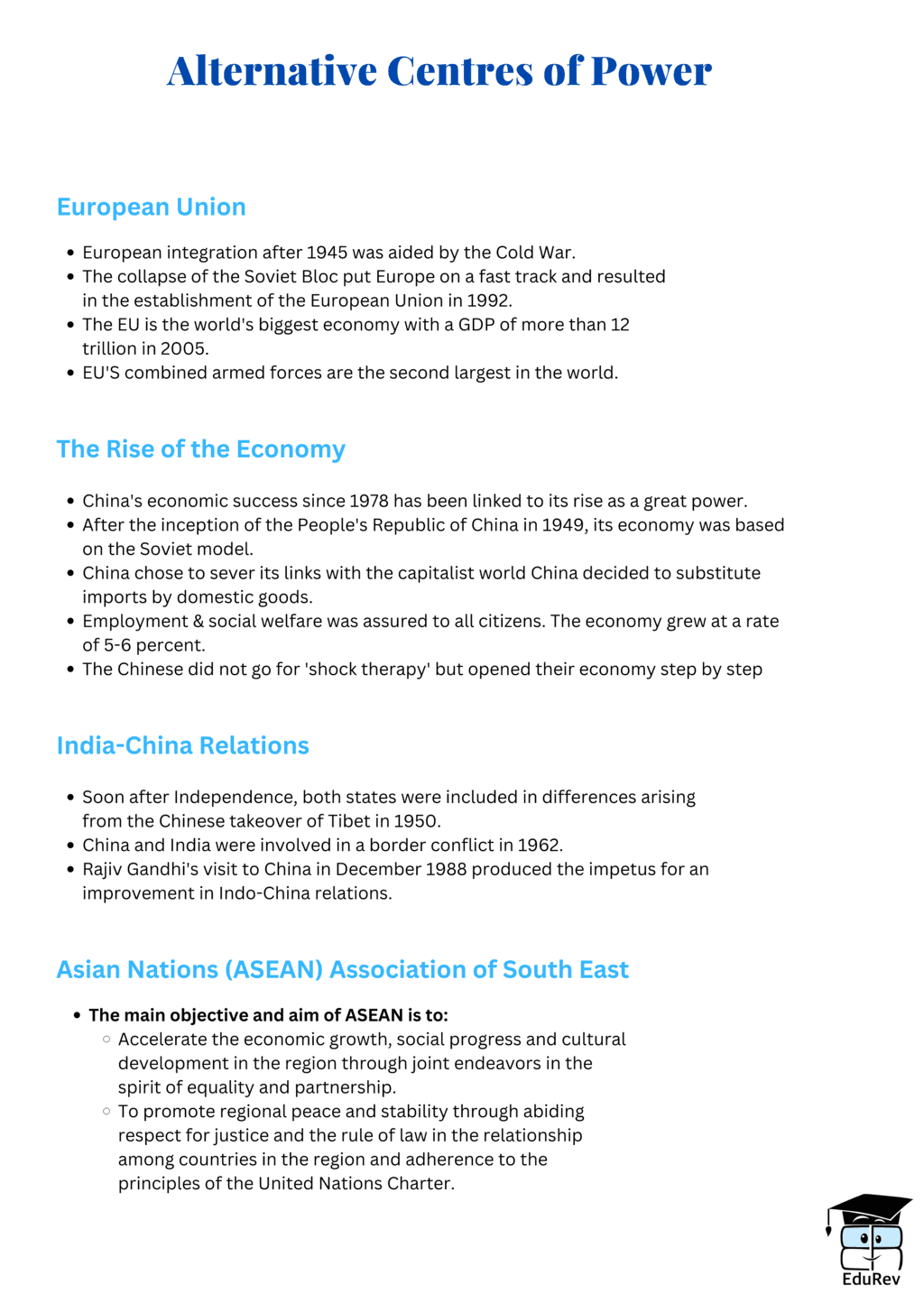
The document Mind Map: Contemporary Centres of Power is a part of the Humanities/Arts Course Political Science Class 12.
All you need of Humanities/Arts at this link: Humanities/Arts
FAQs on Mind Map: Contemporary Centres of Power
| 1. What are the main contemporary centres of power in the world right now? |  |
Ans. Contemporary centres of power refer to nations and regions that wield significant political, economic, and military influence globally-primarily the United States, China, Russia, and the European Union. These powers shape international relations, trade systems, and geopolitical outcomes through their strategic capabilities and diplomatic networks. Understanding their roles helps explain current global conflicts and alliances in Class 12 Political Science.
| 2. How does China's economic power make it a contemporary centre of power? | |
Ans. China functions as a contemporary centre of power through its massive GDP, manufacturing dominance, and technological advancement. Its Belt and Road Initiative extends influence across Asia, Africa, and Europe, creating economic interdependence. Additionally, China's military modernisation and permanent UN Security Council seat amplify its geopolitical weight in shaping international policies and regional stability.
| 3. Why is the United States still considered a superpower despite rising competition? | |
Ans. The United States maintains superpower status through unmatched military spending, technological innovation, and dollar-based global financial systems. Its NATO alliances, intelligence networks, and cultural influence span continents. Despite China's economic rise, America's diversified power-military, economic, technological, and soft power-keeps it central to contemporary international order and decision-making processes worldwide.
| 4. What role does the European Union play as a contemporary centre of power? | |
Ans. The European Union operates as a contemporary centre of power through collective economic strength, unified trade policies, and diplomatic influence. With 27 member states, it shapes global standards in technology, environment, and human rights. The EU's regulatory frameworks and international partnerships make it essential in multilateral negotiations, despite internal challenges and individual nation-state limitations affecting cohesive action.
| 5. How do emerging powers like India and Brazil influence contemporary geopolitics? | |
Ans. Emerging powers including India and Brazil challenge traditional power structures through rapid economic growth, regional influence, and BRICS membership. India's technological sector and demographic dividend enhance its strategic importance, while Brazil controls vast resources and Amazon influence. These nations demand greater representation in international institutions, reshaping the multipolar contemporary global order and reducing Western-centric decision-making in world affairs.
About this Document

4K Views

4.63/5 Rating

Apr 18, 2026 Last updated
Related Exams
Document Description: Mind Map: Contemporary Centres of Power for Humanities/Arts 2026 is part of Political Science Class 12 preparation. The notes and questions for Mind Map: Contemporary Centres of Power have been prepared according to the Humanities/Arts exam syllabus. Information about Mind Map: Contemporary Centres of Power covers topics like and Mind Map: Contemporary Centres of Power Example, for Humanities/Arts 2026 Exam. Find important definitions, questions, notes, meanings, examples, exercises and tests below for Mind Map: Contemporary Centres of Power.
Introduction of Mind Map: Contemporary Centres of Power in English is available as part of our Political Science Class 12 for Humanities/Arts & Mind Map: Contemporary Centres of Power in Hindi for Political Science Class 12 course. Download more important topics related with notes, lectures and mock test series for Humanities/Arts Exam by signing up for free. Humanities/Arts: Mind Map: Contemporary Centres of Power
Description
Mind Map: Contemporary Centres of Power of Political Science Class 12 provides you one-page visual summary of the chapter covering all the important topics. Download the PDF from EduRev.
Information about Mind Map: Contemporary Centres of Power
In this doc you can find the meaning of Mind Map: Contemporary Centres of Power defined & explained in the simplest way possible. Besides explaining types of Mind Map: Contemporary Centres of Power theory, EduRev gives you an ample number of questions to practice Mind Map: Contemporary Centres of Power tests, examples and also practice Humanities/Arts tests



Related Searches
Viva Questions, video lectures, Sample Paper, mock tests for examination, pdf , Mind Map: Contemporary Centres of Power, MCQs, Free, past year papers, ppt, Semester Notes, Extra Questions, Important questions, Mind Map: Contemporary Centres of Power, study material, practice quizzes, Mind Map: Contemporary Centres of Power, Previous Year Questions with Solutions, Objective type Questions, Summary, shortcuts and tricks, Exam;