Humanities/Arts Exam > Humanities/Arts Notes > Political Science Class 12 > Mind Map: Era of One Party Dominance
Mind Map: Era of One Party Dominance

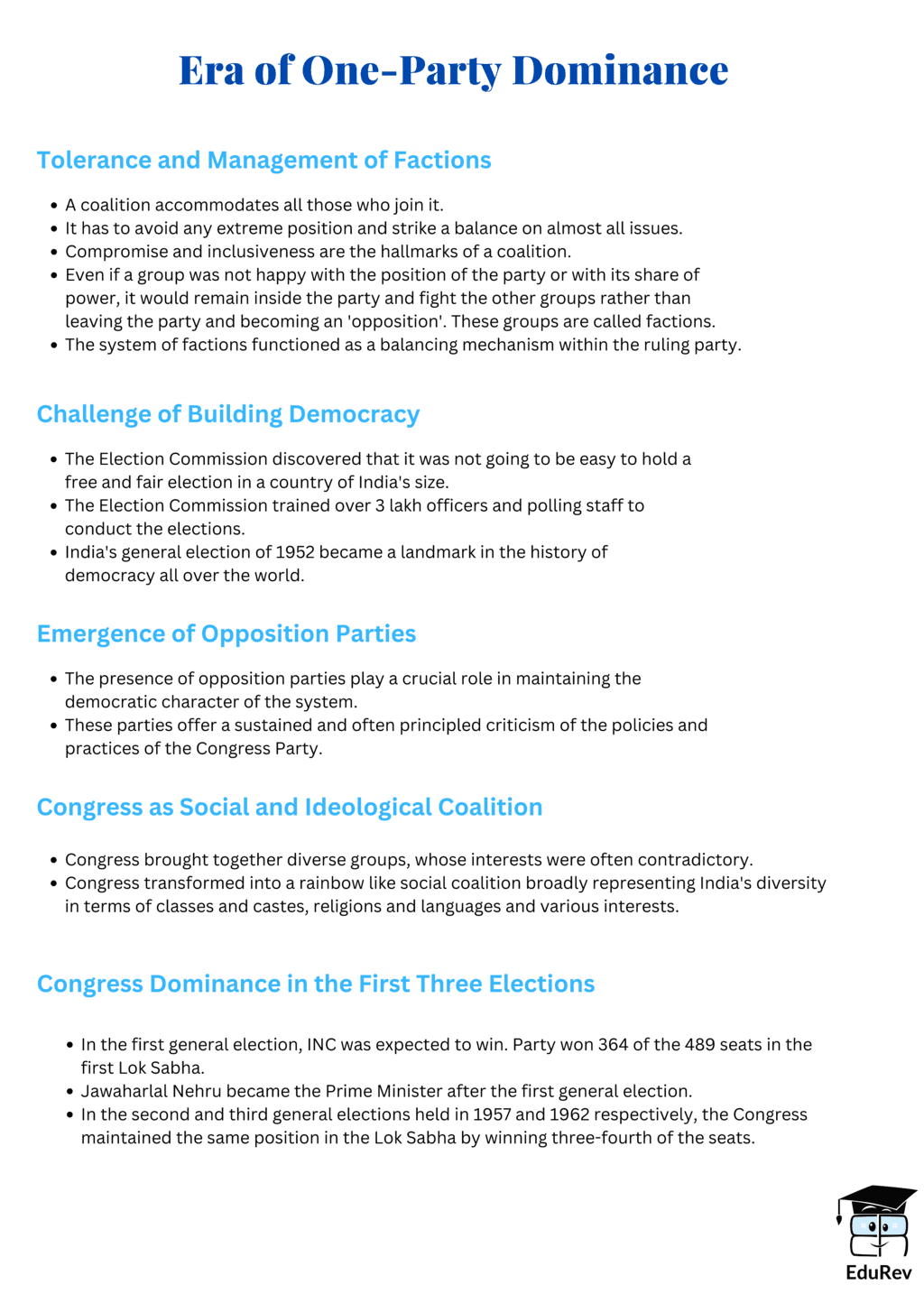
The document Mind Map: Era of One Party Dominance is a part of the Humanities/Arts Course Political Science Class 12.
All you need of Humanities/Arts at this link: Humanities/Arts
FAQs on Mind Map: Era of One Party Dominance
| 1. What exactly was the era of one party dominance in Indian politics and when did it happen? |  |
Ans. The era of one party dominance refers to the period after Indian independence when the Indian National Congress held overwhelming political power and ruled at the national level for consecutive decades. This period lasted roughly from 1947 to the late 1960s, during which Congress won successive general elections and shaped India's early democratic governance, policy direction, and nation-building process under leaders like Jawaharlal Nehru.
| 2. Why did the Congress party manage to stay in power for so long during this one party dominant system? | |
Ans. Congress maintained dominance because it led the freedom struggle, commanded widespread public trust, and had a strong organisational network across India. The party benefited from fragmented opposition, widespread support among diverse communities, and its association with Nehru's secular, progressive vision. Additionally, regional parties hadn't yet consolidated, allowing Congress to win successive elections and maintain its hegemonic control over Indian politics during this critical nation-building phase.
| 3. What were the main characteristics of one party dominance that made Congress different from other political parties at that time? | |
Ans. Congress operated as a catch-all party, accommodating diverse ideologies and regional interests under a single umbrella structure. It maintained centralised leadership while allowing internal debate, commanded resources and organisational strength no rival could match, and enjoyed legitimacy from leading independence. Congress monopolised media coverage, possessed superior electoral machinery, and successfully incorporated local leaders across states, creating an unmatched political advantage that subordinate parties couldn't challenge during this dominant system.
| 4. How did one party dominance affect India's democratic development and why did it eventually decline? | |
Ans. One party dominance enabled rapid policy implementation and nation-building but limited competitive democracy and accountability mechanisms. Decline began in the 1960s due to internal Congress fragmentation, rising regional consciousness, agrarian discontent, and emergence of strong state-level parties. The 1967 elections marked a turning point when Congress lost several state assemblies. Growing anti-incumbency, linguistic and caste-based mobilisation, and Indira Gandhi's controversial Emergency further eroded Congress's monopoly, fundamentally reshaping India's competitive political landscape.
| 5. What's the difference between the Nehruvian consensus and one party dominance-are they the same thing in CBSE Political Science? | |
Ans. The Nehruvian consensus refers to the broad ideological agreement on secularism, democracy, and planned economic development, while one party dominance describes Congress's institutional monopoly on power. The consensus was the shared political philosophy across society; dominance was Congress's electoral and organisational superiority enabling it to implement that vision unchallenged. Both coexisted but represented different aspects-one ideological, one structural-of India's early democratic period under Nehru's leadership.
About this Document

2.6K Views

4.70/5 Rating

Apr 22, 2026 Last updated
Related Exams
Document Description: Mind Map: Era of One Party Dominance for Humanities/Arts 2026 is part of Political Science Class 12 preparation. The notes and questions for Mind Map: Era of One Party Dominance have been prepared according to the Humanities/Arts exam syllabus. Information about Mind Map: Era of One Party Dominance covers topics like and Mind Map: Era of One Party Dominance Example, for Humanities/Arts 2026 Exam. Find important definitions, questions, notes, meanings, examples, exercises and tests below for Mind Map: Era of One Party Dominance.
Introduction of Mind Map: Era of One Party Dominance in English is available as part of our Political Science Class 12 for Humanities/Arts & Mind Map: Era of One Party Dominance in Hindi for Political Science Class 12 course. Download more important topics related with notes, lectures and mock test series for Humanities/Arts Exam by signing up for free. Humanities/Arts: Mind Map: Era of One Party Dominance
Description
Mind Map: Era of One Party Dominance of Political Science Class 12 provides you one-page visual summary of the chapter covering all the important topics. Download the PDF from EduRev.
Information about Mind Map: Era of One Party Dominance
In this doc you can find the meaning of Mind Map: Era of One Party Dominance defined & explained in the simplest way possible. Besides explaining types of Mind Map: Era of One Party Dominance theory, EduRev gives you an ample number of questions to practice Mind Map: Era of One Party Dominance tests, examples and also practice Humanities/Arts tests



Related Searches
Free, pdf , study material, Exam, Previous Year Questions with Solutions, Important questions, mock tests for examination, Sample Paper, ppt, Viva Questions, Extra Questions, Mind Map: Era of One Party Dominance, practice quizzes, MCQs, Semester Notes, past year papers, video lectures, Mind Map: Era of One Party Dominance, Mind Map: Era of One Party Dominance, shortcuts and tricks, Objective type Questions, Summary;