Humanities/Arts Exam > Humanities/Arts Notes > Geography Class 11 > Mind Map: Geomorphic Processes
Mind Map: Geomorphic Processes

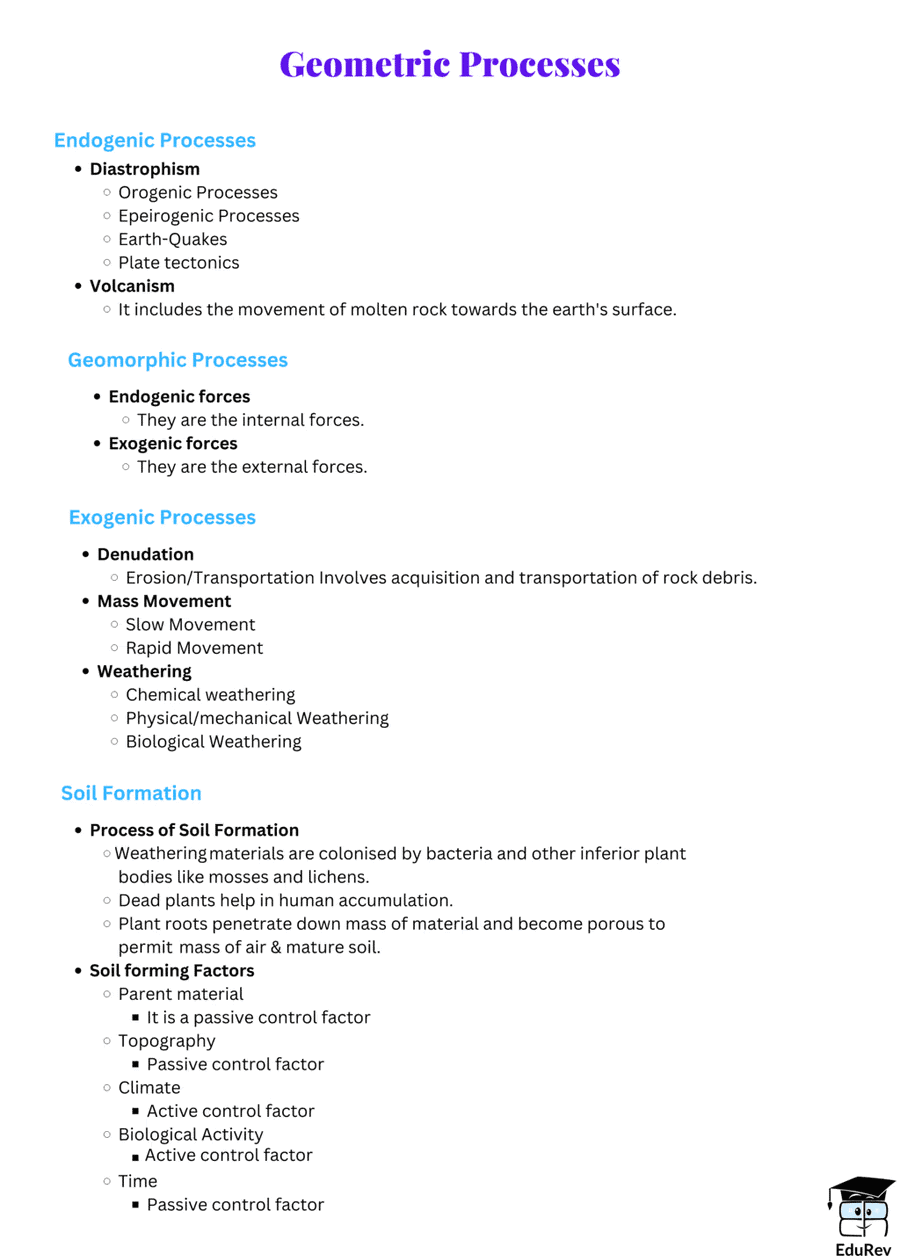
The document Mind Map: Geomorphic Processes is a part of the Humanities/Arts Course Geography Class 11.
All you need of Humanities/Arts at this link: Humanities/Arts
FAQs on Mind Map: Geomorphic Processes
| 1. What are the main types of geomorphic processes? |  |
Ans. The main types of geomorphic processes are weathering, erosion, transportation, and deposition. Weathering involves the breaking down of rocks into smaller particles, while erosion refers to the removal of these particles by natural forces such as water, wind, or ice. Transportation is the movement of eroded materials, and deposition occurs when these materials settle in a new location, forming new landforms.
| 2. How do human activities influence geomorphic processes? | |
Ans. Human activities, such as deforestation, urbanization, and mining, can significantly alter geomorphic processes. Deforestation can increase soil erosion as tree roots that stabilize the soil are removed. Urbanization leads to increased runoff and can change the natural flow of water, while mining can remove large areas of land and disrupt natural processes, leading to increased erosion and sedimentation in nearby waterways.
| 3. What is the role of climate in shaping geomorphic processes? | |
Ans. Climate plays a crucial role in shaping geomorphic processes by influencing weathering rates, erosion, and sediment transport. For instance, areas with high rainfall may experience more intense weathering and erosion due to increased water flow, while arid regions may see slower weathering processes. Temperature variations can also affect freeze-thaw cycles, impacting rock breakdown and landscape formation.
| 4. Can you explain the difference between mechanical and chemical weathering? | |
Ans. Mechanical weathering involves the physical breakdown of rocks into smaller pieces without changing their chemical composition, often through processes like freeze-thaw or abrasion. In contrast, chemical weathering involves the alteration of the chemical structure of rocks, such as when minerals react with water or acids, leading to changes in the rock's properties and structure.
| 5. What are some common landforms created by geomorphic processes? | |
Ans. Common landforms created by geomorphic processes include mountains, valleys, plateaus, hills, and deltas. Mountains can form through tectonic forces and erosion, valleys are typically shaped by river erosion, plateaus result from volcanic activity or uplift, hills may form through deposition, and deltas are created where rivers deposit sediments at their mouths, leading to fertile land.
About this Document

1.7K Views

4.98/5 Rating

Apr 29, 2026 Last updated
Related Exams
Document Description: Mind Map: Geomorphic Processes for Humanities/Arts 2026 is part of Geography Class 11 preparation. The notes and questions for Mind Map: Geomorphic Processes have been prepared according to the Humanities/Arts exam syllabus. Information about Mind Map: Geomorphic Processes covers topics like and Mind Map: Geomorphic Processes Example, for Humanities/Arts 2026 Exam. Find important definitions, questions, notes, meanings, examples, exercises and tests below for Mind Map: Geomorphic Processes.
Introduction of Mind Map: Geomorphic Processes in English is available as part of our Geography Class 11 for Humanities/Arts & Mind Map: Geomorphic Processes in Hindi for Geography Class 11 course. Download more important topics related with notes, lectures and mock test series for Humanities/Arts Exam by signing up for free. Humanities/Arts: Mind Map: Geomorphic Processes
Description
Mind Map: Geomorphic Processes of Geography Class 11 provides you one-page visual summary of the chapter covering all the important topics. Download the PDF from EduRev.
Information about Mind Map: Geomorphic Processes
In this doc you can find the meaning of Mind Map: Geomorphic Processes defined & explained in the simplest way possible. Besides explaining types of Mind Map: Geomorphic Processes theory, EduRev gives you an ample number of questions to practice Mind Map: Geomorphic Processes tests, examples and also practice Humanities/Arts tests



Related Searches
practice quizzes, Extra Questions, Mind Map: Geomorphic Processes, past year papers, Sample Paper, Exam, pdf , Previous Year Questions with Solutions, Viva Questions, MCQs, Mind Map: Geomorphic Processes, Summary, Free, Important questions, study material, Mind Map: Geomorphic Processes, video lectures, mock tests for examination, shortcuts and tricks, Objective type Questions, Semester Notes, ppt;