Quartiles Quartiles

Quartile Formula
The quartile formula helps in calculating the value that divides a list of numbers into quarters. The data is firstly arranged into ascending order and is then divided into quartiles. Median divides a given data into two equal parts while quartiles divide it into four parts. Using the quartile formula we can find the first quartile, second quartile, and third quartile.
What Is Quartile Formula?
The quartile formula helps to divide a set of observations into 4 equal parts. The first quartile lies in the middle of the first term and the median. The median is the second quartile. The middle value lying between the median and the last term is the third quartile. Mathematically, they are represented as follows,
When the set of observations are arranged in ascending order the quartiles are represented as,
- First Quartile(Q1) = ((n + 1)/4)th Term
- Second Quartile(Q2) = ((n + 1)/2)th Term
- Third Quartile(Q3) = (3(n + 1)/4)th Term
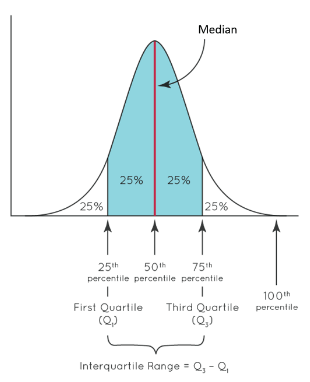
1st quartile is also known as the lower quartile. 2nd quartile is the same as the median dividing data into 2 equal parts. 3rd quartile is also called the upper quartile.
The interquartile range is calculated as Upper Quartile - Lower Quartile.
Solved Example
Example 1: Calculate the median, lower quartile, upper quartile, and interquartile range of the following data set of values: 20, 19, 21, 22, 23, 24, 25, 27, 26
Arranging the values in ascending order: 19, 20, 21, 22, 23, 24, 25, 26, 27
Putting the values in the formulas above we get,
Median(Q2) = 5th Term = 23
Lower Quartile (Q1) = Mean of 2nd and 3rd term = (20 + 21)/2 = 20.5
Upper Quartile(Q3) = Mean of 7th and 8th term = (25 + 26)/2 = 25.5
IQR = Upper Quartile-Lower Quartile
IQR = 25.5 - 20.5
IQR = 5
Example 2: What will be the upper quartile for the following set of numbers?
26, 19, 5, 7, 6, 9, 16, 12, 18, 2, 1.
The formula for the upper quartile formula is Q3 = ¾(n + 1)th Term.
The formula instead of giving the value for the upper quartile gives us the place. For example, 8th place, 10th place, etc.
So firstly we put your numbers in ascending order: 1, 2, 5, 6, 7, 9, 12, 16, 18, 19, 26. There are a total of 11 numbers, so:
Q3 = ¾(n + 1)th Term.
Q3 = ¾(12)th Term. = 9th Term.
The upper quartile (18) is the 9th term or on the 9th place from the left.
Example 3: Find the 3rd quartile in the following data set: 4, 5, 8, 7, 11, 9, 9
Let us first arrange our array in ascending order and it becomes 4, 5, 7, 8, 9, 9, 11
The median of our data is 8.
In order to find the 3rd quartile, we have to deal with the data points that are greater than the median that is 9, 9, 10.
In order to find the 3rd quartile, we have to find the median of the data points that are greater than the median that is 9, 9, 10.




