Grade 10 Exam > Grade 10 Notes > Physics > Radioactive Decay
Radioactive Decay

Unstable Nuclei
- Some atomic nuclei are unstable
- This is because of an imbalance in the forces within the nucleus
- Forces exist between the particles in the nucleus
- Carbon-14 is an isotope of carbon which is unstable
- It has two extra neutrons compared to stable carbon-12
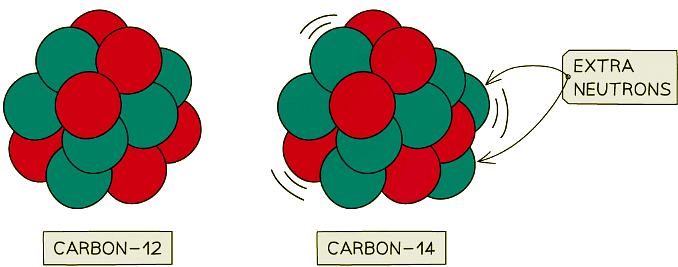 Carbon-12 is stable, whereas carbon-14 is unstable. This is because carbon-14 has two extra neutrons
 - Some isotopes are unstable because of their large size or because they have too many or too few neutrons
- It has two extra neutrons compared to stable carbon-12
Radiation
- Unstable nuclei can emit radiation to become more stable
- Radiation can be in the form of a high energy particle or wave
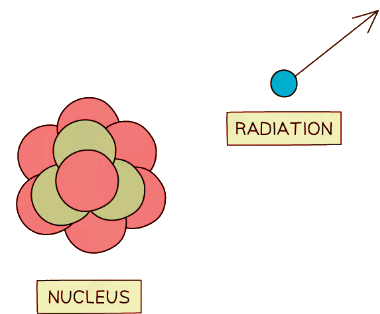 Unstable nuclei decay by emitting high energy particles or waves
 - As the radiation moves away from the nucleus, it takes some energy with it
- This reduces the overall energy of the nucleus
- This makes the nucleus more stable
- The process of emitting radiation is called radioactive decay
- Radioactive decay is a random process
- This means it is not possible to know exactly when a particular nucleus will decay
Tips
- The terms unstable, random and decay have very particular meanings in this topic. Remember to use them correctly when answering questions!
- Do not confuse activity and count rate. Activity is the rate at which unstable nuclei decay, whereas count rate is the rate at which radioactive emissions are detected.
Activity
- Objects containing radioactive nuclei are called sources of radiation
- Sources of radiation decay at different rates which are defined by their activity
- The activity is defined as
- The rate at which the unstable nuclei from a source of radiation decays
- Activity is measured in Becquerels
- The symbol for Becquerels is Bq
- 1 Becquerel is equal to 1 nucleus in the source decaying in 1 second
Example: A source of radiation has an activity of 2000 Bq. How many unstable atoms decay in 2 minutes?
Step 1: Determine the activity
- The activity of the source is 2000 Bq
- This means 2000 nuclei decay every second
Step 2: Determine the time period in seconds
- The time period is 2 minutes
- Each minute has 60 seconds
- The time period in seconds is:
2 × 60 = 120 secondsStep 3: Multiply the activity by the time period
Activity (Bq) × Time period (s) = 2000 × 120 = 240 000
Therefore, 240 000 unstable nuclei decay in 2 minutes
Detecting Radiation
- Radiation that is emitted from an unstable nucleus can be detected in different ways
- For example, photographic film changes colour when exposed to radiation
- A Geiger-Muller tube is a device used to detect radiation
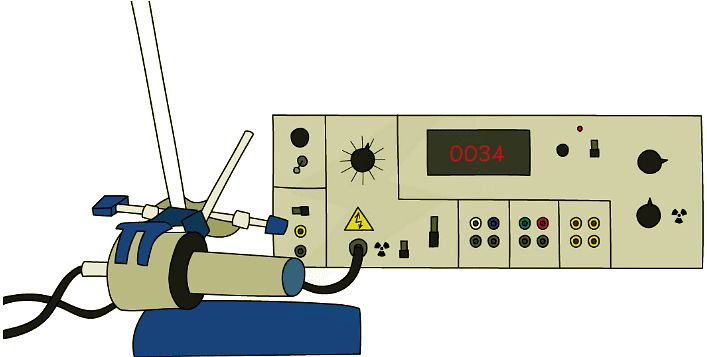 This Geiger-Muller Tube is connected to a Geiger Counter. This a common way of detecting radiation and measuring a count-rate
 - Within the Geiger-Muller tube, ions are created by radiation passing through it
- The Geiger-Muller tube can be connected to a Geiger counter
- This counts the ions created in the Geiger-Muller tube
- Count-rate is the number of decays recorded each second by a detector
Example: A Geiger-Muller tube is used to detect radiation in a particular location. If it counts 16,000 decays in 1 hour, what is the count rate?
Step 1: Identify the different variables
- The number of decays is 16 000
- The time is 1 hour
Step 2: Determine the time period in seconds
- 1 hour is equal to 60 minutes, and 1 minute is equal to 60 seconds
Time period = 1 × 60 × 60 = 3600 secondsStep 3: Divide the total counts by the time period in seconds
Counts ÷ Time period = 16 000 ÷ 3600 = 4.5
Therefore, there are 4.5 decays per second
The document Radioactive Decay is a part of the Grade 10 Course Physics for Grade 10.
All you need of Grade 10 at this link: Grade 10
About this Document

4.67/5 Rating

Apr 29, 2026 Last updated
Document Description: Radioactive Decay for Grade 10 2026 is part of Physics for Grade 10 preparation. The notes and questions for Radioactive Decay have been prepared according to the Grade 10 exam syllabus. Information about Radioactive Decay covers topics like and Radioactive Decay Example, for Grade 10 2026 Exam. Find important definitions, questions, notes, meanings, examples, exercises and tests below for Radioactive Decay.
Introduction of Radioactive Decay in English is available as part of our Physics for Grade 10 for Grade 10 & Radioactive Decay in Hindi for Physics for Grade 10 course. Download more important topics related with notes, lectures and mock test series for Grade 10 Exam by signing up for free. Grade 10: Radioactive Decay
Description
Radioactive Decay of Physics covers all the important topics, helping you prepare for the Grade 10 exam on EduRev. Start for free!
Information about Radioactive Decay
In this doc you can find the meaning of Radioactive Decay defined & explained in the simplest way possible. Besides explaining types of Radioactive Decay theory, EduRev gives you an ample number of questions to practice Radioactive Decay tests, examples and also practice Grade 10 tests



Related Searches
Free, Extra Questions, Important questions, ppt, practice quizzes, Sample Paper, shortcuts and tricks, MCQs, Semester Notes, past year papers, pdf , video lectures, study material, Radioactive Decay, Viva Questions, Exam, Objective type Questions, Radioactive Decay, Summary, Previous Year Questions with Solutions, mock tests for examination, Radioactive Decay;