CTET & State TET Exam  >  CTET & State TET Notes  >  NCERT Textbooks in Hindi (Class 6 to Class 12)  >  NCERT Solutions: भूमि, मृदा, जल, प्राकृतिक वनस्पति और वन्य जीवन संसाधन ( Land, Soil, Water, Natural

NCERT Solutions: भूमि, मृदा, जल, प्राकृतिक वनस्पति और वन्य जीवन संसाधन ( Land, Soil, Water, Natural

प्रश्न.1. निम्न प्रश्नों के उत्तर दीजिए
(क) मृदा निर्माण के लिए उत्तरदायी दो मुख्य जलवायु कारक कौन-से हैं?

मृदा निर्माण के दो मुख्य जलवायु कारक-

(i) तापमान

(ii) वर्षण

(ख) भूमि निम्नीकरण के कोई दो कारण लिखिए।

(i) मानवीय कारण-वनोन्मूलन, अतिचारण,रासायनिक उर्वरकों और कीटनाशकों का अत्यधिक उपयोग।

(ii) प्राकृतिक कारण-वर्षा दोहन,भूस्खलन और बाढ़।

(ग) भूमि को महत्त्वपूर्ण संसाधन क्यों माना जाता है?

भूमि हमारे जीवन का आधार है। इसके बिना हमें आवास, खाना, पानी आदि कुछ भी प्राप्त नहीं होगा।

(घ) किन्हीं दो सोपानों के नाम बताइए जिन्हें सरकार ने पौधों और प्राणियों के संरक्षण के लिए आरंभ किया है।

दो सोपान-
(i) 
जैवमंडल निचय तथा राष्ट्रीय उद्यानों की स्थापना।
(ii) अवैध शिकार और कटाई आदि पर रोक लगाना।

(ङ) जल संरक्षण के तीन तरीके बताइए।

(i) वृक्षारोपण
(ii) रिसाव व वाष्पीकरण रोकना
(iii) वर्षा जल संग्रहण


प्रश्न.2. सही उत्तर को चिह्नित कीजिए-
(क) निम्नलिखित में से कौन-सा कारक मृदा निर्माण का नहीं है?
(i) समय
(ii) मृदा का गठन
(iii) जैव पदार्थ

सही उत्तर (ii) मृदा का गठन

(ख) निम्नलिखित में से कौन-सी विधि तीव्र ढालों पर मृदा अपरदन को रोकने के लिए सर्वाधिक उपयुक्त है?
(i) रक्षक मेखला
(ii) मलचिंग
(iii) वेदिका कृषि

सही उत्तर (iii) वेदिका कृषि

(ग) निम्नलिखित में से कौन-सा प्रकृति के संरक्षण के अनुकूल नहीं है?
(i) जब आवश्यकता न हो तो बल्ब को बंद कर देना चाहिए।
(ii) नल को उपयोग के बाद तुरंत बंद कर देना चाहिए।
(iii) खरीदारी के बाद पॉली पैक को नष्ट कर देना चाहिए।

सही उत्तर (iii) खरीदारी के बाद पॉली पैक को नष्ट कर देना चाहिए।


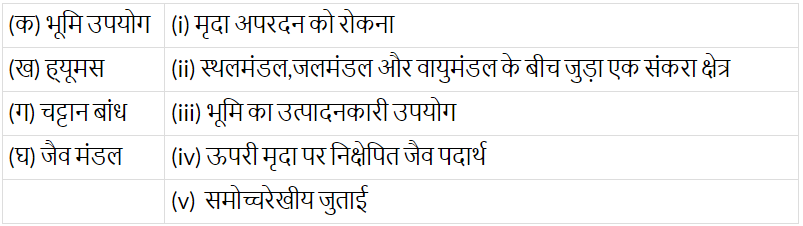
प्रश्न.3. निम्नलिखित का मिलान कीजिए-
NCERT Solutions: भूमि, मृदा, जल, प्राकृतिक वनस्पति और वन्य जीवन संसाधन ( Land, Soil, Water, Natural

(क) भूमि उपयोग - (i) भूमि का उत्पादनकारी उपयोग
(ख) ह्यूमस - (ii) ऊपरी मृदा पर निक्षेपित जैव पदार्थ
(ग) चट्टान बांध - (iii) मृदा अपरदन को रोकना
(घ) जैव मंडल - (iv) स्थलमंडल,जलमंडल और वायुमंडल के बीच जुड़ा एक संकरा क्षेत्र


प्रश्न.4. निम्नलिखित कथनों में से सत्य अथवा असत्य बताइए। यदि सत्य है तो उसके कारण लिखिए-

(i) भारत का गंगा, ब्रह्मपुत्र का मैदान अत्यधिक आबाद प्रदेश है।

सत्य
कारण: 
यह मैदान अत्यधिक उपजाऊ है जिसके कारण अधिक जनसंख्या का भरण-पोषण कर सकता है। - इस मैदान की जलवायु मानवीय गतिविधियों के अनुकूल हैं। यह मैदान समतल है जिसके कारण यातायात के साधनों, नगरों तथा उद्योगों का विकास हुआ है।

(ii) भारत में प्रतिव्यक्ति जल की उपलब्धता कम हो रही है।

सत्य
कारण:
भारत की जनसंख्या तेजी से बढ़ रही है। - प्रदूषण के कारण जल दूषित हो रहा है।

(iii) तटीय क्षेत्रों में पवन गति रोकने के लिए वृक्ष कतार में लगाए जाते हैं, जिसे बीच की फसल उगाना कहते हैं।

सत्य
कारण:
पवन गति रोकने के लिए वृक्ष कतारों में लगाए जाते हैं। ताकि मृदा अपरदन कम हो।

(iv) मानवीय हस्तक्षेप और जलवायु परिवर्तन पारितंत्र को व्यवस्थित रख सकते हैं।

असत्य

The document NCERT Solutions: भूमि, मृदा, जल, प्राकृतिक वनस्पति और वन्य जीवन संसाधन ( Land, Soil, Water, Natural is a part of the CTET & State TET Course NCERT Textbooks in Hindi (Class 6 to Class 12).
All you need of CTET & State TET at this link: CTET & State TET

FAQs on NCERT Solutions: भूमि, मृदा, जल, प्राकृतिक वनस्पति और वन्य जीवन संसाधन ( Land, Soil, Water, Natural

1. What is the difference between soil and land in geography?
Ans. Land refers to the Earth's surface including all natural features, while soil is the uppermost layer of weathered rock and organic matter that supports plant growth. Soil develops through the breakdown of parent rock material over time, containing minerals, humus, water, and air. Land encompasses broader terrain including mountains, plains, and plateaus, whereas soil is specifically the fertile medium found on land. Understanding this distinction is crucial for CBSE geography studies on natural resources.
2. How does soil erosion affect agricultural productivity and food security?
Ans. Soil erosion removes the nutrient-rich topsoil layer essential for crop cultivation, directly reducing agricultural productivity and threatening food security. When soil is washed away by water or wind, fertile land becomes barren and unsuitable for farming. This process degrades land quality, increases desertification, and forces farmers to use more fertilisers to compensate for lost nutrients. Preventing soil degradation through conservation methods is vital for sustainable agriculture and maintaining natural resources.
3. What are the main types of natural vegetation and how do they relate to climate zones?
Ans. Natural vegetation includes tropical forests, temperate woodlands, grasslands, and desert scrub, each adapted to specific climate zones and rainfall patterns. Tropical forests thrive in high-temperature, high-rainfall regions, while grasslands develop in moderate rainfall areas. Desert vegetation survives in arid conditions with minimal water. Climate determines the type of flora, soil composition, and wildlife habitats in each region. This relationship between climate and natural vegetation is essential for understanding ecosystems in CBSE geography.
4. Why do some regions have better soil fertility than others?
Ans. Soil fertility depends on mineral content, organic matter (humus), climate, parent rock composition, and weathering processes that vary by region. Alluvial soils near river valleys are highly fertile due to nutrient-rich sediment deposits, while laterite soils in tropical regions may be less fertile despite heavy rainfall. Soil texture, drainage capacity, and microbial activity also influence productivity. Black soil, red soil, and clay soil each possess distinct fertility levels based on their geological origin and chemical properties.
5. How does deforestation impact wildlife habitats and biodiversity loss?
Ans. Deforestation destroys natural habitats, forcing wildlife species into smaller areas and causing biodiversity loss, ecosystem collapse, and species extinction. When forests-critical ecosystems supporting fauna and flora-are cleared for agriculture or urban development, animals lose shelter, food sources, and breeding grounds. This fragmentation isolates animal populations, reduces genetic diversity, and disrupts food chains. Forest conservation and wildlife protection are interconnected; preserving natural vegetation directly protects endangered species and maintains ecological balance in natural resource management.
Explore Courses for CTET & State TET exam
Get EduRev Notes directly in your Google search
Related Searches
प्राकृतिक वनस्पति और वन्य जीवन संसाधन ( Land, मृदा, Water, Natural, Previous Year Questions with Solutions, प्राकृतिक वनस्पति और वन्य जीवन संसाधन ( Land, Free, mock tests for examination, NCERT Solutions: भूमि, NCERT Solutions: भूमि, मृदा, Exam, study material, Water, Water, जल, Soil, ppt, Objective type Questions, Soil, Summary, Extra Questions, जल, प्राकृतिक वनस्पति और वन्य जीवन संसाधन ( Land, Viva Questions, Natural, मृदा, Natural, Important questions, MCQs, pdf , NCERT Solutions: भूमि, past year papers, Semester Notes, जल, Soil, video lectures, Sample Paper, practice quizzes, shortcuts and tricks;

