Grade 11 Exam > Grade 11 Notes > AP Physics 2 > Seismic Waves
Seismic Waves

What are Seismic Waves
- Earthquakes produce two types of waves:
- P-waves (primary waves)
- S-waves (secondary waves)
- These waves pass through the Earth's centre and can be detected at various points around the Earth using seismometers
- By carefully timing the arrival of the waves at each point, the location of the earthquake, along with its magnitude, can be pinpointed
P-Waves
- P-waves are longitudinal waves
- These waves can pass through solids and liquids
- P-waves are faster than S-waves
- They are very low frequency sound waves known as infrasound
- Infrasound is any sound below the frequency of human hearing (<20 Hz)
- The waves refract as they pass through the different layers of the Earth
- This refraction affects the regions in which waves can be detected, yielding important information about the nature and size of the Earth's various layers
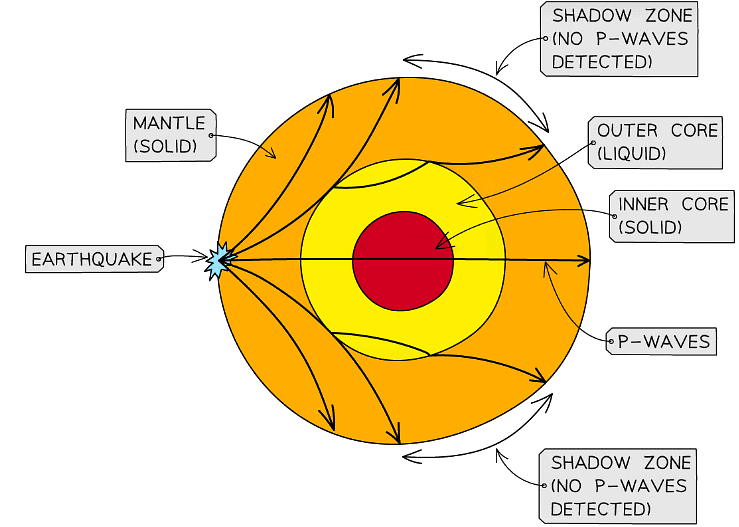 Low frequency sound waves (P-waves) produced by earthquakes, pass through the centre of the Earth, revealing useful information about its structure
S-Waves
- S-waves are a type of transverse wave
- Unlike P-waves, S-waves are unable to travel through liquids
- They pass through solids only
- S-waves are slower than P-waves
- This means that they are unable to travel through the Earth's molten (liquid) outer core - providing important evidence about its state and size
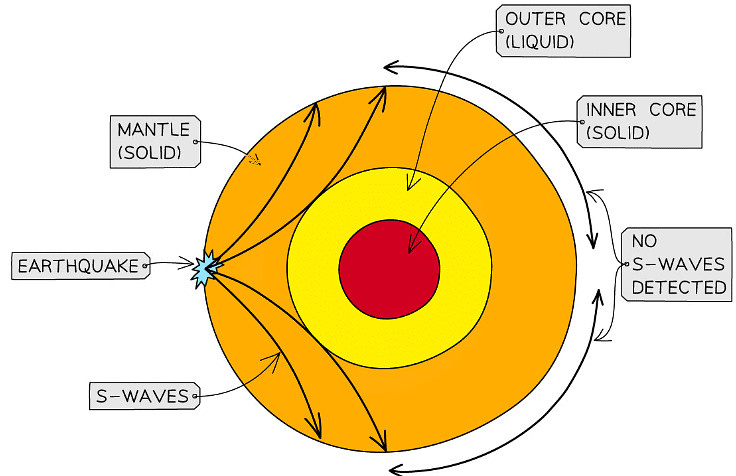
Transverse S-Waves are unable to pass through the Earth's liquid outer core
Discoveries from Seismic Waves
- The interior of the Earth is not directly observable as it is not physically possible to drill that far
- The furthest humans have managed to drill down is 12.2 km - whereas the radius of the Earth is over 6000 km!
- Seismic waves provide vital evidence that has led to a greater understanding of the structure of the Earth
- The two main discoveries are:
- On the opposite side of the Earth to an earthquake, only P-waves are detected, not S-waves, this suggests:
- The mantle is solid - this is because both types of wave can pass through it
- The outer core of the Earth is liquid - hence no S-waves can penetrate it
- Refractions between layers cause two shadow zones, where no P-waves are detected, this suggests:
- The inner core is solid - this is due to the size and positions of these shadow zones which indicate large refraction taking place
- On the opposite side of the Earth to an earthquake, only P-waves are detected, not S-waves, this suggests:
The document Seismic Waves is a part of the Grade 11 Course AP Physics 2.
All you need of Grade 11 at this link: Grade 11
About this Document

4.77/5 Rating

Apr 29, 2026 Last updated
Related Exams
Document Description: Seismic Waves for Grade 11 2026 is part of AP Physics 2 preparation. The notes and questions for Seismic Waves have been prepared according to the Grade 11 exam syllabus. Information about Seismic Waves covers topics like and Seismic Waves Example, for Grade 11 2026 Exam. Find important definitions, questions, notes, meanings, examples, exercises and tests below for Seismic Waves.
Introduction of Seismic Waves in English is available as part of our AP Physics 2 for Grade 11 & Seismic Waves in Hindi for AP Physics 2 course. Download more important topics related with notes, lectures and mock test series for Grade 11 Exam by signing up for free. Grade 11: Seismic Waves
Description
Seismic Waves of AP Physics 2 covers all the important topics, helping you prepare for the Grade 11 exam on EduRev. Start for free!
Information about Seismic Waves
In this doc you can find the meaning of Seismic Waves defined & explained in the simplest way possible. Besides explaining types of Seismic Waves theory, EduRev gives you an ample number of questions to practice Seismic Waves tests, examples and also practice Grade 11 tests



Related Searches
MCQs, pdf , Extra Questions, Seismic Waves, Viva Questions, study material, shortcuts and tricks, Sample Paper, Free, Semester Notes, Exam, Seismic Waves, Previous Year Questions with Solutions, ppt, past year papers, Objective type Questions, Seismic Waves, Summary, Important questions, video lectures, mock tests for examination, practice quizzes;