Antibiotics, Painkillers & Development of Drugs


Antibiotics & Painkillers
- When treating a disease there are two types of medication that an individual can take:
- Medicines that treat the cause of the disease - antibiotics
- Medicines which treat the symptoms of the disease - eg. painkillers
- Antibiotics, such as penicillin, are medicines that help to cure bacterial disease by killing infective bacteria inside the body
- The use of antibiotics has greatly reduced the deaths from infections in the last century
- Only certain antibiotics will work on certain diseases, however, so a doctor will prescribe different antibiotics depending on the type of infection (see Culturing Microorganisms)
- It is important that specific bacteria should be treated by specific antibiotics that are known to work against them
- Antibiotics work by stopping bacteria cellular processes such as the production of the cell wall - they affect processes usually only in bacteria so are not harmful to animal cells
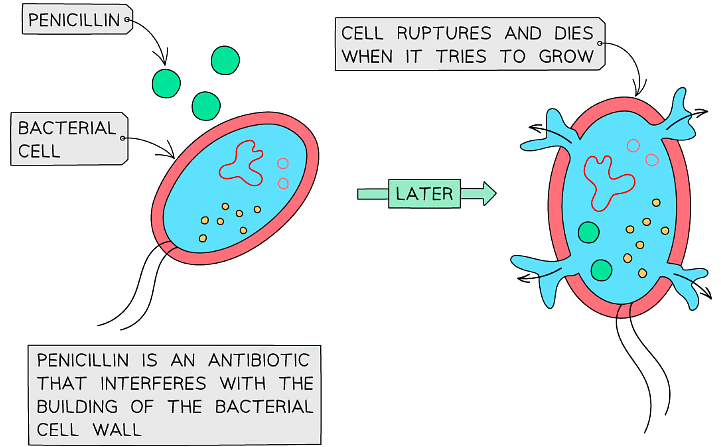 Penicillin was the first antibiotic to be discovered and is widely used, although resistance is a problem
 - Antibiotics will not work against viruses, as viruses reproduce inside cells. It is difficult to develop drugs that kill viruses without also damaging the body's tissues
- Painkillers and other medicines are used to treat the symptoms of disease but do not kill pathogens (eg. ibuprofen can reduce pain and inflammation)
Antibiotic Resistance
- The use of antibiotics has increased exponentially since they were first introduced in the 1930s
- In that time they have saved millions of lives
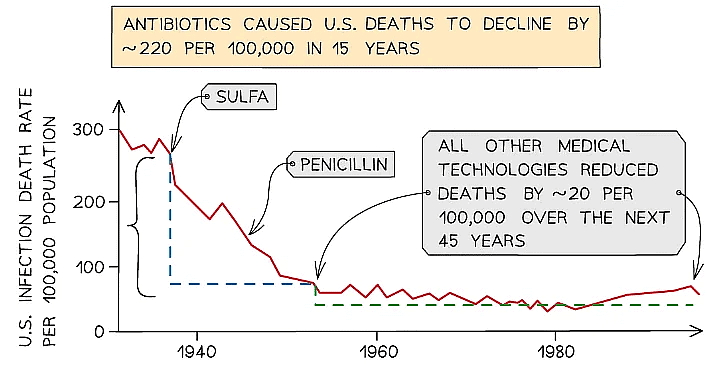 The introduction of antibiotics has had one of the largest impacts on global health, shown by this example in the USA
 - However, since their discovery and widespread use, antibiotics have been overused and antibiotic resistance has developed in many different types of bacterial species
- Bacteria, like all organisms, have random mutations in their DNA
- One of these mutations may give them resistance to an antibiotic
- If an organism is infected with bacteria and some of them have resistance, they are likely to survive treatment with antibiotic
- The population of the resistant bacteria will increase
- If the resistant strain is causing a serious infection then another antibiotic will be needed
- A strain of Staphylococcus aureus has developed resistance to a powerful antibiotic methicillin, this is known as MRSA (Methicillin resistant Staphylococcus aureus)
- MRSA can infect wounds and is difficult to treat without antibiotics
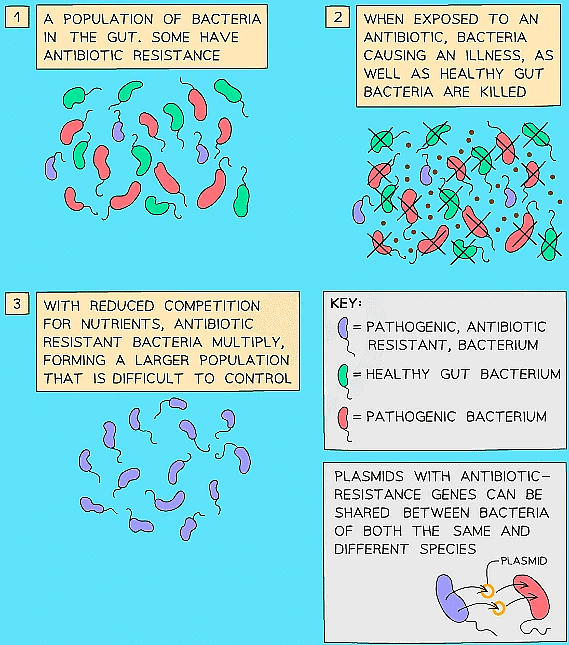 Bacteria evolve rapidly as they reproduce quickly and acquire random mutations - some of which confer resistance
- To reduce the number of bacteria that are becoming resistant to antibiotics:
- Doctors need to avoid the overuse of antibiotics, prescribing them only when needed - they may test the bacteria first to make sure that they prescribe the correct antibiotic
- Antibiotics shouldn't be used in non-serious infections that the immune system will 'clear up'
- Antibiotics shouldn't be used for viral infections
- Patients need to finish the whole course of antibiotics so that all the bacteria are killed and none are left to mutate to resistant strains
- Antibiotics use should be reduced in industries such as agriculture - controls are now in place to limit their use in farming
- Good hygiene practices such as handwashing and the use of hand sanitisers have reduced the rates of resistant strains of bacteria, such as MRSA, in hospitals
- The isolation of infected patients to prevent the spread of resistant strains, in particular in surgical wards where MRSA can infect surgical wounds
Discovering New Drugs
- Traditionally drugs were extracted from plants and microorganisms
- New drugs are being developed all the time by scientists at universities and drug companies around the world
- Lots of the medications that we use today are based on chemicals extracted from plants
- The heart drug digitalis originates from foxgloves
- The painkiller aspirin originates from willow
- Penicillin was discovered by Alexander Fleming from the Penicillium mould
- Most new drugs are synthesised by chemists in the pharmaceutical industry. However, the starting point may still be a chemical extracted from a plant
Drugs from plants table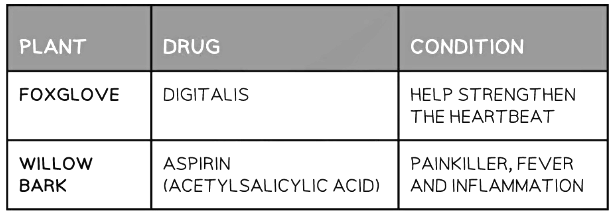
- Penicillin was first discovered by Alexander Flemming in 1928. He left some Petri dishes that had been contaminated with mould and found the bacteria would not grow near the mould
- He discovered that the mould (Penicillium notatum) was releasing a chemical (penicillin) that killed the bacteria surrounding it
- New drugs are now developed by the pharmaceutical industry. Many of these still have plants as their source
Testing New Drugs
- All new drugs need to be tested and trialled before they can be used in patients. They are tested for:
- Toxicity - does it have harmful side effects?
- Efficacy - does the drug work?
- Dose - what dose is the lowest that can be used and still have an effect?
- The results of any testing are then peer-reviewed to make sure that the results are described accurately. The results would then be published in journals
Developing New Drugs
- Preclinical testing is done in a laboratory using cells, tissues and live animals
- Clinical trials use healthy volunteers and patients
- Very low doses of the drug are given at the start of the clinical trial
- If the drug is found to be safe, further clinical trials are carried out to find the optimum dose for the drug
- In double-blind trials, some patients are given a placebo
The 3 stages of drug development
- Preclinical Testing
- The drug is tested on cells in the lab
- Computer models may also be used to simulate the metabolic pathways that may be taken by the drug
- Efficacy and toxicity are tested at this stage
- Whole organism testing
- The drug is tested on animals to see the effect in a whole organism - all new medicines in the UK have to have tests on 2 different animals by law
- Efficacy, toxicity and dosage are tested at this stage
- Clinical trials
- The drug is tested on human volunteers first, generally with a very low dose then increased. This is to make sure it is safe in a body that is working normally
- The next stage is to test on patients with the condition.
- The patients are often split into two groups; one given the drug the other given a placebo. This is called a double-blind study - neither the doctor nor the patient knows if the patient is getting the placebo or the active drug
- Once the drug is found to be safe then the lowest effective dose is tested at this stage
Future medications
- Pharmaceutical companies are always looking to find new medications these include:
- Vaccinations to different diseases
- Antibiotics that have a different action on the bacteria, so that bacteria are not resistant to them
- Painkillers with fewer side effects
- Antiviral drugs that don't damage the body's tissues
- Sources of these medications may be plants or microorganisms
Exam Tip: You should be able to describe the process of discovery and development of potential new medicines, including preclinical and clinical testing in the exam.
Solved Examples
Example 1: HIV/AIDS is what type of pathogen?
HIV/AIDS is a virus.
Example 2: Salmonella is what type of pathogen?
Salmonella is a bacterium.
Example 3: Rose black spot is what type of pathogen?
Rose black spot is a fungus.
Example 4: Malaria is caused by what type of pathogen?
Malaria is caused by a protist.
Example 5: What term describes an organism that transmits a disease?
A vector is an organism that transmits a disease.
Example 6: How is measles often transmitted?
Measles is often transmitted through the air. Escherichia coli is an example of a disease transmitted by uncooked food.
Example 7: In which foods is Salmonella more likely to be found?
Meat, eggs and poultry are more likely to contain Salmonella.
Example 8: Which of these does not prevent the spread of diseases?
Cancer screening does not prevent the spread of the disease. It makes early treatment more likely.
Example 9: Which of these is a non-specific defence against disease?
Skin is a non-specific defence against infection.
Example 10: Which of these do lymphocytes not produce?
Lymphocytes do not produce antigens. Antibodies are produced by lymphocytes after exposure to a pathogen.




