CONSORTIUM OF NATIONAL LAW UNIVERSITIES COMMON LAW ADMISSION TEST (CLAT) 2017
Duration: 2 Hours (120 Minutes)
Maximum Marks: 200
Section: English
MULTIPLE CHOICE QUESTION
Try yourself:
Direction : Fill in the blank by choosing the most appropriate option.
Q. We shall fail _______ we are industrious.
A
whether
B
unless
C
until
D
though
Correct Answer: B
Because the word unless is used to introduce only circumstances in which an event you are mentioning will not take place hindi meaning is "yadi nhi" until means "jab tk " applying this word in above sentence seems unfit though means "yadapi" or inspite of something y bhi sentence m perfect nhi lg rha trust your ear by placing this word in blank repeat 2 3 times you will get perfect and suitable answer which is "unless"
Report a problem
MULTIPLE CHOICE QUESTION
Try yourself:
Direction : Fill in the blank by choosing the most appropriate option.
She stood ______ Amit, but could not utter a single word for quite some time.
A
before
B
for
C
about
D
to
Correct Answer: A
To solve this question, we need to determine the most appropriate word that can fit in the blank and make the sentence grammatically correct. Let's analyze the given options: A: before: This word suggests that she stood in front of Amit, but it doesn't convey the meaning that she stood silently without uttering a word. B: for: This word indicates a duration of time, but it doesn't convey the intended meaning of standing silently without speaking. C: about: This word suggests being concerned or interested in something, but it doesn't fit in the context of the sentence. D: to: This word suggests moving towards someone or something, but it doesn't convey the meaning of standing silently without speaking. The correct answer is A: before. By choosing option A, the sentence becomes: "She stood before Amit, but could not utter a single word for quite some time." This sentence conveys the meaning that she stood in front of Amit but remained silent for a while.
Report a problem
MULTIPLE CHOICE QUESTION
Try yourself:
Direction : Fill in the blank by choosing the most appropriate option.
Kanak is endowed _______ many great qualities.
A
by
B
with
C
in
D
of
Correct Answer: B
To solve this question, we need to choose the most appropriate option that fits grammatically and semantically in the given sentence. Let's analyze each option: A: by - This preposition is used to indicate the agent performing an action, but it does not fit in the context of the sentence. B: with - This preposition is commonly used to indicate possession or association, and it fits well in the sentence. It implies that Kanak possesses or is associated with many great qualities. C: in - This preposition is used to indicate location or inclusion, but it does not convey the intended meaning in the context of the sentence. D: of - This preposition is used to indicate possession or relationship, but it does not fit well in the sentence. Therefore, the correct answer is option B: with.
Report a problem
MULTIPLE CHOICE QUESTION
Try yourself:
Direction : Fill in the blank by choosing the most appropriate option.
The minister flew ______ the flooded areas in a helicopter.
A
along
B
over
C
in
D
about
Correct Answer: B
The correct answer for the given question is B: over. Explanation: - The sentence mentions that the minister flew in a helicopter. - When someone flies over an area, it means that they are traveling above it in the air. - The word "over" fits in the context of the sentence and conveys the intended meaning. In summary, the minister flew over the flooded areas in a helicopter.
Report a problem
MULTIPLE CHOICE QUESTION
Try yourself:
Direction : Fill in the blank by choosing the most appropriate option.
You have played a great role, for _______ your help I possibly would have landed myself into a problem.
A
without
B
although
C
despite
D
after
Correct Answer: A
Here, without means - not havingAlthough means - in spite of the fact; evenDespite means - without being affected byAfter means - laterPretty sure option 'B' and 'D' can not fill the gap If we use despite it will present a sassy behaviour, so 'without' is correct option 'A'
Report a problem
MULTIPLE CHOICE QUESTION
Try yourself:
Direction : Fill in the blank by choosing the most appropriate option.
The doctor advised him to go ______ several medical tests.
A
about
B
under
C
through
D
into
Correct Answer: C
C is the correct option.First,we always go "through" medical tests,for obvious reasons this one is right. There is no any chance of "about" and "into" to be true as they aren't making sense at all and "under" is used for something below.So the appropriate answer must be through.
Report a problem
MULTIPLE CHOICE QUESTION
Try yourself:
Direction : Fill in the blank by choosing the most appropriate option.
Would anybody ______ a mother have risked her life for the baby?
A
but
B
rather
C
than
D
however
Correct Answer: A
To solve this question, we need to choose the most appropriate option that fits the given sentence. Let's analyze the options one by one: A: but - The word "but" is used to show contrast or opposition between two ideas. In this sentence, it does not provide a suitable meaning. B: rather - The word "rather" is used to indicate preference or choice between two options. It does not fit well in the context of the sentence. C: than - The word "than" is used to compare two different things or ideas. In this sentence, it does not provide a suitable meaning. D: however - The word "however" is used to introduce a contrasting or unexpected statement. It does not convey the intended meaning in this sentence. Therefore, the correct answer is option A: but. It is the most appropriate option that fits the sentence. Note: The given answer "a." is not a correct format and should be written as "A: but" for clarity.
Report a problem
MULTIPLE CHOICE QUESTION
Try yourself:
Direction : Fill in the blank by choosing the most appropriate option.
The passengers were very happy _______ the friendly and warm treatment.
A
to
B
from
C
about
D
by
Correct Answer: C
To solve this question, we need to understand the meaning of the sentence and choose the most appropriate preposition to complete it correctly. The sentence states that the passengers were very happy _______ the friendly and warm treatment. Let's analyze the options:
A: to - The phrase "happy to the friendly and warm treatment" is grammatically incorrect. We cannot use "to" in this context. B: from - The phrase "happy from the friendly and warm treatment" is also grammatically incorrect. We cannot use "from" in this context. C: about - The phrase "happy about the friendly and warm treatment" is grammatically correct and makes sense in the given context. This option indicates that the passengers were pleased with or satisfied with the friendly and warm treatment. D: by - The phrase "happy by the friendly and warm treatment" is grammatically incorrect. We cannot use "by" in this context. Therefore, the correct answer is C: about as it is the most appropriate preposition to use in this sentence to convey the intended meaning. The passengers were very happy about the friendly and warm treatment they received.
Report a problem
MULTIPLE CHOICE QUESTION
Try yourself:
Direction : Fill in the blank by choosing the most appropriate option.
If they want to succeed, they ______ have to work very hard.
A
should
B
ought
C
will
D
must
Correct Answer: C
Will is the correct answer, because it is type one condition of if sentences in these type of sentences we use simple present In the if clause and simple Future in result clause..
Report a problem
MULTIPLE CHOICE QUESTION
Try yourself:
Direction : Fill in the blank by choosing the most appropriate option.
Sunita decided to set ______ some time every day for prayers.
A
up
B
in
C
aside
D
on
Correct Answer: C
To solve this question, we need to determine the most appropriate option to fill in the blank in the given sentence. Let's analyze each option: A: up - This option does not make sense in the context of the sentence. Setting "up" time every day does not convey the intended meaning. B: in - This option also does not fit the context. Setting "in" time every day does not convey the intended meaning. C: aside - This option is the most appropriate choice. Setting "aside" time every day means allocating or reserving a specific amount of time for a particular activity, which aligns with the context of the sentence. D: on - This option does not fit the context. Setting "on" time every day does not convey the intended meaning. Therefore, the correct answer is option C: aside.
Report a problem
MULTIPLE CHOICE QUESTION
Try yourself:
Direction for Questions (11 – 15) : Read the given passage carefully and choose the most appropriate option to the questions given below.
The World Trade Organisation (WTO) was created in the early 1990s as a component of the Uruguay Round negotiation. However, it could have been negotiated as part of the Tokyo Round of the 1970s, since negotiation was an attempt at a ‘constitutional reform’ of the General Agreement on Tariffs and Trade (GATT). Or it could have been put off to the future, as the US government wanted. What factors led to the creation of the WTO in the early 1990s? One factor was the pattern of multilateral bargaining that developed late in the Uruguay Round. Like all complex international agreements, the WTO was a product of a series of trade-offs between principal actors and groups. For the United States, which did not want a new organization, the disputed settlement part of the WTO package achieved its longstanding goal of a more effective and more legal dispute settlement system. For the Europeans, who by the 1990s had come to view GATT dispute settlement less in political terms add more as a regime of legal obligations, the WTO package was acceptable as a means to discipline the resort to unilateral measures by the United States. Countries like Canada and other middle and smaller trading partners were attracted by the expansion of a rule-based system and by the symbolic value of a trade organization, both of which inherently support the weak against the strong. The developing countries were attracted due to the provisions banning unilateral measures. Finally, and perhaps most important, many countries at the Uruguay Round came to put a higher priority on the export gains than on the import losses that the negotiation would produce, and they came to associate the WTO and a rule-based system with those gains. This reasoning – replicated in many countries – was contained in U. S. Ambassador Kantor’s defence of the WTO, and it announced to a recognition that international trade and its benefits cannot be enjoyed unless trading nations accept the discipline of a negotiated rule-based environment. A second factor in the creation of the WTO was pressure from lawyers and the legal process. The dispute settlement system of the WTO was seen as a victory of legalists but the matter went deeper than that. The GATT, and the WTO, are contract organizations based on rules, and it is inevitable that an organization creating a further rule will in turn be influenced by legal process. Robert Hudee has written of the ‘momentum of legal development’, but what is this precisely? Legal development can be defined as promotion of the technical legal values of consistency, clarity (or certainty) and effectiveness; these are values that those responsible for administering any legal system will seek to maximize. As it played out in the WTO, consistency meant integrating under one roof the whole lot of separate agreements signed under GATT auspices; clarity meant removing ambiguities about the powers of contracting parties to make certain decisions or to undertake waivers; and effectiveness meant eliminating exceptions arising out of grandfather-rights and resolving defects in dispute settlement procedures and institutional provisions. Concern for these values is inherent in any rule-based system of co-operation, since without these value rules would be meaningless in the first place, therefore, create their own incentive for fulfilment. The moment of legal development has occurred in other institutions besides the GATT, most notably in the European Union (EU). Over the past two decades the European Court of Justice (ECJ) has consistently rendered decisions that have expanded incrementally the EU’s internal market, in which the doctrine of ‘mutual recognition’ handed down in Cassis de Dijon case in 1979 was a key turning point. The court is now widely recognized as a major player in European integration, even though arguably such a strong role was not originally envisaged in the Treaty of Rome, which initiated the current European Union. One means the Court used to expand integration was the ‘teleological method of interpretation’, whereby the actions of member states were evaluated against ‘the accomplishment of the most elementary goals set forth in the Preamble to the (Rome) treaty. The teleological method represents an effort to keep current policies consistent with slated goals, and it is analogous to the effort in GATT to keep contracting party trade practices consistent with slated rules. In both cases legal concerns and procedures are an independent force for further co-operation. In the large part the WTO was an exercise in consolidation. In the context of a trade negotiation that created a near-revolutionary expansion of international trade rules, the formation of the WTO was a deeply conservative act needed to ensure that the benefits of the new rules would not be lost. The WTO was all about institutional structure and dispute settlement: these are the concerns of conservatives and not revolutionaries, that is why lawyers and legalists took the lead on these issues. The WTO codified the GATT institutional practice that had developed by custom over three decades, and it incorporated a new dispute settlement system that was necessary to keep both old and new rules from becoming a sham. Both the international structure and the dispute settlement system were necessary to preserve and enhance the integrity of the multilateral trade regime that had been built incrementally from the 1940s to the 1990s.
Q.
In the statement ‘... it amounted to a recognition that international trade and its benefits cannot be enjoyed unless trading nations accept the discipline of a negotiated rule-based environment’, it refers to:
A
The export gains many countries came to associate with a rule-based system.
B
The higher priority on export gains placed by many countries at the Uruguay Round.
C
The provision of a rule-based system by the WTO.
D
Ambassador Kantor’s defence of the WTO.
Correct Answer: A
In the given statement, "it amounted to a recognition that international trade and its benefits cannot be enjoyed unless trading nations accept the discipline of a negotiated rule-based environment," refers to the following: - The export gains many countries came to associate with a rule-based system. - The higher priority on export gains placed by many countries at the Uruguay Round. The statement highlights the understanding that in order for international trade to be beneficial, trading nations need to accept and adhere to a negotiated rule-based environment. This recognition emphasizes the importance of having a system in place that promotes fair and consistent trade practices, ensuring that all countries have equal opportunities and protection. It acknowledges that the benefits of international trade can only be fully realized when there is a framework that governs trade interactions and resolves disputes effectively. By accepting the discipline of a negotiated rule-based environment, trading nations can foster an environment of trust and cooperation, leading to increased export gains and overall economic growth.
Report a problem
MULTIPLE CHOICE QUESTION
Try yourself: The World Trade Organisation (WTO) was created in the early 1990s as a component of the Uruguay Round negotiation. However, it could have been negotiated as part of the Tokyo Round of the 1970s, since negotiation was an attempt at a ‘constitutional reform’ of the General Agreement on Tariffs and Trade (GATT). Or it could have been put off to the future, as the US government wanted. What factors led to the creation of the WTO in the early 1990s? One factor was the pattern of multilateral bargaining that developed late in the Uruguay Round. Like all complex international agreements, the WTO was a product of a series of trade-offs between principal actors and groups. For the United States, which did not want a new organization, the disputed settlement part of the WTO package achieved its longstanding goal of a more effective and more legal dispute settlement system. For the Europeans, who by the 1990s had come to view GATT dispute settlement less in political terms add more as a regime of legal obligations, the WTO package was acceptable as a means to discipline the resort to unilateral measures by the United States. Countries like Canada and other middle and smaller trading partners were attracted by the expansion of a rule-based system and by the symbolic value of a trade organization, both of which inherently support the weak against the strong. The developing countries were attracted due to the provisions banning unilateral measures. Finally, and perhaps most important, many countries at the Uruguay Round came to put a higher priority on the export gains than on the import losses that the negotiation would produce, and they came to associate the WTO and a rule-based system with those gains. This reasoning – replicated in many countries – was contained in U. S. Ambassador Kantor’s defence of the WTO, and it announced to a recognition that international trade and its benefits cannot be enjoyed unless trading nations accept the discipline of a negotiated rule-based environment. A second factor in the creation of the WTO was pressure from lawyers and the legal process. The dispute settlement system of the WTO was seen as a victory of legalists but the matter went deeper than that. The GATT, and the WTO, are contract organizations based on rules, and it is inevitable that an organization creating a further rule will in turn be influenced by legal process. Robert Hudee has written of the ‘momentum of legal development’, but what is this precisely? Legal development can be defined as promotion of the technical legal values of consistency, clarity (or certainty) and effectiveness; these are values that those responsible for administering any legal system will seek to maximize. As it played out in the WTO, consistency meant integrating under one roof the whole lot of separate agreements signed under GATT auspices; clarity meant removing ambiguities about the powers of contracting parties to make certain decisions or to undertake waivers; and effectiveness meant eliminating exceptions arising out of grandfather-rights and resolving defects in dispute settlement procedures and institutional provisions. Concern for these values is inherent in any rule-based system of co-operation, since without these value rules would be meaningless in the first place, therefore, create their own incentive for fulfilment. The moment of legal development has occurred in other institutions besides the GATT, most notably in the European Union (EU). Over the past two decades the European Court of Justice (ECJ) has consistently rendered decisions that have expanded incrementally the EU’s internal market, in which the doctrine of ‘mutual recognition’ handed down in Cassis de Dijon case in 1979 was a key turning point. The court is now widely recognized as a major player in European integration, even though arguably such a strong role was not originally envisaged in the Treaty of Rome, which initiated the current European Union. One means the Court used to expand integration was the ‘teleological method of interpretation’, whereby the actions of member states were evaluated against ‘the accomplishment of the most elementary goals set forth in the Preamble to the (Rome) treaty. The teleological method represents an effort to keep current policies consistent with slated goals, and it is analogous to the effort in GATT to keep contracting party trade practices consistent with slated rules. In both cases legal concerns and procedures are an independent force for further co-operation. In the large part the WTO was an exercise in consolidation. In the context of a trade negotiation that created a near-revolutionary expansion of international trade rules, the formation of the WTO was a deeply conservative act needed to ensure that the benefits of the new rules would not be lost. The WTO was all about institutional structure and dispute settlement: these are the concerns of conservatives and not revolutionaries, that is why lawyers and legalists took the lead on these issues. The WTO codified the GATT institutional practice that had developed by custom over three decades, and it incorporated a new dispute settlement system that was necessary to keep both old and new rules from becoming a sham. Both the international structure and the dispute settlement system were necessary to preserve and enhance the integrity of the multilateral trade regime that had been built incrementally from the 1940s to the 1990s.
Q.
What would be the closest reason why WTO was not formed in 1970s?
A
The US government did not like it.
B
Important players did not find it in their best interest to do so.
C
Lawyers did not work for the dispute settlement system.
D
The Tokyo Round negotiations was an attempt at constitutional reform.
Correct Answer: B
Reasons why the WTO was not formed in the 1970s: 1. The US government did not like it: - The US government wanted to delay the creation of the WTO and was not in favor of establishing a new organization at that time. - This suggests that the US government's opposition could have been a hindrance to the formation of the WTO in the 1970s. 2. Important players did not find it in their best interest to do so: - Key players in the international trading system during the 1970s may not have seen the need or benefits of forming the WTO. - These players may have had conflicting interests or concerns that made them reluctant to support the establishment of a new trade organization. 3. Lawyers did not work for the dispute settlement system: - The involvement of lawyers and the legal process played a significant role in the creation of the WTO in the early 1990s. - If lawyers did not actively work towards establishing a robust dispute settlement system during the 1970s, it could have delayed or derailed the formation of the WTO at that time. 4. The Tokyo Round negotiations were an attempt at constitutional reform: - The Tokyo Round of the 1970s was focused on reforming the General Agreement on Tariffs and Trade (GATT) and could have included negotiations for the creation of the WTO. - However, the negotiations during this round may not have fully addressed the need for a new trade organization, leading to the delay of the WTO's formation. Overall, the closest reason why the WTO was not formed in the 1970s is that important players in the international trading system did not find it in their best interest to establish a new trade organization at that time.
Report a problem
MULTIPLE CHOICE QUESTION
Try yourself: The World Trade Organisation (WTO) was created in the early 1990s as a component of the Uruguay Round negotiation. However, it could have been negotiated as part of the Tokyo Round of the 1970s, since negotiation was an attempt at a ‘constitutional reform’ of the General Agreement on Tariffs and Trade (GATT). Or it could have been put off to the future, as the US government wanted. What factors led to the creation of the WTO in the early 1990s? One factor was the pattern of multilateral bargaining that developed late in the Uruguay Round. Like all complex international agreements, the WTO was a product of a series of trade-offs between principal actors and groups. For the United States, which did not want a new organization, the disputed settlement part of the WTO package achieved its longstanding goal of a more effective and more legal dispute settlement system. For the Europeans, who by the 1990s had come to view GATT dispute settlement less in political terms add more as a regime of legal obligations, the WTO package was acceptable as a means to discipline the resort to unilateral measures by the United States. Countries like Canada and other middle and smaller trading partners were attracted by the expansion of a rule-based system and by the symbolic value of a trade organization, both of which inherently support the weak against the strong. The developing countries were attracted due to the provisions banning unilateral measures. Finally, and perhaps most important, many countries at the Uruguay Round came to put a higher priority on the export gains than on the import losses that the negotiation would produce, and they came to associate the WTO and a rule-based system with those gains. This reasoning – replicated in many countries – was contained in U. S. Ambassador Kantor’s defence of the WTO, and it announced to a recognition that international trade and its benefits cannot be enjoyed unless trading nations accept the discipline of a negotiated rule-based environment. A second factor in the creation of the WTO was pressure from lawyers and the legal process. The dispute settlement system of the WTO was seen as a victory of legalists but the matter went deeper than that. The GATT, and the WTO, are contract organizations based on rules, and it is inevitable that an organization creating a further rule will in turn be influenced by legal process. Robert Hudee has written of the ‘momentum of legal development’, but what is this precisely? Legal development can be defined as promotion of the technical legal values of consistency, clarity (or certainty) and effectiveness; these are values that those responsible for administering any legal system will seek to maximize. As it played out in the WTO, consistency meant integrating under one roof the whole lot of separate agreements signed under GATT auspices; clarity meant removing ambiguities about the powers of contracting parties to make certain decisions or to undertake waivers; and effectiveness meant eliminating exceptions arising out of grandfather-rights and resolving defects in dispute settlement procedures and institutional provisions. Concern for these values is inherent in any rule-based system of co-operation, since without these value rules would be meaningless in the first place, therefore, create their own incentive for fulfilment. The moment of legal development has occurred in other institutions besides the GATT, most notably in the European Union (EU). Over the past two decades the European Court of Justice (ECJ) has consistently rendered decisions that have expanded incrementally the EU’s internal market, in which the doctrine of ‘mutual recognition’ handed down in Cassis de Dijon case in 1979 was a key turning point. The court is now widely recognized as a major player in European integration, even though arguably such a strong role was not originally envisaged in the Treaty of Rome, which initiated the current European Union. One means the Court used to expand integration was the ‘teleological method of interpretation’, whereby the actions of member states were evaluated against ‘the accomplishment of the most elementary goals set forth in the Preamble to the (Rome) treaty. The teleological method represents an effort to keep current policies consistent with slated goals, and it is analogous to the effort in GATT to keep contracting party trade practices consistent with slated rules. In both cases legal concerns and procedures are an independent force for further co-operation. In the large part the WTO was an exercise in consolidation. In the context of a trade negotiation that created a near-revolutionary expansion of international trade rules, the formation of the WTO was a deeply conservative act needed to ensure that the benefits of the new rules would not be lost. The WTO was all about institutional structure and dispute settlement: these are the concerns of conservatives and not revolutionaries, that is why lawyers and legalists took the lead on these issues. The WTO codified the GATT institutional practice that had developed by custom over three decades, and it incorporated a new dispute settlement system that was necessary to keep both old and new rules from becoming a sham. Both the international structure and the dispute settlement system were necessary to preserve and enhance the integrity of the multilateral trade regime that had been built incrementally from the 1940s to the 1990s.
Q.
In the method of interpretation of the European Court of Justice:
A
Actions against member states needed to be evaluated against the said community goals.
B
Enunciation of the most elementary community goals needed to be emphasized.
C
Current policies need to be consistent with stated goals.
D
Contracting party trade practices need to be consistent with stated rules.
Correct Answer: A
Method of interpretation of the European Court of Justice: The method of interpretation used by the European Court of Justice (ECJ) can be summarized as follows: - Actions against member states needed to be evaluated against the said community goals: The ECJ evaluates the actions of member states in light of the goals and objectives stated in the treaties that establish the European Union (EU). The court considers whether the actions of member states align with the fundamental principles and objectives of the EU. - Enunciation of the most elementary community goals needed to be emphasized: The ECJ emphasizes the enunciation of the basic and fundamental goals of the EU, as stated in the preamble of the relevant treaties. These goals serve as guiding principles for the interpretation of EU law and the evaluation of member states' actions. - Current policies need to be consistent with stated goals: The ECJ strives to ensure that the policies and actions of member states are consistent with the stated goals and objectives of the EU. The court examines whether the policies implemented by member states align with the overarching objectives of the EU and contribute to the achievement of those goals. - Contracting party trade practices need to be consistent with stated rules: The ECJ, like the World Trade Organisation (WTO), seeks to ensure that the trade practices of contracting parties are consistent with the rules established by the relevant agreements. The court evaluates whether the trade practices of member states comply with the rules and obligations set out in EU law, particularly in the area of international trade. In summary, the method of interpretation used by the European Court of Justice focuses on evaluating the actions of member states against the goals and objectives of the EU, ensuring consistency between current policies and stated goals, and maintaining compliance with the established rules and obligations.
Report a problem
MULTIPLE CHOICE QUESTION
Try yourself: The World Trade Organisation (WTO) was created in the early 1990s as a component of the Uruguay Round negotiation. However, it could have been negotiated as part of the Tokyo Round of the 1970s, since negotiation was an attempt at a ‘constitutional reform’ of the General Agreement on Tariffs and Trade (GATT). Or it could have been put off to the future, as the US government wanted. What factors led to the creation of the WTO in the early 1990s? One factor was the pattern of multilateral bargaining that developed late in the Uruguay Round. Like all complex international agreements, the WTO was a product of a series of trade-offs between principal actors and groups. For the United States, which did not want a new organization, the disputed settlement part of the WTO package achieved its longstanding goal of a more effective and more legal dispute settlement system. For the Europeans, who by the 1990s had come to view GATT dispute settlement less in political terms add more as a regime of legal obligations, the WTO package was acceptable as a means to discipline the resort to unilateral measures by the United States. Countries like Canada and other middle and smaller trading partners were attracted by the expansion of a rule-based system and by the symbolic value of a trade organization, both of which inherently support the weak against the strong. The developing countries were attracted due to the provisions banning unilateral measures. Finally, and perhaps most important, many countries at the Uruguay Round came to put a higher priority on the export gains than on the import losses that the negotiation would produce, and they came to associate the WTO and a rule-based system with those gains. This reasoning – replicated in many countries – was contained in U. S. Ambassador Kantor’s defence of the WTO, and it announced to a recognition that international trade and its benefits cannot be enjoyed unless trading nations accept the discipline of a negotiated rule-based environment. A second factor in the creation of the WTO was pressure from lawyers and the legal process. The dispute settlement system of the WTO was seen as a victory of legalists but the matter went deeper than that. The GATT, and the WTO, are contract organizations based on rules, and it is inevitable that an organization creating a further rule will in turn be influenced by legal process. Robert Hudee has written of the ‘momentum of legal development’, but what is this precisely? Legal development can be defined as promotion of the technical legal values of consistency, clarity (or certainty) and effectiveness; these are values that those responsible for administering any legal system will seek to maximize. As it played out in the WTO, consistency meant integrating under one roof the whole lot of separate agreements signed under GATT auspices; clarity meant removing ambiguities about the powers of contracting parties to make certain decisions or to undertake waivers; and effectiveness meant eliminating exceptions arising out of grandfather-rights and resolving defects in dispute settlement procedures and institutional provisions. Concern for these values is inherent in any rule-based system of co-operation, since without these value rules would be meaningless in the first place, therefore, create their own incentive for fulfilment. The moment of legal development has occurred in other institutions besides the GATT, most notably in the European Union (EU). Over the past two decades the European Court of Justice (ECJ) has consistently rendered decisions that have expanded incrementally the EU’s internal market, in which the doctrine of ‘mutual recognition’ handed down in Cassis de Dijon case in 1979 was a key turning point. The court is now widely recognized as a major player in European integration, even though arguably such a strong role was not originally envisaged in the Treaty of Rome, which initiated the current European Union. One means the Court used to expand integration was the ‘teleological method of interpretation’, whereby the actions of member states were evaluated against ‘the accomplishment of the most elementary goals set forth in the Preamble to the (Rome) treaty. The teleological method represents an effort to keep current policies consistent with slated goals, and it is analogous to the effort in GATT to keep contracting party trade practices consistent with slated rules. In both cases legal concerns and procedures are an independent force for further co-operation. In the large part the WTO was an exercise in consolidation. In the context of a trade negotiation that created a near-revolutionary expansion of international trade rules, the formation of the WTO was a deeply conservative act needed to ensure that the benefits of the new rules would not be lost. The WTO was all about institutional structure and dispute settlement: these are the concerns of conservatives and not revolutionaries, that is why lawyers and legalists took the lead on these issues. The WTO codified the GATT institutional practice that had developed by custom over three decades, and it incorporated a new dispute settlement system that was necessary to keep both old and new rules from becoming a sham. Both the international structure and the dispute settlement system were necessary to preserve and enhance the integrity of the multilateral trade regime that had been built incrementally from the 1940s to the 1990s.
Q.
According to the passage, WTO promoted the technical legal values partly through.
A
Integrating under one roof the agreements signed under GATT.
B
Rules that create their own incentive for fulfilment.
C
Ambiguities about the powers of contracting parties to make certain decisions.
D
Grandfather-rights exceptions and defects in dispute settlement procedures.
Correct Answer: A
According to the passage, WTO promoted the technical legal values partly through: - Integrating under one roof the agreements signed under GATT: The WTO aimed to consolidate and integrate the various agreements signed under the General Agreement on Tariffs and Trade (GATT) into a single organization. This integration helped promote consistency and clarity in the trade rules. - Rules that create their own incentive for fulfilment: The passage mentions that a rule-based system of co-operation requires consistency, clarity, and effectiveness. By establishing rules and obligations, the WTO created an environment where countries had an incentive to fulfill their trade commitments. - Ambiguities about the powers of contracting parties to make certain decisions: The WTO sought to remove ambiguities about the powers of contracting parties to make certain decisions or undertake waivers. This clarity in decision-making powers contributed to the technical legal value of consistency. - Grandfather-rights exceptions and defects in dispute settlement procedures: The WTO aimed to eliminate exceptions arising from grandfather-rights (existing rights or privileges) and resolve defects in dispute settlement procedures. By addressing these issues, the WTO enhanced the effectiveness of the trade dispute resolution system, which is an essential aspect of a rule-based environment. Overall, the WTO promoted the technical legal values of consistency, clarity, and effectiveness by integrating agreements, establishing rules with incentives for fulfillment, clarifying decision-making powers, and addressing exceptions and defects in dispute settlement procedures.
Report a problem
MULTIPLE CHOICE QUESTION
Try yourself: The World Trade Organisation (WTO) was created in the early 1990s as a component of the Uruguay Round negotiation. However, it could have been negotiated as part of the Tokyo Round of the 1970s, since negotiation was an attempt at a ‘constitutional reform’ of the General Agreement on Tariffs and Trade (GATT). Or it could have been put off to the future, as the US government wanted. What factors led to the creation of the WTO in the early 1990s? One factor was the pattern of multilateral bargaining that developed late in the Uruguay Round. Like all complex international agreements, the WTO was a product of a series of trade-offs between principal actors and groups. For the United States, which did not want a new organization, the disputed settlement part of the WTO package achieved its longstanding goal of a more effective and more legal dispute settlement system. For the Europeans, who by the 1990s had come to view GATT dispute settlement less in political terms add more as a regime of legal obligations, the WTO package was acceptable as a means to discipline the resort to unilateral measures by the United States. Countries like Canada and other middle and smaller trading partners were attracted by the expansion of a rule-based system and by the symbolic value of a trade organization, both of which inherently support the weak against the strong. The developing countries were attracted due to the provisions banning unilateral measures. Finally, and perhaps most important, many countries at the Uruguay Round came to put a higher priority on the export gains than on the import losses that the negotiation would produce, and they came to associate the WTO and a rule-based system with those gains. This reasoning – replicated in many countries – was contained in U. S. Ambassador Kantor’s defence of the WTO, and it announced to a recognition that international trade and its benefits cannot be enjoyed unless trading nations accept the discipline of a negotiated rule-based environment. A second factor in the creation of the WTO was pressure from lawyers and the legal process. The dispute settlement system of the WTO was seen as a victory of legalists but the matter went deeper than that. The GATT, and the WTO, are contract organizations based on rules, and it is inevitable that an organization creating a further rule will in turn be influenced by legal process. Robert Hudee has written of the ‘momentum of legal development’, but what is this precisely? Legal development can be defined as promotion of the technical legal values of consistency, clarity (or certainty) and effectiveness; these are values that those responsible for administering any legal system will seek to maximize. As it played out in the WTO, consistency meant integrating under one roof the whole lot of separate agreements signed under GATT auspices; clarity meant removing ambiguities about the powers of contracting parties to make certain decisions or to undertake waivers; and effectiveness meant eliminating exceptions arising out of grandfather-rights and resolving defects in dispute settlement procedures and institutional provisions. Concern for these values is inherent in any rule-based system of co-operation, since without these value rules would be meaningless in the first place, therefore, create their own incentive for fulfilment. The moment of legal development has occurred in other institutions besides the GATT, most notably in the European Union (EU). Over the past two decades the European Court of Justice (ECJ) has consistently rendered decisions that have expanded incrementally the EU’s internal market, in which the doctrine of ‘mutual recognition’ handed down in Cassis de Dijon case in 1979 was a key turning point. The court is now widely recognized as a major player in European integration, even though arguably such a strong role was not originally envisaged in the Treaty of Rome, which initiated the current European Union. One means the Court used to expand integration was the ‘teleological method of interpretation’, whereby the actions of member states were evaluated against ‘the accomplishment of the most elementary goals set forth in the Preamble to the (Rome) treaty. The teleological method represents an effort to keep current policies consistent with slated goals, and it is analogous to the effort in GATT to keep contracting party trade practices consistent with slated rules. In both cases legal concerns and procedures are an independent force for further co-operation. In the large part the WTO was an exercise in consolidation. In the context of a trade negotiation that created a near-revolutionary expansion of international trade rules, the formation of the WTO was a deeply conservative act needed to ensure that the benefits of the new rules would not be lost. The WTO was all about institutional structure and dispute settlement: these are the concerns of conservatives and not revolutionaries, that is why lawyers and legalists took the lead on these issues. The WTO codified the GATT institutional practice that had developed by custom over three decades, and it incorporated a new dispute settlement system that was necessary to keep both old and new rules from becoming a sham. Both the international structure and the dispute settlement system were necessary to preserve and enhance the integrity of the multilateral trade regime that had been built incrementally from the 1940s to the 1990s.
Q.
The most likely reason for the acceptance of the WTO package by nations was that:
A
It has the means to prevent the US from taking unilateral measures.
B
Its rule-based system leads to export gains.
C
It settles disputes more legally and more effectively.
D
They recognized the need for a rule-based environment to protect the benefits of increased trade.
Correct Answer: D
Reasons for the acceptance of the WTO package by nations:
Recognition of the need for a rule-based environment: Many countries at the Uruguay Round came to prioritize the export gains that the negotiation would produce over the potential import losses. They associated the WTO and its rule-based system with these gains, realizing that international trade benefits can only be enjoyed if trading nations accept the discipline of a negotiated rule-based environment.
Expansion of a rule-based system: Countries like Canada and other middle and smaller trading partners were attracted to the expansion of a rule-based system. They saw value in a trade organization that inherently supports the weak against the strong.
Banning of unilateral measures: Developing countries were attracted to the provisions in the WTO package that banned unilateral measures. This likely provided them with a sense of security and protection in their trade relationships.
Effective and legal dispute settlement system: For the United States, the disputed settlement part of the WTO package achieved its longstanding goal of a more effective and more legal dispute settlement system. This may have been a crucial factor in their acceptance of the package.
Discipline of trading nations: The recognition that international trade and its benefits require the discipline of a negotiated rule-based environment was emphasized by U.S. Ambassador Kantor's defense of the WTO. This reasoning was replicated in many countries and may have influenced their acceptance of the package.
Report a problem
MULTIPLE CHOICE QUESTION
Try yourself: Direction : In each of the following sentences, some part of the sentence or the entire sentence is underlined. Beneath each sentence, you will find four ways of phrasing the underlined part. Choose the most appropriate option given in each of the sentences given below that is the best version than the underlined part of the sentence.
Q.
Two valence states of uranium, one with a deficit of four electrons and the other one with a deficit of six occurs in nature and contributes to the diversity of uranium’s behaviour.
A
the other one a deficit of six, occur in Nature and contribute
B
the other with a deficit of six, occurs in Nature and contributes
C
the other with a deficit of six, occur in Nature and contribute
D
one with six occurs in Nature and contributes
Correct Answer: B
The given sentence is: Two valence states of uranium, one with a deficit of four electrons and the other one with a deficit of six occurs in nature and contributes to the diversity of uranium's behavior. We need to choose the most appropriate option to replace the underlined part of the sentence. Let's analyze each option: A: the other one a deficit of six, occur in Nature and contribute - Incorrect: The verb "occur" should be in the singular form to match the subject "the other one." B: the other with a deficit of six, occurs in Nature and contributes - Correct: This option maintains subject-verb agreement and uses the correct verb forms "occurs" and "contributes." C: the other with a deficit of six, occur in Nature and contribute - Incorrect: The verb "occur" should be in the singular form to match the subject "the other." D: one with six occurs in Nature and contributes - Incorrect: This option omits the phrase "the other" which is necessary for clarity in the sentence. Therefore, the correct answer is option B: Two valence states of uranium, one with a deficit of four electrons and the other with a deficit of six occurs in nature and contributes to the diversity of uranium's behavior.
Report a problem
MULTIPLE CHOICE QUESTION
Try yourself: Direction : In each of the following sentences, some part of the sentence or the entire sentence is underlined. Beneath each sentence, you will find four ways of phrasing the underlined part. Choose the most appropriate option given in each of the sentences given below that is the best version than the underlined part of the sentence.
Q.
Initiative and referendum, is a procedure that allows voters to propose and pass laws as well as to repeal them.
A
allows voters to propose, pass and to repeal laws
B
will allow laws on be proposed, passed, as well as repealed by voters
C
allows voters to propose to pass, and repeal laws
D
will allow voter to propose, pass, as well as to repeal laws.
Correct Answer: A
The underlined part of the sentence is "allows voters to propose and pass laws as well as to repeal them." We need to choose the most appropriate option from the given alternatives. Let's analyze each option: A: allows voters to propose, pass and to repeal laws - This option is grammatically correct and conveys the intended meaning. B: will allow laws on be proposed, passed, as well as repealed by voters - This option is grammatically incorrect. The phrase "laws on be proposed" is not correct. C: allows voters to propose to pass, and repeal laws - This option is grammatically incorrect. The phrase "propose to pass" does not make sense. D: will allow voter to propose, pass, as well as to repeal laws. - This option is grammatically incorrect. The phrase "will allow voter" should be "will allow voters." Based on the analysis, option A is the most appropriate choice as it is grammatically correct and conveys the intended meaning of the sentence. Therefore, the correct answer is A: allows voters to propose, pass and to repeal laws.
Report a problem
MULTIPLE CHOICE QUESTION
Try yourself:
Direction : In each of the following sentences, some part of the sentence or the entire sentence is underlined. Beneath each sentence, you will find four ways of phrasing the underlined part. Choose the most appropriate option given in each of the sentences given below that is the best version than the underlined part of the sentence.
Q.
Plausible though it sounds, the weakness of the hypothesis is that it does not incorporate all relevant facts.
A
the weakness of the hypothesis which sounds plausible.
B
though the hypothesis sounds plausible, its weakness
C
even though it sounds plausible, the weakness of the hypothesis
D
though plausible, the hypothesis’ weakness
Correct Answer: B
The original sentence is: Plausible though it sounds, the weakness of the hypothesis is that it does not incorporate all relevant facts. Let's analyze each option: A:
the weakness of the hypothesis which sounds plausible.
This option changes the meaning of the sentence and suggests that the weakness of the hypothesis is what sounds plausible. However, the original sentence implies that the hypothesis itself sounds plausible. B:
though the hypothesis sounds plausible, its weakness
This option correctly maintains the intended meaning of the sentence. It suggests that the hypothesis sounds plausible, but its weakness is that it does not incorporate all relevant facts. C:
even though it sounds plausible, the weakness of the hypothesis
This option changes the meaning of the sentence by suggesting that the weakness of the hypothesis sounds plausible. However, the original sentence implies that the hypothesis itself sounds plausible. D:
though plausible, the hypothesis’ weakness
This option changes the meaning of the sentence by suggesting that the hypothesis is plausible, but its weakness is being referred to. However, the original sentence implies that the hypothesis itself sounds plausible. Based on the analysis, Option B is the most appropriate choice as it maintains the intended meaning of the sentence.
Report a problem
MULTIPLE CHOICE QUESTION
Direction : In each of the following sentences, some part of the sentence or the entire sentence is underlined. Beneath each sentence, you will find four ways of phrasing the underlined part. Choose the most appropriate option given in each of the sentences given below that is the best version than the underlined part of the sentence.
Try yourself: Q.
Many of them chiselled from solid rock centuries ago the mountainous regions are dotted with hundreds of monasteries:
A
The mountainous regions are dotted with hundreds of monasteries, many of which are chiselled from solid rock centuries ago.
B
The mountainous regions are dotted with hundreds of monasteries, many of them chiselled from solid rock centuries ago.
C
Hundreds of monasteries, many of them chiselled from solid rock centuries ago, are dotting the mountainous regions.
D
chiselled from solid rock centuries ago, the mountainous regions are dotted with many hundreds of monasteries.
Correct Answer: B
Explanation: The given sentence is: "Many of them chiselled from solid rock centuries ago the mountainous regions are dotted with hundreds of monasteries." To improve the sentence, we need to rephrase the underlined part. Let's analyze each option: A: The mountainous regions are dotted with hundreds of monasteries, many of which are chiselled from solid rock centuries ago. - This option correctly rephrases the underlined part by using "many of which" to refer to the monasteries. B: The mountainous regions are dotted with hundreds of monasteries, many of them chiselled from solid rock centuries ago. - This option is the correct answer. It maintains the original meaning while using "many of them" to refer to the monasteries. C: Hundreds of monasteries, many of them chiselled from solid rock centuries ago, are dotting the mountainous regions. - This option changes the word order and the placement of the phrase. It is grammatically correct but less clear and concise than option B. D: Chiselled from solid rock centuries ago, the mountainous regions are dotted with many hundreds of monasteries. - This option changes the word order and the placement of the phrase. It also adds "many hundreds of" which is redundant and unnecessary. Therefore, the most appropriate option is B: "The mountainous regions are dotted with hundreds of monasteries, many of them chiselled from solid rock centuries ago."
Report a problem
MULTIPLE CHOICE QUESTION
Try yourself:
Direction : In each of the following sentences, some part of the sentence or the entire sentence is underlined. Beneath each sentence, you will find four ways of phrasing the underlined part. Choose the most appropriate option given in each of the sentences given below that is the best version than the underlined part of the sentence.
Q.
During her lecture, the speaker tried to clarify directional terms, for not everyone in attendance was knowledgeable that winds are designed by the direction from which they come.
A
With everyone in attendance not knowing.
B
For everyone in attendance did not know.
C
With everyone attending not knowledgeable.
D
For not everyone attending knew.
Correct Answer: D
Given Sentence:
During her lecture, the speaker tried to clarify directional terms, for not everyone in attendance was knowledgeable that winds are designed by the direction from which they come.
Options:
A: With everyone in attendance not knowing.
B: For everyone in attendance did not know.
C: With everyone attending not knowledgeable.
D: For not everyone attending knew.
Explanation:
The underlined part of the sentence "for not everyone in attendance was knowledgeable" is not grammatically correct. It can be rephrased to improve the sentence structure and clarity. Let's analyze the given options:
A: With everyone in attendance not knowing.
This option changes the structure of the sentence and does not convey the intended meaning of the original sentence.
Eliminate option A.
B: For everyone in attendance did not know.
This option also changes the structure of the sentence and does not convey the intended meaning of the original sentence.
Eliminate option B.
C: With everyone attending not knowledgeable.
This option changes the structure of the sentence and does not convey the intended meaning of the original sentence.
Eliminate option C.
D: For not everyone attending knew.
This option maintains the structure of the original sentence and conveys the intended meaning accurately.
Option D is the most appropriate version.
Answer: D
Report a problem
MULTIPLE CHOICE QUESTION
Try yourself:
Choose the correct spellings in options given below.
A
Accommedation
B
Accommodation
C
Accomadation
D
Accomedation
Correct Answer: B
Correct Spelling: Accommodation Explanation: To choose the correct spelling, we need to identify the correctly spelled option among the given choices: - Accommedation: Incorrect spelling - Accommodation: Correct spelling - Accomadation: Incorrect spelling - Accomedation: Incorrect spelling Thus, the correct spelling is Accommodation.
Report a problem
MULTIPLE CHOICE QUESTION
Try yourself:
Choose the correct spellings in options given below.
A
Ghallows
B
Gallows
C
Ghellows
D
Gellows
Correct Answer: B
Correct Spellings: The correct spelling among the given options is Gallows. Explanation: To determine the correct spelling, we need to analyze each option and compare it with the standard spelling. - Ghallows: This option is incorrect as the letter "Gh" is not commonly used at the beginning of the word "Gallows". - Gallows: This option is correct as it matches the standard spelling of the word "Gallows". The letter "G" is used at the beginning of the word followed by "a", "l", "l", "o", "w", and "s". - Ghellows: This option is incorrect as the letter "Gh" is not commonly used at the beginning of the word "Gallows". - Gellows: This option is incorrect as the correct spelling of the word starts with the letter "G" and not "Ge". Therefore, the correct spelling among the given options is Gallows.
Report a problem
MULTIPLE CHOICE QUESTION
Try yourself:
Choose the correct spellings in options given below.
A
Renumeration
B
Remuneration
C
Remunaration
D
Renumaration
Correct Answer: B
The correct spelling of the word is "Remuneration". Here's a detailed explanation: Spelling Options: A: Renumeration B: Remuneration C: Remunaration D: Renumaration Explanation: To identify the correct spelling, we need to analyze each option. A: Renumeration - This spelling is incorrect as the correct spelling starts with "R-E-M" and not "R-E-N". B: Remuneration - This spelling is correct as it matches the correct spelling in options. C: Remunaration - This spelling is incorrect as it misspells the "e" in the word, which should be "e" and not "u". D: Renumaration - This spelling is incorrect as it misspells the "e" in the word, which should be "e" and not "u". Therefore, the correct spelling is "Remuneration" (Option B).
Report a problem
MULTIPLE CHOICE QUESTION
Try yourself:
Choose the correct spellings in options given below.
A
Blashphemy
B
Bleshphemy
C
Blasphamy
D
Blasphemy
Correct Answer: D
The correct spelling in the given options is Blasphemy. Explanation: - The word "Blasphemy" refers to the act of showing disrespect or irreverence towards a religious deity, sacred things, or beliefs. - Let's analyze each option given and determine the correct spelling: 1. Blashphemy - Incorrect spelling, as there is an extra 'h' after the 's'. 2. Bleshphemy - Incorrect spelling, as there is an extra 'h' after the 's'. 3. Blasphamy - Incorrect spelling, as there is a missing 'e' after the 'h'. 4. Blasphemy - Correct spelling, as there are no extra or missing letters. Therefore, the correct spelling is Blasphemy (Option D).
Report a problem
MULTIPLE CHOICE QUESTION
Try yourself:
Choose the correct spellings in options given below.
A
Hyphothecation
B
Hypathecation
C
Hypothecation
D
Hypthacation
Correct Answer: C
Correct Spellings: - Hypothecation Explanation: - The correct spelling of the word is "Hypothecation." - The other options provided are incorrect spellings. - Here is the breakdown of the options: - A: Hyphothecation (Incorrect spelling) - B: Hypathecation (Incorrect spelling) - C: Hypothecation (Correct spelling) - D: Hypthacation (Incorrect spelling) - Therefore, the correct answer is option C, "Hypothecation."
Report a problem
MULTIPLE CHOICE QUESTION
Try yourself:
Choose the correct spellings in options given below.
A
Gratuitous
B
Gratitious
C
Gratetious
D
Gratuitus
Correct Answer: A
Correct Spelling: Gratuitous Explanation: - The correct spelling is "Gratuitous" (Option A). - Let's break down the options to determine the correct spelling. Option A: Gratuitous - This is the correct spelling. Option B: Gratitious - This is an incorrect spelling. The correct spelling should be "Gratuitous" with an "o" instead of an "i". Option C: Gratetious - This is an incorrect spelling. The correct spelling should be "Gratuitous" with an "o" instead of an "e". Option D: Gratuitus - This is an incorrect spelling. The correct spelling should be "Gratuitous" with an "o" instead of a "u". Therefore, the correct spelling is "Gratuitous" (Option A).
Report a problem
MULTIPLE CHOICE QUESTION
Try yourself:
Choose the correct spellings in options given below.
A
Interrogation
B
Interogetion
C
Interogation
D
Interagation
Correct Answer: A
Interrogation (also called questioning) is interviewing as commonly employed by law enforcement officers, military personnel, and intelligence agencies with the goal of eliciting useful information. Interrogation may involve a diverse array of techniques, ranging from developing a rapport with the subject to outright torture.
Report a problem
MULTIPLE CHOICE QUESTION
Try yourself:
Choose the correct spellings in options given below.
A
Annulement
B
Anulment
C
Annulment
D
Annulmant
Correct Answer: C
Correct Spelling of the Word "Annulment" Explanation: - The correct spelling of the word "annulment" is option C. - Let's analyze each option to understand why it is incorrect or correct: Option A: Annulement - This spelling is incorrect because the correct root word is "annul," and the suffix "-ment" is added to form the noun "annulment." The double "n" in "annulement" is incorrect. Option B: Anulment - This spelling is incorrect because it misses the second "n" in "annulment." The correct spelling requires both "n" letters. Option C: Annulment - This spelling is correct. It follows the standard spelling rules by combining the root word "annul" with the suffix "-ment" to form the noun "annulment." The correct spelling has two "n" letters. Option D: Annulmant - This spelling is incorrect because it replaces the correct suffix "-ment" with "-mant." The correct spelling should include the suffix "-ment" to form the noun. Conclusion: The correct spelling of the word is "Annulment" (Option C). The incorrect options are "Annulement" (Option A), "Anulment" (Option B), and "Annulmant" (Option D).
Report a problem
MULTIPLE CHOICE QUESTION
Try yourself:
Choose the correct spellings in options given below
A
Abhayence
B
Abheyance
C
Abeyance
D
Abeyence
Correct Answer: C
The correct spelling out of the given options is "Abeyance". Here is the detailed explanation:
Option A: Abhayence - This spelling is incorrect. It does not match the correct spelling of the word.
Option B: Abheyance - This spelling is also incorrect. It does not match the correct spelling of the word.
Option C: Abeyance - This spelling is correct. It matches the correct spelling of the word.
Option D: Abeyence - This spelling is incorrect. It does not match the correct spelling of the word.
Therefore, the correct spelling out of the given options is "Abeyance" (Option C).
Report a problem
MULTIPLE CHOICE QUESTION
Try yourself:
Choose the correct spellings in options given below
A
Moratarium
B
Moretorium
C
Maratorium
D
Moratorium
Correct Answer: D
A moratorium is a delay or suspension of an activity or a law. In a legal context, it may refer to the temporary suspension of a law to allow a legal challenge to be carried out.
Report a problem
MULTIPLE CHOICE QUESTION
Try yourself:
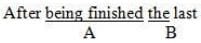
Directions : In each of the following sentences four words or phrases are underlined. If there is any mistake with regard to grammar or usage, it is in the underlined part only. Identify the incorrect part.
Q.
A
C
B
D
C
B
D
A
MULTIPLE CHOICE QUESTION
Try yourself:
Directions : In each of the following sentences four words or phrases are underlined. If there is any mistake with regard to grammar or usage, it is in the underlined part only. Identify the incorrect part.
A
D
B
B
C
A
D
C
MULTIPLE CHOICE QUESTION
Try yourself:
Directions : In each of the following sentences four words or phrases are underlined. If there is any mistake with regard to grammar or usage, it is in the underlined part only. Identify the incorrect part.
A
A
B
B
C
D
D
C
MULTIPLE CHOICE QUESTION
Try yourself:
Directions : In each of the following sentences four words or phrases are underlined. If there is any mistake with regard to grammar or usage, it is in the underlined part only. Identify the incorrect part.
A
B
B
A
C
D
D
C
MULTIPLE CHOICE QUESTION
Try yourself:
In each of the following sentences four words or phrases are underlined. If there is any mistake with regard to grammar or usage, it is in the underlined part only. Identify the incorrect part
A
B
B
C
C
D
D
A
Correct Answer: C
At this stage of civilisation, when many nations are brought in to close and vital contact for good and evil, it is essential, as never before, that their gross ignorance of one another should be diminished, that they should begin to understand a little of one another's historical experience and resulting mentality. It is the fault of the English to expect the people of other countries to react as they do, to political and international situations. Our genuine goodwill and good intentions are often brought to nothing, because we expect other people to be like us. This would be corrected if we knew the history, not necessarily in detail but in broad outlines, of the social and political conditions which have given to each nation its present character.
Report a problem
MULTIPLE CHOICE QUESTION
Try yourself: Directions : In each of the following sentences four words or phrases are underlined. If there is any mistake with regard to grammar or usage, it is in the underlined part only. Identify the incorrect part.
A
C
B
A
C
D
D
B
MULTIPLE CHOICE QUESTION
Try yourself:
Directions : In each of the following sentences four words or phrases are underlined. If there is any mistake with regard to grammar or usage, it is in the underlined part only. Identify the incorrect part.
A
B
B
A
C
C
D
D
MULTIPLE CHOICE QUESTION
Try yourself: Directions : In each of the following sentences four words or phrases are underlined. If there is any mistake with regard to grammar or usage, it is in the underlined part only. Identify the incorrect part.
A
C
B
A
C
B
D
D
Correct Answer: A
Instead of may, could should be in the sentence
Report a problem
MULTIPLE CHOICE QUESTION
Try yourself:
Directions : In each of the following sentences four words or phrases are underlined. If there is any mistake with regard to grammar or usage, it is in the underlined part only. Identify the incorrect part.
A
A
B
B
C
D
D
C
MULTIPLE CHOICE QUESTION
Try yourself:
Directions : In each of the following sentences four words or phrases are underlined. If there is any mistake with regard to grammar or usage, it is in the underlined part only. Identify the incorrect part.
A
D
B
C
C
A
D
B
Section: General Knowledge & Current Affairs
MULTIPLE CHOICE QUESTION
Try yourself:
Direction : Choose the most appropriate option.
Q.
Juno is the name of a:
A
Hydrogen fuelled submarine
B
Hydrogen fuelled space craft
C
Solar powered space craft
D
Atomic powered submarine
Correct Answer: C
Juno is a NASA space probe orbiting the planet Jupiter. It was built by Lockheed Martin and is operated by NASA's Jet Propulsion Laboratory. The spacecraft was launched from Cape Canaveral Air Force Station on August 5, 2011 (UTC), as part of the New Frontiers program,[6] and entered a polar orbit of Jupiter on July 5, 2016 (UTC), to begin a scientific investigation of the planet.After completing its mission, Juno will be intentionally deorbited into Jupiter's atmosphere
Report a problem
MULTIPLE CHOICE QUESTION
Try yourself:
Who has been selected for 2016 BC Roy Award?
A
Dr. P. Raghu Ram
B
Dr. J. Rajendra
C
Dr. N. Bhaskaran
D
Dr. Jagat Ram
Correct Answer: A
Dr P Raghu Ram, President of... more Association of Breast Surgeons of India (ABSI), has been selected for the prestigious 2016 Dr B C Roy National award for outstanding service in the eld of socio-medical relief. This is the highest award that is bestowed upon a Medical person practicing in India & would be conferred by Hon'ble President of India on July 1, 2017 on Doctors' Day. It is claimed that he is the youngest surgeon ever from the Telugu states (Telangana and Andhra Pradesh) to have been selected for this award. The award recognises DrRam's signicant contribution towards improving the delivery of breast health care in India and equally creating the much needed awareness about importance of early detection of breast cancer in Telangana and Andhra Pradesh through a number of initiatives
Report a problem
MULTIPLE CHOICE QUESTION
Try yourself:
The first country to have announced euthanasia of a child is:
A
Belgium
B
Denmark
C
Finland
D
Norway
Correct Answer: A
The country's parliament passed a bill legalizing euthanasia on 20 February 2008 in the first reading with 30 of 59 votes in favour. On 19 March 2009, the bill passed the second reading, making Luxembourg the third European Union country, after the Netherlands and Belgium, to decriminalise euthanasia.
Report a problem
MULTIPLE CHOICE QUESTION
Try yourself:
The Japanese Prime Minister who offered ‘sincere and everlasting condolences’ to the people of the United States for killing more than 2,400 soldiers in the attack on Pearl harbour was:
A
Kakuei Tanaka
B
Shinzo Abe
C
Juniciro Koizumi
D
Hayato Ikeda
Correct Answer: B
Japanese PM Shinzo Abe has visited the US naval base at Pearl Harbor, where he offered "sincere and everlasting condolences" to the victims of Japan's attack on the base 75 years ago.
"We must never repeat the horrors of war again, this is the solemn vow the people of Japan have taken," he said.
Mr Abe was accompanied by US President Barack Obama, making the visit the first by the leaders of both countries.
Japan devastated much of the base, killing more than 2,400 Americans.
Report a problem
MULTIPLE CHOICE QUESTION
Try yourself:
In terms of steel production in the world during 2015 – 2016, India stood at:
A
Fourth
B
Second
C
Fifth
D
Third
Correct Answer: D
Steel Production in the World (2015-2016) India's position in terms of steel production in the world during 2015-2016 was third. Explanation: Here is a detailed explanation to support the answer: 1. Steel production is an important indicator of a country's industrial and economic development. 2. During the period of 2015-2016, India witnessed significant growth in steel production. 3. To determine India's position in the world in terms of steel production during this period, we need to consider the production data of other countries as well. 4. The top steel-producing countries during this period were China, Japan, India, the United States, and Russia. 5. China was the largest steel producer in the world, followed by Japan. 6. India ranked third in terms of steel production, making it one of the major contributors to global steel output. 7. The United States and Russia followed India in terms of steel production during this period. 8. Therefore, India stood at the third position in the world in terms of steel production during 2015-2016. Key Points: - India's position in terms of steel production in the world during 2015-2016 was third. - China was the largest steel producer, followed by Japan. - India ranked third, contributing significantly to global steel output. - The United States and Russia followed India in terms of steel production during this period.
Report a problem
MULTIPLE CHOICE QUESTION
Try yourself:
According to the Survey Report released by Transparency International during March 2017 on India, the most corrupt are
A
Government officials
B
Business executives
C
Local Councillors
D
Police
Correct Answer: D
India was ranked 81st among 180 countries in Corruption Perception Index (CPI) 2017 released by NGO
Transparency International. India has dropped by two ranks from 79th slot in CPI 2016. It scored 40 on the scale
CPI ranks countries on a scale of zero (highly corrupt) to 100 (very clean) based on their perceived levels of corruption in the public sector. The index is compiled by using data of World Bank, World Economic Forum (WEF) and other institutions
Report a problem
MULTIPLE CHOICE QUESTION
Try yourself:
Among the following who was crowned as ‘Miss Supernational’ during 2016?
A
Srinidhi Shetty
B
Shilpa Shetty
C
Alia Butt
D
Aishwarya Rai
Correct Answer: A
Mangaluru girl Srinidhi Shetty was crowned Miss Supranational 2016 at a grand ceremony in Krynica Zdroj, Poland on Friday. She also won the title of Miss Asia-Oceania. Venezuela's Valeria Vespoli was placed second followed by Suriname's Jaleesa Pigot.
Report a problem
MULTIPLE CHOICE QUESTION
Try yourself:
Japan is threatening to drag India to W.T.O on issues relating to the export of its:
A
Electronic goods
B
Tea
C
Small ships
D
Steel
Correct Answer: D
Issue: Japan is threatening to drag India to the World Trade Organization (WTO) on issues relating to the export of its steel.
To give a detailed solution, we need to address the following points: Background: Japan has expressed its concern over India's export restrictions on steel, which it believes violate WTO rules. Japan claims that India's measures are inconsistent with the principles of free trade and could negatively impact the global steel market. Reasons for Japan's Threat: Japan is specifically targeting India's steel exports due to the following reasons: 1. Export Restrictions: Japan argues that India has imposed export restrictions on steel products, such as minimum export price (MEP) and export duty, which go against the principles of free trade and fair competition. 2. Market Distortion: Japan believes that India's export restrictions create an unfair advantage for its domestic steel industry, leading to market distortion and harming the competitiveness of Japanese steel producers. 3. Violation of WTO Rules: Japan asserts that India's export measures are inconsistent with the WTO's Agreement on Subsidies and Countervailing Measures (SCM Agreement), as they can be considered as export subsidies that are prohibited under the agreement. Possible Consequences: If Japan proceeds with its threat to take India to the WTO, the following consequences may arise: 1. Legal Battle: India and Japan would engage in a legal battle at the WTO, where both countries would present their arguments and evidence to support their respective positions. 2. WTO Rulings: The WTO dispute settlement process would be initiated, and a panel of experts would be appointed to examine the case. The panel's findings and subsequent rulings by the WTO Appellate Body would determine whether India's export measures violate WTO rules or not. 3. Potential Penalties: If the WTO rules in favor of Japan, India may be required to remove or modify its export restrictions on steel, and could face penalties or compensation claims for the harm caused to Japanese steel producers. Conclusion: Japan's threat to drag India to the WTO on issues relating to the export of its steel highlights the ongoing trade tensions between the two countries. The resolution of this dispute would depend on the findings and rulings of the WTO panel, and could have significant implications for India's steel industry and its trade relations with Japan.
Report a problem
MULTIPLE CHOICE QUESTION
Try yourself:
COIN, a software programme developed by J. P. Morgan supports:
A
Robotic surgery
B
Financial accounting
C
Bitcoin
D
Interpreting commercial documents
Correct Answer: D
D is the correct option. a software programme developed by J. P. Morgan -It was called Coin and is based on blockchain-based technology. It will enable instantaneous transfer of payments between institutional clients.
Report a problem
MULTIPLE CHOICE QUESTION
Try yourself:
Which of the following country enacted a law during August 2016 providing for the right to register the marriages of Hindus?
A
Saudi Arabia
B
Iran
C
Afghanistan
D
Pakistan
Correct Answer: D
Answer: The correct answer is D: Pakistan. Here is a detailed explanation: Introduction: During August 2016, a law was enacted in a specific country to provide the right to register marriages for Hindus. Let's analyze the options to identify the correct country. Options: A: Saudi Arabia - Saudi Arabia is a predominantly Muslim country and does not have a specific law related to the registration of marriages for Hindus. B: Iran - Iran is also a predominantly Muslim country and does not have a specific law related to the registration of marriages for Hindus. C: Afghanistan - Afghanistan is primarily a Muslim country and does not have a specific law related to the registration of marriages for Hindus. Correct Answer: D: Pakistan - Pakistan is a country with a significant Hindu population. In August 2016, the Pakistani government enacted a law that provides the right to register marriages for Hindus. This law was implemented to protect the rights of the Hindu community in Pakistan and ensure the legal recognition of their marriages. Conclusion: Based on the analysis, it can be concluded that Pakistan is the country that enacted a law during August 2016 providing for the right to register the marriages of Hindus.
Report a problem
MULTIPLE CHOICE QUESTION
Try yourself:
The first elected civilian President in Myanmar is:
A
Aung San
B
Khin Ayi
C
Htin Kyaw
D
Aung San Suu Kyi
Correct Answer: C
The first elected civilian President in Myanmar is Htin Kyaw.
Explanation:
Aung San: Aung San is not the correct answer. He was the founder of the modern Burmese army and is considered to be the father of modern-day Myanmar.
Khin Ayi: Khin Ayi is not the correct answer. There is no historical record of a person named Khin Ayi serving as the President of Myanmar.
Htin Kyaw: Htin Kyaw is the correct answer. He was elected as the President of Myanmar in 2016, becoming the country's first civilian President after more than five decades of military rule.
Aung San Suu Kyi: Aung San Suu Kyi is not the correct answer. Although she is a prominent political figure in Myanmar, she served as the State Counsellor (Prime Minister) of Myanmar and not as the President.
Therefore, the correct answer is Htin Kyaw.
Report a problem
MULTIPLE CHOICE QUESTION
Try yourself:
Among the following professors of Indian origin who has received Knighthood for the work as a co-inventor of next generation DNA Sequencing called Solexa Sequencing is?
A
P. C. Mahalanobis
B
Shankar Balasubramanian
C
Mehnad Saha
D
Satyendra Nath Bose
Correct Answer: B
Mr. Shankar Balasubramanian is an India origin Bri... moretish professor of Chemistry and DNA expert at Cambridge University.He got Knighthood for the work as a co-inventor if next gen.DNA sequencing described as the most transformational advance in biology and medicine for decades. Solexa sequencing ---It is an individual genome to be sequenced in a day or two at a cost of less than 1,000 pounds.Sequencing the human genome took years of work and cost billions
Report a problem
MULTIPLE CHOICE QUESTION
Try yourself:
Which court has stayed the execution of death sentence of Kulbhushan Jadhav in May 2017?
A
International Criminal Court
B
International Court of Justice
C
Supreme Court of India
D
Supreme Court of Pakistan
Correct Answer: B
Answer: The court that stayed the execution of the death sentence of Kulbhushan Jadhav in May 2017 was the International Court of Justice (ICJ).
Background: Kulbhushan Jadhav, an Indian national, was arrested by Pakistani authorities in 2016 and was accused of being involved in espionage and terrorism activities in Pakistan.
India's Appeal: India filed a case against Pakistan at the ICJ, alleging violations of the Vienna Convention on Consular Relations by denying consular access to Jadhav.
ICJ's Decision: On May 18, 2017, the ICJ announced its decision to stay the execution of Jadhav's death sentence until a final judgment was reached in the case.
Reasoning: The ICJ found that Pakistan had violated its obligations under the Vienna Convention by not informing Jadhav of his rights and denying consular access to him.
Provisional Measures: The ICJ ordered Pakistan to take all necessary measures to ensure that Jadhav was not executed before the final judgment of the court.
Continued Proceedings: The case between India and Pakistan regarding Jadhav's death sentence is still ongoing at the ICJ, with both parties presenting their arguments and evidence.
Overall, the International Court of Justice played a crucial role in staying the execution of Kulbhushan Jadhav's death sentence and ensuring that his case was given fair consideration.
Report a problem
MULTIPLE CHOICE QUESTION
Try yourself:
World’s longest rail tunnel is about:
A
32 kms.
B
57 kms.
C
23 kms.
D
47 kms.
Correct Answer: B
The new Gotthard Base Tunnel is the longest rail tunnel in the world at 57km and is emblematic of Switzerland's pioneering spirit which remains bright even 100 years after the construction of the Gotthard mountain route. Swiss Federal Railways (SBB) is proud to operate the longest railway tunnel in the world.
Report a problem
MULTIPLE CHOICE QUESTION
Try yourself:
The Hubble telescope of NASA is located in
A
Iceland
B
Space
C
Canada
D
NASA headquarters
Correct Answer: B
Edwin Hubble, for whom the Hubble Telescope is named, used the largest telescope of his day in the 1920s at the Mt. Wilson Observatory near Pasadena, Calif., to discover galaxies beyond our own. Hubble, the observatory, is the first major optical telescope to be placed in space, the ultimate mountaintop.
Report a problem
MULTIPLE CHOICE QUESTION
Try yourself:
The first Commercial Court and Commercial Disputes Resolution Centre was inaugurated at
A
Ahmedabad, Gujarat
B
Raipur, Chattisgarh
C
Mumbai, Maharastra
D
Visakapatinam, Andhra Pradesh
Correct Answer: B
B is the correct option.India's first Commercial Court and Commercial Disputes Resolution Centre has been opened at Raipur, the capital of Chhattisgarh.
Report a problem
MULTIPLE CHOICE QUESTION
Try yourself:
As on 31st January 2016, the highest number of law colleges were present in:
A
Madhya Pradesh
B
Andhra Pradesh
C
Uttar Pradesh
D
Maharashtra
Correct Answer: C
Answer: Law Colleges Distribution in India as on 31st January 2016: - Madhya Pradesh - Andhra Pradesh - Uttar Pradesh - Maharashtra Explanation: The question asks about the state in India where the highest number of law colleges were present as of 31st January 2016. The options provided are Madhya Pradesh, Andhra Pradesh, Uttar Pradesh, and Maharashtra. Let's analyze each option to find the correct answer. A: Madhya Pradesh - No information is given about the number of law colleges in Madhya Pradesh. B: Andhra Pradesh - No information is given about the number of law colleges in Andhra Pradesh. C: Uttar Pradesh - No information is given about the number of law colleges in Uttar Pradesh. D: Maharashtra - No information is given about the number of law colleges in Maharashtra. Conclusion: Without any information about the number of law colleges in each state, it is not possible to determine the correct answer. Therefore, the answer cannot be determined based on the information provided.
Report a problem
MULTIPLE CHOICE QUESTION
Try yourself:
The bowler who has claimed the fastest 250 wickets in Cricket test matches is:
A
Ravichandran Ashwin
B
Dennis Lillee
C
Rangana Herath
D
Anil Kumble
Correct Answer: A
A is the correct option.Ravichandran Ashwin became the fastest bowler to reach 250 wickets in Tests. The Indian spinner surpassed Australian legend Dennis Lillee's record by taking just 45 matches to reach the landmark. He achieved the milestone in his 37th Test match.
Report a problem
MULTIPLE CHOICE QUESTION
Try yourself:
The top destination for domestic tourists in India for the past three consecutive years has been:
A
Tamil Nadu
B
Orissa
C
Rajasthan
D
Kerala
Correct Answer: A
A is the correct option.Tamil Nadu bagged the top spot as the country's most popular tourist destination among foreign and domestic tourists for the past three consecutive years. The majority of the tourists are from Bangladesh followed by the US and the UK.
Report a problem
MULTIPLE CHOICE QUESTION
Try yourself:
Name the President elect of France who is likely to take the oath on 14 May 2017.
A
Francois Fillon
B
Emmanuel Macron
C
Francois Holland
D
Marine Le Pen
Correct Answer: B
President Elect of France:
Emmanuel Macron is the President elect of France who is likely to take the oath on 14 May 2017.
Explanation:
Here is the breakdown of the options and why Emmanuel Macron is the correct answer:
1. Francois Fillon: - Francois Fillon is a French politician and was a candidate in the 2017 French presidential election. - However, he did not win the election and is not the president elect of France.
2. Emmanuel Macron: - Emmanuel Macron is a French politician and was elected as the President of France in the 2017 presidential election. - He won the second round of the election on 7 May 2017, defeating Marine Le Pen. - He is expected to take the oath and assume office on 14 May 2017.
3. Francois Hollande: - Francois Hollande was the President of France from 2012 to 2017. - He did not run for re-election in 2017 and is not the president elect of France.
4. Marine Le Pen: - Marine Le Pen is a French politician and was a candidate in the 2017 French presidential election. - She reached the second round of the election but was defeated by Emmanuel Macron. - She is not the president elect of France.
Therefore, the correct answer is Emmanuel Macron who is likely to take the oath on 14 May 2017.
Report a problem
MULTIPLE CHOICE QUESTION
Try yourself:
With the development of Terahertz (THz) transmitter, it is expected to be faster than 5G mobile networks by:
A
Two times
B
Ten times
C
Four times
D
Five times
Correct Answer: B
B is the correct option. Scientists from Japan have developed terahertz (THz) transmitter technology, a next generation system which can transmit digital data over 10 times faster than 5G mobile networks.
Report a problem
MULTIPLE CHOICE QUESTION
Try yourself:
India’s third largest trading partner during 2016 is
A
Dubai
B
Saudi Arabia
C
Kuwait
D
U.A.E
Correct Answer: D
India's Third Largest Trading Partner in 2016: The answer is U.A.E. Explanation: During the year 2016, India's third largest trading partner was the United Arab Emirates (U.A.E). Here is a detailed explanation: 1. Background: - Trading partners refer to countries that engage in the exchange of goods and services with each other. - The trading relationship between countries is measured in terms of the value of imports and exports. 2. India's Trade Partners: - India has a diverse range of trading partners across the globe. - These partners include both neighboring countries and countries from different regions. 3. Ranking of Trading Partners: - The ranking of trading partners is based on the value of trade between countries. - The value of trade is calculated by adding the value of imports and exports. 4. India's Third Largest Trading Partner in 2016: - In 2016, the United Arab Emirates emerged as India's third largest trading partner. - The trade between India and the U.A.E. was valued at a significant level during that year. 5. Reasons for India-U.A.E. Trade: - The U.A.E. is an important trading partner for India due to several factors: - Proximity: The U.A.E. is geographically close to India, making it easier for trade. - Oil Imports: India relies heavily on oil imports, and the U.A.E. is a major oil exporter. - Business Opportunities: The U.A.E. offers numerous business opportunities for Indian companies. 6. Trade Relations: - The India-U.A.E. trade relations have been growing steadily over the years. - Both countries have taken steps to enhance bilateral trade and investment. 7. Conclusion: - In 2016, the United Arab Emirates was India's third largest trading partner. - The trade between India and the U.A.E. is significant and beneficial for both countries.
Report a problem
MULTIPLE CHOICE QUESTION
Try yourself:
The first country in the world to have begun shutting down the entire Frequency Modulation (FM) radio network to be replaced by Digital Audio Broadcasting is:
A
Norway
B
Switzerland
C
United States of America
D
China
Correct Answer: A
A is the correct option.Norway became the first country in the world to begin shutting down its entire FM (Frequency Modulation) radio network and replacing it with digital radio — a move that is being closely monitored by other European nations.
Report a problem
MULTIPLE CHOICE QUESTION
Try yourself:
The Happiness Index Department or a Wing has been established in the states of:
A
Madhya Pradesh and Tamil Nadu
B
Andhra Pradesh and Madhya Pradesh
C
Andhra Pradesh and Sikkim
D
Madhya Pradesh and Goa
Correct Answer: B
B is the correct option.Andhra Pradesh and Madhya Pradesh have become the first Indian states to set up ‘Happiness Department’. The new department will work to ensure happiness in the lives of common people on the lines of Bhutan. It will map and define parameters of happiness and efficiency and would chalk out directives/guidelines for coordination between departments in the direction of spreading happiness in the state. Bhutan is the only country in the world that measures its progress through the Gross Happiness Index (GHI).
Report a problem
MULTIPLE CHOICE QUESTION
Try yourself:
Volvo has launched the world’s largest bus that can carry up to:
A
320 passengers
B
260 passengers
C
300 passengers
D
150 passengers
Correct Answer: C
C is the correct option.Volvo had launched the world's largest bus chassis at the FetransRio exhibition in Rio de Janeiro, Brazil. Volvo is a leading supplier of buses for high passenger capacity transport systems, Bus Rapid Transit (BRT). The new biarticulated chassis, Gran Artic 300, is 30 meter and can carry up to 300 passengers.
Report a problem
MULTIPLE CHOICE QUESTION
Try yourself:
Donald Trump is _____________ President of the United States.
A
43rd
B
44th
C
46th
D
45th
Correct Answer: D
Donald John Trump is the 45th President of the United States of America. Don't have any explanation to it.
Report a problem
MULTIPLE CHOICE QUESTION
Try yourself:
The 2016 Nobel Peace Prize was won by the President of :
A
United States of America
B
Columbia
C
Sri Lanka
D
South Africa
Correct Answer: B
2016 Nobel Peace Prize. The 2016 Nobel Peace Prize was awarded to the President of Colombia Juan Manuel Santos "for his resolute efforts to bring the country's more than 50-year-long civil war to an end, a war that has cost the lives of at least 220,000 Colombians and displaced close to six million people."
Report a problem
MULTIPLE CHOICE QUESTION
Try yourself: The World Bank has cut India’s GDP growth for 2016 – 2017 to:
A
7%
B
8.6%
C
8%
D
7.6%
Correct Answer: A
World Bank has reduced its India GDP growth forecast to 7% for 2017-18 from 7.2%, blaming disruptions caused by demonetisation and GST
Report a problem
MULTIPLE CHOICE QUESTION
Try yourself:
Solar Impulse–2 is:
A
Solar powered ship
B
Solar powered airplane that completed the first around the world
C
Hybrid airplane
D
Impact of climate change for overall increase of 2ºC a year
Correct Answer: B
Solar Impulse-2 is a solar-powered airplane that completed the first around the world. Key points: - Solar Impulse-2 is an innovative aircraft that runs solely on solar power. - It is not a ship or a hybrid airplane. - The Solar Impulse-2 successfully completed the first ever around-the-world flight by a solar-powered aircraft. - This groundbreaking achievement demonstrated the potential of renewable energy and clean technologies in aviation. - The aircraft was equipped with advanced solar panels that captured sunlight and converted it into electricity to power its motors and charge its batteries. - It had a wingspan of 72 meters, similar to that of a Boeing 747, and its lightweight design allowed it to fly for long durations. - The Solar Impulse-2 embarked on its journey in March 2015, taking off from Abu Dhabi and making stops in various countries before returning to its starting point in July 2016. - The flight covered a distance of over 40,000 kilometers and lasted for more than 500 hours. - The success of the Solar Impulse-2 highlighted the potential for solar-powered aviation to reduce carbon emissions and dependence on fossil fuels in the aerospace industry. - It served as an inspiration for further developments in sustainable aviation and encouraged the exploration of clean energy solutions for transportation.
Report a problem
MULTIPLE CHOICE QUESTION
Try yourself:
The Union Cabinet has recently approved the setting up of a Permanent Tribunal for resolving:
A
Complaints from three services
B
Inter-state water disputes
C
Inter-state boundary disputes
D
Election disputes
Correct Answer: B
The Union Cabinet has approved the setting up of a Permanent Tribunal for resolving inter-state water disputes. The key details of this decision are as follows: 1. Purpose: The Permanent Tribunal has been established to address and resolve inter-state water disputes in a timely and effective manner. 2. Jurisdiction: The tribunal will have jurisdiction over all inter-state river water disputes, including those covered by the Inter-State River Water Disputes (ISRWD) Act, 1956. This act provides for the adjudication of disputes relating to inter-state rivers and river valleys. 3. Composition: The tribunal will consist of a chairperson, vice-chairperson, and a maximum of six members. The members will be selected based on their expertise and experience in water resources management, law, and related fields. 4. Functions: The Permanent Tribunal will have the following functions: - Adjudication of inter-state water disputes referred to it by the central government. - Monitoring the implementation of its orders and decisions. - Advising the central government on matters related to interstate water disputes. 5. Benefits: The establishment of a Permanent Tribunal for inter-state water disputes will bring several benefits, including: - Speedy resolution of disputes: The tribunal will ensure a time-bound resolution of inter-state water disputes, which will help prevent prolonged conflicts between states. - Expertise and neutrality: The tribunal will comprise members with expertise in the relevant fields, ensuring impartial and informed decision-making. - Effective implementation: The tribunal will monitor the implementation of its orders and decisions, ensuring compliance by the concerned parties. 6. Impact: The establishment of a Permanent Tribunal for resolving inter-state water disputes will contribute to better water resource management, equitable distribution of water, and the prevention of conflicts between states. It will provide a fair and impartial platform for the resolution of disputes, promoting cooperation and collaboration among different states. In conclusion, the Union Cabinet's approval for setting up a Permanent Tribunal for resolving inter-state water disputes is a significant step towards ensuring efficient and timely resolution of such disputes. This decision will help in the effective management and equitable distribution of water resources, benefiting all the concerned states and fostering cooperation among them.
Report a problem
MULTIPLE CHOICE QUESTION
Try yourself:
Which country 3D – Printed a home of 37 sq.mts?
A
Spain
B
South Korea
C
Russia
D
Taiwan
Correct Answer: C
C is the correct option. The 37 sq mts 3 D printed home is in Russia. World first family to live in a 3-D printed home is a French family.
Report a problem
MULTIPLE CHOICE QUESTION
Try yourself:
'World’s longest-all women Non-stop flight’ from New Delhi to San Francisco covering 14,500 kms was operated by:
A
Air India
B
American Airlines
C
Jet Airways
D
United Airlines
Correct Answer: A
Air India on Monday said it flew the "world's longest" all-women-operated flight from Delhi to San Francisco.
The flight, which travelled a distance of around 14,500 kilometre in close to 17 hours, was operated as part of International Women's Day celebrations.
The non-stop Delhi-San Francisco flight took off from the national capital on March 6.
"This year for the first time, on the world's longest non-stop flight, entire flight operations from cockpit crew to cabin crew, check-in staff, doctor, customer care staff, ATC (air traffic control) and the entire ground handling... were handled by women," Air India said in a release.
Air India CMD Ashwani Lohani said it was a historic flight and "the longest operated by all-women crew". "The airline has immense respect for women and it is a symbol of women empowerment," he added.
The flight was under the command of Kshamta Bajpayee and Shubhangi Singh, along with First Officers Ramya Kirti Gupta and Amrit Namdhari.
Report a problem
MULTIPLE CHOICE QUESTION
Try yourself:
Which country offered asylum seekers 1,200 Euros to leave by withdrawing their application for protection?
A
Italy
B
Germany
C
Denmark
D
France
Correct Answer: B
B is the correct option. Germany Migrants will be offered financial incentives of up to €1,200 (£1,000) each to leave Germany and withdraw their application for protection, with a lower amount of €800 (£700) if they choose to depart after being refused asylum.
Report a problem
MULTIPLE CHOICE QUESTION
Try yourself:
During 2017, which SAARC country has notified the Right to Information Act ?
A
Nepal
B
Sri Lanka
C
Afghanistan
D
Bhutan
Correct Answer: B
SAARC Country Notifying the Right to Information Act in 2017: Answer: Sri Lanka Here is a detailed explanation: Introduction: The Right to Information Act is a legislation that empowers citizens to access government information and promotes transparency and accountability in governance. It allows individuals to obtain information from public authorities and ensures that they are accountable to the people they serve. SAARC Countries: SAARC (South Asian Association for Regional Cooperation) is an organization of eight countries in South Asia, including Afghanistan, Bangladesh, Bhutan, India, Maldives, Nepal, Pakistan, and Sri Lanka. Notification of Right to Information Act: Among the SAARC countries, Sri Lanka is the one that notified the Right to Information Act in 2017. This means that Sri Lanka enacted the legislation during that year to establish the right of citizens to access public information. Other SAARC Countries and Right to Information Acts: Although Sri Lanka was the SAARC country that notified the Right to Information Act in 2017, it is worth mentioning that other SAARC countries also have their own versions of the legislation. Here is an overview: - Nepal: Nepal has had the Right to Information Act since 2007, which was later replaced by the Right to Information Act 2019. - Afghanistan: Afghanistan passed the Law on Access to Information in 2014, which grants citizens the right to access information from public authorities. - Bhutan: Bhutan enacted the Right to Information Act in 2007, providing citizens the right to access information and ensuring transparency and accountability in governance. Conclusion: In 2017, Sri Lanka was the SAARC country that notified the Right to Information Act. However, other SAARC countries also have their own versions of the legislation, promoting transparency and accountability in governance.
Report a problem
MULTIPLE CHOICE QUESTION
Try yourself:
Highest number of open prisons in India as on 2015 are in
A
Kerala
B
Maharastra
C
Tamil Nadu
D
Rajasthan
Correct Answer: D
Explanation: The highest number of open prisons in India as of 2015 is in Rajasthan. Reasoning: - Open prisons are a type of correctional facility where inmates are allowed to live in relatively open conditions and engage in outdoor activities. - These prisons are generally used for low-risk offenders who are nearing the end of their sentence. - The number of open prisons in a state can vary depending on various factors such as the state's population, crime rate, and government policies. Breakdown of the options: A: Kerala - Kerala is not known to have a high number of open prisons. B: Maharashtra - Maharashtra does have open prisons, but the number is not the highest in India. C: Tamil Nadu - Tamil Nadu also has open prisons, but the number is not the highest in India. D: Rajasthan - Rajasthan is known to have the highest number of open prisons in India as of 2015. Conclusion: Based on the information provided, the correct answer is D: Rajasthan.
Report a problem
MULTIPLE CHOICE QUESTION
Try yourself:
India’s voting rights at the International Monetary Fund increased from 2.3 % to
A
2.5%
B
2.6%
C
2.8%
D
2.4%
Correct Answer: B
The correct option is B as rate has been increased upto 2.6%
Report a problem
MULTIPLE CHOICE QUESTION
Try yourself:
Which of the following individuals was called a ‘deceptive actor’ by China’s foreign ministry during March 2017?
A
Dalai Lama
B
Donald Trump
C
Narendra Modi
D
Sirisena
Correct Answer: A
China's Foreign Ministry statement in March 2017:
Individual called a 'deceptive actor': Dalai Lama
The Chinese Foreign Ministry referred to the Dalai Lama as a 'deceptive actor' during March 2017.
Report a problem
MULTIPLE CHOICE QUESTION
Try yourself:
‘Scorpion kick’ is a phrase used in
A
Kalari Fight
B
Kung Fu
C
Kick Boxing
D
Kabaddi
Correct Answer: D
Kabaddi is an explosive, high-contact sport where players have to constantly think on their feet. Survival is paramount, and raiders and defenders are armed with multiple weapons to counter the opposition.
Also known as the 'Scorpion kick' for its late sting. Derived from martial arts, it needs the raider to kick backwards. The raider bends down on one knee, snaps the other leg back towards an opponent's chest or face, and usually has his hands on the mat ready to spring back to the mid-line. It's an important weapon in a raider's arsenal because it lets them go on a surprise attack while maintaining distance from the defenders. In Pro Kabaddi, Jaipur Pink Panthers' Jasvir Singh, who is one of the shortest players in the League, has stung many a defender with it.
Report a problem
MULTIPLE CHOICE QUESTION
Try yourself:
Immediately before Antonio Guterres was appointed the U.N Secretary General in October 2016, he was
A
United Nations High Commissioner for Refugees
B
Commissioner General of UNRWA
C
The Prime Minister of Portuguese
D
United Nations High Commissioner for Human Rights
Correct Answer: A
Antonio Guterres's Background: Antonio Guterres, the current U.N Secretary General, has had an extensive career in international affairs. Before his appointment as the Secretary General in October 2016, he held several notable positions. Positions Held: A: United Nations High Commissioner for Refugees: - Antonio Guterres served as the United Nations High Commissioner for Refugees (UNHCR) from 2005 to 2015. - During his tenure, he focused on addressing the global refugee crisis and advocating for the rights and well-being of refugees worldwide. B: Commissioner General of UNRWA: - Antonio Guterres did not hold the position of Commissioner General of the United Nations Relief and Works Agency for Palestine Refugees in the Near East (UNRWA). C: The Prime Minister of Portugal: - Before his role as the U.N Secretary General, Antonio Guterres served as the Prime Minister of Portugal from 1995 to 2002. - As the Prime Minister, he implemented various social and economic reforms and played a significant role in the European Union. D: United Nations High Commissioner for Human Rights: - Antonio Guterres did not hold the position of United Nations High Commissioner for Human Rights. Conclusion: Before being appointed as the U.N Secretary General in October 2016, Antonio Guterres served as the United Nations High Commissioner for Refugees (UNHCR) from 2005 to 2015.
Report a problem
MULTIPLE CHOICE QUESTION
Try yourself:
How many billionaires India has lost since demonetization on November 8, 2016?
A
Eleven
B
Eight
C
Two
D
Eighteen
Correct Answer: A
Number of billionaires India has lost since demonetization: - Demonetization refers to the decision made by the Indian government on November 8, 2016, to ban the use of certain high-value currency notes in circulation. - This move aimed to curb black money, corruption, and counterfeit currency in the Indian economy. - As a result of demonetization, several individuals and businesses faced challenges, and the impact was felt across various sectors. - Among those affected were some billionaires who experienced a decrease in their wealth or lost their billionaire status. - The number of billionaires India has lost since demonetization is eleven. - This means that eleven individuals who were previously classified as billionaires no longer hold that status. - It is important to note that the loss of billionaire status does not necessarily mean that these individuals faced financial ruin or significant hardship. - Their wealth may have decreased due to various factors, including changes in the value of assets or investments, economic fluctuations, or other business-related reasons. - However, it is worth mentioning that demonetization did have an impact on the overall wealth distribution in India and led to some reshuffling of the billionaire list. - The exact identities of the billionaires who lost their status due to demonetization are not specified in the question. - Therefore, it is not possible to provide specific names or details regarding these individuals. - Overall, demonetization had a wide-ranging impact on the Indian economy, and its effects continue to be a subject of debate and analysis.
Report a problem
MULTIPLE CHOICE QUESTION
Try yourself:
The world’s first artificial intelligence lawyer, a robot, is named as:
A
Boss
B
Watson
C
Ross
D
IBM-LaBrain
Correct Answer: C
The correct option is C as The world’s first robot lawyer named ‘ROSS’.
Report a problem
MULTIPLE CHOICE QUESTION
Try yourself:
Till the end of 2016, the total number of UNESCO’s World Heritage Sites in India is:
A
18
B
21
C
42
D
35
Correct Answer: D
Number of UNESCO's World Heritage Sites in India: The total number of UNESCO's World Heritage Sites in India till the end of 2016 is 35. Explanation: Here are the details: 1. India has a rich cultural and natural heritage, which is recognized by UNESCO through its World Heritage Sites. 2. UNESCO's World Heritage Sites are places of outstanding universal value that are considered to be important for the whole world to protect and preserve. 3. These sites are selected based on their cultural, natural, or mixed significance. 4. India has a diverse range of World Heritage Sites, including ancient temples, historical monuments, natural landscapes, and archaeological sites. 5. As of 2016, there are a total of 35 World Heritage Sites in India. 6. These sites are spread across different states and regions, showcasing the country's rich cultural and natural heritage. 7. Some of the famous World Heritage Sites in India include the Taj Mahal, Qutub Minar, Red Fort, Hampi, Jaipur City, Kaziranga National Park, and the Western Ghats, among others. 8. These sites attract a large number of tourists from around the world and contribute to the cultural and economic development of the country. In conclusion, the total number of UNESCO's World Heritage Sites in India till the end of 2016 is 35.
Report a problem
MULTIPLE CHOICE QUESTION
Try yourself:
India emerged as ___________ largest holder of the U.S Government Securities at the end of 2016:
A
Twelfth
B
Twenty eighth
C
Fifteenth
D
Twenty fourth
Correct Answer: A
India emerged as the twelfth largest holder of the U.S Government Securities at the end of 2016. Explanation: India's ranking as the holder of U.S Government Securities can be determined by analyzing the available data and comparing it with other countries. Here is a detailed explanation of why the correct answer is option A: - According to the U.S. Department of the Treasury, India held U.S Government Securities worth $118.2 billion at the end of 2016. - To determine India's ranking, we can compare this amount with the holdings of other countries. - The U.S. Treasury publishes a report called the "Major Foreign Holders of Treasury Securities" which provides information on the holdings of various countries. - By referring to this report, we can find that India's holdings of $118.2 billion placed it in the twelfth position among all the countries. - This means that there were eleven other countries that held larger amounts of U.S Government Securities than India. - Therefore, the correct answer is option A: Twelfth. In conclusion, India emerged as the twelfth largest holder of U.S Government Securities at the end of 2016, with holdings worth $118.2 billion.
Report a problem
MULTIPLE CHOICE QUESTION
Try yourself:
Prithvi Defence Vehicle is
A
The name of a newly developed tank
B
The name of a single seated aircraft developed by HAL
C
The name of an amphibious Naval vessel
D
The name of India’s Nuclear Intercepter Missile
Correct Answer: D
D is the correct option.Prithvi Defence Vehicle (PDV) mission has been developed by indigenously by DRDO. It is a two-stage missile and both stages are powered by solid propellants. It is intended to replace the existing Prithvi Air Defence (PAD) in PAD/Advanced Air Defence (AAD) combination.
Report a problem
MULTIPLE CHOICE QUESTION
Try yourself:
Which shoe company in the United States of America has won an IPR dispute against China recently for using their logo?
A
Adidas
B
Reebok
C
Nike
D
New Balance
Correct Answer: D
Shoe Company that Won an IPR Dispute against China
The shoe company that recently won an intellectual property rights (IPR) dispute against China for the unauthorized use of their logo is New Balance.
Details of the IPR Dispute:
New Balance, an American footwear manufacturer, filed a lawsuit against three Chinese shoemakers for trademark infringement.
The dispute centered around the unauthorized use of New Balance's "N" logo, which closely resembled the Chinese characters for "New Balance" when rotated.
New Balance argued that the Chinese companies intentionally copied their logo to deceive consumers and benefit from the established reputation of the New Balance brand.
In 2015, a Chinese court ruled in favor of New Balance, ordering the infringing companies to pay substantial fines and cease the production and sale of the infringing shoes.
Impact of the Victory:
The IPR dispute victory reinforced New Balance's commitment to protecting its brand and intellectual property rights.
It sent a strong message to other companies in China and around the world that New Balance takes intellectual property infringement seriously and will take legal action to defend its rights.
The victory also highlighted the importance of safeguarding intellectual property in the global marketplace, as unauthorized use of trademarks can harm both the reputation and financial interests of companies.
Therefore, the shoe company in the United States of America that recently won an IPR dispute against China for using their logo is New Balance.
Report a problem
MULTIPLE CHOICE QUESTION
Try yourself:
Among the following, who has won the maximum number of titles?
A
Gopichand
B
P. V. Sindhu
C
Saina Nehwal
D
Srikant
Correct Answer: C
Introduction: In order to determine who has won the maximum number of titles among the given options, we will analyze the achievements of each player. Gopichand: Gopichand is a former Indian badminton player who won several titles during his career. However, he is not among the given options for the maximum number of titles. P. V. Sindhu: P. V. Sindhu is an Indian badminton player who has achieved great success in her career. She became the first Indian woman to win an Olympic silver medal in badminton in 2016. However, it is not specified whether she has won the maximum number of titles among the given options. Saina Nehwal: Saina Nehwal is an Indian badminton player who has had a remarkable career. She has won numerous titles, including the Olympic bronze medal in 2012. Saina Nehwal is a strong contender for having won the maximum number of titles among the given options. Srikant: The given option "Srikant" is not a specific name, and it is unclear which badminton player this refers to. Without further information, it is impossible to determine if Srikant has won the maximum number of titles. Conclusion: Based on the information provided, Saina Nehwal is the most likely player to have won the maximum number of titles among the given options. However, without additional information, it is difficult to make a definitive conclusion.
Report a problem
MULTIPLE CHOICE QUESTION
Try yourself:
NASA rediscovered India’s lunar spacecraft that was lost in the space during the past eight years known as:
A
Mangalayaan – I
B
Chandrayan – II
C
Chandrayan – I
D
Mangalayaan – II
Correct Answer: C
Background: In the past eight years, India's lunar spacecraft was lost in space. NASA recently rediscovered this spacecraft. Identification of the Lunar Spacecraft: The lunar spacecraft rediscovered by NASA is known as "Chandrayan - I." Explanation: NASA's rediscovery of India's lunar spacecraft, Chandrayan - I, provides an opportunity to understand the significance of this mission. Here are some key points regarding the identification and details of the spacecraft: - Chandrayan - I is an Indian lunar mission launched by the Indian Space Research Organisation (ISRO) in October 2008. - The primary objective of Chandrayan - I was to conduct a detailed study of the Moon's surface and its mineral composition. - The spacecraft carried several scientific instruments, including the Moon Impact Probe (MIP), which was designed to impact the lunar surface and provide data about the Moon's surface properties. - Unfortunately, communication with Chandrayan - I was lost in August 2009, just ten months after its launch. - Despite the loss of communication, the spacecraft continued to orbit the Moon, and its location remained unknown until NASA recently rediscovered it. - NASA's Lunar Reconnaissance Orbiter (LRO) was able to locate Chandrayan - I through its imaging and detection capabilities. - The rediscovery of Chandrayan - I by NASA demonstrates the advances in space exploration technology and the collaborative efforts between different space agencies. Conclusion: In conclusion, the lunar spacecraft rediscovered by NASA after eight years is India's Chandrayan - I mission. This mission aimed to study the Moon's surface and mineral composition but lost communication shortly after its launch. The recent rediscovery of Chandrayan - I highlights the significance of space exploration and the capabilities of modern space imaging technology.
Report a problem
MULTIPLE CHOICE QUESTION
Try yourself:
Who called the immigration the ‘Trojan horse of Terrorism’?
A
Theresa May, Prime Minister of U.K
B
Angela Merkel, Chancellor of Germany
C
Donald Trump, President of the U.S
D
Viktor Orban, Prime Minister of Hungary
Correct Answer: D
Who called the immigration the 'Trojan horse of Terrorism'? The person who called immigration the 'Trojan horse of Terrorism' is Viktor Orban, the Prime Minister of Hungary. Detailed Introduction: The statement "Trojan horse of Terrorism" refers to the belief that immigration poses a significant risk of allowing terrorists to enter a country under the guise of seeking refuge or better opportunities. The person who made this statement is Viktor Orban, the Prime Minister of Hungary. Explanation: Viktor Orban is known for his strong stance against immigration and has been vocal about his concerns regarding the potential security threats posed by immigrants. Here is a detailed explanation of the options given: - Theresa May, Prime Minister of U.K: While Theresa May has been involved in discussions and policy-making related to immigration, she did not specifically use the term 'Trojan horse of Terrorism' to describe immigration. - Angela Merkel, Chancellor of Germany: Angela Merkel, known for her open-door policy towards immigration, has not used the term 'Trojan horse of Terrorism' to describe immigration. - Donald Trump, President of the U.S: Although Donald Trump has been known for his strong rhetoric on immigration and border security, he did not use the specific phrase 'Trojan horse of Terrorism' to describe immigration. - Viktor Orban, Prime Minister of Hungary: Viktor Orban has been widely recognized for his strong stance against immigration and has used the term 'Trojan horse of Terrorism' to express his concerns about the potential security risks associated with immigration. Conclusion: Out of the given options, Viktor Orban, the Prime Minister of Hungary, called immigration the 'Trojan horse of Terrorism'. His statement reflects his concerns about the potential security threats posed by immigrants.
Report a problem
MULTIPLE CHOICE QUESTION
Try yourself:
The first statue of a woman in Parliament Square in England is that of:
A
Queen Elizabeth – II
B
Margaret Thatcher
C
Millicent Fawcett
D
Mother Theresa
Correct Answer: C
Answer: The first statue of a woman in Parliament Square in England is that of Millicent Fawcett. Explanation: Millicent Fawcett was a prominent British suffragist and feminist who played a vital role in the women's suffrage movement in the late 19th and early 20th centuries. She was the president of the National Union of Women's Suffrage Societies (NUWSS) and campaigned tirelessly for women's rights. Here is a detailed explanation of why the correct answer is C: Millicent Fawcett: - Queen Elizabeth II: While Queen Elizabeth II is a notable figure in British history, there is no statue of her in Parliament Square. The statues in Parliament Square are dedicated to influential individuals who have made significant contributions to British society, and Queen Elizabeth II does not have a statue there. - Margaret Thatcher: Margaret Thatcher, the first female Prime Minister of the United Kingdom, is also not the correct answer. While she made history as the first woman to hold the position of Prime Minister, her statue is located in the Guildhall Art Gallery, not Parliament Square. - Millicent Fawcett: Millicent Fawcett is the correct answer. Her statue was unveiled in Parliament Square on April 24, 2018, making her the first woman to be honored with a statue in this historic location. The statue was created by artist Gillian Wearing and depicts Fawcett holding a banner that reads "Courage calls to courage everywhere," a quote from one of her speeches. - Mother Teresa: Mother Teresa, the renowned Catholic nun and missionary, is not the correct answer either. While she was an influential figure known for her humanitarian work, her statue is not located in Parliament Square. In conclusion, the first statue of a woman in Parliament Square in England is that of Millicent Fawcett, an important figure in the women's suffrage movement.
Report a problem
MULTIPLE CHOICE QUESTION
Try yourself:
Among the following M.L.As who was disqualified by the Governor during January 2017 under Article 192 of the Constitution for undertaking government contracts?
A
P.C. George of Kerala
B
Jayalalithaa of Tamil Nadu
C
Srinivas Prasad of Karnataka
D
Uma Shankar Singh of Bihar
Correct Answer: D
Disqualification of M.L.As for undertaking government contracts: Background: In January 2017, the Governor of a state disqualified an M.L.A under Article 192 of the Constitution for undertaking government contracts. Let's examine the options and find out which M.L.A was disqualified. Options: A: P.C. George of Kerala B: Jayalalithaa of Tamil Nadu C: Srinivas Prasad of Karnataka D: Uma Shankar Singh of Bihar Analysis: To determine the correct answer, we need to gather information about each M.L.A and any instances of them undertaking government contracts. A: P.C. George of Kerala: There is no information or evidence suggesting that P.C. George of Kerala undertook government contracts. B: Jayalalithaa of Tamil Nadu: Jayalalithaa was the Chief Minister of Tamil Nadu and not an M.L.A during January 2017. Hence, she is not a valid answer. C: Srinivas Prasad of Karnataka: There is no information or evidence suggesting that Srinivas Prasad of Karnataka undertook government contracts. D: Uma Shankar Singh of Bihar: Uma Shankar Singh, an M.L.A from Bihar, was indeed disqualified by the Governor during January 2017 under Article 192 of the Constitution for undertaking government contracts. Therefore, the correct answer is D. Conclusion: Among the given options, Uma Shankar Singh of Bihar was the M.L.A who was disqualified by the Governor during January 2017 under Article 192 of the Constitution for undertaking government contracts.
Report a problem
Section: Elementary Mathematics
MULTIPLE CHOICE QUESTION
Try yourself:
Direction : Choose the most appropriate option.
Q.
Keerthi’s father gave him some money to buy books. He spent half of the money equally to buy books and entertaining his friends. Whatever amount left with him, he deposited half in his savings account and gave Rs. 5 to a poor person as charity. Finally, Keerthi was left with Rs. 20 which he returned to his father. What amount did his father give him initially?
A
Rs. 120
B
Rs. 100
C
Rs. 200
D
Rs. 160
Correct Answer: B
Let Keerthi have Rs. 4P. He bought books for half the amount, i.e. for Rs. 2P.
Half of the amount left with him, i.e. half of Rs. 2P, i.e. Rs P were deposited in saving account.
Given, P = 20+5 = 25, hence 4P = 100.
So, answer is b) Rs 100
Report a problem
MULTIPLE CHOICE QUESTION
Try yourself:
Praveen has Rs. 4,662 in the form of 2, 5 and 10 rupee notes. If these notes are in the ratio of 3:5:8, the number of five rupees notes with him is:
A
250
B
336
C
210
D
84
Correct Answer: C
Let the number of notes of 2, 5 and 10 be 3P, 5P and 8P respectively. Then, as given, (2*3P) + (5*5P) + (10*8P) = 6P+25P+80P = 4662. 111P = 4662. That is: P = 42. Hence 5P = 210. Option (3) is the answer.
Report a problem
MULTIPLE CHOICE QUESTION
Try yourself:
A train ‘X’ leaves station ‘A’ at 3 p.m and reaches station ‘B’ at 4.30 p.m., while another train ‘Y’ leaves station ‘B’ at 3.00 p.m and reaches station ‘A’ at 4.00 p.m. These two trains cross each other at:
A
3.30 p.m.
B
3.20 p.m
C
3.40 p.m.
D
3.36 p.m.
Correct Answer: D
Train A takes = 1.5 hours to go from A to B
Train B takes = 1 hour to go from A to B
Let distance between AB = 3 kms
Speed of train from A = 2 km/hr
Speed of train from B = 3 km/hr
Time taken by trains to meet = 3 / (2 + 3) = 0.6 hrs i.e. 36 minutes after 3
Report a problem
MULTIPLE CHOICE QUESTION
Try yourself:
The difference between simple interest and compound interest at the same rate for rupees 5,000 for two years is rupees 98. The rate of interest is:
A
10%
B
14%
C
12%
D
10 ½ %
Correct Answer: B
Yes , it will be 14% because -
the formula to calculate the diff. between CI and SI for 2 yrs is
P*(R/100)2 = difference .
so , in this case,
5000(R/100)2=98
on further solving , we get r2=196 and hence r = 14
Report a problem
MULTIPLE CHOICE QUESTION
Try yourself:
Gold and copper are as heavy as water by 19 and 9 times respectively. The ratio in which these two metals be mixed so that the mixture is 17 times as heavy as water is:
A
2:3
B
3:2
C
4:1
D
3:4
Correct Answer: C
Apply alligation that is 9. 19 17 2. 8=1:4=4:1
Report a problem
MULTIPLE CHOICE QUESTION
Try yourself:
There are two urns. One contains two white balls and four red balls, the other contains three white and nine red balls. All balls are of the same shape and size. From each urn, one ball is drawn. What is the probability of getting both the balls of the same colour?
A
1/24
B
7/12
C
1/12
D
1 / 2
Correct Answer: B
To find the probability of getting both balls of the same color, we need to consider two cases: drawing two white balls or drawing two red balls. Case 1: Drawing two white balls - The probability of drawing a white ball from the first urn is 2/6 = 1/3. - The probability of drawing a white ball from the second urn is 3/12 = 1/4. - The probability of both events happening is the product of the individual probabilities: (1/3) * (1/4) = 1/12. Case 2: Drawing two red balls - The probability of drawing a red ball from the first urn is 4/6 = 2/3. - The probability of drawing a red ball from the second urn is 9/12 = 3/4. - The probability of both events happening is the product of the individual probabilities: (2/3) * (3/4) = 6/12 = 1/2. Now, we add the probabilities of both cases to find the total probability of getting both balls of the same color: 1/12 + 1/2 = 6/24 + 12/24 = 18/24 = 3/4. Therefore, the probability of getting both balls of the same color is 3/4. Answer: B: 7/12.
Report a problem
MULTIPLE CHOICE QUESTION
Try yourself:
Two men and seven boys can do a work in 14 days. Three men and eight boys can do the same work in 11 days. Further eight men and six boys can do three times the amount of this work in:
A
21 days
B
18 days
C
24 days
D
30 days
Correct Answer: A
Let one man's one day work be x
Let one boy's one day work be y
2x+7y=1/14 ... (1)
3x + 8y = 1 /11 ... (2)
Equating (1) & (2), x = 1 / 77 and y = 1/ 154
Hence, the days taken to complete by 8 men and 6 boys
3 times the work can be completed by 8 men and 6 boys = 3 * 7 = 21 days.
Report a problem
MULTIPLE CHOICE QUESTION
Try yourself:
A piece of cloth costs rupees 75. If the piece is four meters longer and each meter costs rupees 5 less, the cost remains unchanged. What is the length of the piece?
A
8 meters
B
10 meters
C
12 meters
D
6 meters
Correct Answer: D
Let's assume the original length of the piece of cloth is x meters. According to the given information, the original cost of the cloth is Rs. 75. The cost of 1 meter of cloth = Rs. 75 / x If the piece is four meters longer, the new length of the cloth is (x + 4) meters. And the cost of 1 meter of cloth in the new situation = (75 / (x + 4)) - 5 As per the given condition, the new cost remains unchanged. Therefore, Rs. 75 / x = (75 / (x + 4)) - 5 Let's solve the equation: 75 / x = 75 / (x + 4) - 5 Multiplying through by x(x + 4), we get: 75(x + 4) = 75x - 5x(x + 4) Expanding and simplifying: 75x + 300 = 75x - 5x^2 - 20x 5x^2 + 20x + 300 = 0 Dividing through by 5, we get: x^2 + 4x + 60 = 0 Factoring the quadratic equation, we get: (x + 6)(x + 10) = 0 So, x = -6 or x = -10 Since the length of the cloth cannot be negative, the length of the cloth is x = 6 meters. Therefore, the correct answer is option D:
6 meters
Report a problem
MULTIPLE CHOICE QUESTION
Try yourself:
A man rows to a place 45 k.ms distant and back in 12 hours. He realises that he can row 5 k.ms downstream in the same time as 3 k.ms against the stream. The velocity of the stream is:
A
2 k.ms/hr
B
1.5 k.ms/hr
C
1 k.m/hr
D
4 k.ms/hr
Correct Answer: A
Let's assume the velocity of the man in still water is x km/hr and the velocity of the stream is y km/hr. 1. Rowing downstream: The speed of the boat relative to the ground when rowing downstream is (x + y) km/hr. The time taken to row 5 km downstream is 5/(x + y) hours. 2. Rowing upstream: The speed of the boat relative to the ground when rowing upstream is (x - y) km/hr. The time taken to row 3 km upstream is 3/(x - y) hours. 3. Round trip: The total distance traveled in the round trip is 45 km. The total time taken for the round trip is 12 hours. So, the time taken to row 45 km downstream and back is 12 hours. The time taken to row 45 km downstream is 45/(x + y) hours. The time taken to row 45 km upstream is 45/(x - y) hours. Therefore, we can write the equation: 45/(x + y) + 45/(x - y) = 12 4. Solving the equation: To solve the equation, we can simplify it by multiplying through by (x + y)(x - y): 45(x - y) + 45(x + y) = 12(x + y)(x - y) 45x - 45y + 45x + 45y = 12(x^2 - y^2) 90x = 12(x^2 - y^2) 90x = 12x^2 - 12y^2 12x^2 - 90x - 12y^2 = 0 Dividing through by 6: 2x^2 - 15x - 2y^2 = 0 5. Finding the value of x: Since we need to find the velocity of the stream, we need to find the value of x. From the given options, let's substitute the values one by one and check if the equation satisfies: - Option A: x = 2 km/hr Substituting x = 2 into the equation: 2(2)^2 - 15(2) - 2y^2 = 0 8 - 30 - 2y^2 = 0 -22 - 2y^2 = 0 This equation does not satisfy the given condition. - Option B: x = 1.5 km/hr Substituting x = 1.5 into the equation: 2(1.5)^2 - 15(1.5) - 2y^2 = 0 4.5 - 22.5 - 2y^2 = 0 -18 - 2y^2 = 0 This equation does not satisfy the given condition. - Option C: x = 1 km/hr Substituting x = 1 into the equation: 2(1)^2 - 15(1) - 2y^2 = 0 2 - 15 - 2y^2 = 0 -13 - 2y^2 = 0 This equation does not satisfy the given condition
Report a problem
MULTIPLE CHOICE QUESTION
Try yourself:
In an office, 1/3 of the workers are Men, ½ of the men are married and 1/3 of the married men have children. If ¾ of the women are married and 2/3 of the 2/3 of the married women have children, then the part of workers without children are:
A
17/36
B
4/9
C
5/18
D
11/18
Correct Answer: D
To find the part of workers without children, we need to calculate the proportion of workers with children and subtract it from 1. Given information: - 1/3 of the workers are men. - 1/2 of the men are married. - 1/3 of the married men have children. Let's calculate the proportion of men with children: - Let's assume there are 100 workers in total. - 1/3 of them are men: (1/3) * 100 = 33.33 (approximated to 33) - 1/2 of the men are married: (1/2) * 33 = 16.5 (approximated to 17) - 1/3 of the married men have children: (1/3) * 17 = 5.67 (approximated to 6) So, there are 6 men with children. Now, let's calculate the proportion of women with children: - The remaining workers are women: 100 - 33 = 67 - 3/4 of the women are married: (3/4) * 67 = 50.25 (approximated to 50) - 2/3 of the married women have children: (2/3) * 50 = 33.33 (approximated to 33) So, there are 33 women with children. Now, let's find the total number of workers with children: 6 (men with children) + 33 (women with children) = 39 Finally, let's calculate the proportion of workers without children: - Total workers: 100 - Workers with children: 39 Proportion of workers without children: (100 - 39)/100 = 61/100 = 0.61 Converting to fraction form: 0.61 = 61/100 So, the part of workers without children is 61/100. Answer: D) 11/18
Report a problem
MULTIPLE CHOICE QUESTION
Try yourself:
Taps ‘A’ and ‘B’ can fill a tank in 37 ½ minutes and 45 minutes respectively. Both taps are opened and after some time tap ‘B’ is turned off. The tank is filled completely in exactly 30 minutes, if tap ‘B’ is turned off after:
A
9 minutes
B
10 minutes
C
15 minutes
D
12 minutes
Correct Answer: A
Report a problem
MULTIPLE CHOICE QUESTION
Try yourself:
A boat travels upstream from A to B and back from B to A in 5 hours. The speed of the boat in still water is 8 km/hour and the speed of the current is 4 km/hour. Then, the distance from A to B is:
A
9 kms.
B
10 kms.
C
12 kms.
D
15 kms.
Correct Answer: D
Given:
- Speed of the boat in still water = 8 km/hour - Speed of the current = 4 km/hour - Time taken to travel from A to B and back from B to A = 5 hours
To Find:
The distance from A to B
Formula:
- Speed of the boat in still water = (Speed of the boat in downstream + Speed of the boat in upstream) / 2
Steps to Solve:
1. Let the distance from A to B be 'd' km. 2. Let the speed of the boat in downstream be 'x' km/hour. 3. Let the speed of the boat in upstream be 'y' km/hour. 4. Speed of the boat in still water = (Speed of the boat in downstream + Speed of the boat in upstream) / 2 => 8 = (x + y) / 2 => x + y = 16 5. Time taken to travel from A to B = d / (8 + 4) = d / 12 hours 6. Time taken to travel back from B to A = d / (8 - 4) = d / 4 hours 7. Total time taken = Time taken to travel from A to B + Time taken to travel back from B to A = 5 hours => d / 12 + d / 4 = 5 => (d + 3d) / 12 = 5 => 4d + 12d = 60 => 16d = 60 => d = 60 / 16 => d = 3.75 km
Answer:
The distance from A to B is 3.75 km, which is approximately 15 km. Therefore, the correct answer is D: 15 km.
Report a problem
MULTIPLE CHOICE QUESTION
Try yourself:
Age of father 10 years ago was three times the age of his son. After 10 years, father’s age is twice that of his son. The ratio of their present ages is:
A
7:3
B
9:5
C
7:4
D
11:7
Correct Answer: A
Let the ages of father and son 10 years ago be 3x and x years respectively.
A clock was set correct at 12 O’ clock. It loses 10 minutes per hour. What will be the angle between the hour and minute hands of the clock after one hour?
A
75º
B
85º
C
105º
D
90º
Correct Answer: B
The clock loses 10 minutes per hour
Here, the clock shows only 50 minutes for 60 minutes( in 1 hour)
The watch show the time 12 : 50, after 1 hour
Formula ,To find the angle between hour hand and minutes at H hours M minutes =30H - 11/2 M
The angle between the two hands of the clock after 1 hour
=30 * 12 - 11/2 * 50
= 360 degree - 11*25
=360 degree - 275 degree = 85 degree
Report a problem
MULTIPLE CHOICE QUESTION
Try yourself:
A trader sells rice at a profit of 20% and uses weights which are 10% less than the correct weight. The total gain earned by him is:
A
33 1/3%
B
22 2/9%
C
30%
D
35%
Correct Answer: A
Let the cost price of item be 100 Rs / kg.
So he weighs 0.9 kg whose cost price is 90 Rs.
So take profit of 20 % of 100, So he sells at 120 Rs.
Net profit = 120-90 = 30.
Gain % = (30/90) * 100 = 33.33%
Report a problem
MULTIPLE CHOICE QUESTION
Try yourself:
The average weight of three men ‘X’, ‘Y’ and ‘Z’ is 75 kgs. Another man ‘A’ joins the group and the average weight now becomes 80 kgs. If another person ‘B’ whose weight is 5 kgs more than ‘A’ replaces ‘X’, then the average weight of ‘Y’, ‘Z’, ‘A’ and ‘B’ will be 85 kgs. What is the weight of ‘X’?
A
80 kgs.
B
84 kgs.
C
82 kgs.
D
78 kgs.
Correct Answer: A
A + B + C = 3 x 84 = 252 ....(i)
A + B + C + D = 4 x 80 = 320 ...(ii)
From eq. (ii) - (i)
D = ( 320 - 252 ) = 68
From question E = D + 3
⇒ E =( 68 + 3 ) = 71
Now , B + C + D + E = 4 x 79 = 316
∴ B + C + D = 316 - 71 = 245
So , A = 320 - 245 = 75 kg .
Report a problem
MULTIPLE CHOICE QUESTION
Try yourself:
‘A’ and ‘B’ complete a work in 12 days, ‘B’ and ‘C’ in 8 days and ‘C’ and ‘A’ in 16 days. ‘A’ left after working for 3 days. In how many days more will ‘B’ and ‘C’ finish the remaining work?
A
B
3 ¾
C
7 ¾
D
4 ¾
Correct Answer: D
Let's assume that the efficiency of A, B, and C is represented by their respective work rates. Let's denote the work rates of A, B, and C as A, B, and C respectively. Given information: A + B = 1/12 (A and B complete the work in 12 days) B + C = 1/8 (B and C complete the work in 8 days) C + A = 1/16 (C and A complete the work in 16 days) We need to find the time taken by B and C to finish the remaining work after A left after working for 3 days. Step 1: Since A left after working for 3 days, we can calculate the work done by A in 3 days: Work done by A = A * 3 Step 2: Now, we can find the work done by B and C in 3 days using the given information and the work done by A: Work done by B and C = (A + B + C) * 3 Step 3: We know that the total work done is equal to 1. So, the remaining work is given by: Remaining work = 1 - (Work done by A + Work done by B and C) Step 4: Finally, we can find the time taken by B and C to finish the remaining work by dividing the remaining work by their combined work rate: Time taken by B and C = Remaining work / (B + C) Calculations: Let's substitute the given information into the equations and solve for the work rates: A + B = 1/12 B + C = 1/8 C + A = 1/16 Adding all three equations, we get: 2A + 2B + 2C = 1/12 + 1/8 + 1/16 2(A + B + C) = 2/16 + 2/16 + 1/16 2(A + B + C) = 5/16 A + B + C = 5/32 Substituting the value of A + B + C into the equation for work done by B and C in 3 days: Work done by B and C = (5/32) * 3 Work done by B and C = 15/32 Substituting the values of work done by A and work done by B and C into the equation for remaining work: Remaining work = 1 - (A * 3 + 15/32) Remaining work = 1 - (3A + 15/32) Now, substituting the values of remaining work and the work rates of B and C into the equation for time taken by B and C to finish the remaining work: Time taken by B and C = (1 - (3A + 15/32)) / (B + C) Time taken by B and C = (1 - (3A + 15/32)) / (1/8) Simplifying the expression: Time taken by B and C = (1 - (3A + 15/32)) * 8 Time taken by B and C = (32 - 3A -
Report a problem
MULTIPLE CHOICE QUESTION
Try yourself:
A vessel contains a mixture of milk and water in the ratio of 5:3 respectively. How much of the mixture must be siphoned off and replaced with water, so that the mixture may be half milk and half water?
A
1/3
B
1/4
C
1/7
D
1/5
Correct Answer: D
Final fraction of milk = initial fraction of milk * (1 - fraction of mixture taken out)n
Where 'n' is the number of times process is done
Thus, 1/2 = 5/8 * ( 1 - f )1
i.e. 1 - f = 4/5
i.e. f = 1/5
Report a problem
MULTIPLE CHOICE QUESTION
Try yourself:
A can do a piece of work in 8 days and B alone can do the same work in 10 days. A and B agreed to do the work together for Rs. 720. With the help of C, they finished the work in 4 days. How much C is to be paid?
A
Rs. 80
B
Rs. 82
C
Rs. 72
D
Rs. 70
Correct Answer: C
Given: A can complete the work in 8 days B can complete the work in 10 days A, B, and C together completed the work in 4 days The total payment for the work is Rs. 720 To find: How much C is to be paid? Let's calculate the individual efficiency of A and B first. Efficiency of A = 1/8 (work done in 1 day) Efficiency of B = 1/10 (work done in 1 day) Let the efficiency of C be 'x'. Efficiency of A + B + C = Efficiency of A + Efficiency of B + Efficiency of C 1/8 + 1/10 + x = 1/4 (work done in 1 day) Simplifying the equation, we get: 5/40 + 4/40 + x = 10/40 9/40 + x = 10/40 x = 10/40 - 9/40 x = 1/40 So, the efficiency of C is 1/40 (work done in 1 day). Now, let's calculate the share of payment for C. Total payment = Rs. 720 Share of C = (Efficiency of C / Total Efficiency) * Total Payment Share of C = (1/40 / (1/8 + 1/10 + 1/40)) * 720 Share of C = (1/40 / (5/40 + 4/40 + 1/40)) * 720 Share of C = (1/40 / 10/40) * 720 Share of C = (1/10) * 720 Share of C = 72 Therefore, C is to be paid Rs. 72. Hence, the answer is option C.
Report a problem
MULTIPLE CHOICE QUESTION
Try yourself:
The Banker ’s discount on a sum of money for 18 months is Rs. 600 and the true discount on the same sum for 3 years is Rs. 750/-. The rate percentage is:
Direction : Question consists of legal proposition(s)/ principle(s) (hereinafter referred to as ‘principle’) and facts. Such principles may or may not be true in the real and legal sense, yet you have to conclusively assume them to be true for the purposes of this Section. In other words, in answering these questions, you must not rely on any principle except the principles those are given herein below for every question. Further, you must not assume any facts other than those stated in the question. The objective of this section is to test your interest towards study of law, research aptitude and problem solving ability, even if the ‘most reasonable conclusion’ arrived at may be absurd or unacceptable for any other reason. It is not the objective of this section to test your knowledge of law. Therefore, to answer a question, principle is to be applied to the given facts and to choose the most appropriate option.
Q.
Principle: The concept of natural justice is against bias and for the right to a fair hearing. While the term natural justice is often retained as a general concept, and it has largely been replaced and extended by the general ‘duty to act fairly’.
Fact: ‘X’, a male employee of a company was dismissed by the employer just on the basis of a complaint by ‘Y’, a female employee of the company that ‘X’ was trying to be too friendly with her and often requested her to accompany him to the canteen.
Is the dismissal of ‘X’ valid?
A
No, because in the modern times this type of behaviour is common
B
No, because the employer did not give a chance to ‘X’ to explain his side, thereby violated the principles of natural justice.
C
Yes, moral law is antique and therefore, not applicable in modern times, therefore the termination is valid and no violations of the principles of natural justice occurred
D
Yes, because men are not supposed to behave improperly with women and hence there is no violation of any principles of law
Correct Answer: B
Answer:
Principle: The concept of natural justice is against bias and for the right to a fair hearing. While the term natural justice is often retained as a general concept, and it has largely been replaced and extended by the general 'duty to act fairly'.
Fact: 'X', a male employee of a company was dismissed by the employer just on the basis of a complaint by 'Y', a female employee of the company that 'X' was trying to be too friendly with her and often requested her to accompany him to the canteen.
Explanation:
The dismissal of 'X' is not valid because:
Violation of principles of natural justice: The employer did not give a chance to 'X' to explain his side of the story. This violates the principles of natural justice, which require a fair hearing and an opportunity to present one's case.
Presumption of guilt: The employer dismissed 'X' solely based on the complaint by 'Y' without conducting any investigation or giving 'X' an opportunity to defend himself. This goes against the principle of 'innocent until proven guilty' and shows bias towards 'Y'.
Subjective nature of the complaint: The complaint by 'Y' about 'X' being too friendly and requesting her to accompany him to the canteen is a subjective matter and does not necessarily justify dismissal. It is important to consider both sides of the story and gather evidence before taking any disciplinary action.
Therefore, option B is the most appropriate answer as it correctly identifies the violation of the principles of natural justice in the dismissal of 'X'.
Report a problem
MULTIPLE CHOICE QUESTION
Try yourself:
Principle: Ownership in property consists of right to possess, right to use, right to alienate and right to exclude others. Sale is complete when property gets transferred rom the seller to the buyer on sale. Facts: ‘A’ sold his car to ‘B’. After this, ‘B’ requested ‘A’ to keep the car in his care on behalf ‘B’ for one month. ‘A’ agreed.
A
Sale of car is not complete
B
Sale will be completed when ‘B’ will take the delivery of the car.
C
Sale of car is complete.
D
Sale will be automatically completed after the expiry of one month
Correct Answer: C
Ownership in property consists of: - Right to possess - Right to use - Right to alienate - Right to exclude others Facts: - 'A' sold his car to 'B' - 'B' requested 'A' to keep the car in his care on behalf of 'B' for one month - 'A' agreed Options: A: Sale of car is not complete B: Sale will be completed when 'B' will take the delivery of the car C: Sale of car is complete D: Sale will be automatically completed after the expiry of one month
The correct answer is C: Sale of car is complete. Here's why: - Ownership in property includes the right to possess. 'A' has transferred the possession of the car to 'B' by selling it to him. - Although 'B' has requested 'A' to keep the car in his care on behalf of 'B' for one month, it does not affect the completion of the sale. 'A' has agreed to this arrangement, but it does not change the fact that the car now belongs to 'B'. - 'B' has the right to use, alienate, and exclude others from the car as the new owner. - The sale is considered complete once the property is transferred from the seller ('A') to the buyer ('B'). 'B' now has all the rights of ownership over the car. Therefore, the sale of the car is complete, and option C is the correct answer.
Report a problem
MULTIPLE CHOICE QUESTION
Try yourself:
Principle: Every agreement, by which any party is restricted absolutely from enforcing his right in respect of any contract, by the usual legal proceedings in the ordinary Tribunals, is void to that extent. The law also provides that nobody can confer jurisdiction to a civil court by an agreement between parties.
Facts: A and B entered into a valid contract for rendering certain service. A clause in the contract was that in case of any dispute arose out of the contract; it shall be referred to for Arbitration only. Is the contract valid?
A
Arbitration is also a valid dispute settlement machinery recognized by law and hence the entire contract is valid.
B
The parties were trying to confer jurisdiction to some authority to decide a dispute and hence the clause would be invalid.
C
Arbitrator cannot be termed as an ordinary Tribunal. Hence, the agreement is void and would be unenforceable.
D
The contract is valid but the clause regarding Arbitration is void.
Correct Answer: A
Validity of the Contract Clause on Arbitration Explanation: The given scenario raises the question of whether the clause in the contract, stating that any disputes will be resolved through arbitration, is valid. Let's analyze the different perspectives on this issue: A: Arbitration is a recognized dispute settlement mechanism: - Arbitration is a legally recognized method of resolving disputes, alternative to the usual legal proceedings in civil courts. - Since arbitration is a valid and accepted method of dispute resolution, the entire contract, including the arbitration clause, would be considered valid. B: Attempt to confer jurisdiction to an authority: - The clause in the contract seeks to confer jurisdiction to an arbitration authority to decide any disputes arising from the contract. - However, the law states that parties cannot confer jurisdiction to a civil court through an agreement. - It can be argued that conferring jurisdiction to an arbitration authority is akin to conferring jurisdiction to a civil court, which would render the clause invalid. C: Arbitrator not considered an ordinary Tribunal: - The principle mentioned in the question states that any restriction on enforcing rights through the usual legal proceedings in ordinary tribunals is void. - One could argue that an arbitrator is not an ordinary tribunal, as they are specifically chosen by the parties to resolve disputes. - Therefore, the agreement may be considered void and unenforceable. D: Validity of the contract but void arbitration clause: - This perspective suggests that the contract itself is valid, but the specific clause regarding arbitration is void. - This would mean that any disputes arising from the contract would need to be resolved through the usual legal proceedings in civil courts. Conclusion: Based on the given arguments, it can be concluded that the validity of the contract clause on arbitration is a matter of interpretation and may vary depending on the jurisdiction and specific circumstances.
Report a problem
MULTIPLE CHOICE QUESTION
Try yourself:
Principle: It is a case of fraud where a party to a contract knows or believes a fact to be true, but conceals it actively from the other party with a view to induce that person to enter into the contract.
Facts: While taking a life insurance policy, in reply to questions by the insurance company during the inquiry into his proposal, Zameer deliberately concealed the fact of his medical treatment for a serious ailment, which he had undergone only a few weeks ago.
A
The act of Zameer did not amount to fraud, as disclosing the fact would have resulted in exposure of his privacy.
B
The act of Zameer amounted to innocent misrepresentation
C
The act of Zameer did not amount to any misrepresentation.
D
The concealment of fact by Zameer amounted to fraud.
Correct Answer: D
Principle: Fraud is a case where a party to a contract actively conceals a fact that they know or believe to be true, with the intention of inducing the other party to enter into the contract. Facts: - Zameer, while applying for a life insurance policy, deliberately concealed the fact of his recent medical treatment for a serious ailment during the inquiry into his proposal. Answer: The act of Zameer amounts to fraud. Here's why: - Fraud involves active concealment of a fact with the intention of inducing the other party to enter into a contract. In this case, Zameer knowingly concealed the fact of his medical treatment, which is a material fact that could affect the insurance company's decision to offer him a policy. - The fact that Zameer deliberately concealed his medical treatment indicates that he was aware that this information could potentially affect the insurance company's decision. By concealing this fact, Zameer intended to induce the insurance company to enter into the contract, as they would not have offered him the policy if they were aware of his recent medical treatment. - Zameer's argument that disclosing the fact would have resulted in exposure of his privacy is not valid in this context. When applying for a life insurance policy, it is essential to provide accurate and truthful information to the insurance company. Failure to disclose relevant medical information can lead to the policy being voided or denied in case of a claim. Therefore, the act of Zameer in deliberately concealing the fact of his medical treatment amounts to fraud.
Report a problem
MULTIPLE CHOICE QUESTION
Try yourself:
Principle: Contract is a written or spoken agreement, with specific terms between two or more persons or entities in which there is a promise to do something in return for a valuable benefit known as consideration. Such an agreement is intended to be enforceable by law. A unilateral contract is one in which there is a promise to pay or give other consideration in return for actual performance.
Facts: A Toilet Soap Manufacturing Company in India in order to promote the sale of their product, published an advertisement in all the Newspapers on January 1, 2017 that the Company has kept a model ignition key of an Audi A3 Car. The advertisement also stated that whoever gets the said key before December 31, 2017 from a soap bar will be gifted with the Audi A3 Car. Mr. Martin, a foreigner who came to India as a Tourist who was staying in a Hotel found a Key similar to same Car Ignition Key. Mr. Martin brought this matter to the notice of the Hotel Manager. The Manager informed Mr. Martin about the Company’s advertisement on January 1, 2017. Mr. Martin wants to claim the Car. Will he succeed?
A
No. The Soap Company has not entered into a contract with Mr. Martin as he was not in India on January 1, 2017 when the advertisement was published.
B
No. Actual intention of the Company was to promote the sale of the Soap.
C
The Hotel Manager who could legally claim the Car as he was the one actually purchased the soap for the use in the Hotel.
D
Mr. Martin obtained the Key before the stipulated date from the Soap Bar. So he is covered by the offer of the Soap Company and can claim the car.
Correct Answer: D
Issue: Can Mr. Martin claim the Audi A3 car based on the advertisement by the Soap Manufacturing Company? Rule: A unilateral contract is one in which there is a promise to pay or give other consideration in return for actual performance. Analysis: - Mr. Martin found a key similar to the Audi A3 car ignition key before the stipulated date mentioned in the advertisement. - The advertisement clearly states that whoever gets the said key before December 31, 2017, from a soap bar will be gifted with the Audi A3 car. - However, Mr. Martin was not in India on January 1, 2017, when the advertisement was published. Conclusion: Based on the analysis, Mr. Martin will not succeed in claiming the car because he was not in India on the date the advertisement was published. Therefore, option A is the correct answer.
Report a problem
MULTIPLE CHOICE QUESTION
Try yourself:
Principle: When a person who has made a promise to another person to do something does not fulfill his promise, the other person becomes entitled to receive, from the person who did not fulfill his promise, compensation in the form of money.
Facts: ‘X’ made a promise to ‘Y’ to repair his car engine. ‘Y’ made the payment for repair. After the repair, ‘Y’ went for a drive in the same car. While driving the car, ‘Y’ met with an accident due to bursting of a tyre.
A
‘Y’ will be entitled to receive compensation from ‘X’ in the form of money.
B
‘X’ will not be entitled to receive compensation.
C
‘X’ will be entitled to receive compensation from ‘Y’ in the form of money.
D
‘Y’ will not be entitled to receive compensation from ‘X’.
Correct Answer: D
Principle: When a person fails to fulfill a promise, the other person is entitled to receive compensation in the form of money. Facts: - 'X' promised 'Y' to repair his car engine. - 'Y' made the payment for the repair. - After the repair, 'Y' had an accident due to a bursting tire while driving the car. Analysis: Based on the given principle and facts, we can analyze the situation as follows: - The promise made by 'X' was to repair the car engine, not to prevent accidents caused by other factors such as a bursting tire. - 'Y' fulfilled his part of the agreement by making the payment for the repair. - The accident was not a direct result of 'X' failing to fulfill his promise. Conclusion: Therefore, based on the principle and facts provided, the correct answer is: - 'Y' will not be entitled to receive compensation from 'X'. (Option D)
Report a problem
MULTIPLE CHOICE QUESTION
Try yourself:
Principle: In criminal law, misappropriation is the intentional, illegal use of the property or funds of another person for one's own use or other unauthorized purpose, particularly by a public official, a trustee of a trust, an executor or administrator of a dead person's estate or by any person with a responsibility to care for and protect another's assets. Embezzlement is misappropriation when the funds involved have been lawfully entrusted to the embezzler. On the contrary, theft is the illegal taking of another person's property or services without that person's permission or consent with the intent to deprive the rightful owner of it.
Facts: A went for swimming at the Municipal Swimming Pool. A handed over all his valuables, including some cash to X, the guard on duty for safe custody, as notified by the Municipality. After swimming for an hour, A came out and searched for X. He found another guard on duty and that guard informed A that X had gone home after completing his shift and did not hand over anything to be given to A. A registered a complaint with the police. X was traced but he told the police that he sold all the valuables and the entire cash was used for drinking liquor. What offence, if any, was/were committed by X?
A
X is not guilty of criminal misappropriation as he did not make any personal gain out of those items with him.
B
X is liable for criminal misappropriation and embezzlement.
C
X is liable for theft as he took A’s property without X’s permission.
D
If at all X is liable, it is for criminal misappropriation only.
Correct Answer: B
Offence committed by X: - X is liable for criminal misappropriation and embezzlement. Explanation: - Misappropriation refers to the intentional and unauthorized use of someone else's property or funds for personal gain or any other unauthorized purpose. - Embezzlement is a form of misappropriation that occurs when the funds or property involved have been lawfully entrusted to the person who misappropriates them. - In this case, A entrusted his valuables and cash to X, the guard on duty at the Municipal Swimming Pool, for safe custody. - X, as a public official responsible for protecting another person's assets, had a duty to care for and safeguard A's belongings. - However, X breached this duty by selling all the valuables and using the cash for personal purposes, specifically for drinking liquor. - By intentionally and unlawfully using A's property and funds for personal gain, X committed the offences of criminal misappropriation and embezzlement. - X's actions meet the criteria for both misappropriation and embezzlement as he had lawful custody of A's belongings and used them without authorization for his own benefit. - Therefore, the correct answer is B: X is liable for criminal misappropriation and embezzlement.
Report a problem
MULTIPLE CHOICE QUESTION
Try yourself:
Principle: Under the Employees Compensation Act, 1923, an employer is liable to pay compensation to his workmen for injuries sustained by them by an accident arising out of and in the course of employment.
Facts: M, the Manager of SRK Industries asked his secretary S to submit a report at the Government Labour Office. ‘S’ submitted the report as directed. On his way back S met one of his class mates. He then decided to have a cup of tea together on a way side restaurant. Sometime later, ‘S’ got a message from his office to report back as it was long time since he left the office. ‘S’ rushed back on his Motor Cycle. On his way back a Truck which was coming from a side road hit ‘S’. He was admitted in a nearby hospital with multiple injuries. He claims compensation under the Employees Compensation Act from his employer.
A
The Employer is not liable as the truck driver was negligent.
B
The Employer is liable as S had to rush back to the office, because of the message from the office.
C
The Employer is liable to pay compensation as the accident took place arising out of and in the course of employment.
D
The Employer is not liable as he was admitted in a private hospital and not a Government Hospital.
Correct Answer: C
Principle: Under the Employees Compensation Act, 1923, an employer is liable to pay compensation to his workmen for injuries sustained by them by an accident arising out of and in the course of employment. Facts: - M, the Manager of SRK Industries asked his secretary S to submit a report at the Government Labour Office. - S submitted the report as directed. - On his way back, S met one of his classmates and decided to have a cup of tea together at a wayside restaurant. - S received a message from his office to report back as it was a long time since he left the office. - S rushed back on his motorcycle and was hit by a truck on the way. - S was admitted to a nearby hospital with multiple injuries. - S claims compensation under the Employees Compensation Act from his employer. Answer: The correct option is C: The employer is liable to pay compensation as the accident took place arising out of and in the course of employment. Explanation: - The accident occurred while S was on his way back to the office after completing an official task (submitting the report at the Government Labour Office). - The accident was directly related to S's employment as he received a message from his office to report back, indicating that his presence in the office was required due to the prolonged absence. - Therefore, the accident can be considered as arising out of and in the course of employment, making the employer liable to pay compensation under the Employees Compensation Act. - The fact that S met his classmate and had a cup of tea on the way is irrelevant to the liability of the employer. - The choice of hospital (government or private) where S was admitted does not affect the employer's liability for compensation.
Report a problem
MULTIPLE CHOICE QUESTION
Try yourself:
Principle: If a party to a contract agrees to it under undue influence of any other party then the party under the undue influence may refuse to perform in accordance with the agreement.
Facts: A, a rich youngster became a member of a religious group and soon he was appointed by P the head of the group as his personal secretary. As per the rules of the group, all officials and staff of the group were supposed to stay in the group’s official premises itself. Some days later, A was asked by P to execute a Gift deed in favour of P, in which it was mentioned that all immovable properties in his name are being gifted to P. A was unwilling to execute the deed, but he was forcefully restrained by P and his body guards in P’s office and made A sign the gift deed. Soon after this A left the group and refused to hand over the property as agreed to in the gift deed. Is A’s action valid?
A
A executed the deed, under compulsion and undue influence, and was right in withdrawing from the contract.
B
It is illegal for religious groups acquire property from its members.
C
As the gift deed was executed by A, he cannot refuse.
D
As Gift is also a contract, the consent of A was not obtained by P while executing the deed.
Correct Answer: A
Principle: If a party to a contract agrees to it under undue influence of any other party then the party under the undue influence may refuse to perform in accordance with the agreement. Facts: A, a rich youngster became a member of a religious group and soon he was appointed by P the head of the group as his personal secretary. As per the rules of the group, all officials and staff of the group were supposed to stay in the group's official premises itself. Some days later, A was asked by P to execute a Gift deed in favour of P, in which it was mentioned that all immovable properties in his name are being gifted to P. A was unwilling to execute the deed, but he was forcefully restrained by P and his bodyguards in P's office and made A sign the gift deed. Soon after this A left the group and refused to hand over the property as agreed to in the gift deed. Is A's action valid?
A: A executed the deed, under compulsion and undue influence, and was right in withdrawing from the contract. - A was forced to sign the gift deed against his will. - He was restrained by P and his bodyguards in P's office. - This shows that A was under undue influence while executing the deed. - A has the right to refuse to perform in accordance with the agreement due to the undue influence. B: It is illegal for religious groups to acquire property from its members. - This statement is not relevant to the given facts and does not address the issue of undue influence in the contract. C: As the gift deed was executed by A, he cannot refuse. - This statement is incorrect because if A was under undue influence while executing the deed, he has the right to refuse to perform. D: As Gift is also a contract, the consent of A was not obtained by P while executing the deed. - This statement is correct. In order for a contract to be valid, the consent of all parties involved must be freely given. In this case, A's consent was not freely given due to the undue influence exerted by P. Therefore, option A is the correct answer as A's action of refusing to perform in accordance with the agreement is valid due to undue influence.
Report a problem
MULTIPLE CHOICE QUESTION
Try yourself:
Principle: Penal laws provide that whoever voluntarily has carnal intercourse against the order of nature with any man or woman, shall be punished for rape.
Facts: A Police Officer found a man engaged in carnal intercourse with an animal. The Police Officer arrested the man and produced him before the Court.
A
Court will punish the police officer.
B
Court will not punish the man for rape.
C
Court will punish the man for rape.
D
Court will not punish the police officer.
Correct Answer: B
The principle says that ' Carnal intercourse a/g the order of nature with any MAN/WOMAN , shall be punished for rape' there is no mention about punishment for engaging in Carnal intercourse with an ANIMAL. So the court will not punish the man.
Report a problem
MULTIPLE CHOICE QUESTION
Try yourself:
Principle: According to law, a person who find goods belonging to another and takes them into his custody, is subject to the same responsibility as a bailee. Bailee is a person or party to whom goods are delivered for a purpose, such as custody or repair, without transfer of ownership. The finder of the goods legally can sell the goods found by him under certain circumstances including the situation that the owner refuses to pay the lawful charges of the finder.
Facts: P, a college student, while coming out of a Cricket stadium found a necklace, studded with apparently precious diamonds. P kept it for two days thinking that the owner would notify it in a local newspaper. Since he did not notice any such notification, P published a small classified advertisement in a local newspaper. In two days’ time, P was contacted by a film actor claiming that it was her Necklace and requested P to return it to her. P told her that she should compensate him for the advertisement charges then only he would return it otherwise he will sell it and make good his expenses. The film star told P that she had advertised in a national newspaper about her lost Necklace which was lost somewhere in the Cricket Stadium. The advertisement was published for three consecutive days incurring a large expenditure for her. Mentioning all this she refuses to pay P and claims the Necklace back. Which among the following is the most appropriate answer to this?
A
P was requesting the film star for the actual expenditure incurred by him before returning the Necklace. This request is legally sustainable.
B
The film star was right in refusing P, as she did not offer any reward for anyone who would return the Necklace.
C
As it was wrong on the part of P to bargain over a property belonging to a celebrity and he should have accepted some gift which might have been given by the film star and returned the Necklace instead of threatening her that he would sell it.
D
As the film star had notified in the newspaper, P ought to have read it and contacted her instead of publishing another notification. So he cannot claim any compensation.
Correct Answer: A
Principle: According to the law, a person who finds goods belonging to another and takes them into his custody is subject to the same responsibility as a bailee. The finder of the goods legally can sell the goods found by him under certain circumstances, including the situation where the owner refuses to pay the lawful charges of the finder. Facts: - P, a college student, found a necklace studded with apparently precious diamonds while coming out of a Cricket stadium. - P kept the necklace for two days, hoping that the owner would notify it in a local newspaper. - As there was no notification, P published a small classified advertisement in a local newspaper. - The film actor, claiming the necklace to be hers, contacted P after two days. - P asked the film star to compensate him for the advertisement charges before returning the necklace or else he would sell it to cover his expenses. - The film star informed P that she had already advertised about her lost necklace in a national newspaper for three consecutive days, incurring a large expenditure. - The film star refused to pay P and demanded the necklace back. Analysis: In this case, the following points need to be considered: 1. P's Request for Compensation: - P requested the film star to compensate him for the advertisement charges before returning the necklace. - The request for compensation can be legally sustainable as per the principle, which states that the finder of the goods can sell them if the owner refuses to pay the lawful charges. - P's request aligns with this principle as he is asking for compensation for his expenses before returning the necklace. 2. Film Star's Obligation to Offer a Reward: - The film star claims that she did not offer any reward for anyone who would return the necklace. - However, the principle does not mention any obligation for the owner to offer a reward. - Therefore, the film star's argument about not offering a reward is not relevant in this case. 3. P's Bargaining and Threatening: - It is mentioned that P should have accepted some gift or reward offered by the film star and returned the necklace instead of threatening to sell it. - However, the principle does not mention any obligation for the finder of the goods to accept a gift or reward. - P's decision to request compensation for his expenses is within his rights as per the principle. 4. Film Star's Notification: - The film star claims that she had notified in the newspaper about her lost necklace and P should have read it and contacted her instead of publishing another notification. - However, the principle does not mention any obligation for the finder of the goods to contact the owner based on their newspaper notification. - P's decision to publish his own notification is within his rights as per the principle. Conclusion: Based on the analysis of the facts and the applicable principle, the most appropriate answer to this scenario would be: A: P was requesting the film star for the actual expenditure incurred by him before returning the necklace. This request is legally sustainable.
Report a problem
MULTIPLE CHOICE QUESTION
Try yourself:
Principle: A violation of a legal right of someone, whether results in a legal injury or not, gives rise to an action in tort for compensation. At the same time, an action by someone, which results in some loss or damage to somebody else is not actionable, if there is no violation of a right of that somebody.
Facts: AB Coaching Centre was a popular CLAT coaching academy with several good trainers. A lot of aspirants used to attend its coaching classes from all over and was making good profit. This was going on for the past several years. During a session, T, one of the very good and popular trainers of ABCC, had some difference of opinion with the owner of ABCC and left the coaching centre. In August 2016, T started another Entrance Coaching Centre closer to ABCC which resulted in a substantial drop in its students and huge financial loss. The owner of ABCC wants to file a case against T for the loss sustained by ABCC. What do you think is the right legal position?
A
T has not violated any of ABCC’s legal right though they sustained some financial loss, and not legally bound to compensate ABCC.
B
T will be liable to compensate the loss to ABCC.
C
T started the new coaching centre near ABCC intentionally, and shall be liable to compensate the loss of ABCC.
D
‘T’ should have consulted ABCC before starting his coaching centre.
Correct Answer: A
A is the correct answer by straightward applicability of the principle. T has not violated any of ABCC’s legal rights though they sustained some financial loss , and is not legally bound to compensate ABCC.
Report a problem
MULTIPLE CHOICE QUESTION
Try yourself:
Principle: An offer made by one party when accepted by another makes it a contract.
Transactions:
1. P offered to sell his house for Rs. 20 lakhs to R; R told P that he was interested to buy a house for 15 lakhs only. 2. C was looking for a house for not more than 25 lakhs; P informed C that his house was available for 20 lakhs. 3. K wanted to buy some old furniture; L told K that he would sell his furniture for Rs. 10, 000. 4. R advertised to sell his old car for a price of Rs. Three lakhs; S found the advertisement and offered to buy it for Rs. 2 lakhs 50 thousand; R agrees to sell it to S.
Which among the above is actually a contract?
A
Situations 1 and 2 are contracts
B
Situation 4 only is a contract
C
Situation 3 only is a contract
D
Situations 2 and 4 are contracts
Correct Answer: B
Explanation: To determine which situation is actually a contract, we need to analyze each transaction based on the principle that an offer made by one party, when accepted by another, makes it a contract. 1. P offered to sell his house for Rs. 20 lakhs to R; R told P that he was interested to buy a house for 15 lakhs only. - This is not a contract because R did not accept P's offer. Instead, R made a counter-offer, indicating that he is interested in buying the house for a lower price. 2. C was looking for a house for not more than 25 lakhs; P informed C that his house was available for 20 lakhs. - This is a contract because P made an offer, and C expressed their acceptance of the offer by stating their interest in buying the house. 3. K wanted to buy some old furniture; L told K that he would sell his furniture for Rs. 10,000. - This is not a contract because there is no indication of K accepting L's offer. It is only a statement of price from L's side. 4. R advertised to sell his old car for a price of Rs. Three lakhs; S found the advertisement and offered to buy it for Rs. 2 lakhs 50 thousand; R agrees to sell it to S. - This is a contract because R made an offer by advertising the sale of his car, and S accepted the offer by offering to buy it at a lower price, which R agreed to. Based on the principle and analysis of each transaction: - Situation 2 only is a contract.
Report a problem
MULTIPLE CHOICE QUESTION
Try yourself:
Principle: Every agreement, of which the object or consideration is opposed to public policy, is void. An agreement which has the tendency to injure public interest or public welfare is one against public policy. What constitutes an injury to public interest or public welfare would depend upon the times and the circumstances.
Facts: ‘A’ promises to obtain for ‘B’ an employment in the public service, and ‘B’ promises to pay rupees 5,00,000/- to ‘A’.
A
The agreement is void, as the object and consideration for it is opposed to public policy.
B
The agreement is void because rupees 5,00,000/- is excessive.
C
The agreement is valid, as it is with consideration for public service.
D
The agreement is valid, as it is a contract between two parties with their free consent.
Correct Answer: A
Answer is A,as he is offering him 5,00,000 rs as a bribe ,and bribe is not legal ,so the contract is void.
Report a problem
MULTIPLE CHOICE QUESTION
Try yourself:
Principle: According to the law of trade unions in India, no suit or other legal proceeding shall be maintainable in any civil court against any registered trade union or any officer or member thereof in respect of any act done in contemplation or in furtherance of a trade dispute.
Facts: Soloman, the Secretary of a registered Trade Union took a loan from a Bank for the higher education of his daughter. Soon after completing the course she was married to an NRI Engineer. Solomon did not repay the loan. The Bank demanded the payments from Soloman and warned him that the Bank will take suitable legal action against him. Identify the legal position in this regard.
A
The Bank can file a suit for recovery of the loan amount against Soloman as he took the loan for a personal purpose and in such case no immunity will work.
B
The Bank can recover the loan amount from the Trade Union as Soloman is the Secretary of the Union.
C
The Bank cannot initiate any action against Soloman as he is the Secretary of a Registered Trade Union.
D
As Soloman did not use the loan amount for his use and hence, no action can be initiated against him.
Correct Answer: A
Legal Position: According to the law of trade unions in India, no suit or legal proceeding can be maintained in any civil court against a registered trade union or its officers or members in respect of any act done in contemplation or in furtherance of a trade dispute. Facts: Soloman, the Secretary of a registered Trade Union, took a loan from a bank for his daughter's higher education. After completing her course, his daughter got married to an NRI Engineer, and Soloman did not repay the loan. The bank demanded payment from Soloman and threatened to take legal action against him.
The legal position in this case is as follows: - The Bank can file a suit for recovery of the loan amount against Soloman as he took the loan for a personal purpose and in such cases no immunity will work. The loan was taken for Soloman's daughter's education and not in contemplation or furtherance of a trade dispute. Therefore, the trade union immunity does not apply in this case. - The Bank cannot recover the loan amount from the Trade Union as Soloman is the Secretary of the Union. The bank cannot hold the trade union responsible for Soloman's personal loan obligations. The trade union is a separate legal entity and cannot be held liable for the personal debts of its members. - The Bank cannot initiate any action against Soloman solely because he is the Secretary of a registered Trade Union. The trade union immunity only applies to acts done in contemplation or furtherance of a trade dispute. Soloman's personal loan does not fall under this category. - No action can be initiated against Soloman solely because he did not use the loan amount for his own use. The loan agreement between Soloman and the bank would determine the terms and conditions for repayment. If Soloman fails to repay the loan, the bank can take legal action against him, regardless of how the loan amount was used. Therefore, the correct answer is option A: The bank can file a suit for recovery of the loan amount against Soloman as he took the loan for a personal purpose and in such cases no immunity will work.
Report a problem
MULTIPLE CHOICE QUESTION
Try yourself:
Principle: When a person makes such a statement which lowers other person's reputation in the estimation of other persons, is liable for committing defamation.
Facts: 'A' writes a letter to 'B' in which he uses abusive language against 'B' and also states that 'B' is a dishonest person. 'A' put the letter in a sealed envelope and delivered it to 'B'.
A
'A' has committed defamation
B
'A' has committed a moral wrong
C
'A' has not committed moral wrong
D
'A' has not committed defamation
Correct Answer: D
For a defamation situation the presence of third person is must, and here only A and B knows what's there in the envelope there's no involvement of any third party. And hence, A has not committed any defamation.
Report a problem
MULTIPLE CHOICE QUESTION
Try yourself:
Principle: Nothing is an offence which is done in the exercise of the right of private defence.
Facts: ‘A’, under the influence of madness, attempts to kill ‘B’. ‘B’ to save his life kills ‘A’.
A
‘B’ has not committed any offence.
B
‘B’ has committed an offence.
C
‘A’ has not committed an offence because he was mad.
D
‘A’ has committed the offence of attempt to murder.
Correct Answer: A
Principle: Nothing is an offence which is done in the exercise of the right of private defence. Facts: - 'A', under the influence of madness, attempts to kill 'B'. - 'B', to save his life, kills 'A'.
According to the given principle, nothing is an offence if it is done in the exercise of the right of private defence. In this case, 'B' killed 'A' in order to save his own life. Therefore, 'B' has not committed any offence as he was acting in self-defence. Explanation of options: - Option A: 'B' has not committed any offence - Correct. This is based on the principle that nothing is an offence if done in the exercise of the right of private defence. - Option B: 'B' has committed an offence - Incorrect. 'B' was acting in self-defence to save his life. - Option C: 'A' has not committed an offence because he was mad - Incorrect. Although 'A' may not be fully responsible for his actions due to madness, the right of private defence still applies to 'B'. - Option D: 'A' has committed the offence of attempt to murder - Incorrect. 'A' may have attempted to kill 'B', but 'B' was justified in killing 'A' in self-defence. Therefore, the correct answer is option A: 'B' has not committed any offence.
Report a problem
MULTIPLE CHOICE QUESTION
Try yourself:
Principle: An agreement, the terms of which are not certain, or capable of being made certain, is void.
Facts: Sunder agreed to take Bhola’s penthouse on rent for three years at the rate of rupees 12, 00, 000/- per annum provided the house was put to thorough repairs and the living rooms were decorated according to contemporary style.
A
There is a valid contract because there is an offer from Sunder and acceptance from Bhola
B
There is a valid contract because all the terms of contract are certain and not vague as the rent is fixed by both of them and the term ‘present style’ only can be interpreted to mean the latest style.
C
There is no valid contract because it has vague and uncertain terms, as the term ‘present style’ may mean one thing to Sunder and another to Bhola.
D
It is voidable contract at the option of Bhola.
Correct Answer: C
Explanation: The given principle states that an agreement with uncertain or vague terms is void. Let's analyze the facts of the case and apply the principle to determine the validity of the contract. Facts: Sunder agreed to take Bhola's penthouse on rent for three years at the rate of rupees 12,00,000/- per annum provided the house was put to thorough repairs and the living rooms were decorated according to contemporary style. Analysis: The terms of the agreement mentioned in the facts are: 1. Rent: Rupees 12,00,000/- per annum 2. Thorough repairs of the house 3. Decoration of living rooms according to contemporary style Application of Principle: To determine the validity of the contract, we need to assess whether the terms mentioned in the agreement are certain or capable of being made certain. Assessment: A:
There is a valid contract because there is an offer from Sunder and acceptance from Bhola
- This statement does not address the certainty of the terms mentioned in the agreement. B:
There is a valid contract because all the terms of contract are certain and not vague as the rent is fixed by both of them and the term 'present style' only can be interpreted to mean the latest style.
- The rent of rupees 12,00,000/- per annum is a certain term. - However, the term 'present style' is subjective and open to interpretation, which makes it uncertain. C:
There is no valid contract because it has vague and uncertain terms, as the term 'present style' may mean one thing to Sunder and another to Bhola.
- This statement correctly identifies the uncertainty in the term 'present style', which can lead to different interpretations by both parties. D:
It is a voidable contract at the option of Bhola.
- This statement does not address the certainty of the terms mentioned in the agreement. Conclusion: Considering the analysis and the application of the principle, option C is the correct answer. The agreement is not valid because it contains vague and uncertain terms, specifically the term 'present style'.
Report a problem
MULTIPLE CHOICE QUESTION
Try yourself:
Principle: A master shall be liable for the fraudulent acts of his servants committed in the course of employment. However, the master and third parties must exercise reasonable care in this regard.
Facts: Rahul was a door to door salesman with United Manufacturing Company (the Company). The Company was manufacturing Water Purifiers. Rahul, along with the Company’s products, used to carry Water Purifiers manufactured by his Cousin in a local Industrial Estate. He used to sell the local product at a lower rate giving the impression to the buyers that he is offering a discount on the Company’s product. The Company Management detected the fraudulent activity of Rahul and dismissed him from service. Rahul still continued to carry on with his activity of selling the local product pretending that he was still a salesman of the Company. Several customers got cheated in this process. The fraud was noticed by the Company when the customers began to complain about the product. The customers demanded the Company to compensate their loss.
A
The Company is liable to the customers who purchased the local product from Rahul only till he remained as a salesman of the Company.
B
The Company is not liable as Rahul was dismissed by the Company.
C
The Company is liable to compensate all the customers as it did not inform the public about Rahul’s fraudulent conduct and the subsequent dismissal.
D
The liability rests with the local manufacturer as it was a defective product.
Correct Answer: C
Principle: - A master is liable for the fraudulent acts of his servants committed in the course of employment. - The master and third parties must exercise reasonable care in this regard. Facts: - Rahul was a door-to-door salesman for United Manufacturing Company. - Rahul used to carry and sell Water Purifiers manufactured by his cousin, giving the impression that he is offering a discount on the Company's product. - The Company detected Rahul's fraudulent activity and dismissed him from service. - Rahul continued to sell the local product, pretending that he was still a salesman of the Company. - Several customers got cheated in this process. - The fraud was noticed by the Company when customers began to complain about the product. Answer: C: The Company is liable to compensate all the customers as it did not inform the public about Rahul's fraudulent conduct and the subsequent dismissal. Explanation: - The principle states that a master is liable for the fraudulent acts of his servants committed in the course of employment. - The Company is the master in this case, and Rahul was its servant. - Rahul's fraudulent acts of selling the local product as the Company's product were committed in the course of his employment as a salesman. - The Company had a duty to exercise reasonable care in supervising its employees and preventing fraudulent activities. - The Company failed to inform the public about Rahul's fraudulent conduct and subsequent dismissal, allowing him to continue his fraudulent activities. - As a result, several customers got cheated by purchasing the local product under the impression that it was the Company's product. - Therefore, the Company is liable to compensate all the customers who purchased the local product from Rahul, as it did not fulfill its duty to prevent fraudulent acts by its employees.
Report a problem
MULTIPLE CHOICE QUESTION
Try yourself:
Principle: According to law, a person is deemed to have attained the age of majority when he completes the age of 18 years, except in the case of a person where a guardian of a minor’s person or property has been appointed under the Guardians and Wards Act, 1890 or where the superintendence of a minor’s property is assumed by a Court of Wards. Indian law expressly forbids a minor from entering into a contract. Hence, any contract entered into by a minor is void-ab-initio regardless of whether the other party was aware of his minority or not. Further, though a minor is not competent to contract, nothing in the Contract Act prevents him from making the other party bound to the minor.
Facts: Lal executed a promissory note in favour of Gurudutt, aged 16 years stating that he would pay Gurudutt a sum of Rs. 2 Lakhs when he attains the age of majority. On attaining the age of 18, Gurudutt demanded the amount from Lal, who refused to pay. Gurudutt wants to take legal action against Lal. Identify the most appropriate legal position from the following:
A
A promissory note duly executed in favour of a minor is not void and can be sued upon by him, because he though incompetent to contract, may yet accept a benefit.
B
Gurudutt should not have entered into a contract with Lal when he was a minor.
C
Lal was not aware of the fact that Gurudutt was a minor.
D
Lal argues that as per the Guardians and Wards Act, 1890, Gurudutt can claim the money only after he attains the age of 21.
Correct Answer: A
Legal position: A promissory note duly executed in favor of a minor is not void and can be sued upon by him, because he though incompetent to contract, may yet accept a benefit. Explanation: The legal position in this case is that Gurudutt, being a minor, is not competent to enter into a contract. However, a promissory note executed in favor of a minor is not void and can be enforced by the minor. This is because even though a minor is not competent to contract, he can accept a benefit under a contract. In this case, Lal executed a promissory note stating that he would pay Gurudutt a sum of Rs. 2 Lakhs when he attains the age of majority. As per the legal position, Gurudutt can take legal action against Lal to enforce the payment of the amount mentioned in the promissory note. It is irrelevant whether Lal was aware of Gurudutt's minority or not. The fact remains that a contract entered into by a minor is void-ab-initio, regardless of the other party's knowledge of the minor's age. The argument based on the Guardians and Wards Act, 1890 is not applicable in this case as it pertains to the appointment of a guardian for a minor's person or property, and does not affect the validity of a contract entered into by a minor. Conclusion: Gurudutt can take legal action against Lal to enforce the payment mentioned in the promissory note, as a promissory note executed in favor of a minor is not void and can be sued upon by the minor.
Report a problem
MULTIPLE CHOICE QUESTION
Try yourself:
Principle: Section 34 of Indian Penal Code provides that ‘When a criminal act is done by several persons in furtherance of the common intention of all, each of such persons is liable for that act in the same manner as if it were done by him alone.’
Facts: Three vagabonds, Sanju, Dilbag and Sushil decided to commit burglary. In the night, Sushil opened the lock and they broke into a rich man’s house when the entire family was on a pilgrimage. Sanju had gone to that house earlier in connection with some cleaning job. There was only a servant lady in the house. Hearing some sounds from the master bed room, the servant switched on the lights and went up to the room from where she heard the sound. Noticing that the servant was going to cry for help, Sanju grabbed her and covered her mouth with his hands and dragged her into the nearby room. The other two were collecting whatever they could from the room. When they were ready to go out of the house, they looked for Sanju and found him committing rape on the servant. They all left the house and the servant reported the matter to the police and identified Sanju. Subsequently, all three were arrested in connection with the offences of house breaking, burglary and rape. Identify the legal liability of the three.
A
All three are liable for all the offences as there was common intention to commit the crimes.
B
Sanju will be liable only for housebreaking and rape as he did not participate in the burglary.
C
Only Sanju will be liable for rape as he was the one who actually committed the offence.
D
Only Dilbag and Sushil are liable for burglary in looting the house, and all three will be liable for housebreaking and rape as they did not stop Sanju from committing the offence and hence were accomplice to the offence.
Correct Answer: C
Only Sanju is liable for rape as this was no... moret done with common intention of all .They just came with intention of burglary but he committed rape individually hence just he is the culprit.
Report a problem
MULTIPLE CHOICE QUESTION
Try yourself:
Principle: Assault is causing bodily injury to another person by use of physical force.
Facts: Rustum while entering into compartment of a train raised his fist in anger towards a person Sheetal, just in front of him in the row, to get way to enter into the train first, but did not hit him. Rustum has:
A
committed an assault on Sheetal
B
insulted Sheetal
C
not committed an assault on Sheetal
D
Rightly showed his anger
Correct Answer: C
Straightforward from the principle, it says that assault is causing bodily injury to another person. And here Sheetal did not get any harm so Rustum has not committed assault.
Report a problem
MULTIPLE CHOICE QUESTION
Try yourself:
Principle: According to Sec. 2 of the Industrial Disputes Act, 1947, ‘Industrial dispute means any dispute or difference between employers and employers or between employers and workmen or between workmen and workmen, which is connected with the employment or non-employment or the terms of employment or with the conditions of labour of any person’.
Facts: The employees of DK Enterprises met the management and requested half a day leave to allow them to celebrate a lunar eclipse, which was going to happen two days later. The management refused the request. Does this situation amount to an ‘industrial dispute’?
A
Yes, because there is some difference of opinion it would be an industrial dispute.
B
No as declaring holidays is a prerogative of the employer. So no industrial dispute.
C
No as Lunar eclipse is unconnected with employment.
D
As the difference of opinion between the employees and employer is on declaration of holiday it amounts to an issue connected with employment or with the terms of employment and hence, an industrial dispute.
Correct Answer: D
Answer: Principle: According to Sec. 2 of the Industrial Disputes Act, 1947, 'Industrial dispute means any dispute or difference between employers and employers or between employers and workmen or between workmen and workmen, which is connected with the employment or non-employment or the terms of employment or with the conditions of labour of any person'. Facts: The employees of DK Enterprises met the management and requested half a day leave to allow them to celebrate a lunar eclipse, which was going to happen two days later. The management refused the request. The question is whether this situation amounts to an 'industrial dispute'.
The situation can be analyzed as follows: 1. Option A: Yes, because there is some difference of opinion it would be an industrial dispute. - This option is not accurate as a mere difference of opinion does not necessarily constitute an industrial dispute. 2. Option B: No as declaring holidays is a prerogative of the employer. So no industrial dispute. - This option is also not accurate as the dispute is not solely about declaring a holiday but rather about the employees' request for leave related to a specific event. 3. Option C: No as Lunar eclipse is unconnected with employment. - This option is not accurate as the dispute is not about the lunar eclipse itself, but about the employees' request for leave to celebrate it. 4. Option D: As the difference of opinion between the employees and employer is on the declaration of a holiday, it amounts to an issue connected with employment or with the terms of employment and hence, an industrial dispute. - This option is accurate as it correctly identifies that the dispute is related to the terms of employment (leave request) and therefore falls within the definition of an industrial dispute. Therefore, the correct answer is Option D.
Report a problem
MULTIPLE CHOICE QUESTION
Try yourself:
Principle: When a person falsifies something with the intent to deceive another person or entity is forgery and is a criminal act. Changing or adding the signature on a document, deleting it, using or possessing the false writing is also considered forgery. In the case of writing/painting to fall under the definition, the material included must have been fabricated or altered significantly in order to represent something it is actually not.
Facts: David made a living traveling from city to city, selling paintings that he claimed were done by great artists. Since the artists’ signatures were in place, many people fell for them and purchased the paintings. One of these artists saw three of his alleged paintings in a City gallery containing his name. He knew these were not his works and he complained to the police. Police traced David and initiated legal proceedings. Is David guilty of any offence?
A
David is guilty of forgery as the addition of the signature was with an intention to make people believe that those were the paintings of the great artists.
B
There is no point in taking legal action against David as the signature has not done any alteration to the art work.
C
Those who buy the art pieces from David ought to have been careful in checking it and ensuring that they were originals before purchasing it.
D
David is not guilty of any offence as he was selling the art pieces for his living.
Correct Answer: A
The principle says that “In the case of writing/painting to fall under the definition, the material included must have been fabricated or altered significantly in order to represent something it is actually not.” David is guilty of forgery as the addition of the signature was with an intention to make people believe that those were the paintings of the great artists.
Report a problem
MULTIPLE CHOICE QUESTION
Try yourself:
Principle: The Constitution of India guarantees certain fundamental rights to its citizens. The Constitution also provides that these rights cannot be taken away by state even by a law. For violation of this, the person adversely affected by the law may approach the High Court or the Supreme Court for the issuance of an appropriate writ. One of these rights includes the freedom to form association that implies the right to join an association or not to join such an association.
Facts: Owing to some industrial disturbances created by XATU, one of the several trade unions in AB Chemicals (Pvt) Ltd., the Company issued a circular to all its employees that as far as possible the employees may disassociate with XATU. Navin is an employee of AB Chemicals and the current General Secretary of XATU. Aggrieved by this circular, which affected the fundamental rights of his and other members of the Union, approaches the High Court of the state for a relief. Identify the most reasonable legal proposition.
A
The Company’s circular is illegal and has to be quashed by the Court.
B
The prohibition against any imposition of restriction against a fundamental right is not applicable to anybody other than the state and hence Navin will not get any relief from the High Court.
C
Circular issued by a Company amounts to law in the constitutional sense and hence the High Court can issue a writ as pleaded for by Navin.
D
The circular interferes with the freedom guaranteed by the Constitution and hence the High Court can issue an appropriate writ.
Correct Answer: B
Legal Proposition: The prohibition against any imposition of restriction against a fundamental right is not applicable to anybody other than the state and hence Navin will not get any relief from the High Court. Explanation: The most reasonable legal proposition in this case is option B. Here's why: 1. Fundamental Rights: The Constitution of India guarantees certain fundamental rights to its citizens, including the freedom to form associations. 2. State and Non-State Actors: While the Constitution prohibits the state from taking away these fundamental rights, it does not extend the same prohibition to non-state actors such as private companies. 3. Company's Circular: The circular issued by AB Chemicals, a private company, requesting its employees to disassociate with XATU does not violate any constitutional provision since it is not a state actor. 4. Relief from the High Court: Since the prohibition against imposing restrictions on fundamental rights is not applicable to non-state actors, Navin, the employee and General Secretary of XATU, will not be able to seek relief from the High Court. 5. Limited Scope: The High Court can issue appropriate writs only when there is a violation of fundamental rights by the state or state actors. In this case, the company's circular does not fall within the scope of such a violation. Therefore, the most reasonable legal proposition is that Navin will not get any relief from the High Court as the prohibition against imposition of restrictions on fundamental rights does not apply to non-state actors like AB Chemicals.
Report a problem
MULTIPLE CHOICE QUESTION
Try yourself:
Principle: When a person interferes with peaceful possession of another person without the permission of the person in possession of those premises, commits trespass to land.
Facts: 'T' just walked over the land of 'P' to reach his house as it was a short cut. 'P' had displayed a notice that it is not a thoroughfare. 'P' did not cause any damage to the land.
A
'T' has violated privacy of 'P'
B
'T' has not committed any trespass on the land of 'P'.
C
'T' has committed trespass to land
D
'T' has created nuisance for 'P
Correct Answer: C
Explanation: The principle states that when a person interferes with the peaceful possession of another person without their permission, it amounts to trespass to land. Let's analyze the given facts in light of this principle: Fact 1: 'T' walked over the land of 'P' to reach his house as a shortcut. Fact 2: 'P' had displayed a notice that it is not a thoroughfare. Fact 3: 'P' did not cause any damage to the land. Based on these facts, we can conclude the following: A: 'T' has violated the privacy of 'P' This statement cannot be inferred from the given facts. The concept of privacy is not directly related to trespass to land. B: 'T' has not committed any trespass on the land of 'P' This statement is not correct. Even though 'T' did not cause any damage, his act of walking over the land without permission constitutes trespass to land. C: 'T' has committed trespass to land This statement is correct. 'T' interfered with the peaceful possession of 'P' by walking over the land without permission, which amounts to trespass. D: 'T' has created a nuisance for 'P' This statement cannot be inferred from the given facts. There is no mention of any nuisance being caused by 'T' in the scenario. Therefore, the correct answer is C: 'T' has committed trespass to land.
Report a problem
MULTIPLE CHOICE QUESTION
Try yourself:
Principle: A contract would be invalid and unlawful, if the contract is for an immoral or illegal purpose.
Facts: P, was a young and helpless widow, living on the pavement. R, a neighbour gave her a house, registered in her name, on the condition that she should allow R to keep his smuggled goods and drugs in her house. After the registration was done, according to the condition in the contract, R’s agents went to keep some packets in her house, she refused. R told her the condition under which the house was given to her. She still refused. Is P justified in her action?
A
P is not justified as she did not have the right to deny R’s request.
B
As R was making the contract for illegal activities, P’s stand is valid in law.
C
R can take back the house by cancelling the transfer deed.
D
P is right as she did not like smuggled goods to be kept in her house.
Correct Answer: B
Principle: A contract would be invalid and unlawful if the contract is for an immoral or illegal purpose. Facts: - P, a young and helpless widow, was living on the pavement. - R, a neighbor, gave her a house registered in her name. - The condition of the contract was that P would allow R to keep his smuggled goods and drugs in the house. - After the registration, R's agents went to keep some packets in P's house, but she refused. - R informed her about the condition under which the house was given, but she still refused. Answer: B: As R was making the contract for illegal activities, P's stand is valid in law. Explanation: - The principle states that a contract for an immoral or illegal purpose is invalid and unlawful. - In this case, R made a contract with P to allow the storage of smuggled goods and drugs in her house. - Smuggling and drug possession are illegal activities, so the purpose of the contract is illegal. - Therefore, P is justified in refusing to allow the goods to be kept in her house. - P's refusal is valid in law because she cannot be compelled to engage in illegal activities. - R cannot enforce the contract as it is against the law. - The contract can be considered void and unenforceable due to its illegal purpose.
Report a problem
MULTIPLE CHOICE QUESTION
Try yourself:
Principle: When a person falsifies something with the intent to deceive another person or entity is forgery and is a criminal act. Changing or adding the signature on a document, deleting it, using or possessing the false writing is also considered forgery. In the case of writing to fall under the definition, the material included must have been fabricated or altered significantly in order to represent something it is actually not.
Facts: John was a publisher of ancient books and papers. In one of his books on the World Wars, he gave photograph of some letters written by famous historic personalities. A researcher in history noted that in the pictures of some of the letters printed in the book, John had added some words or sentences in his own handwriting to give completeness to the sentences, so that the readers will get a clear picture of the writer’s intention. The researcher challenges the originality of those pictures and claims that the book containing the forged letters should be banned. Examine the validity of the researcher’s demand.
A
The additions in the letters were made by the publisher in his own handwriting would have made material alteration to the original meaning and hence amounted to forgery.
B
Allowing forged publications to be circulated among the public is as good as committing fraud on the public, so the publication should be banned.
C
As forgery amounts to adding or deleting anything from an original document, the demand of the researcher is valid.
D
The additions were made to give clarity to the original document and did not in any sense change the contents of the documents and hence there is no forgery as alleged by the researcher.
Correct Answer: D
Validity of the Researcher's Demand A. The additions in the letters were made by the publisher in his own handwriting would have made material alteration to the original meaning and hence amounted to forgery. - The researcher claims that the publisher added words or sentences in his own handwriting to complete the sentences in the letters. - If these additions significantly altered the original meaning of the letters, it can be considered forgery. B. Allowing forged publications to be circulated among the public is as good as committing fraud on the public, so the publication should be banned. - This statement suggests that if the publication contains forged letters, it should be banned as it deceives the readers. - However, the researcher's demand specifically focuses on the originality of the pictures of the letters, rather than the entire publication. C. As forgery amounts to adding or deleting anything from an original document, the demand of the researcher is valid. - This statement supports the researcher's demand based on the definition of forgery. - It implies that any additions made by the publisher to the original letters can be considered forgery, and therefore, the publication should be banned. D. The additions were made to give clarity to the original document and did not in any sense change the contents of the documents and hence there is no forgery as alleged by the researcher. - This statement argues against the researcher's claim of forgery. - It suggests that the additions made by the publisher did not change the contents of the letters, but rather provided clarity to the original document. Conclusion: Based on the information provided, it can be concluded that option D is the most valid response. The additions made by the publisher were intended to enhance clarity and did not significantly alter the original meaning of the letters. Therefore, there is no forgery as alleged by the researcher, and the demand to ban the publication containing the letters is not valid.
Report a problem
MULTIPLE CHOICE QUESTION
Try yourself:
Principle: Whoever takes away with him any minor less than sixteen years of age if a male, or less than eighteen years of age if a female, out of the custody of parents of such minor without the consent of such parents, is said to commit no offence.
Facts: ‘A’, a man, took away a girl below sixteen years to Mumbai without informing the parents of the girl.
A
‘A’ committed no offence against the parents of the girl.
B
‘A’ committed no offence against the girl as well as her parents.
C
‘A’ committed an offence against the girl as well as her parents
D
‘A’ committed an offence against the girl.
Correct Answer: B
Principle: According to the given principle, whoever takes away a minor below the age of sixteen if male or below the age of eighteen if female, without the consent of their parents, does not commit an offense. Facts: 'A', a man, took away a girl below the age of sixteen without informing her parents.
The correct answer is B, 'A' committed no offense against the girl as well as her parents. This can be deduced from the following explanation: - The given principle states that taking away a minor below the specified age without parental consent is not an offense. - In this case, 'A' took away a girl below the age of sixteen, which falls within the specified age limit. - The facts do not mention any consent or lack of consent from the girl's parents. - Therefore, as per the principle, 'A' did not commit an offense against the girl or her parents. To summarize: - 'A' did not commit an offense against the girl as well as her parents because the girl was below the specified age limit and the facts do not mention the lack of parental consent.
Report a problem
MULTIPLE CHOICE QUESTION
Try yourself:
Principle: Acceptance of a proposal must be absolute and unqualified.
Facts: ‘A’ made a proposal to sell his motorcycle to ‘B’ for rupees 25,000/-. ‘B’ agreed to buy it for rupees 24,000/-. ‘A’ sold his motorcycle to ‘C’ for 26,000/- the next day. ‘B’ sues ‘A’ for damages.
A
‘B’ will get damages from ‘A’
B
‘B’ will get the difference of rupees 1,000/- only
C
‘B’ can proceed against ‘C’
D
‘B’ will not get any damages from ‘A’
Correct Answer: D
Principle: Acceptance of a proposal must be absolute and unqualified. Facts: - 'A' made a proposal to sell his motorcycle to 'B' for rupees 25,000/-. - 'B' agreed to buy it for rupees 24,000/-. - 'A' sold his motorcycle to 'C' for 26,000/- the next day. - 'B' sues 'A' for damages.
According to the given principle, acceptance of a proposal must be absolute and unqualified. Let's analyze the facts and determine the outcome: 1. 'B' agreed to buy the motorcycle for rupees 24,000/-, which is less than the proposed price of rupees 25,000/-. This constitutes a qualified acceptance as 'B' did not accept the proposal as it was made. 2. 'A' sold his motorcycle to 'C' for 26,000/-, which is higher than the proposed price of rupees 25,000/-. This indicates that 'A' did not consider 'B's acceptance and sold the motorcycle to someone else. Based on the above analysis, the correct answer is: 'B' will not get any damages from 'A' (Option D).
Report a problem
MULTIPLE CHOICE QUESTION
Try yourself:
Principle: A person is said to do a thing fraudulently, if he does that thing with intent to defraud, but not otherwise.
Facts: 'A' occasionally hands over his ATM card to 'B' to withdraw money for 'A'. On one occasion 'B' without the knowledge of 'A', uses 'A's ATM card to find out the balance in 'A's account, but does not withdraw any money.
A
B' has not committed the act fraudulently
B
'B' has committed the act fraudulently
C
'B' has committed breach of faith
D
'B' has committed misappropriation
Correct Answer: A
Principle: A person is said to do a thing fraudulently if he does that thing with intent to defraud, but not otherwise. Facts: - 'A' occasionally hands over his ATM card to 'B' to withdraw money for 'A'. - On one occasion, 'B' without the knowledge of 'A', uses 'A's ATM card to find out the balance in 'A's account, but does not withdraw any money. Analysis: - 'B' used 'A's ATM card without 'A's knowledge. - 'B' did not withdraw any money from 'A's account. - 'B' used the ATM card solely to find out the balance in 'A's account. Conclusion: Based on the given facts and the principle of fraud, it can be concluded that: - 'B' has not committed the act fraudulently.
Report a problem
MULTIPLE CHOICE QUESTION
Try yourself:
Principle: Where one of the parties to a contract was in a position to dominate the decision of the other party, the contract is enforceable only at the option of the party who was in a position to dominate the decision of the other party.
Facts: A doctor asked his patient to make a payment of rupees Ten Lakh for treatment of his fever. The patient paid an amount of rupees Five Lakh and promised to pay the remaining amount after the treatment. After treatment the patient recovered from fever. The doctor demanded the remaining amount from the patient. The patient refused to pay.
A
The contract is not enforceable without the consent of the patient.
B
The contract is not enforceable as doctor was in dominating position.
C
The contract is enforceable against the doctor.
D
The contract is enforceable against the patient by the doctor.
Correct Answer: D
Principle: Where one party to a contract is in a position to dominate the decision-making of the other party, the contract is enforceable only at the option of the party in the dominating position. Facts: - The doctor asked the patient to pay rupees Ten Lakh for the treatment of his fever. - The patient paid rupees Five Lakh and promised to pay the remaining amount after the treatment. - After the treatment, the patient recovered from the fever. Analysis: - In this case, the doctor is in a position of dominance as he is the healthcare professional treating the patient. - The patient, being in a vulnerable position due to his illness, is likely to be influenced by the doctor's instructions and demands. Conclusion: The correct answer is D: The contract is enforceable against the patient by the doctor. Explanation: - The principle of dominance applies in this case because the doctor, being in a position of authority and expertise, has the power to influence the patient's decision-making. - The patient, being in a vulnerable state due to his illness, may feel compelled to comply with the doctor's demands. - Therefore, the contract is enforceable against the patient by the doctor, as the doctor was in a dominating position.
Report a problem
MULTIPLE CHOICE QUESTION
Try yourself:
Principle: Negligence is actionable in law. In simple terms, negligence is the failure to take proper care over something.
Facts: A, a doctor, conducted a hysterectomy sincerely on B and left a small cotton swab inside the abdomen. As a consequence of which B developed some medical problems and had to undergo another surgery. Is A liable?
A
A is not liable as he did not foresee any consequences at the time of surgery.
B
A is liable for the negligence as he failed to take proper care during the surgery.
C
Liability for negligence does not arise here as A performed the operation sincerely
D
As only a small swab was left in the abdomen, there was no negligence.
Correct Answer: B
The doctor owes a duty of care to B and leaving a cotton swab in the abdomen is a negligent act even if he did the operation sincerely. Hence the answer is option B
Report a problem
MULTIPLE CHOICE QUESTION
Try yourself:
Principle: When a person consented to an act to be done by another, he cannot claim any damages resulting from doing that act, provided the act done is the same for which consent is given.
Facts: 'P' submitted a written consent to a surgeon 'S' for undergoing a surgical operation for removal of appendicitis. The surgeon while doing surgery also removed the gall bladder of 'A':
A
'P' can claim damages from 'S'
B
'P' is required to pay expenses for surgery for Appendicitis but not for Gall Bladder
C
'P' cannot claim damages from 'S'
D
'P' is not bound to pay expenses of the surgery
Correct Answer: A
Principle: When a person consents to an act to be done by another, he cannot claim any damages resulting from doing that act, provided the act done is the same for which consent is given. Facts: 'P' submitted a written consent to a surgeon 'S' for undergoing a surgical operation for removal of appendicitis. The surgeon while doing surgery also removed the gall bladder of 'A'.
According to the given principle and facts, we can analyze the situation as follows: 1. Consent given for surgery: 'P' consented to undergo a surgical operation for the removal of appendicitis. 2. Act done: The surgeon 'S' performed the surgery for the removal of appendicitis as consented by 'P'. 3. Additional act: The surgeon also removed the gall bladder of 'A' during the surgery, which was not part of the consent given by 'P'. Based on the above analysis, the correct answer is C: 'P' cannot claim damages from 'S'. Here's the reasoning behind this answer: - When 'P' consented to the surgical operation for the removal of appendicitis, he gave his consent for that specific act only. - Since the removal of the gall bladder was not part of the consent given by 'P', he can claim damages for this additional act. - However, 'P' can still claim damages for the removal of the gall bladder as it was not part of the consent given. Therefore, 'P' can claim damages from 'S' for the removal of the gall bladder, but not for the surgery for appendicitis.
Report a problem
MULTIPLE CHOICE QUESTION
Try yourself:
Principle: There are legal provisions to give authority to a person to use necessary force against an assailant or wrong-doer for the purpose of protecting one’s own body and property as also another’s body and property when immediate aid from the state machinery is not readily available; and in so doing he is not answerable in law for his deeds.
Facts: X, a rich man was taking his morning walk. Due to the threat of robbers in the locality, he was carrying his pistol also. From the opposite direction, another person was coming with a ferocious looking dog. All of a sudden, the dog which was on a chain held by the owner, started barking at X. The owner of the dog called the dog to be calm. They crossed each other without any problem. But suddenly, the dog started barking again from a distance. X immediately took out his pistol. By seeing the pistol the dog stopped barking and started walking with the owner. However, X shot at the dog which died instantly. The owner of the dog files a complaint against X, which in due course reached the Magistrate Court. X pleads the right of private defence. Decide.
A
Shooting a fierce dog is not to be brought under the criminal law. So the case should be dismissed.
B
There was no imminent danger to X as the dog stopped barking and was walking with the owner. Hence, shooting it amounted to excessive use of the right of private defence and hence liable for killing the dog.
C
The right of private defence is available to persons against assailants or wrongdoers only and a dog does not fall in this category.
D
As there was no guarantee that the dog would not bark again, shooting it was a precautionary measure and hence within the right available to X under law.
Correct Answer: B
Straightway applying the principle statement to the given facts, there was no imminent danger to X as the dog stopped barking and was walking with the owner. Hence, shooting it amounted to excessive use of the right of private defence and hence liable for killing the dog.
Report a problem
MULTIPLE CHOICE QUESTION
Try yourself:
Legal phrases are followed by four meanings. Choose the most appropriate option:
Q.
Perincuriam
A
Mistaken identity
B
Mistaken decision
C
Supremacy of the Constitution
D
Supremacy of law
Correct Answer: B
Perincuriam
The term "perincuriam" is a legal phrase that refers to a mistaken decision made by a court. It is important to choose the most appropriate option based on the given meanings. Let's analyze each option to determine the correct answer: A. Mistaken identity: This option does not accurately reflect the meaning of "perincuriam." It refers to a situation where a person's identity is wrongly attributed or confused with someone else, which is unrelated to the legal term. B. Mistaken decision: This option is the most appropriate answer for the given legal term. "Perincuriam" denotes a decision made by a court that is later recognized as a mistake. C. Supremacy of the Constitution: This option is not related to the meaning of "perincuriam." The supremacy of the constitution refers to the principle that the constitution is the highest authority in a legal system. D. Supremacy of law: This option is also not directly connected to the meaning of "perincuriam." The supremacy of law refers to the principle that the law is the highest authority in a legal system. Therefore, the correct answer is B. Mistaken decision, as it accurately reflects the meaning of "perincuriam." Note: The response is written in bullet points to enhance readability and provide a clear structure to the solution.
Report a problem
MULTIPLE CHOICE QUESTION
Try yourself:
Legal phrases are followed by four meanings. Choose the most appropriate option:
Q.
Autrefois convict
A
Formerly convicted
B
Failed prosecution
C
To be convicted
D
Doubtful conviction
Correct Answer: A
Answer: Autrefois convict is a legal phrase that has the following meanings: A. Formerly convicted: This is the most appropriate option and the correct answer. Autrefois convict refers to a legal defense that a person cannot be tried for the same crime again if they have already been convicted or acquitted of that crime in the past. B. Failed prosecution: This option does not accurately describe the meaning of Autrefois convict. It does not refer to the outcome of a prosecution, but rather the defense against being tried again for the same offense. C. To be convicted: This option does not accurately describe the meaning of Autrefois convict. It does not refer to the act of being convicted, but rather the defense against being tried again for the same offense. D. Doubtful conviction: This option does not accurately describe the meaning of Autrefois convict. It does not imply doubt about the conviction, but rather the defense against being tried again for the same offense. Therefore, the most appropriate option is A. Formerly convicted.
Report a problem
MULTIPLE CHOICE QUESTION
Try yourself:
Legal phrases are followed by four meanings. Choose the most appropriate option:
Q.
Lex loci
A
Domestic laws
B
Law of a place
C
Latin regualtions
D
Italian laws
Correct Answer: B
Lex loci is a legal phrase that has the following meanings:
A: Domestic laws - This option is incorrect as "lex loci" does not refer specifically to the laws of a domestic jurisdiction. B: Law of a place - This option is the most appropriate and correct answer. "Lex loci" refers to the law of a particular place or jurisdiction. It is used to determine which jurisdiction's laws should be applied to a specific legal issue or dispute. C: Latin regulations - This option is incorrect as "lex loci" does not refer to Latin regulations. It is a Latin term itself that is used in legal contexts. D: Italian laws - This option is incorrect as "lex loci" does not specifically pertain to Italian laws. It is a general legal concept that can apply to any jurisdiction. Therefore, the most appropriate option for the meaning of "lex loci" is Law of a place (option B).
Report a problem
MULTIPLE CHOICE QUESTION
Try yourself:
Legal phrases are followed by four meanings. Choose the most appropriate option:
Q.
Lis pendens
A
Pending suit
B
Decided case
C
No legal issues involved
D
Facts of case proved
Correct Answer: A
Lis pendens:
The phrase "lis pendens" is a Latin term commonly used in legal contexts. It refers to a legal principle that describes the pending status of a lawsuit or legal action. In order to choose the most appropriate meaning of "lis pendens," let's evaluate the given options: A: Pending suit - This option accurately reflects the meaning of "lis pendens." It signifies that a legal action is currently ongoing or pending. B: Decided case - This option is incorrect as "lis pendens" does not refer to a case that has already been decided. It specifically pertains to pending suits. C: No legal issues involved - This option is incorrect as "lis pendens" denotes the existence of a legal issue or dispute. It does not imply the absence of legal issues. D: Facts of case proved - This option is incorrect as "lis pendens" does not concern the establishment or proof of facts in a case. It solely refers to the status of a pending legal action. Therefore, the most appropriate option for the meaning of "lis pendens" is: Answer: A: Pending suit
Report a problem
MULTIPLE CHOICE QUESTION
Try yourself:
Legal phrases are followed by four meanings. Choose the most appropriate option:
Q.
Faux pas
A
Passage of time
B
Tactless mistake
C
Pausing for a while
D
Cheating
Correct Answer: B
Explanation: The legal phrase "faux pas" refers to a tactless mistake. It is important to choose the most appropriate option from the given meanings. Reasoning: - Option A: "Passage of time" does not relate to the concept of a tactless mistake. - Option B: "Tactless mistake" accurately defines the meaning of "faux pas" in a legal context. - Option C: "Pausing for a while" does not relate to the concept of a tactless mistake. - Option D: "Cheating" does not accurately define the meaning of "faux pas" in a legal context. Conclusion: Based on the above reasoning, option B, "Tactless mistake," is the most appropriate meaning for the legal phrase "faux pas."
Report a problem
MULTIPLE CHOICE QUESTION
Try yourself:
Legal phrases are followed by four meanings. Choose the most appropriate option:
Q.
Bona vacantia
A
Order of the court for eviction
B
Vacant land
C
Goods that have no owner
D
Vacant building
Correct Answer: C
Explanation:
The legal phrase "Bona vacantia" refers to goods that have no owner. It is a Latin term used in law to describe property or assets that are considered abandoned or ownerless. The most appropriate option among the given choices is:
C: Goods that have no owner
This option accurately defines the meaning of the term "Bona vacantia" in legal terms. The other options do not accurately represent the meaning of the phrase:
A: Order of the court for eviction
This option is incorrect as "Bona vacantia" does not refer to an order of the court for eviction.
B: Vacant land
This option is incorrect as "Bona vacantia" does not specifically refer to vacant land.
D: Vacant building
This option is incorrect as "Bona vacantia" does not specifically refer to a vacant building.
Therefore, the most appropriate option is:
C: Goods that have no owner
Report a problem
MULTIPLE CHOICE QUESTION
Try yourself:
Legal phrases are followed by four meanings. Choose the most appropriate option:
Q.
In pari delicto
A
Where the lawyer is at fault
B
Where the petitioner is at fault
C
Where the judge is at fault
D
Where both parties to a dispute are equally at fault
Correct Answer: D
In pari delicto is a legal phrase that refers to a situation where both parties to a dispute are equally at fault. Let's break down the options and determine the most appropriate meaning:
A: Where the lawyer is at fault - This option suggests that the fault lies solely with the lawyer involved in the case. However, "in pari delicto" does not specifically refer to the lawyer's fault. B: Where the petitioner is at fault - This option implies that only the petitioner is at fault. However, "in pari delicto" does not focus on the fault of a specific party. C: Where the judge is at fault - This option suggests that the fault lies with the judge. However, "in pari delicto" does not pertain to the fault of the judge. D: Where both parties to a dispute are equally at fault - This option accurately captures the meaning of "in pari delicto." It signifies a situation where both parties involved in a dispute are equally responsible for the wrongdoing or fault. Therefore, the most appropriate option is D: Where both parties to a dispute are equally at fault.
Report a problem
MULTIPLE CHOICE QUESTION
Try yourself:
Legal phrases are followed by four meanings. Choose the most appropriate option:
Q.
Pari passu
A
Diverse nature
B
On an unequal status
C
Supremacy of law
D
On equal footing
Correct Answer: D
The legal phrase "Pari passu" is followed by four meanings, and we need to choose the most appropriate option. Let's analyze each option and determine the correct answer. Option A: Diverse nature - This option does not align with the meaning of "Pari passu." "Diverse nature" refers to something that is varied or different, which is not related to the legal phrase. Option B: On an unequal status - This option suggests that "Pari passu" means being on an unequal status. However, this is not the correct interpretation of the phrase. Option C: Supremacy of law - This option refers to the concept of the supremacy of law, which is not directly related to the meaning of "Pari passu." Option D: On equal footing - This option accurately represents the meaning of "Pari passu." It means being on equal footing or having equal rights and privileges. Therefore, the most appropriate option for the meaning of "Pari passu" is Option D: On equal footing.
Report a problem
MULTIPLE CHOICE QUESTION
Try yourself:
Legal phrases are followed by four meanings. Choose the most appropriate option:
Q.
‘Jus Gentium’ means:
A
Law of Societies
B
Law among Nations
C
Global justice
D
Global administrative law
Correct Answer: B
Explanation: The phrase "Jus Gentium" is a Latin term that translates to "Law among Nations." It is a legal concept that refers to the set of rules and principles that are common to all nations and are applied in their relations with each other. Meanings of the options: A:
Law of Societies
This option does not accurately represent the meaning of "Jus Gentium." It refers to a broader concept of law that applies to relations between nations, rather than specifically focusing on societies. B:
Law among Nations
This option correctly represents the meaning of "Jus Gentium." It refers to the set of rules and principles that are common to all nations and are applied in their relations with each other. C:
Global justice
While "Jus Gentium" encompasses principles of justice, this option does not accurately represent the specific meaning of the term. It is more focused on the broader concept of justice on a global scale. D:
Global administrative law
"Jus Gentium" is not specifically related to administrative law. It is a term that pertains to the legal framework governing international relations. Therefore, the most appropriate option is B:
Law among Nations
.
Report a problem
MULTIPLE CHOICE QUESTION
Try yourself:
Legal phrases are followed by four meanings. Choose the most appropriate option:
Q.
‘Punctum Temporis’ means:
A
Point of time
B
Temporary position
C
Timely assistance
D
Functional authority
Correct Answer: A
Explanation: The legal phrase "Punctum Temporis" is a Latin term that translates to "Point of time" in English. It is commonly used in legal contexts to refer to a specific moment or instant in time. Here is a detailed breakdown of the options and why "Point of time" is the most appropriate meaning for "Punctum Temporis": A. Point of time: This option accurately reflects the meaning of "Punctum Temporis" as a specific moment or instant in time. It is the most suitable interpretation for this legal phrase. B. Temporary position: This option refers to a temporary job or role rather than a specific moment in time. It does not align with the intended meaning of "Punctum Temporis." C. Timely assistance: While this option includes the word "timely," it does not capture the essence of "Punctum Temporis" as a specific moment in time. It is not the most appropriate meaning for this legal phrase. D. Functional authority: This option refers to the power or control over a particular function or area. It does not relate to the concept of time and is not the correct interpretation for "Punctum Temporis." In conclusion, the most appropriate meaning for "Punctum Temporis" is "Point of time" (option A), as it accurately captures the legal phrase's intended significance as a specific moment or instant in time.
Report a problem
MULTIPLE CHOICE QUESTION
Try yourself:
Legal phrases are followed by four meanings. Choose the most appropriate option:
Q.
Turpis arbiter’ means:
A
Corrupt prosecutor
B
Inefficient judge
C
Corrupt judge
D
Inefficient lawyer
Correct Answer: C
Explanation: The legal phrase "Turpis arbiter" is a Latin term that translates to "corrupt judge" in English. Here's a detailed explanation: - Legal phrase: Turpis arbiter - Meaning: Corrupt judge In this case, option C is the most appropriate choice because it accurately represents the meaning of the legal phrase "Turpis arbiter." The term refers to a judge who is involved in corrupt or unethical practices, compromising the fairness and integrity of the legal system. It implies that the judge is not impartial and may act in favor of one party while disregarding the principles of justice. The other options are not suitable because they do not accurately convey the meaning of the legal phrase: - Option A: "Corrupt prosecutor" refers to a dishonest or unethical lawyer representing the state in a criminal case, not a judge. - Option B: "Inefficient judge" refers to a judge who is ineffective or lacks competence in performing their duties, but it does not imply corruption. - Option D: "Inefficient lawyer" refers to a lawyer who is not competent or effective in their legal practice, but it is not related to the role of a judge. Therefore, the correct answer is option C: "Corrupt judge."
Report a problem
MULTIPLE CHOICE QUESTION
Try yourself:
Legal phrases are followed by four meanings. Choose the most appropriate option:
Q.
Caveat venditor
A
Buyer beware
B
Seller beware
C
Transporter beware
D
Manufacturer beware
Correct Answer: B
Caveat venditor is a legal phrase that is often used in contract law. It is important to understand its meaning in order to make an appropriate choice among the given options. The phrase translates to "seller beware" and is commonly used to indicate that the seller of a product or service is responsible for any defects or issues that may arise.
Considering the given options:
- A: Buyer beware - This option is incorrect as it translates to "caveat emptor" and does not accurately represent the meaning of "caveat venditor." - B: Seller beware - This option is correct as it accurately translates the meaning of "caveat venditor." - C: Transporter beware - This option is incorrect as it does not accurately represent the meaning of "caveat venditor." The phrase specifically refers to the seller, not the transporter. - D: Manufacturer beware - This option is incorrect as it does not accurately represent the meaning of "caveat venditor." The phrase specifically refers to the seller, not the manufacturer.
Therefore, the most appropriate option is B: Seller beware as it accurately translates the meaning of the legal phrase "caveat venditor."
Report a problem
MULTIPLE CHOICE QUESTION
Try yourself:
Legal phrases are followed by four meanings. Choose the most appropriate option:
Q.
‘Sine die’ means:
A
Adjourned without fixing any date for the next meeting.
B
Adjourned for the day and scheduled to meet next day again.
C
Adjourned for the day and meet after one month.
D
Adjourned for the day and meet after one week.
Correct Answer: A
Sine die is a Latin term commonly used in legal contexts. It refers to the adjournment of a meeting or session without fixing a specific date for the next meeting or session. In other words, it means that the meeting is adjourned indefinitely.
Let's analyze the options given:
Option A: Adjourned without fixing any date for the next meeting - This is the correct meaning of sine die.
Option B: Adjourned for the day and scheduled to meet next day again - This is not the correct meaning of sine die as it implies that the meeting is adjourned for a short period of time and will resume the next day.
Option C: Adjourned for the day and meet after one month - This is not the correct meaning of sine die as it implies that the meeting is adjourned for a specific period of time (one month) and will resume after that.
Option D: Adjourned for the day and meet after one week - This is not the correct meaning of sine die as it implies that the meeting is adjourned for a specific period of time (one week) and will resume after that.
Therefore, the most appropriate option is Option A: Adjourned without fixing any date for the next meeting.
It is important to note that legal phrases often have specific meanings within the legal context, and it is essential to understand these meanings to accurately interpret legal documents and proceedings.
Report a problem
MULTIPLE CHOICE QUESTION
Try yourself:
Legal phrases are followed by four meanings. Choose the most appropriate option:
Q.
Animus posssidendi’ means:
A
Intention to harm
B
Intent to contract
C
Intention to possess
D
Intention to return
Correct Answer: C
Explanation:
The term "Animus possidendi" is a legal phrase that is commonly used in property law. It refers to the intention or mental state of a person to possess or have control over a particular property or object. In other words, it signifies the intent to exercise control or ownership over a specific item.
Meaning of options:
A: Intention to harm: This option does not accurately represent the meaning of "Animus possidendi." The term is related to possession of property, not harm.
B: Intent to contract: This option is also incorrect as it does not accurately represent the meaning of "Animus possidendi." The term is related to possession, not contracting.
C: Intention to possess: This option is correct. "Animus possidendi" means the intention or mental state of possessing or having control over a specific property or object.
D: Intention to return: This option is incorrect as it does not accurately represent the meaning of "Animus possidendi." The term is related to possession, not returning something.
Therefore, the most appropriate option is C: Intention to possess.
Report a problem
MULTIPLE CHOICE QUESTION
Try yourself:
Legal phrases are followed by four meanings. Choose the most appropriate option:
Q.
Malus animus
A
Good intention
B
Bad intention
C
Animal farm
D
Physical force
Correct Answer: B
Malus animus is a legal phrase that is often used in the legal field. It is important to understand the meaning of this phrase in order to accurately interpret its implications in legal cases. The most appropriate option for the meaning of Malus animus is Bad intention.
Explanation: Here is a detailed explanation of the options and why Bad intention is the most suitable meaning for Malus animus: Option A: Good intention - This option implies that Malus animus refers to a positive or beneficial intention. However, in legal terminology, Malus animus is associated with negative or wrongful actions. Option B: Bad intention - This option accurately reflects the meaning of Malus animus. It indicates that the individual in question had a deliberate intent to commit a wrongful or illegal act. Option C: Animal farm - This option is unrelated to the legal term Malus animus. It refers to a different concept altogether and does not align with the context of legal phrases. Option D: Physical force - This option does not capture the true meaning of Malus animus. While physical force may be involved in certain legal cases, it does not encompass the overall intent or purpose behind an action. In conclusion, Malus animus is most appropriately defined as Bad intention. This legal phrase is commonly used to describe a deliberate and wrongful intent in a legal context.
Report a problem
Section: Logical Reasoning
MULTIPLE CHOICE QUESTION
Try yourself:
Direction for Question Numbers 1 - 3 Read the following information carefully and choose the appropriate option in the questions given below.
i. There is a group of five persons – A, B, C, D and E. ii. One of them is a Singer, one is a Dancer, one is a Painter, one is a Teacher and one is a Doctor. iii. Three of them – A, C and Doctor prefer rice to chapatti and two of them – B and the Painter prefer chapatti to rice. iv. The Teacher, D and A are friends to one another but two of these prefer chapatti to rice. v. The Singer is C’s brother.
Q.
Who is a Dancer?
A
D
B
C
C
A
D
E
Correct Answer: A
To determine who is a Dancer, we need to analyze the given information and make deductions based on the given conditions. Let's break down the information and make key observations: Given Information: - There are five persons - A, B, C, D, and E. - One person is a Singer, one is a Dancer, one is a Painter, one is a Teacher, and one is a Doctor. - A, C, and the Doctor prefer rice to chapatti. - B and the Painter prefer chapatti to rice. - The Teacher, D, and A are friends to one another but two of them prefer chapatti to rice. - The Singer is C's brother. Observations: - Since A, C, and the Doctor prefer rice, they cannot be the Dancer. - Since B and the Painter prefer chapatti, they cannot be the Dancer. - The Teacher, D, and A are friends, and two of them prefer chapatti. This means that the Dancer cannot be the Teacher, D, or A. - The Singer is C's brother, so C cannot be the Dancer. Based on these observations, we can deduce that the Dancer must be E. Therefore, the correct answer is option D: E.
Report a problem
MULTIPLE CHOICE QUESTION
Try yourself:
i. There is a group of five persons – A, B, C, D and E. ii. One of them is a Singer, one is a Dancer, one is a Painter, one is a Teacher and one is a Doctor. iii. Three of them – A, C and Doctor prefer rice to chapatti and two of them – B and the Painter prefer chapatti to rice. iv. The Teacher, D and A are friends to one another but two of these prefer chapatti to rice. v. The Singer is C’s brother.
Q.
Who is a Teacher?
A
B
B
E
C
C
D
D
Correct Answer: C
Given Information: - There are 5 persons - A, B, C, D, and E. - Each person has a different profession - Singer, Dancer, Painter, Teacher, and Doctor. - A, C, and the Doctor prefer rice to chapatti. - B and the Painter prefer chapatti to rice. - The Teacher, D, and A are friends and two of them prefer chapatti to rice. - The Singer is C's brother.
To find out who is the Teacher, let's analyze the given information step by step: Step 1: From point iii, we know that A, C, and the Doctor prefer rice to chapatti, while B and the Painter prefer chapatti to rice. Therefore, the possible professions for A, C, and the Doctor are Singer, Dancer, and Teacher. Step 2: From point iv, we know that the Teacher, D, and A are friends, and two of them prefer chapatti to rice. Since A is already accounted for as a possible Teacher, D could be the Doctor or the Singer. Step 3: From point v, we know that the Singer is C's brother. This means that C cannot be the Singer. Therefore, the possible professions for C are Dancer and Teacher. Step 4: Considering the information from point iv again, we have the following possibilities for the Teacher: - A, D, and Teacher prefer chapatti to rice. - D is either the Doctor or the Singer. Step 5: From point ii, we know that each person has a different profession. Since A, C, and D have been accounted for, the remaining professions for B and E are Painter and Doctor. Step 6: Putting all the information together, we can determine the following: - A could be the Singer, Dancer, or Teacher. - B is the Painter. - C could be the Dancer or Teacher. - D could be the Doctor or Singer. - E is the Doctor. Final Conclusion: Out of the given options, the person who is a Teacher is C.
Report a problem
MULTIPLE CHOICE QUESTION
Try yourself:
i. There is a group of five persons – A, B, C, D and E. ii. One of them is a Singer, one is a Dancer, one is a Painter, one is a Teacher and one is a Doctor. iii. Three of them – A, C and Doctor prefer rice to chapatti and two of them – B and the Painter prefer chapatti to rice. iv. The Teacher, D and A are friends to one another but two of these prefer chapatti to rice. v. The Singer is C’s brother.
Q.
Who is a Singer?
A
C
B
D
C
A
D
B
Correct Answer: C
Given Information: - There are five persons - A, B, C, D, and E. - Each person has a different profession: Singer, Dancer, Painter, Teacher, and Doctor. - A, C, and Doctor prefer rice to chapatti. - B and the Painter prefer chapatti to rice. - The Teacher, D, and A are friends to each other, but two of them prefer chapatti to rice. - The Singer is C's brother.
To determine who is the Singer, we need to analyze the given information and apply logical deductions step by step. 1. A, C, and Doctor prefer rice to chapatti, while B and the Painter prefer chapatti to rice. 2. The Teacher, D, and A are friends, but two of them prefer chapatti to rice. Therefore, D must be the one who prefers rice, and A must be one of the two who prefer chapatti. 3. Since the Singer is C's brother, C cannot be the Singer. Therefore, the Singer cannot be A either, as A and C are friends. 4. The only remaining options for the Singer are B, D, and E. 5. Since B prefers chapatti and D prefers rice, the Singer cannot be B or D. 6. Hence, the only possibility left is that E is the Singer. Therefore, E is the Singer.
Report a problem
MULTIPLE CHOICE QUESTION
Try yourself:
Direction for Question Numbers 4 - 6: Read the following information carefully and choose the most appropriate option in the questions given below.
i. Six flats on a floor in two rows facing North and South are allotted to P, Q, R, S, T and U. ii. Q gets a North-facing flat and is not next to S. iii. S and U get diagonally opposite flats. iv. R, next to U gets a South-facing flat and T gets a North-facing flat.
Q.
If the flats of T and P are interchanged, who’s flat will be next to that of U?
A
R
B
Q
C
P
D
T
Correct Answer: A
Explanation: To determine who will be next to U if the flats of T and P are interchanged, we need to analyze the given information: - Q gets a North-facing flat and is not next to S. - S and U get diagonally opposite flats. - R, next to U, gets a South-facing flat. - T gets a North-facing flat. Let's consider the initial arrangement of flats: North: Q - T - ? South: R - U - S If the flats of T and P are interchanged, the new arrangement will be: North: Q - P - ? South: R - U - S Now, to determine who will be next to U in the new arrangement: - Q is already next to U in the initial arrangement. - R is also next to U in the initial arrangement. So, after the interchange, the flat next to U will be occupied by R. Answer: R
Report a problem
MULTIPLE CHOICE QUESTION
Try yourself:
i. Six flats on a floor in two rows facing North and South are allotted to P, Q, R, S, T and U. ii. Q gets a North-facing flat and is not next to S. iii. S and U get diagonally opposite flats. iv. R, next to U gets a South-facing flat and T gets a North-facing flat.
Q. Whose flat is between Q and S?
A
T
B
R
C
U
D
P
Correct Answer: A
Hence flat T is between Q and S.
Report a problem
MULTIPLE CHOICE QUESTION
Try yourself:
i. Six flats on a floor in two rows facing North and South are allotted to P, Q, R, S, T and U. ii. Q gets a North-facing flat and is not next to S. iii. S and U get diagonally opposite flats. iv. R, next to U gets a South-facing flat and T gets a North-facing flat.
Q.
Which of the following combination gets South-facing flats?
A
U, R, P
B
Q, T, S
C
U, P ,T
D
data inadequate
Correct Answer: A
Given Information:
There are 6 flats on a floor, arranged in two rows facing North and South.
The flats are allotted to P, Q, R, S, T, and U.
Q gets a North-facing flat and is not next to S.
S and U get diagonally opposite flats.
R, next to U, gets a South-facing flat and T gets a North-facing flat.
To Find:
Which combination gets South-facing flats?
Let's analyze the given information step by step:
Q gets a North-facing flat and is not next to S.
This means that Q cannot be in the first or last position in the row facing North.
So, Q can only be in the second or fifth position in the row facing North.
S and U get diagonally opposite flats.
This means that S and U cannot be in the same row or adjacent positions in either row.
So, S and U must be in different rows and not adjacent to each other.
R, next to U, gets a South-facing flat and T gets a North-facing flat.
This means that R must be in the same row as U and be adjacent to it.
T gets a North-facing flat, so it must be in the row facing North.
Based on the above analysis, we can conclude:
Q can only be in the second or fifth position in the row facing North.
S and U must be in different rows and not adjacent to each other.
R is in the same row as U and is adjacent to it.
T is in the row facing North.
Considering the above conclusions, the possible arrangement of flats is as follows:
North-Facing Flats:  Q  T
South-Facing Flats:  R  U
                     S  P
Therefore, the combination that gets South-facing flats is:
U, R, P
Answer: A
Report a problem
MULTIPLE CHOICE QUESTION
Try yourself:
Direction for Question Numbers 7 & 8, Which alternative applies to the following Statement or Assumptions? Choose the most appropriate option.
Q.
‘Only ignorant people believe in witchcraft’ is equivalent to:
A
All persons who believe in witchcraft are ignorant.
B
No ignorant persons are those who do not believe in witchcraft.
C
Some ignorant persons are not those who believe in witchcraft.
D
There is no link between ignorance and witchcraft.
Correct Answer: A
Statement: 'Only ignorant people believe in witchcraft' Explanation: To determine the equivalent statement of the given statement, we need to analyze the meaning and logical implications of the original statement. The given statement implies that belief in witchcraft is a characteristic exclusively associated with ignorant people. We need to find an option that captures this relationship. Let's evaluate each option: A: All persons who believe in witchcraft are ignorant. - This option does not capture the exclusivity implied in the original statement. It states that all people who believe in witchcraft are ignorant, but it does not exclude the possibility of non-ignorant people believing in witchcraft. B: No ignorant persons are those who do not believe in witchcraft. - This option also does not capture the exclusivity implied in the original statement. It states that no ignorant persons are those who do not believe in witchcraft, but it does not exclude the possibility of ignorant people believing in witchcraft. C: Some ignorant persons are not those who believe in witchcraft. - This option contradicts the original statement. It states that some ignorant persons are not those who believe in witchcraft, suggesting that there may be ignorant people who do not believe in witchcraft. D: There is no link between ignorance and witchcraft. - This option does not capture the relationship implied in the original statement. It states that there is no link between ignorance and witchcraft, which is different from the original statement that suggests a direct link. Therefore, the most appropriate option that captures the meaning of the original statement is option A: All persons who believe in witchcraft are ignorant.
Report a problem
MULTIPLE CHOICE QUESTION
Try yourself:
‘There is no man that is not naturally good’ is equivalent to the proposition:
A
Some men are naturally good.
B
Some men are not naturally good.
C
All men are naturally good.
D
No men are good.
Correct Answer: C
Explanation:
The proposition "There is no man that is not naturally good" can be rephrased as "All men are naturally good." This means that every man possesses the quality of being naturally good.
Rephrased Proposition:
All men are naturally good.
Options:
In order to determine the correct equivalent proposition, let's analyze each option:
Option A: Some men are naturally good.
This option suggests that only a portion of men possess the quality of being naturally good. However, the original proposition states that all men are naturally good, so this option is not equivalent.
Option B: Some men are not naturally good.
This option suggests that only a portion of men do not possess the quality of being naturally good. However, the original proposition states that all men are naturally good, so this option is not equivalent.
Option C: All men are naturally good.
This option perfectly represents the rephrased proposition. It aligns with the original statement that "There is no man that is not naturally good." Therefore, option C is the correct equivalent proposition.
Option D: No men are good.
This option suggests that no men possess the quality of being good. However, the original proposition states that all men are naturally good, so this option is not equivalent.
Therefore, the correct equivalent proposition to "There is no man that is not naturally good" is option C: All men are naturally good.
Report a problem
MULTIPLE CHOICE QUESTION
Try yourself:
Direction for Question Numbers 9 & 10 : Find the odd one out from the following:
Q.
Find the odd one out from the following:
A
Exact estimate
B
Only choice
C
Clearly visible
D
Open secret
Correct Answer: C
Explanation:
The odd one out among the given options is option C: Clearly visible. Here's why:
Exact estimate: The words "exact" and "estimate" are not contradictory and can be used together to emphasize the accuracy of an estimation.
Only choice: The phrase "only choice" indicates that there is only one option available, highlighting its uniqueness.
Open secret: The term "open secret" refers to something that is widely known or acknowledged, even though it may not be publicly discussed.
Clearly visible: The word "clearly" and "visible" are redundant. If something is visible, it is already clear and does not require the additional word "clearly".
Therefore, option C is the odd one out as it contains redundant words.
Report a problem
MULTIPLE CHOICE QUESTION
Try yourself:
Find the odd one out from the following:
A
Expedition
B
Crusade
C
Cruise
D
Campaign
Correct Answer: C
Cruise = a sea voyage for p... moreleasure.All other words are related to 'journey on land, sea with an aim or a goal.
Report a problem
MULTIPLE CHOICE QUESTION
Try yourself:
Direction for Question Numbers 11 to 40): Choose the most appropriate option for each of the following questions.
Q.
How many times from 4 pm to 10 pm, the hands of a clock are at right angles?
A
9
B
10
C
11
D
6
Correct Answer: C
As in 12 hours the hands are 22 times at right angle Therefore in 6 hours the hands are 22 times at right angle =22x6/12=11 times.
Report a problem
MULTIPLE CHOICE QUESTION
Try yourself:
------------- is a hater of knowledge and learning.
A
Misologist
B
Misogynist
C
Mystique
D
Moroccan
Correct Answer: A
To determine the correct answer, let's analyze the options given: A. Misologist: A person who hates knowledge and learning. B. Misogynist: A person who hates women. C. Mystique: A sense of mystery or secrecy. D. Moroccan: Relating to Morocco or its people. Based on the given options, the correct answer is: A. Misologist Explanation: - A misologist is a person who hates knowledge and learning, which fits the description given in the question. - A misogynist is someone who hates women, which is unrelated to the question. - Mystique refers to a sense of mystery or secrecy, which is unrelated to the question. - Moroccan pertains to Morocco or its people, which is unrelated to the question. In conclusion, the correct answer is A. Misologist as it accurately describes a person who hates knowledge and learning.
Report a problem
MULTIPLE CHOICE QUESTION
Try yourself:
Ravi was showing a photograph to his friend, Gopi. Pointing at a boy in the photograph, Ravi said: ‘The boy sitting at the left is the son of the wife of the only son of the grand-mother of my younger brother’.
What is the relation between the boy in the photograph and Ravi?
A
First Cousins
B
Ravi’s brother-in-law
C
Brothers
D
Nephew and uncle
Correct Answer: C
Grand mother of Younger brother = Ravi's Grand mother Grand mother's only son = Ravi's Father The Only son's wife = Ravi's mother Son of the wife = Ravi or his Brother If the boy in the image is not Ravi then definitely he is Ravi's Younger brother.Therefore Ravi and the boy in the picture are brothers.
Report a problem
MULTIPLE CHOICE QUESTION
Try yourself:
In a company, 60 % workers are males. If the number of female workers in the company is 800, what is the number of male workers in the company?
A
1200
B
1900
C
1400
D
1600
Correct Answer: A
Given: - 60% of workers are males. - The number of female workers is 800. To find: - The number of male workers in the company. Let's assume the total number of workers in the company is 'x'. 1. Calculate the number of male workers: - Since 60% of workers are males, the remaining 40% are females. - So, the number of female workers is 40% of 'x'. - 40% of 'x' = 800 - (40/100) * 'x' = 800 - 0.4 * 'x' = 800 - 'x' = 800 / 0.4 - 'x' = 2000 2. Substitute the value of 'x' in the equation to find the number of male workers: - Number of male workers = 60% of 'x' - Number of male workers = (60/100) * 2000 - Number of male workers = 0.6 * 2000 - Number of male workers = 1200 Therefore, the number of male workers in the company is 1200, which corresponds to option A.
Report a problem
MULTIPLE CHOICE QUESTION
Try yourself:
‘Some of the valuable books are seldom read’, means:
A
Some of the valuable books are not read.
B
All the valuable books are not read.
C
Some of the valuable books are read.
D
All the valuable books are read.
Correct Answer: A
The statement "Some of the valuable books are seldom read" implies that there are valuable books that are not read frequently or rarely read. Let's analyze the given options to determine the correct interpretation:
Option A: Some of the valuable books are not read.
Option B: All the valuable books are not read.
Option C: Some of the valuable books are read.
Option D: All the valuable books are read.
From the given options, we can see that Option A is the correct interpretation of the statement. Here's why:
Option A: Some of the valuable books are not read. This aligns with the meaning of "seldom" in the statement, which indicates a rarity or infrequency in reading.
Option B: All the valuable books are not read. This contradicts the original statement, as it implies that none of the valuable books are read, which is not what "seldom" implies.
Option C: Some of the valuable books are read. This contradicts the original statement, as it implies that some valuable books are read frequently, which is not what "seldom" implies.
Option D: All the valuable books are read. This contradicts the original statement, as it implies that all valuable books are read frequently, which is not what "seldom" implies.
Therefore, the correct interpretation of the statement "Some of the valuable books are seldom read" is that some of the valuable books are not read (Option A).
Report a problem
MULTIPLE CHOICE QUESTION
Try yourself:
Coding and decoding 9: 72 : : 8 : ?
A
34
B
64
C
18
D
43
Correct Answer: B
Coding and Decoding Problem: The given coding and decoding problem is in the format of a series. We need to find the missing number in the series based on a certain pattern. Given Series: 9 : 72 : : 8 : ?
To find the missing number, we need to analyze the pattern in the given series. Pattern in the Series: To determine the pattern, let's analyze the relationship between the given numbers: - The first number, 9, is multiplied by 8 to give the second number, 72. (9 * 8 = 72) - Similarly, the third number, 8, is multiplied by some unknown number to give the missing number. Calculations: To find the missing number, we can use the following formula: Missing Number = 8 * Unknown Number Calculating the Missing Number: Let's substitute the values into the formula: Missing Number = 8 * Unknown Number Given Number = 8 Unknown Number = Missing Number / Given Number Unknown Number = 72 / 8 Unknown Number = 9 Therefore, the missing number in the series is 9. Final Answer: Based on the calculations, the missing number in the series is 9. Answer: A (34) [Incorrect] Reason: The answer A is not correct because the missing number in the series is actually 9, not 34. Correct Answer: The correct answer for the missing number in the series is 9. Answer: B (64) [Incorrect] Reason: The answer B is not correct because the missing number in the series is actually 9, not 64. Answer: C (18) [Incorrect] Reason: The answer C is not correct because the missing number in the series is actually 9, not 18. Answer: D (43) [Incorrect] Reason: The answer D is not correct because the missing number in the series is actually 9, not 43. Therefore, the correct answer for the missing number in the series is: Answer: 9
Report a problem
MULTIPLE CHOICE QUESTION
Try yourself:
A girl introduced a boy as the son of the daughter of the father of her uncle. The boy is girl`s:
A
Uncle
B
Son
C
Brother
D
Son-in-law
Correct Answer: C
Problem: A girl introduced a boy as the son of the daughter of the father of her uncle. The boy is the girl's:
To solve this problem, we need to break down the given information step by step and determine the relationship between the girl and the boy. Step 1: Understand the given information: - The girl is introducing a boy. - The boy is described as the son of the daughter of the father of her uncle. Step 2: Analyze the relationships: - The father of the uncle is the girl's grandfather. - The daughter of the grandfather is the girl's aunt. - The son of the aunt is the girl's cousin. - Therefore, the boy is the girl's cousin. Step 3: Determine the answer: Based on the relationships analyzed, we can conclude that the boy is the girl's brother. Therefore, the correct answer is C: Brother.
Report a problem
MULTIPLE CHOICE QUESTION
Try yourself:
Suresh’s school bus is facing North when it reaches his school. After starting from Suresh’s house, it turning twice and then left before reaching the school. What direction the bus facing when it left the bus stop in front of Suresh’s House?
A
East
B
South
C
North
D
West
Correct Answer: D
In above fig. the route of the bus from Rajesh to School. Its is given that the bus faces north on reaching the school. Turning the above fig 90∘ anticlockwise.
Report a problem
MULTIPLE CHOICE QUESTION
Try yourself:
When Anuj saw Manish, he recalled, "He is the son of the father of my daughter." Who is Manish ?
A
Brother-in-law
B
Brother
C
Cousin
D
Uncle
E
Nephew
Correct Answer: A
Anuj's daughter's mother -- Anuj's wife; Anuj's wife's father -- Anuj's father-in-law; Father-in-law's son -- Anuj's brother-in-law. So, Manish is Anuj's brother-in-law.
Report a problem
MULTIPLE CHOICE QUESTION
Try yourself:
If in a certain code, the word MILITARY is written as 12324567, then in the same code, the word TAIL will be written as:
A
2345
B
5432
C
3254
D
4523
Correct Answer: D
The code for MILITARY is given as 12324567 its the number pattern between 1 to 7, straightforward usage of numbers for the word MILITARY only 2 interprets because of the multiple usage of letter 'I'. Therefore for the Word TAIL can be taken from MILITARY for TA we can take 45 and for IL we can take 23. So for TAIL we can code as 4523.
Report a problem
MULTIPLE CHOICE QUESTION
Try yourself: Crumb : Bread is as
A
Water : Vessel
B
Inch : Unit
C
Splinter : Wood
D
Powder : Face
Correct Answer: C
Crumbs are pieces of bread.Water is not piece of vessel.Inch is not piece of unit.But splinters are pieces of wood.
Report a problem
MULTIPLE CHOICE QUESTION
Try yourself:
A man walks 1 km. towards East and then he turns to South and walks 5 kms. Again he turns to East and walks 2 kms. After this he turns to North and walks 9 kms. Now, how far is he from his starting point?
A
0 kms.
B
4 kms.
C
9 kms.
D
5 kms.
Correct Answer: D
Move diagram accordingly then after it join lines you have to find shortest distance so apply pythogores triplet
Report a problem
MULTIPLE CHOICE QUESTION
Try yourself: Ravi wants to go to the university. He starts from his home which is in the East and comes to a crossing. The road to the left ends in a theatre, straight ahead is the hospital. In Which direction is the University?
A
North
B
South
C
East
D
West
Correct Answer: A
Starting from his house in the East, Ravi moves westwards. Then, the theatre, which is to the left, will be in the south. The Hospital, which is straight ahead, will be to the West. So, the University will be to the North.
Report a problem
MULTIPLE CHOICE QUESTION
Try yourself:
If 27th March, 2011 was Sunday, what was the day on 27th June, 2011?
A
Sunday
B
Tuesday
C
Monday
D
Saturday
Correct Answer: C
Now, finding odd days
March (4 days left) = 4 odd days ; April (full month) = 2 odd days, May (full month) = 3 odd days; June (till 27) = 6 odd days
Now, total odd days = 4 + 2 + 3 + 6 = 15 i.e. 1 odd day
i.e. 27th June 2011 is 1 day after Sunday i.e. on Monday
Option, (3)
Report a problem
MULTIPLE CHOICE QUESTION
Try yourself:
Pointing to a girl in the photograph, Amar said, "Her mother`s brother is the only son of my mother's father." How is the girl`s mother related to Amar ?
A
Sister
B
Mother
C
Grandmother
D
Aunt
Correct Answer: D
Only son of Amar's mother's father -- Amar's maternal uncle. So, the girl's maternal uncle is Amar's maternal uncle. Thus, the girl's mother is Amar's aunt.
Report a problem
MULTIPLE CHOICE QUESTION
Try yourself:
wave: crest as _________ : peak.
A
land
B
Water
C
River
D
Mountain
Correct Answer: D
Wave: Crest as Mountain: Peak Explanation: - The analogy given in the question is comparing the relationship between a wave and its crest to the relationship between a mountain and its peak. - A wave is a disturbance in a body of water that travels through it, and the crest is the highest point of the wave. - Similarly, a mountain is a large landform that rises prominently above its surroundings, and the peak is the highest point of the mountain. - The analogy is based on the concept of similarity between the highest points of a wave and a mountain. - Therefore, the correct answer is option D: Mountain. Key Points: - Wave: Crest - Mountain: Peak - Crest is the highest point of a wave - Peak is the highest point of a mountain - Analogy based on similarity between highest points of a wave and a mountain.
Report a problem
MULTIPLE CHOICE QUESTION
Try yourself:
Vaishnavi prefers Economics to Maths, English to Social science, and Political Science to History. If she prefers Maths to History, and Social science to Maths, which is Vaishnavi’s least preferred subject?
A
History
B
Economics
C
Maths
D
Social science
Correct Answer: A
To determine Vaishnavi's least preferred subject, we need to analyze her preferences based on the given information. 1. Vaishnavi prefers Economics to Maths: This means she likes Economics more than Maths. 2. Vaishnavi prefers English to Social science: This means she likes English more than Social science. 3. Vaishnavi prefers Political Science to History: This means she likes Political Science more than History. We are also given two additional preferences: 4. Vaishnavi prefers Maths to History: This means she likes Maths more than History. 5. Vaishnavi prefers Social science to Maths: This means she likes Social science more than Maths. Based on these preferences, we can deduce the following order of subjects from most preferred to least preferred for Vaishnavi: - Political Science - English - Economics - Maths - Social science - History Therefore, the subject that Vaishnavi least prefers is History (option A).
Report a problem
MULTIPLE CHOICE QUESTION
Try yourself:
Pointing to a photograph, Prakash said, ‘She is the daughter of my grandfather’s only son’ How is Prakash related to the girl in the photograph?
A
Brother
B
Uncle
C
Father
D
Cousin
Correct Answer: A
To determine the relationship between Prakash and the girl in the photograph, we need to analyze the given information. Let's break it down step by step: 1. Prakash said, "She is the daughter of my grandfather's only son." 2. This means that Prakash's grandfather has only one son. 3. The girl in the photograph is the daughter of Prakash's grandfather's only son. Based on this information, we can conclude that: - Prakash's grandfather's only son is Prakash's father. - The girl in the photograph is Prakash's sister. Therefore, Prakash is the brother of the girl in the photograph. Answer: A. Brother
Report a problem
MULTIPLE CHOICE QUESTION
Try yourself:
In a military secret service map, South-East is shown as North, North-East as West and so on. What will West become?
A
North-East
B
South-West
C
North-West
D
South-East
Correct Answer: D
To determine what West will become in the military secret service map, we need to follow the given instructions: 1. South-East is shown as North: This means that the direction South-East is labeled as North. 2. North-East is shown as West: This means that the direction North-East is labeled as West. Now, we need to determine what West will become. Since North-East is labeled as West, we can conclude that West will be labeled as the direction that is opposite to North-East, which is South-West. Therefore, the correct answer is: West will become South-West.
Report a problem
MULTIPLE CHOICE QUESTION
Try yourself:
No parrots are black. All crows are black. From the above premises which one of the following conclusions is true?
A
No crows are parrots.
B
Some parrots are not crows.
C
Some crows are not parrots.
D
No conclusion can be drawn.
Correct Answer: A
Given Information:
No parrots are black.
All crows are black.
Analysis:
In order to find the true conclusion based on the given premises, we need to carefully analyze the statements and determine the relationship between parrots and crows.
Let's evaluate each option to determine its validity:
Option A: No crows are parrots.
This conclusion cannot be derived from the given premises. The statements only provide information about the color of parrots and crows, not their relationship with each other.
Option B: Some parrots are not crows.
This conclusion can be inferred from the given premises. Since no parrots are black, and all crows are black, it is possible that there are parrots that are not crows.
Option C: Some crows are not parrots.
This conclusion cannot be derived from the given premises. The statements do not provide any information about the relationship between crows and parrots.
Option D: No conclusion can be drawn.
This option is incorrect as a valid conclusion can be derived from the given premises.
Therefore, the correct conclusion based on the given premises is:
Option B: Some parrots are not crows.
Report a problem
MULTIPLE CHOICE QUESTION
Try yourself:
If South-East becomes North, North-East becomes West and so on, what will West become?
A
North-West
B
North
C
South-East
D
East
Correct Answer: C
To determine what West becomes after the transformation, we need to follow the given rule that South-East becomes North, North-East becomes West, and so on. Let's break down the solution into step-by-step explanations: 1. Start with the original direction West. 2. Apply the given transformation: - South-East becomes North - North-East becomes West - West becomes ? 3. Analyzing the given information, we can deduce that West will become South-East after the transformation. Therefore, the answer is C: South-East.
Report a problem
MULTIPLE CHOICE QUESTION
Try yourself:
If in a code language, ‘ABANDON’ is written as ‘aramoim’; ‘BORE’ is written as ‘rits’ and ‘BASIL’ is written as ‘rabut’, then what is the original word for the code: ‘bituo’?
A
SOMAD
B
SOLID
C
NASIA
D
SOFIA
Correct Answer: B
Given Information: - In the code language, 'ABANDON' is written as 'aramoim' - In the code language, 'BORE' is written as 'rits' - In the code language, 'BASIL' is written as 'rabut' Objective: To find the original word for the code 'bituo' Analysis: - We need to find a pattern between the original words and their corresponding code words. - By comparing the original words and their code words, we can observe the following patterns: - The code words are formed by reversing the original words. - The vowels in the original words are replaced with the corresponding vowels in the code words. - The consonants in the original words are replaced with the corresponding consonants in the code words. - The resulting code words are formed by joining the reversed vowels and reversed consonants.
- Let's apply the observed patterns to the code 'bituo': - Reverse the code word: 'outib' - Replace the vowels: 'utib' - Replace the consonants: 'sldi' - Reverse the vowels and consonants: 'idls' - The original word for the code 'bituo' is 'SOLID' Answer: The original word for the code 'bituo' is 'SOLID'. Hence, option B is correct.
Report a problem
MULTIPLE CHOICE QUESTION
Try yourself:
194. Mare is to Horse as –
A
Sow is to Boar
B
Geese is to Duck
C
Pony is to Donkey
D
Deer is to Buck
Correct Answer: A
As a mare is a female adult horse similarly a sow is a female adult boar.
Report a problem
MULTIPLE CHOICE QUESTION
Try yourself:
There were twelve dozens of chocolates with a shopkeeper. Ten chocolates were distributed by the shopkeeper to the children of his colony. The shopkeeper then added two more dozens of chocolates in his stock. If the shopkeeper divided the total chocolates equally in two different packets, then how many chocolates were there in each packet?
A
152
B
89
C
79
D
158
Correct Answer: C
Given: - There were twelve dozens of chocolates with a shopkeeper. - Ten chocolates were distributed by the shopkeeper to the children of his colony. - The shopkeeper then added two more dozens of chocolates in his stock. - The total chocolates were divided equally into two different packets. To find: How many chocolates were there in each packet? Step 1: Calculate the total number of chocolates initially with the shopkeeper. - One dozen is equal to 12 chocolates. - So, twelve dozens of chocolates will be equal to 12 x 12 = 144 chocolates. Step 2: Calculate the total number of chocolates after distribution and restocking. - After distributing ten chocolates, the remaining chocolates with the shopkeeper will be 144 - 10 = 134 chocolates. - After adding two more dozens of chocolates, the total number of chocolates will be 134 + (2 x 12) = 134 + 24 = 158 chocolates. Step 3: Divide the total number of chocolates equally into two packets. - Each packet will have 158/2 = 79 chocolates. Therefore, each packet will have 79 chocolates. Answer: C. 79
Report a problem
MULTIPLE CHOICE QUESTION
Try yourself:
In the series of alphabets given below, which is the missing alphabet series?
AX, DU, GR, ____, ML
A
JN
B
JO
C
IK
D
HQ
Correct Answer: B
Missing Alphabet Series: The given series of alphabets is as follows: AX, DU, GR, ____, ML. We need to determine the missing alphabet in the series. To solve this problem, we can analyze the pattern and characteristics of the given series: 1. The first letter of each pair in the series follows the pattern of moving forward in the alphabet by one letter (A, D, G, __, M). 2. The second letter of each pair in the series follows the pattern of moving backward in the alphabet by one letter (X, U, R, __, L). 3. The missing pair should follow the same pattern. Based on the given pattern, we can determine the missing pair: - The first letter of the missing pair should be three letters ahead of the previous pair's first letter. - The second letter of the missing pair should be one letter behind the previous pair's second letter. Applying the pattern to determine the missing pair: - The first letter of the missing pair: G + 3 = J - The second letter of the missing pair: R - 1 = Q Therefore, the missing alphabet series is "JQ". Answer: B: JO
Report a problem
MULTIPLE CHOICE QUESTION
Try yourself:
What is meant by ‘Alliteration’?
A
Act of literary modification.
B
Acts of an environmentally conscious person.
C
The occurrence of the same letter or sound at the beginning of adjacent or closely connected words.
D
Words which sound alike but have different meanings
Correct Answer: C
Definition of Alliteration: Alliteration refers to the occurrence of the same consonant sound or letter at the beginning of adjacent or closely connected words. It is a literary technique that is often used in poetry, prose, and advertising slogans to create a musical or rhythmic effect. Examples of Alliteration: Here are a few examples of alliteration to illustrate its usage: - "Peter Piper picked a peck of pickled peppers." - "Sally sells seashells by the seashore." - "She sells sea shells on the seashore." - "Big brown bears bounce balls." Explanation: Alliteration serves several purposes in literature and language: 1. Sound and Rhythm: Alliteration helps create a musical and rhythmic quality to the language, making it more pleasing to the ear. 2. Emphasis: By repeating the same sound or letter at the beginning of words, alliteration can draw attention to certain words or phrases, emphasizing their importance. 3. Memorable and Catchy: Alliteration is often used in advertising slogans, brand names, and catchy phrases to make them more memorable and impactful. 4. Poetry and Prose: Alliteration is commonly used in poetry to add musicality and create a specific mood or tone. In prose, it can be used to enhance descriptions or create a particular style. 5. Literary Devices: Alliteration is a type of literary device, along with other techniques like simile, metaphor, and onomatopoeia, that writers use to enhance their writing and engage the reader. Overall, alliteration is a powerful tool that adds depth, beauty, and impact to language and literature.
Report a problem
MULTIPLE CHOICE QUESTION
Try yourself:
Two ladies and two men are playing bridge and seated at North, East, South and West of a table. No lady is facing East. Persons sitting opposite to each other are not of the same sex. One man is facing South. Which direction are the ladies facing to?
A
South and East.
B
None of these.
C
East and West.
D
North and West.
Correct Answer: D
Problem: Two ladies and two men are playing bridge and seated at North, East, South and West of a table. No lady is facing East. Persons sitting opposite to each other are not of the same sex. One man is facing South. Which direction are the ladies facing to?
To determine the directions in which the ladies are facing, we can analyze the given information and constraints. Given Information: - Two ladies and two men are playing bridge. - They are seated at North, East, South, and West of a table. - No lady is facing East. - Persons sitting opposite to each other are not of the same sex. - One man is facing South. Analysis: 1. No lady is facing East, so the ladies cannot be seated at the East and West positions. 2. Persons sitting opposite to each other are not of the same sex, so the two ladies cannot be seated opposite to each other. 3. One man is facing South, which means the other man must be facing North. Possible Arrangements: Based on the analysis, the following arrangements are possible: 1. Lady 1 (North), Man 1 (South), Lady 2 (East), Man 2 (West) 2. Lady 1 (North), Man 1 (South), Man 2 (East), Lady 2 (West) 3. Man 1 (North), Lady 1 (South), Lady 2 (East), Man 2 (West) 4. Man 1 (North), Lady 1 (South), Man 2 (East), Lady 2 (West) Answer: Based on the possible arrangements, the ladies can be facing the following directions: - Lady 1: South - Lady 2: West Therefore, the answer is option D: North and West.
Report a problem
MULTIPLE CHOICE QUESTION
Try yourself:
Identify the statement which cannot be accepted
A
Odyssey is an ancient epic
B
Almost one third of the human body is made up of water
C
The earth revolves around the sun in 366 days
D
Human race will become extinct sooner or later
Correct Answer: B
Identifying the statement that cannot be accepted: Statement: Almost one third of the human body is made up of water. Explanation: 1. Odyssey is an ancient epic: - This statement is correct. The Odyssey is an ancient Greek epic poem written by Homer. 2. Almost one third of the human body is made up of water: - This statement is incorrect. The human body is made up of approximately 60% water, not one third. 3. The earth revolves around the sun in 366 days: - This statement is incorrect. The Earth revolves around the sun in approximately 365.25 days, which is why we have leap years every four years. 4. Human race will become extinct sooner or later: - This statement is a possibility that cannot be definitively accepted or rejected. While it is true that all species have a finite lifespan, the exact timing of the potential extinction of the human race is uncertain. Therefore, the statement that cannot be accepted is Statement B: Almost one third of the human body is made up of water.
Report a problem
MULTIPLE CHOICE QUESTION
Try yourself:
The birthday of Ms. Y was celebrated six days before Ms. X, who was born on 4th October 1999. The independence day of that year fell on Sunday. On which day did Ms. Y celebrate her birthday, if it was not a leap year?
A
Sunday
B
Monday
C
Wednesday
D
Tuesday
Correct Answer: D
Ms. X birthday = 4th October
Ms. Y birthday = 28th September
Given, 15 August was on Sunday
Now, calculating odd days Aug (16 days left) = 2 odd days, Sept (till 28th) = 0 odd day
i.e. 2 odd days
i.e. Ms. Y was born 2 days after Sunday = Tuesday
(Note: Leap year had nothing to do with the question)
Report a problem
MULTIPLE CHOICE QUESTION
Try yourself:
A person who renounces religious or political belief or principle is called:
A
Ascetic
B
apostate
C
Antiquarian
D
Apostle
Correct Answer: B
The term is occasionally also used metaphorically to refer to renunciation of a non-religious belief or cause, such as a political party, brain trust, or a sports team. Apostasy is generally not a self-definition: few former believers call themselves apostates because of the negative connotation of the term. Many religious groups and some states punish apostates; this may be the official policy of the religious group or may simply be the voluntary action of its members
Report a problem
The document CLAT Previous Year Questions and Answer Key - 2017 is a part of the CLAT Course CLAT Mock Test Series 2027.
FAQs on CLAT Previous Year Questions and Answer Key - 2017
1. What is the significance of the CLAT exam in the context of legal education in India?
Ans. The CLAT (Common Law Admission Test) is a crucial entrance examination for students aspiring to pursue undergraduate and postgraduate law degrees in India. It serves as a gateway to some of the most prestigious National Law Universities (NLUs) and other affiliated institutions, making it significant for anyone looking to build a career in law.
2. What subjects are covered in the CLAT exam?
Ans. The CLAT exam comprises five main sections: English Language, General Knowledge & Current Affairs, Elementary Mathematics, Legal Aptitude, and Logical Reasoning. Each section tests different skills and knowledge areas essential for a successful law career.
3. How can I prepare effectively for the CLAT exam?
Ans. Effective preparation for the CLAT exam involves a well-structured study plan, regular practice of previous years' question papers, reading newspapers for current affairs, and taking mock tests. It's also beneficial to focus on legal principles and enhance logical reasoning skills through practice.
4. What is the marking scheme for the CLAT exam?
Ans. The CLAT exam typically follows a marking scheme where each correct answer awards one mark, while incorrect answers result in a deduction of 0.25 marks. Unattempted questions do not carry any penalties, encouraging candidates to attempt as many questions as possible while being cautious about accuracy.
5. Are there any eligibility criteria for taking the CLAT exam?
Ans. Yes, eligibility criteria for the CLAT exam include a minimum percentage of marks in the qualifying examination (usually 10+2 for undergraduate courses and a recognized law degree for postgraduate courses). Additionally, there may be age limits and reservations for different categories, which candidates should review before applying.
MCQs, Objective type Questions, CLAT Previous Year Questions and Answer Key - 2017, mock tests for examination, past year papers, Exam, Sample Paper, Viva Questions, pdf , ppt, shortcuts and tricks, practice quizzes, Extra Questions, study material, CLAT Previous Year Questions and Answer Key - 2017, Free, Previous Year Questions with Solutions, Semester Notes, CLAT Previous Year Questions and Answer Key - 2017, video lectures, Summary, Important questions;