CLAT Previous Year Questions and Answer Key - 2015

Consortium of National Law Universities Common Law Admission Test (CLAT) 2015
Duration: 2 hours (120 minutes)
Maximum marks: 200
Section: English Language
Try yourself: Directions : Answer the question based on the following information. Indicate which of the statement given with that particular question consistent with the description of unreasonable man in the passage below. Unreasonableness is tendency to do socially permissible things at the wrong time. The unreasonable man is the sort of person who comes to confide in your when you are busy. He serenades his beloved when she is ill. He asks a man who has just lost money by paying a bill for a friend to pay a bill for him. He invites a friend to go for a ride just after the friend has finished a long car trip. He is eager to offer services which are not wanted, but which cannot be politely refused. If he is present at an arbitration he stirs up dissension between the two parties, who we really anxious to agree. Such is the unreasonable man. Q. The unreasonable man tends to
Try yourself: Directions : Answer the question based on the following information. Indicate which of the statement given with that particular question consistent with the description of unreasonable man in the passage below. Unreasonableness is tendency to do socially permissible things at the wrong time. The unreasonable man is the sort of person who comes to confide in your when you are busy. He serenades his beloved when she is ill. He asks a man who has just lost money by paying a bill for a friend to pay a bill for him. He invites a friend to go for a ride just after the friend has finished a long car trip. He is eager to offer services which are not wanted, but which cannot be politely refused. If he is present at an arbitration he stirs up dissension between the two parties, who we really anxious to agree. Such is the unreasonable man. Q. The unreasonable man tends to
Try yourself: Directions : Fill up the blanks, numbered [1] [2] [3] [4] [5] and [6] in the passage given below with the most appropriate word from the options given for each blank. “Between the year 1946 and the year 1995, I did not file any income tax returns”, with that [1] statement, soubhik embarked on an account of his encounter with the Income Tax Department. “I originally owed Rs. 20,000 in unpaid taxes. With [2] and [3], the 20,000 became 60,000. The Income Tax Department then went into action, and I learned first-hand just now much power the Tax Department wields. Royalties and trust funds can be [4], automobiles may be [5] and auctioned off. Nothing belongs to the [6] until the case is settled.” Q. Fill up the blank [5]
Try yourself: Directions : Fill up the blanks, numbered [1] [2] [3] [4] [5] and [6] in the passage given below with the most appropriate word from the options given for each blank. “Between the year 1946 and the year 1995, I did not file any income tax returns”, with that [1] statement, soubhik embarked on an account of his encounter with the Income Tax Department. “I originally owed Rs. 20,000 in unpaid taxes. With [2] and [3], the 20,000 became 60,000. The Income Tax Department then went into action, and I learned first-hand just now much power the Tax Department wields. Royalties and trust funds can be [4], automobiles may be [5] and auctioned off. Nothing belongs to the [6] until the case is settled.” Q. Fill up the blank [1]
Try yourself: Directions : Fill up the blanks, numbered [1] [2] [3] [4] [5] and [6] in the passage given below with the most appropriate word from the options given for each blank. “Between the year 1946 and the year 1995, I did not file any income tax returns”, with that [1] statement, soubhik embarked on an account of his encounter with the Income Tax Department. “I originally owed Rs. 20,000 in unpaid taxes. With [2] and [3], the 20,000 became 60,000. The Income Tax Department then went into action, and I learned first-hand just now much power the Tax Department wields. Royalties and trust funds can be [4], automobiles may be [5] and auctioned off. Nothing belongs to the [6] until the case is settled.” Q. Fill up the blank [2]
Try yourself: Directions : Fill up the blanks, numbered [1] [2] [3] [4] [5] and [6] in the passage given below with the most appropriate word from the options given for each blank. “Between the year 1946 and the year 1995, I did not file any income tax returns”, with that [1] statement, soubhik embarked on an account of his encounter with the Income Tax Department. “I originally owed Rs. 20,000 in unpaid taxes. With [2] and [3], the 20,000 became 60,000. The Income Tax Department then went into action, and I learned first-hand just now much power the Tax Department wields. Royalties and trust funds can be [4], automobiles may be [5] and auctioned off. Nothing belongs to the [6] until the case is settled.” Q. Fill up the blank [6]
Try yourself: Directions : Fill up the blanks, numbered [1] [2] [3] [4] [5] and [6] in the passage given below with the most appropriate word from the options given for each blank. “Between the year 1946 and the year 1995, I did not file any income tax returns”, with that [1] statement, soubhik embarked on an account of his encounter with the Income Tax Department. “I originally owed Rs. 20,000 in unpaid taxes. With [2] and [3], the 20,000 became 60,000. The Income Tax Department then went into action, and I learned first-hand just now much power the Tax Department wields. Royalties and trust funds can be [4], automobiles may be [5] and auctioned off. Nothing belongs to the [6] until the case is settled.” Q. Fill up the blank [3]
Try yourself: Directions : Fill up the blanks, numbered [1] [2] [3] [4] [5] and [6] in the passage given below with the most appropriate word from the options given for each blank. “Between the year 1946 and the year 1995, I did not file any income tax returns”, with that [1] statement, soubhik embarked on an account of his encounter with the Income Tax Department. “I originally owed Rs. 20,000 in unpaid taxes. With [2] and [3], the 20,000 became 60,000. The Income Tax Department then went into action, and I learned first-hand just now much power the Tax Department wields. Royalties and trust funds can be [4], automobiles may be [5] and auctioned off. Nothing belongs to the [6] until the case is settled.” Q. Fill up the blank [4]
Try yourself: Directions : For the word a contextual sentence is given. Pick the word from the alternatives given that is most inappropriate the given context. OBVIATE: The new transit system may obviate the need for the use of personal cars.
Try yourself: Directions : For the word a contextual sentence is given. Pick the word from the alternatives given that is most inappropriate the given context. SPECIOUS: A specious argument is not simply a false on but one that has the ring of truth.
Try yourself: Directions : For the word a contextual sentence is given. Pick the word from the alternatives given that is most inappropriate the given context. PARSIMONIOUS: The evidence was constructed from every parsimonious scraps of information.
Try yourself: Directions : For the word a contextual sentence is given. Pick the word from the alternatives given that is most inappropriate the given context. FACETIOUS: When I suggested that war is a method of controlling population, my father remarked that I was being facetious.
Try yourself: Directions : For the word a contextual sentence is given. Pick the word from the alternatives given that is most inappropriate the given context. DISUSE: Some words fall into disuse as technology makes object to obsolete.
Try yourself: Directions: Choose the option closest in meaning to the Capitalized word. FUDGE
Try yourself: Directions: Choose the option closest in meaning to the Capitalized word. GRANDIOSE
Try yourself: Directions: Choose the option closest in meaning to the Capitalized word. SPRY
Try yourself: At the end of 1995, the Union of India composed of
Try yourself: The full status of “State” was conferred upon the Union Territories of Manipur and Tripura in
Try yourself: In the word GRAPHOLOGIST, if 1st and 7th letters, 2nd and 9th letters, 3rd letters and 11th letters, 4th and 8th letters and 5th and 12th letters are mutually interchanged then which will be 6th letters from the left of the 10th letter from the left side?
Try yourself: Directions : Four alternative summaries are given below the text. Choose the option that best captures the essence of the text. Physically, inertia is a feeling that you just can’t move mentally, it is a sluggish mind. Even you try to be sensitive, if your mind is sluggish; you just do not feel anything intensely. You may even see a tragedy enacted in front of your eyes and it will be able to respond meaningfully. You may see one person exploiting another, one group persecuting another, and not be able to get angry, your energy is frozen. You are not deliberately refusing to act; you don’t just have the capacity. A. Inertia makes your body and mind sluggish. They become insensitive to tragedies, exploitation, and persecution because it freezes your energy and decapitates it. B. When you have inertia you do not act although your see one person exploiting another or on group persecuting another. You do not get angry because you are incapable. C. Inertia is of two types- physical and mental. Physical inertia restricts bodily movements. Mental inertia prevents response to events enacted in front or your eyes. D. Physical inertia stops your body from moving: mental inertia freezes your energy and stops your mind for responding meaningfully to events, even tragedies, in front to you.
Directions : Four alternative summaries are given below the text. Choose the option that best captures the essence of the text. Some decisions will be fairly obvious- “no brainers”. Your bank account is tow, but you have two week vacation coming up and you want to get away to some place warm to relax with your family. Will you accept your in-law's offer of free use of their Florida beachfront condo? Sure. You like your employer and feel I ready to move forward in your career. Will your step in for your boss for three weeks while she attends a professional development course? Of course. A. Some decisions are obvious under certain circumstances. You may, for example, readily accept a relative’s offer of free holiday accommodation. Or, step in for your boss when she is away. B. Some decisions are no-brainers. Your need think when making them. Examples are condo offers from in laws and job offers from bosses when your bank account is low or boss in away. C. Easy decisions are called “no-brainers” because they do not require any cerebral activity. Examples such as accepting free holiday accommodation abound in our lives. D. Accepting and offer from in-laws when you are short on found and want a holiday is a no-brainer. Another no-brainer is taking the boss’s job when she is away.
Try yourself: Directions: In the question, a pair of words or phrases follows a related pair of words or phrases: Select the pair that best expresses a relationship similar to the one expressed in the original pair. Dulcet : Raucous
Try yourself: Directions: In the question, a pair of words or phrases follows a related pair of words or phrases: Select the pair that best expresses a relationship similar to the one expressed in the original pair. Malapropism : Words
Try yourself: Directions: In the question, a pair of words or phrases follows a related pair of words or phrases: Select the pair that best expresses a relationship similar to the one expressed in the original pair. Peel: Peal
Try yourself: Directions : In view of the passage given below: Choose the best option for question. Compare with large chunks of what was then the developing world South Korea, Singapore, Malaysia, Thailand, Indonesia, China and what was till lately a separate Hong Kong- India has fared abysmally, It began with a far better infrastructure than most of these countries had. It suffered hardly or not at all during the Second World War It ha advantages like a English speaking elite, quality scientific manpower (including a Novel laureate and others who could be ranked according to their global competitiveness, it is tiny Singapore that figures at the top. Hong Kong is an export powerhouse. So is Taiwan. If a symbol were needed of, how far we have fallen back, note that while Korean Ceils are sold in India, no one is South Korea is rushing to by an Indian car. The reasons list themselves, Top most in economic isolationism. The government discouraged imports and encouraged self-sufficiency. Whatever the aim was, the result was the creation of totally inefficient industry that failed to keep pace with global trends and, therefore, became absolutely uncompetitive. Only when the trade gates were opened a little did this become apparent. The years since then have been spent in merely trying to catch up. That the government actually sheltered it’s the years since then have been spent in merely trying to catch up. That the government actually sheltered its industrialists from foreign competition is a little strange. For in all other respects, it operated under the conviction that businessman were little more than crooks how were to be prevented from entering the most important area of the economy, how were to be hamstrung in as many ways as possible, how were to be tolerated in the same way as an in excisable wart. The high expropriator rates taxation, the licensing laws, the reservation of whole swathes of industry for the public sector, and the granting of monopolies to the public sector firms were the principle manifestations of this attitude. The government forget that before wealth could be distributed, it had to be created. The government forgot that it itself could not create, but only squander wealth, Some of the manifestations of the old attitude have changed, Tax rates have fallen, Licensing has been al but abolished. And the gates of global trade have been open wide. But most of these changes were first by circumstances partly by the funds of support the public sector, leave alone expand it. Weather the attitude of the government itself, of that of more than handful of ministers, has changed, is open of question. In many other ways, however, the government has not changed one with. Business till has to negotiable a welter of negotiations. Transparency is still a longer way off. And there is no exit policy. In defending the existing policy, politicians betray and inability to see beyond their noses. A no-exit policy for labour is equivalent to a no-entry policy for new business. If one industry is not allowed to retrench labour, other industries will think a hundred times before employing new labour. In other ways, the government hurts industries. Public sector monopolies like the department of telecommunications and Videsh Sanchar Nigam Ltd. make it possible for Indian business to operator only at cost several times that off their counterparts abroad. The infrastructure is in a shambles partly because it is unable to formulate a sufficiently remunerative policy for private business, and partly because it does not have the stomach to change market rates for services. After a burst of activity in the early nineties, the government is dragging its feet. At the rate it is going, it will be another fifty years before the government realizes that a pro-business policy is the best pro-people policy. By then of course, the world would have moved even further ahead. Q. According to the writer……
When talks come to how India has done for itself in 50 years of independence, the world has nothing but praise for our success in remaining a democracy. On other front, the applause is less loud. In absolute terms, India has not done too badly, Of course, life expectancy has increased. So has literacy. Industry, which was barely a fledging, has grown tremendously, As far as agriculture is concerned, India has been transformed from a country perpetually on the edge of starvation into a success story held up for others to emulate. But these are competitive times when change is rapid, and to walk slowly when rest of the world is running is almost as bad standing still on walking backwards.
Try yourself: Directions : In view of the passage given below: Choose the best option for question. When talks come to how India has done for itself in 50 years of independence, the world has nothing but praise for our success in remaining a democracy. On other front, the applause is less loud. In absolute terms, India has not done too badly, Of course, life expectancy has increased. So has literacy. Industry, which was barely a fledging, has grown tremendously, As far as agriculture is concerned, India has been transformed from a country perpetually on the edge of starvation into a success story held up for others to emulate. But these are competitive times when change is rapid, and to walk slowly when rest of the world is running is almost as bad standing still on walking backwards. Compare with large chunks of what was then the developing world South Korea, Singapore, Malaysia, Thailand, Indonesia, China and what was till lately a separate Hong Kong- India has fared abysmally, It began with a far better infrastructure than most of these countries had. It suffered hardly or not at all during the Second World War It ha advantages like a English speaking elite, quality scientific manpower (including a Novel laureate and others who could be ranked according to their global competitiveness, it is tiny Singapore that figures at the top. Hong Kong is an export powerhouse. So is Taiwan. If a symbol were needed of, how far we have fallen back, note that while Korean Ceils are sold in India, no one is South Korea is rushing to by an Indian car. The reasons list themselves, Top most in economic isolationism. The government discouraged imports and encouraged self-sufficiency. Whatever the aim was, the result was the creation of totally inefficient industry that failed to keep pace with global trends and, therefore, became absolutely uncompetitive. Only when the trade gates were opened a little did this become apparent. The years since then have been spent in merely trying to catch up. That the government actually sheltered it’s the years since then have been spent in merely trying to catch up. That the government actually sheltered its industrialists from foreign competition is a little strange. For in all other respects, it operated under the conviction that businessman were little more than crooks how were to be prevented from entering the most important area of the economy, how were to be hamstrung in as many ways as possible, how were to be tolerated in the same way as an in excisable wart. The high expropriator rates taxation, the licensing laws, the reservation of whole swathes of industry for the public sector, and the granting of monopolies to the public sector firms were the principle manifestations of this attitude. The government forget that before wealth could be distributed, it had to be created. The government forgot that it itself could not create, but only squander wealth, Some of the manifestations of the old attitude have changed, Tax rates have fallen, Licensing has been al but abolished. And the gates of global trade have been open wide. But most of these changes were first by circumstances partly by the funds of support the public sector, leave alone expand it. Weather the attitude of the government itself, of that of more than handful of ministers, has changed, is open of question. In many other ways, however, the government has not changed one with. Business till has to negotiable a welter of negotiations. Transparency is still a longer way off. And there is no exit policy. In defending the existing policy, politicians betray and inability to see beyond their noses. A no-exit policy for labour is equivalent to a no-entry policy for new business. If one industry is not allowed to retrench labour, other industries will think a hundred times before employing new labour. In other ways, the government hurts industries. Public sector monopolies like the department of telecommunications and Videsh Sanchar Nigam Ltd. make it possible for Indian business to operator only at cost several times that off their counterparts abroad. The infrastructure is in a shambles partly because it is unable to formulate a sufficiently remunerative policy for private business, and partly because it does not have the stomach to change market rates for services. After a burst of activity in the early nineties, the government is dragging its feet. At the rate it is going, it will be another fifty years before the government realizes that a pro-business policy is the best pro-people policy. By then of course, the world would have moved even further ahead. Q. The example of the Korean Cielo has been presented to highlight…..
Try yourself: Directions : In view of the passage given below: Choose the best option for question. When talks come to how India has done for itself in 50 years of independence, the world has nothing but praise for our success in remaining a democracy. On other front, the applause is less loud. In absolute terms, India has not done too badly, Of course, life expectancy has increased. So has literacy. Industry, which was barely a fledging, has grown tremendously, As far as agriculture is concerned, India has been transformed from a country perpetually on the edge of starvation into a success story held up for others to emulate. But these are competitive times when change is rapid, and to walk slowly when rest of the world is running is almost as bad standing still on walking backwards. Compare with large chunks of what was then the developing world South Korea, Singapore, Malaysia, Thailand, Indonesia, China and what was till lately a separate Hong Kong- India has fared abysmally, It began with a far better infrastructure than most of these countries had. It suffered hardly or not at all during the Second World War It ha advantages like a English speaking elite, quality scientific manpower (including a Novel laureate and others who could be ranked according to their global competitiveness, it is tiny Singapore that figures at the top. Hong Kong is an export powerhouse. So is Taiwan. If a symbol were needed of, how far we have fallen back, note that while Korean Ceils are sold in India, no one is South Korea is rushing to by an Indian car. The reasons list themselves, Top most in economic isolationism. The government discouraged imports and encouraged self-sufficiency. Whatever the aim was, the result was the creation of totally inefficient industry that failed to keep pace with global trends and, therefore, became absolutely uncompetitive. Only when the trade gates were opened a little did this become apparent. The years since then have been spent in merely trying to catch up. That the government actually sheltered it’s the years since then have been spent in merely trying to catch up. That the government actually sheltered its industrialists from foreign competition is a little strange. For in all other respects, it operated under the conviction that businessman were little more than crooks how were to be prevented from entering the most important area of the economy, how were to be hamstrung in as many ways as possible, how were to be tolerated in the same way as an in excisable wart. The high expropriator rates taxation, the licensing laws, the reservation of whole swathes of industry for the public sector, and the granting of monopolies to the public sector firms were the principle manifestations of this attitude. The government forget that before wealth could be distributed, it had to be created. The government forgot that it itself could not create, but only squander wealth, Some of the manifestations of the old attitude have changed, Tax rates have fallen, Licensing has been al but abolished. And the gates of global trade have been open wide. But most of these changes were first by circumstances partly by the funds of support the public sector, leave alone expand it. Weather the attitude of the government itself, of that of more than handful of ministers, has changed, is open of question. In many other ways, however, the government has not changed one with. Business till has to negotiable a welter of negotiations. Transparency is still a longer way off. And there is no exit policy. In defending the existing policy, politicians betray and inability to see beyond their noses. A no-exit policy for labour is equivalent to a no-entry policy for new business. If one industry is not allowed to retrench labour, other industries will think a hundred times before employing new labour. In other ways, the government hurts industries. Public sector monopolies like the department of telecommunications and Videsh Sanchar Nigam Ltd. make it possible for Indian business to operator only at cost several times that off their counterparts abroad. The infrastructure is in a shambles partly because it is unable to formulate a sufficiently remunerative policy for private business, and partly because it does not have the stomach to change market rates for services. After a burst of activity in the early nineties, the government is dragging its feet. At the rate it is going, it will be another fifty years before the government realizes that a pro-business policy is the best pro-people policy. By then of course, the world would have moved even further ahead. Q. One of the factors of the government’s projectionist policy was…..
Try yourself: Directions : In view of the passage given below: Choose the best option for question. When talks come to how India has done for itself in 50 years of independence, the world has nothing but praise for our success in remaining a democracy. On other front, the applause is less loud. In absolute terms, India has not done too badly, Of course, life expectancy has increased. So has literacy. Industry, which was barely a fledging, has grown tremendously, As far as agriculture is concerned, India has been transformed from a country perpetually on the edge of starvation into a success story held up for others to emulate. But these are competitive times when change is rapid, and to walk slowly when rest of the world is running is almost as bad standing still on walking backwards. Compare with large chunks of what was then the developing world South Korea, Singapore, Malaysia, Thailand, Indonesia, China and what was till lately a separate Hong Kong- India has fared abysmally, It began with a far better infrastructure than most of these countries had. It suffered hardly or not at all during the Second World War It ha advantages like a English speaking elite, quality scientific manpower (including a Novel laureate and others who could be ranked according to their global competitiveness, it is tiny Singapore that figures at the top. Hong Kong is an export powerhouse. So is Taiwan. If a symbol were needed of, how far we have fallen back, note that while Korean Ceils are sold in India, no one is South Korea is rushing to by an Indian car. The reasons list themselves, Top most in economic isolationism. The government discouraged imports and encouraged self-sufficiency. Whatever the aim was, the result was the creation of totally inefficient industry that failed to keep pace with global trends and, therefore, became absolutely uncompetitive. Only when the trade gates were opened a little did this become apparent. The years since then have been spent in merely trying to catch up. That the government actually sheltered it’s the years since then have been spent in merely trying to catch up. That the government actually sheltered its industrialists from foreign competition is a little strange. For in all other respects, it operated under the conviction that businessman were little more than crooks how were to be prevented from entering the most important area of the economy, how were to be hamstrung in as many ways as possible, how were to be tolerated in the same way as an in excisable wart. The high expropriator rates taxation, the licensing laws, the reservation of whole swathes of industry for the public sector, and the granting of monopolies to the public sector firms were the principle manifestations of this attitude. The government forget that before wealth could be distributed, it had to be created. The government forgot that it itself could not create, but only squander wealth, Some of the manifestations of the old attitude have changed, Tax rates have fallen, Licensing has been al but abolished. And the gates of global trade have been open wide. But most of these changes were first by circumstances partly by the funds of support the public sector, leave alone expand it. Weather the attitude of the government itself, of that of more than handful of ministers, has changed, is open of question. In many other ways, however, the government has not changed one with. Business till has to negotiable a welter of negotiations. Transparency is still a longer way off. And there is no exit policy. In defending the existing policy, politicians betray and inability to see beyond their noses. A no-exit policy for labour is equivalent to a no-entry policy for new business. If one industry is not allowed to retrench labour, other industries will think a hundred times before employing new labour. In other ways, the government hurts industries. Public sector monopolies like the department of telecommunications and Videsh Sanchar Nigam Ltd. make it possible for Indian business to operator only at cost several times that off their counterparts abroad. The infrastructure is in a shambles partly because it is unable to formulate a sufficiently remunerative policy for private business, and partly because it does not have the stomach to change market rates for services. After a burst of activity in the early nineties, the government is dragging its feet. At the rate it is going, it will be another fifty years before the government realizes that a pro-business policy is the best pro-people policy. By then of course, the world would have moved even further ahead. Q. The write ends the passage on a note of…..
Try yourself: Directions : In view of the passage given below: Choose the best option for question. When talks come to how India has done for itself in 50 years of independence, the world has nothing but praise for our success in remaining a democracy. On other front, the applause is less loud. In absolute terms, India has not done too badly, Of course, life expectancy has increased. So has literacy. Industry, which was barely a fledging, has grown tremendously, As far as agriculture is concerned, India has been transformed from a country perpetually on the edge of starvation into a success story held up for others to emulate. But these are competitive times when change is rapid, and to walk slowly when rest of the world is running is almost as bad standing still on walking backwards. Compare with large chunks of what was then the developing world South Korea, Singapore, Malaysia, Thailand, Indonesia, China and what was till lately a separate Hong Kong- India has fared abysmally, It began with a far better infrastructure than most of these countries had. It suffered hardly or not at all during the Second World War It ha advantages like a English speaking elite, quality scientific manpower (including a Novel laureate and others who could be ranked according to their global competitiveness, it is tiny Singapore that figures at the top. Hong Kong is an export powerhouse. So is Taiwan. If a symbol were needed of, how far we have fallen back, note that while Korean Ceils are sold in India, no one is South Korea is rushing to by an Indian car. The reasons list themselves, Top most in economic isolationism. The government discouraged imports and encouraged self-sufficiency. Whatever the aim was, the result was the creation of totally inefficient industry that failed to keep pace with global trends and, therefore, became absolutely uncompetitive. Only when the trade gates were opened a little did this become apparent. The years since then have been spent in merely trying to catch up. That the government actually sheltered it’s the years since then have been spent in merely trying to catch up. That the government actually sheltered its industrialists from foreign competition is a little strange. For in all other respects, it operated under the conviction that businessman were little more than crooks how were to be prevented from entering the most important area of the economy, how were to be hamstrung in as many ways as possible, how were to be tolerated in the same way as an in excisable wart. The high expropriator rates taxation, the licensing laws, the reservation of whole swathes of industry for the public sector, and the granting of monopolies to the public sector firms were the principle manifestations of this attitude. The government forget that before wealth could be distributed, it had to be created. The government forgot that it itself could not create, but only squander wealth, Some of the manifestations of the old attitude have changed, Tax rates have fallen, Licensing has been al but abolished. And the gates of global trade have been open wide. But most of these changes were first by circumstances partly by the funds of support the public sector, leave alone expand it. Weather the attitude of the government itself, of that of more than handful of ministers, has changed, is open of question. In many other ways, however, the government has not changed one with. Business till has to negotiable a welter of negotiations. Transparency is still a longer way off. And there is no exit policy. In defending the existing policy, politicians betray and inability to see beyond their noses. A no-exit policy for labour is equivalent to a no-entry policy for new business. If one industry is not allowed to retrench labour, other industries will think a hundred times before employing new labour. In other ways, the government hurts industries. Public sector monopolies like the department of telecommunications and Videsh Sanchar Nigam Ltd. make it possible for Indian business to operator only at cost several times that off their counterparts abroad. The infrastructure is in a shambles partly because it is unable to formulate a sufficiently remunerative policy for private business, and partly because it does not have the stomach to change market rates for services. After a burst of activity in the early nineties, the government is dragging its feet. At the rate it is going, it will be another fifty years before the government realizes that a pro-business policy is the best pro-people policy. By then of course, the world would have moved even further ahead. Q. The writer is surprised at the government’s attitude towards its industrialists because….
Try yourself: When talks come to how India has done for itself in 50 years of independence, the world has nothing but praise for our success in remaining a democracy. On other front, the applause is less loud. In absolute terms, India has not done too badly, Of course, life expectancy has increased. So has literacy. Industry, which was barely a fledging, has grown tremendously, As far as agriculture is concerned, India has been transformed from a country perpetually on the edge of starvation into a success story held up for others to emulate. But these are competitive times when change is rapid, and to walk slowly when rest of the world is running is almost as bad standing still on walking backwards. Compare with large chunks of what was then the developing world South Korea, Singapore, Malaysia, Thailand, Indonesia, China and what was till lately a separate Hong Kong- India has fared abysmally, It began with a far better infrastructure than most of these countries had. It suffered hardly or not at all during the Second World War It ha advantages like a English speaking elite, quality scientific manpower (including a Novel laureate and others who could be ranked according to their global competitiveness, it is tiny Singapore that figures at the top. Hong Kong is an export powerhouse. So is Taiwan. If a symbol were needed of, how far we have fallen back, note that while Korean Ceils are sold in India, no one is South Korea is rushing to by an Indian car. The reasons list themselves, Top most in economic isolationism. The government discouraged imports and encouraged self-sufficiency. Whatever the aim was, the result was the creation of totally inefficient industry that failed to keep pace with global trends and, therefore, became absolutely uncompetitive. Only when the trade gates were opened a little did this become apparent. The years since then have been spent in merely trying to catch up. That the government actually sheltered it’s the years since then have been spent in merely trying to catch up. That the government actually sheltered its industrialists from foreign competition is a little strange. For in all other respects, it operated under the conviction that businessman were little more than crooks how were to be prevented from entering the most important area of the economy, how were to be hamstrung in as many ways as possible, how were to be tolerated in the same way as an in excisable wart. The high expropriator rates taxation, the licensing laws, the reservation of whole swathes of industry for the public sector, and the granting of monopolies to the public sector firms were the principle manifestations of this attitude. The government forget that before wealth could be distributed, it had to be created. The government forgot that it itself could not create, but only squander wealth, Some of the manifestations of the old attitude have changed, Tax rates have fallen, Licensing has been al but abolished. And the gates of global trade have been open wide. But most of these changes were first by circumstances partly by the funds of support the public sector, leave alone expand it. Weather the attitude of the government itself, of that of more than handful of ministers, has changed, is open of question. In many other ways, however, the government has not changed one with. Business till has to negotiable a welter of negotiations. Transparency is still a longer way off. And there is no exit policy. In defending the existing policy, politicians betray and inability to see beyond their noses. A no-exit policy for labour is equivalent to a no-entry policy for new business. If one industry is not allowed to retrench labour, other industries will think a hundred times before employing new labour. In other ways, the government hurts industries. Public sector monopolies like the department of telecommunications and Videsh Sanchar Nigam Ltd. make it possible for Indian business to operator only at cost several times that off their counterparts abroad. The infrastructure is in a shambles partly because it is unable to formulate a sufficiently remunerative policy for private business, and partly because it does not have the stomach to change market rates for services. After a burst of activity in the early nineties, the government is dragging its feet. At the rate it is going, it will be another fifty years before the government realizes that a pro-business policy is the best pro-people policy. By then of course, the world would have moved even further ahead. Q. According to the writer India should have performed better thant the other Asian nations because…..
Try yourself: Directions : In view of the passage given below: Choose the best option for question. When talks come to how India has done for itself in 50 years of independence, the world has nothing but praise for our success in remaining a democracy. On other front, the applause is less loud. In absolute terms, India has not done too badly, Of course, life expectancy has increased. So has literacy. Industry, which was barely a fledging, has grown tremendously, As far as agriculture is concerned, India has been transformed from a country perpetually on the edge of starvation into a success story held up for others to emulate. But these are competitive times when change is rapid, and to walk slowly when rest of the world is running is almost as bad standing still on walking backwards. Compare with large chunks of what was then the developing world South Korea, Singapore, Malaysia, Thailand, Indonesia, China and what was till lately a separate Hong Kong- India has fared abysmally, It began with a far better infrastructure than most of these countries had. It suffered hardly or not at all during the Second World War It ha advantages like a English speaking elite, quality scientific manpower (including a Novel laureate and others who could be ranked according to their global competitiveness, it is tiny Singapore that figures at the top. Hong Kong is an export powerhouse. So is Taiwan. If a symbol were needed of, how far we have fallen back, note that while Korean Ceils are sold in India, no one is South Korea is rushing to by an Indian car. The reasons list themselves, Top most in economic isolationism. The government discouraged imports and encouraged self-sufficiency. Whatever the aim was, the result was the creation of totally inefficient industry that failed to keep pace with global trends and, therefore, became absolutely uncompetitive. Only when the trade gates were opened a little did this become apparent. The years since then have been spent in merely trying to catch up. That the government actually sheltered it’s the years since then have been spent in merely trying to catch up. That the government actually sheltered its industrialists from foreign competition is a little strange. For in all other respects, it operated under the conviction that businessman were little more than crooks how were to be prevented from entering the most important area of the economy, how were to be hamstrung in as many ways as possible, how were to be tolerated in the same way as an in excisable wart. The high expropriator rates taxation, the licensing laws, the reservation of whole swathes of industry for the public sector, and the granting of monopolies to the public sector firms were the principle manifestations of this attitude. The government forget that before wealth could be distributed, it had to be created. The government forgot that it itself could not create, but only squander wealth, Some of the manifestations of the old attitude have changed, Tax rates have fallen, Licensing has been al but abolished. And the gates of global trade have been open wide. But most of these changes were first by circumstances partly by the funds of support the public sector, leave alone expand it. Weather the attitude of the government itself, of that of more than handful of ministers, has changed, is open of question. In many other ways, however, the government has not changed one with. Business till has to negotiable a welter of negotiations. Transparency is still a longer way off. And there is no exit policy. In defending the existing policy, politicians betray and inability to see beyond their noses. A no-exit policy for labour is equivalent to a no-entry policy for new business. If one industry is not allowed to retrench labour, other industries will think a hundred times before employing new labour. In other ways, the government hurts industries. Public sector monopolies like the department of telecommunications and Videsh Sanchar Nigam Ltd. make it possible for Indian business to operator only at cost several times that off their counterparts abroad. The infrastructure is in a shambles partly because it is unable to formulate a sufficiently remunerative policy for private business, and partly because it does not have the stomach to change market rates for services. After a burst of activity in the early nineties, the government is dragging its feet. At the rate it is going, it will be another fifty years before the government realizes that a pro-business policy is the best pro-people policy. By then of course, the world would have moved even further ahead. Q. India was in better condition than the other Asian nations because…
Try yourself: Directions : In view of the passage given below: Choose the best option for question. When talks come to how India has done for itself in 50 years of independence, the world has nothing but praise for our success in remaining a democracy. On other front, the applause is less loud. In absolute terms, India has not done too badly, Of course, life expectancy has increased. So has literacy. Industry, which was barely a fledging, has grown tremendously, As far as agriculture is concerned, India has been transformed from a country perpetually on the edge of starvation into a success story held up for others to emulate. But these are competitive times when change is rapid, and to walk slowly when rest of the world is running is almost as bad standing still on walking backwards. Compare with large chunks of what was then the developing world South Korea, Singapore, Malaysia, Thailand, Indonesia, China and what was till lately a separate Hong Kong- India has fared abysmally, It began with a far better infrastructure than most of these countries had. It suffered hardly or not at all during the Second World War It ha advantages like a English speaking elite, quality scientific manpower (including a Novel laureate and others who could be ranked according to their global competitiveness, it is tiny Singapore that figures at the top. Hong Kong is an export powerhouse. So is Taiwan. If a symbol were needed of, how far we have fallen back, note that while Korean Ceils are sold in India, no one is South Korea is rushing to by an Indian car. The reasons list themselves, Top most in economic isolationism. The government discouraged imports and encouraged self-sufficiency. Whatever the aim was, the result was the creation of totally inefficient industry that failed to keep pace with global trends and, therefore, became absolutely uncompetitive. Only when the trade gates were opened a little did this become apparent. The years since then have been spent in merely trying to catch up. That the government actually sheltered it’s the years since then have been spent in merely trying to catch up. That the government actually sheltered its industrialists from foreign competition is a little strange. For in all other respects, it operated under the conviction that businessman were little more than crooks how were to be prevented from entering the most important area of the economy, how were to be hamstrung in as many ways as possible, how were to be tolerated in the same way as an in excisable wart. The high expropriator rates taxation, the licensing laws, the reservation of whole swathes of industry for the public sector, and the granting of monopolies to the public sector firms were the principle manifestations of this attitude. The government forget that before wealth could be distributed, it had to be created. The government forgot that it itself could not create, but only squander wealth, Some of the manifestations of the old attitude have changed, Tax rates have fallen, Licensing has been al but abolished. And the gates of global trade have been open wide. But most of these changes were first by circumstances partly by the funds of support the public sector, leave alone expand it. Weather the attitude of the government itself, of that of more than handful of ministers, has changed, is open of question. In many other ways, however, the government has not changed one with. Business till has to negotiable a welter of negotiations. Transparency is still a longer way off. And there is no exit policy. In defending the existing policy, politicians betray and inability to see beyond their noses. A no-exit policy for labour is equivalent to a no-entry policy for new business. If one industry is not allowed to retrench labour, other industries will think a hundred times before employing new labour. In other ways, the government hurts industries. Public sector monopolies like the department of telecommunications and Videsh Sanchar Nigam Ltd. make it possible for Indian business to operator only at cost several times that off their counterparts abroad. The infrastructure is in a shambles partly because it is unable to formulate a sufficiently remunerative policy for private business, and partly because it does not have the stomach to change market rates for services. After a burst of activity in the early nineties, the government is dragging its feet. At the rate it is going, it will be another fifty years before the government realizes that a pro-business policy is the best pro-people policy. By then of course, the world would have moved even further ahead. Q. The writer’s attitude towards the governments is…..
Try yourself: Directions : In view of the passage given below: Choose the best option for question. When talks come to how India has done for itself in 50 years of independence, the world has nothing but praise for our success in remaining a democracy. On other front, the applause is less loud. In absolute terms, India has not done too badly, Of course, life expectancy has increased. So has literacy. Industry, which was barely a fledging, has grown tremendously, As far as agriculture is concerned, India has been transformed from a country perpetually on the edge of starvation into a success story held up for others to emulate. But these are competitive times when change is rapid, and to walk slowly when rest of the world is running is almost as bad standing still on walking backwards. Compare with large chunks of what was then the developing world South Korea, Singapore, Malaysia, Thailand, Indonesia, China and what was till lately a separate Hong Kong- India has fared abysmally, It began with a far better infrastructure than most of these countries had. It suffered hardly or not at all during the Second World War It ha advantages like a English speaking elite, quality scientific manpower (including a Novel laureate and others who could be ranked according to their global competitiveness, it is tiny Singapore that figures at the top. Hong Kong is an export powerhouse. So is Taiwan. If a symbol were needed of, how far we have fallen back, note that while Korean Ceils are sold in India, no one is South Korea is rushing to by an Indian car. The reasons list themselves, Top most in economic isolationism. The government discouraged imports and encouraged self-sufficiency. Whatever the aim was, the result was the creation of totally inefficient industry that failed to keep pace with global trends and, therefore, became absolutely uncompetitive. Only when the trade gates were opened a little did this become apparent. The years since then have been spent in merely trying to catch up. That the government actually sheltered it’s the years since then have been spent in merely trying to catch up. That the government actually sheltered its industrialists from foreign competition is a little strange. For in all other respects, it operated under the conviction that businessman were little more than crooks how were to be prevented from entering the most important area of the economy, how were to be hamstrung in as many ways as possible, how were to be tolerated in the same way as an in excisable wart. The high expropriator rates taxation, the licensing laws, the reservation of whole swathes of industry for the public sector, and the granting of monopolies to the public sector firms were the principle manifestations of this attitude. The government forget that before wealth could be distributed, it had to be created. The government forgot that it itself could not create, but only squander wealth, Some of the manifestations of the old attitude have changed, Tax rates have fallen, Licensing has been al but abolished. And the gates of global trade have been open wide. But most of these changes were first by circumstances partly by the funds of support the public sector, leave alone expand it. Weather the attitude of the government itself, of that of more than handful of ministers, has changed, is open of question. In many other ways, however, the government has not changed one with. Business till has to negotiable a welter of negotiations. Transparency is still a longer way off. And there is no exit policy. In defending the existing policy, politicians betray and inability to see beyond their noses. A no-exit policy for labour is equivalent to a no-entry policy for new business. If one industry is not allowed to retrench labour, other industries will think a hundred times before employing new labour. In other ways, the government hurts industries. Public sector monopolies like the department of telecommunications and Videsh Sanchar Nigam Ltd. make it possible for Indian business to operator only at cost several times that off their counterparts abroad. The infrastructure is in a shambles partly because it is unable to formulate a sufficiently remunerative policy for private business, and partly because it does not have the stomach to change market rates for services. After a burst of activity in the early nineties, the government is dragging its feet. At the rate it is going, it will be another fifty years before the government realizes that a pro-business policy is the best pro-people policy. By then of course, the world would have moved even further ahead. Q. The government was compelled to open the economy due to….
Try yourself: Directions : In view of the passage given below: Choose the best option for question. When talks come to how India has done for itself in 50 years of independence, the world has nothing but praise for our success in remaining a democracy. On other front, the applause is less loud. In absolute terms, India has not done too badly, Of course, life expectancy has increased. So has literacy. Industry, which was barely a fledging, has grown tremendously, As far as agriculture is concerned, India has been transformed from a country perpetually on the edge of starvation into a success story held up for others to emulate. But these are competitive times when change is rapid, and to walk slowly when rest of the world is running is almost as bad standing still on walking backwards. Compare with large chunks of what was then the developing world South Korea, Singapore, Malaysia, Thailand, Indonesia, China and what was till lately a separate Hong Kong- India has fared abysmally, It began with a far better infrastructure than most of these countries had. It suffered hardly or not at all during the Second World War It ha advantages like a English speaking elite, quality scientific manpower (including a Novel laureate and others who could be ranked according to their global competitiveness, it is tiny Singapore that figures at the top. Hong Kong is an export powerhouse. So is Taiwan. If a symbol were needed of, how far we have fallen back, note that while Korean Ceils are sold in India, no one is South Korea is rushing to by an Indian car. The reasons list themselves, Top most in economic isolationism. The government discouraged imports and encouraged self-sufficiency. Whatever the aim was, the result was the creation of totally inefficient industry that failed to keep pace with global trends and, therefore, became absolutely uncompetitive. Only when the trade gates were opened a little did this become apparent. The years since then have been spent in merely trying to catch up. That the government actually sheltered it’s the years since then have been spent in merely trying to catch up. That the government actually sheltered its industrialists from foreign competition is a little strange. For in all other respects, it operated under the conviction that businessman were little more than crooks how were to be prevented from entering the most important area of the economy, how were to be hamstrung in as many ways as possible, how were to be tolerated in the same way as an in excisable wart. The high expropriator rates taxation, the licensing laws, the reservation of whole swathes of industry for the public sector, and the granting of monopolies to the public sector firms were the principle manifestations of this attitude. The government forget that before wealth could be distributed, it had to be created. The government forgot that it itself could not create, but only squander wealth, Some of the manifestations of the old attitude have changed, Tax rates have fallen, Licensing has been al but abolished. And the gates of global trade have been open wide. But most of these changes were first by circumstances partly by the funds of support the public sector, leave alone expand it. Weather the attitude of the government itself, of that of more than handful of ministers, has changed, is open of question. In many other ways, however, the government has not changed one with. Business till has to negotiable a welter of negotiations. Transparency is still a longer way off. And there is no exit policy. In defending the existing policy, politicians betray and inability to see beyond their noses. A no-exit policy for labour is equivalent to a no-entry policy for new business. If one industry is not allowed to retrench labour, other industries will think a hundred times before employing new labour. In other ways, the government hurts industries. Public sector monopolies like the department of telecommunications and Videsh Sanchar Nigam Ltd. make it possible for Indian business to operator only at cost several times that off their counterparts abroad. The infrastructure is in a shambles partly because it is unable to formulate a sufficiently remunerative policy for private business, and partly because it does not have the stomach to change market rates for services. After a burst of activity in the early nineties, the government is dragging its feet. At the rate it is going, it will be another fifty years before the government realizes that a pro-business policy is the best pro-people policy. By then of course, the world would have moved even further ahead. Q. The major reason for India’s poor performance is…..
Try yourself: Regrettably [A]/ regretfully [B] I have to decline your invitation. The critics censored [A]/censured [B] the new movie because of its social unacceptability. He was besides [A]/ beside [B] himself with range when I told him what I had done. Anita had beautiful broach [A]/ brooch [B]on the lapel of her jacket. He has the same capacity as an adult to consent [A]/ assent [B] to surgical treatment.
Try yourself: The further [A]/ farther [B] he pushed himself, the more disillusioned he grew. For the crowed it was more of a historical [A]/ historic [B]event; for their leader it was just another day. The old has healthy distrust [A] mistrust [B] for all new technology. The film is based on a worthy [A]/ true [B] story. She coughed discreetly [A]/discretely [B] to announce her presence.
Try yourself: The prisoner’s interment [A]/ interment [B] came to an end with his early release. She manages to bite back the ironic [A]/ caustic [B] retort on the tip of her tongue. Jeans that flair [A]/ flare [B] at the bottom are in fashion these days. The heard the bells peeling [A]/ pealing [B] far the wide. The students baited [A]/ bated [B] the instructor with irrelevant questions.
Try yourself: Directions: In the following sentence, a part of the sentence is underlined. Beneath each sentence, four different ways of paraphrasing the underlined part are indicated. Choose the best alternative among the four options. The Romanians may be restive under Soviet direction but "they are tied to Moscow by Ideological and military links. "
Try yourself: Directions: In the following sentence, a part of the sentence is underlined. Beneath each sentence, four different ways of paraphrasing the underlined part are indicated. Choose the best alternative among the four options. Government has given subsidies to the Navratnas but there is no telling whether the subsequent one will do.
Try yourself: Directions: In the following sentence, a part of the sentence is underlined. Beneath each sentence, four different ways of paraphrasing the underlined part are indicated. Choose the best alternative among the four options. The management can still hire freely but cannot scold freely
Try yourself: Recently, which country became the first member country to the UN Framework Convention on Climate Change (UNFCCC) to submit its action plan on Intended Nationally Determined Contribution (INDC)?
Section: General Knowledge
Try yourself: Who among the following is India’s first chief of Cyber Security?
Try yourself: Project Varsha, India’s new naval base under construction is near which of the following cities?
Try yourself: Which among the following is a direct tax?
Try yourself: Who among the following 18th century Indian rulers has been called 'Plato of his tribe'?
Try yourself: Which one of the following Railway zones and corresponding Head quarter pairs is not correctly matched?
Try yourself: Young Indian shutter K. Srikanth on 15 March 2015 won which of the following major badminton championship?
Try yourself: IRCTC has recently launched a new service called ‘Rupay Prepaid Cards’ which will enable passengers to book their tickets, do shopping and pay services bills online. This service was launched in collaborate on with which bank?
Try yourself: President Pranab Mukherjee on 6 January 2015 singed the ordinance to amend Citizenship Act, 1955. Which of the statements in this regards is/ are right? I. The ordinance exempts persons of Indian Origin (PIO) from appearing before the local police station on every visit. II. It replace the clause that say foreigners marrying Indians Must continuously stay in the country for a period of six month before they get and Indian citizenship.
Try yourself: Name the Indian Industrialist on whose 175th birth anniversary, Union government launched the commemorative stamp on 6 January 2015?
Try yourself: Who among the following was the author of Rajatarangini, commonly regarded as the first genunine history of India written by an Indian?
Try yourself: Which one of the following is essentially a solo dance nowadays performed in group as well?
Try yourself: Which among the following is the world’s largest e-commerce company?
Try yourself: Name the renowned Indian ecologist who has been chosen for the prestigious 2015 Tyler prize of Environment Achievement on 23 March 2015?
Try yourself: Name the golfer who won the Indian open title on 22 February 2015.
Try yourself: Prime Minister Modi has launched the “Give it Up” campaign for voluntarily giving up…
Try yourself: Attukal Pongal festival, which is figured is Guinness book of world records is celebrated in…….
Try yourself: Which of the following is the oldest share market in India?
Try yourself: The National Industrial Corridor (NIC) that was proposed to be established in the Union Budget of 2014-15, will have its headquarters at which city?
Try yourself: What is the name given to the dedicated TV channel for farmers that was announced in the Union Budget for 2014-15 and Rs. 100 crore was set aside for its establishment?
Try yourself: Which of the following Acts formally introduced the principle of election for the first time?
Try yourself: The name of new Andhra Pradesh Capita is likely to be…..
Try yourself: Which one of the following pairs is not correctly marched?
Try yourself: Which city has become India’s first fully Wi-fi enabled metro city on 5 February 2015?
Try yourself: What is the correct sequence of the following movement in chronological order? 1. Civil Disobedience Movement 2. Khilafat Movement 3. Home Rule Movement 4. Quit India Movement
Try yourself: The “Ease of doing Business Index” is prepared and published by……
Try yourself: Which committee was constituted by RBI to review governance of boards in india?
Try yourself: Recently in which country did Indian Prime Minister Narendra Modi inaugurate the first of the eight Coastal Surveillance Radar System (CSRS) being set up by India?
Try yourself: The “Friends for life” an elephant conservation project has been launched by world wide fund for nature India and……
Try yourself: In February 2015, which Indian Cricket legend has been inducted into the ICC hall of Fame?
Try yourself: Lysosomes, which are known as suicide bags, are produced by which organelle?
Try yourself: Garuda Shakti III is the military exercise between India and which country?
Try yourself: Match List – I with List – II and select the best option using the code given below the lists: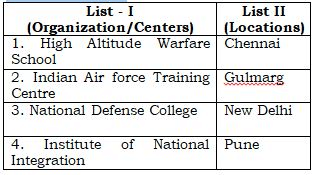
Try yourself: Name India’s Beyond Visual Range (BVR) Air-to-Air missile which was successfully test fired on 19 March 2015 from a Sukhoi-30 fighter aircraft?
Try yourself: The ISRO has developed a “Flood Hazard Atlas” by mapping flood prone and vulnerable areas in which state?
Try yourself: The Ufa city, where annual BRICS summit-2015 is scheduled to be held is in which country?
Try yourself: Which one of the following Railway Zones and the corresponding Headquarter pairs is not correctly matched?
Try yourself: The winner of 2015 Malayasian Grand Prix is ….?
Try yourself: Who among the following was the author of Rajtarangini, commonly regarded as the first genuine history of India written by an Indian?
Try yourself: Which space agency has successfully launched the world’s first all electric satellites in March, 2015?
Try yourself: Bhalchandra Nemade who has been selected for the 50th Jnanpith Award for 2014, on 6 February 2015, is a famous writer in which language?
Try yourself: Which of the following is incorrect option?
Try yourself: Which one of the following is the online grievances monitoring portals launched by union government for Indians living abroad?
Try yourself: Which of the following is a Direct Tax?
Try yourself: Indian Space Research Organisation was recently conferred ‘Space Pioneer Award’ by the National Space Society (NSS) of which country over the historic feat on successfully sending an orbit to Martin atmosphere in its very first attempt?
Try yourself: Which one of the following pairs is not correctly matched?
Try yourself: Which state is to host the 36th National Games in 2016?
Try yourself: Young Indian shuttler K. Srikanth on 15 March 2015 won which of the following major badminton championship?
Try yourself: How much Foreign Direct Investment (FDI) in country’s defence sector was proposed in the Union Budget 2014-15 presented on 10 July 2014?
Try yourself: The protein CA – 125 (Cancer Antigen – 125) is used as biomarker for detection of which type of cancer?
Section: Elementary Mathematics
Try yourself: Answer the questions based on the information given in the following table. A, B, C, D, E denote companies and 2006, 2007, 2008, 2009, & 2010 denote years. Number of Units Manufactured (M) and Number of Units Sold (S) (in hundreds) by five different companies over the years. Q. What is the total number of units manufactured by Company C over all the years together?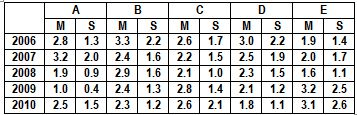
Try yourself: Answer the questions based on the information given in the following table. A, B, C, D, E denote companies and 2006, 2007, 2008, 2009, & 2010 denote years. Number of Units Manufactured (M) and Number of Units Sold (S) (in hundreds) by five different companies over the years. Q. What is the approximate percent increase in the number of units sold by Company E in the year 2007 from the previous year?
Try yourself: Answer the questions based on the information given in the following table. A, B, C, D, E denote companies and 2006, 2007, 2008, 2009, & 2010 denote years. Number of Units Manufactured (M) and Number of Units Sold (S) (in hundreds) by five different companies over the years. Q. The number of units sold by Company D in the year 2006 is what percent of the number of units manufactured by it in that year? (rounded off to two digits after decimal)
Try yourself: Answer the questions based on the information given in the following table. A, B, C, D, E denote companies and 2006, 2007, 2008, 2009, & 2010 denote years. Number of Units Manufactured (M) and Number of Units Sold (S) (in hundreds) by five different companies over the years. Q. What is the respective ratio of total number of units manufactured by Company A and B together in the year 2009 to those sold by them in the same year?
Try yourself: Answer the questions based on the information given in the following table. A, B, C, D, E denote companies and 2006, 2007, 2008, 2009, & 2010 denote years. Number of Units Manufactured (M) and Number of Units Sold (S) (in hundreds) by five different companies over the years. Q. What is the average number of units sold by Company D over all the years together?
Try yourself: What is the value of (x) in the following equation? X0.4/16=32/x2.6
Try yourself: The simplified value of [(0.111)3+(0.222)3-(0.333)3+(0.333)2x (0.222)]3 is:
Try yourself: When  is added to a number and the sum is multiplied by
  and then 3 is added to the product and then the sum is divided by
  , the quotient becomes 25. What is that number?
Try yourself: If x = (163+ 173+183+193), then x divided by 70 leaves a remainder of ….
Try yourself: A man has 9 friends: 4 boys and 5 girls. In how many ways can he invite them, if there have to be exactly 3 girls in the invitees?
Try yourself: A group of 630 children is arranged in rows for a group photograph session. Each row contains three fewer children than the row in front of it. What number of rows is not possible?
Try yourself: A die is rolled twice. What is the probability that the sum of the numbers on the two faces is 5?
Try yourself: Two trains, one from Howrah to Patna and other from Patna to Howrah, start simultaneously. After they meet, the trains reach their destinations after 9 hours and 16 hours respectively. The ratio of their speed is….
Try yourself: A watch which gains uniformly is 2 minutes slow at noon on Monday and is 4 minute 48 second fast at 2 p.m. on the following Monday. When was it correct?
Try yourself: A speaks truth in 75% cases and B in 80% of the cases. In what percentage of cases are they likely to contradict each other, narrating the same incident?
Try yourself: The sum of all the natural numbers from 200 to 600 (both inclusive) which are neither divisible by 8 nor by 12 is:
Try yourself: In a tournament, there are n teams T1, T2, ……. Tn, with n > 5. Each team consists of k players, k > 3. The following pairs of teams have one player in common T1 and T2, T2 and T3, ……., Tn-1 and Tn, and T1. No other pair of teams has any player in common. How many players are participating in the tournament, considering all the n teams together?
Try yourself: If n2 = 12345678987654321, what is n?
Try yourself: Along a road lie an odd number of stones placed at intervals of 10m. These stones have to be assembled around the middle stone. A person can carry only one stone at a time. A man carried, out the job starting with the stone in the middle, carrying stones in succession, thereby covering a distance of 4.8 km. then, the number of stones is:
Try yourself: What are the last two digits of 72008?
Section: Legal Aptitude
Try yourself: The question consist of two statements, one labeled as PRINCIPLE each other as FACT. You are to examine the principle and apply it to the given facts carefully and select the best option. Q. PRINCIPLE: Whoever, intending to take dishonestly any movable property out of the possession of any person without that person’s consent moves that property, such taking is said to commit theft. FACT: RAMU cuts down a tree on RINKU’s ground, with the intention of dishonestly taking the tree out of RINKU’s possession without RINKU’s consent. A could not take the tree away.
Try yourself: The question consist of two statements, one labeled as PRINCIPLE each other as FACT. You are to examine the principle and apply it to the given facts carefully and select the best option. Q. PRINCIPLE: injuria sine damnum i.e. injury without damage. FACT: SONU, who was returning officer at a polling booth, wrongly refused to register a duly tendered vote of MONU, though he was a qualified voter. The candidate, whom MONU sought to vote, was declared elected.
Try yourself: The question consist of two statements, one labeled as PRINCIPLE each other as FACT. You are to examine the principle and apply it to the given facts carefully and select the best option. Q. PRINCIPLE: A person is said to be of sound mind for the purpose of making a contrast if, at the time when he makes it, he is capable of understanding it and of forming a rational judgment as to its effect upon his interests. FACT: Mr. X who is usually of sound mind, but occasionally of unsound mind enters into a contract with Mr. Y when he is of unsound mind. Y came to know about this fact afterwards and now wants to file a suit against Mr. X.
Try yourself: The question consist of two statements, one labeled as PRINCIPLE each other as FACT. You are to examine the principle and apply it to the given facts carefully and select the best option. Q. PRINCIPLE: When one person signifies to another his willingness to do or to abstain from doing anything, with a view to obtaining the assent of that other to such act or abstinence, he is said to make a proposal. FACT: “Ramanuj telegrammed to the Shyamsunder, writing: “will you sell me your Rolls Royce CAR? Telegram the lowest cash price.” Shyamsunder replied, too by telegram: “Lowest price for CAR is Rs. 20 lacs.’ Ramanuj immediately sends his consent through telegram starting: ‘I agree to buy the CAR for 20 lakhs asked by you.’ Now Shyamsunder refused to sell the CAR.
Try yourself: The question consist of two statements, one labeled as PRINCIPLE each other as FACT. You are to examine the principle and apply it to the given facts carefully and select the best option. Q. PRINCIPLE: A master is liable for the acts committed by his servant in the course of employment. FACT: Sanjay is a driver working in Brookebond and Co. One day, the Manager asked him to drop a customer at the airport and get back at the earliest. On his way back from the airport, he happened to see his fiancé Ruina waiting for a bus to go home. He offered to drop at home which is to be close to his office. She got into the car and soon thereafter, the car somersaulted due to the negligence of Sanjay. Ruhina was thrown out of the car and suffered multiple injuries. She seeks compensation from Brookebond and Co.
Try yourself: The question consist of two statements, one labeled as PRINCIPLE each other as FACT. You are to examine the principle and apply it to the given facts carefully and select the best option. Q. PRINCIPLE: Nuisance as a tort (civil wrong) means an unlawful interference with a person’s use or enjoyment of land, or some right over, or in connection with it. FACT: During the scarcity of onions, long queues were made outside the defendant’s shop who having a license to sell fruits and vegetables used to sell only 1 kg. of onion per ration card. The queues extended on to the highway and also caused some obstruction to the neighboring shops. The neighboring shopkeepers brought an action for nuisance against the defendant. Options:
Try yourself: The question consist of two statements, one labeled as PRINCIPLE each other as FACT. You are to examine the principle and apply it to the given facts carefully and select the best option. Q. PRINCIPLE: Nothing is an offence which is done by a person who, at the time of doing it, by reason of unsoundness of mind, is incapable of knowing the nature of the act, or that he is doing what is either wrong or contrary to law. FACT: A takes his son B who is three years old, for a bath to the well. He throws his son inside the well so that he could have a good bath. After 10 minutes he also jumped in the well to take a bath and take his son out of the well. Both were rescued by the villagers but his son was found dead.
Try yourself: The question consist of two statements, one labeled as PRINCIPLE each other as FACT. You are to examine the principle and apply it to the given facts carefully and select the best option. Q. PRINCIPLE: ignorantia juris non excusat and ingnorantia facit excusat. FACT: George was a passenger from Zurich to Manila in a Swiss Plane. When the plane landed at the airport at Bombay on 28th Nov. 1962 it was found on search that George carried 34 kgs of gold bars in person and that he had not declared it in the ‘Manifest for transit’. On 26th Nov. 1962 Government of India issued a notification and modified its earlier exemption and now it is necessary that, the gold must be declared in the “Manifest” of the aircraft.
Try yourself: The question consist of two statements, one labeled as PRINCIPLE each other as FACT. You are to examine the principle and apply it to the given facts carefully and select the best option. Q. PRINCIPLE: Everybody is under a legal obligation to take reasonable care to avoid an act or omission which he can foresee would injure his neighbor. The neighbor for this purpose, is any person whom he should have in his mind as likely to be affected by his act. FACT: Krishanan, while driving a car at high speed in a crowded road, knocked down a cyclist. The cyclist died on the spot with a lot of blood spilling around, Lakshmi, a pregnant woman passing by, suffered from a nervous shock, leading to abortion. Lakshmi filed a suit against Krishnan claiming damages.
Try yourself: The question consist of two statements, one labeled as PRINCIPLE each other as FACT. You are to examine the principle and apply it to the given facts carefully and select the best option. Q. PRINCIPLE: Preparation is not an offence except the preparation of some special offences FACT: Ramesh keeps poisoned halua in his house, wishing to kill Binoy whom he invited to a party and to whom he wishes to give it. Unknown to Ramesh, his only son takes the halua and dies. In this case
Try yourself: The question consist of two statements, one labeled as PRINCIPLE each other as FACT. You are to examine the principle and apply it to the given facts carefully and select the best option. Q. PRINCIPLE: Agreements, the meaning of which is not certain, or capable of being made certain, are void. FACT: A horse was bought for a certain price coupled with a promise to give Rs. 500 more if the horse proved lucky.
Try yourself: The question consist of two statements, one labeled as PRINCIPLE each other as FACT. You are to examine the principle and apply it to the given facts carefully and select the best option. Q. PRINCIPLE: Mere silence as to facts likely to affect the willingness of a person to enter into a contract is not fraud, unless the circumstances of the case are such that, regard being had to them, it is the duty of the person keeping silence to speak, or unless his silence is, in itself, equivalent to speech. FACT: A sells, by auction, to B, a horse which A knows to be unsound. A says nothing to B about the horse’s unsoundness.
Try yourself: The question consist of two statements, one labeled as PRINCIPLE each other as FACT. You are to examine the principle and apply it to the given facts carefully and select the best option. Q. PRINCIPLE: Any direct physical interference with the goods in somebody’s possession without lawful justification is called trespass to goods. FACT: A purchased a car from a person who had not title to it and had sent it to a garage for repair. X believing, wrongly, that the car was his, removed it from the garage.
Try yourself: The question consist of two statements, one labeled as PRINCIPLE each other as FACT. You are to examine the principle and apply it to the given facts carefully and select the best option. Q. PRINCIPLE: “Nobody shall unlawfully interfere with a person’s use or enjoyment of land, or some right over, or in connection with it. The use or enjoyment envisaged herein, should be normal and reasonable taking into account surrounding situation.” FACT: Jeevan and Pavan were neighbours in a residential locality. Pavan started a typing class in a part of his house and his typing sound disturbed Jeevan who could not put up with any kind of continuous noise. He filed a suit against Pavan.
Try yourself: The question consist of two statements, one labeled as PRINCIPLE each other as FACT. You are to examine the principle and apply it to the given facts carefully and select the best option. Q. PRINCIPLE: Doctrine of Double Jeopardy. No person shall be prosecuted and punished for the same offence twice. FACT: Maqbool brought some gold into India without making any declaration to custom department on the airport. The custom authorities confiscated the gold under the Sea Customs Act. Maqbool was later charged for having committed an offence under Foreign Exchange Regulation Act.
Try yourself: The question consist of two statements, one labeled as Assertion (A) and other as Reason (R). You are to examine the two statements carefully and select the best option. Q. Assertion: Custom per se is law, independent of prior recognition by the sovereign or the judge. Reason: custom is source of law but by itself is not law.
Try yourself: The question consist of two statements, one labeled as Assertion (A) and other as Reason (R). You are to examine the two statements carefully and select the best option. Q. Assertion: Idol is a person who can hold property. Reason: Only human being can be called person not the lifeless things.
Try yourself: The question consist of two statements, one labeled as Assertion (A) and other as Reason (R). You are to examine the two statements carefully and select the best option. Q. Assertion: Laws are means of achieving an end namely social control Reason: The ultimate end of law is to secure greatest happiness to greatest number.
Try yourself: The question consist of two statements, one labeled as Assertion (A) and other as Reason (R). You are to examine the two statements carefully and select the best option. Q. Assertion: Every person should have the freedom of speech and expression. Reason: If a person is stopped from speaking then mankind will lose the truth.
Try yourself: The question consist of two statements, one labeled as Assertion (A) and other as Reason (R). You are to examine the two statements carefully and select the best option. Q. Assertion: Attempt to commit an offence though does not result in any harm, should also be punished. Reason: A person who tries to cause a prohibited harm and fails, is, in terms of oral culpability, not materially different from the person who tries and succeeds.
Try yourself: The question consist of two statements, one labeled as Assertion (A) and other as Reason (R). You are to examine the two statements carefully and select the best option. Q. Assertion: In India, every state has a High Court in its territory. Reason: The Constitution of India provides for a High Court in each state.
Try yourself: The question consist of two statements, one labeled as Assertion (A) and other as Reason (R). You are to examine the two statements carefully and select the best option. Q. Assertion: The Council of Ministers at the centre is collectively responsible both to the Lok Sabha and Rajya Sabha. Reason: The members of both Lok Sabha and Rajya Sabha are eligible to be ministers of the Union Government.
Try yourself: The question consist of two statements, one labeled as Assertion (A) and other as Reason (R). You are to examine the two statements carefully and select the best option. Q. Assertion: The reservation of thirty-three percent of seats for women in Parliament and State Legislature does not require Constitutional Amendment. Reason: Political parties contesting elections can allocate thirty-three per cent of seats they contest to women candidates without any Constitutional Amendment.
Try yourself: The question consist of two statements, one labeled as Assertion (A) and other as Reason (R). You are to examine the two statements carefully and select the best option. Q. Assertion: We, the people of India, having solemnly resolved to constitute India into a Democratic Republic. Reason: A republic will ensure we have a head of state that is democratically elected and accountable to voters. As a result the head of state will be a more effective constitutional safeguard.
Try yourself: The question consist of two statements, one labeled as Assertion (A) and other as Reason (R). You are to examine the two statements carefully and select the best option. Q. Assertion: Republic Day is celebrated on 26th January every year in the country. Reason: The Constitution of India came into force on 26th January 1950.
Try yourself: Read the definition and elements of the attempt, apply them on the given fact situations and answer the question: Definition of Attempt: Lord Blackburn has said that “there is no doubt that there is difference between a preparation antecedent to an attempt and the actual attempt, but if the actual transaction has commenced which would have ended in the crime if not interrupted, there is clearly an attempt to commit the crime.” 1) Fault element: Intention or knowledge requisite for committing an offence; and 2) Conduct Element: does any act towards its commission and has crossed the state of preparation. This act is so closely connected with, and proximate to the commission that it fails in object because of facts not known to him or because of circumstances beyond his control. Q. ‘RANI’ ran to a well stating that she would jump into it, and she started running towards the well but she was caught before she could reach it.
Try yourself: Read the definition and elements of the attempt, apply them on the given fact situations and answer the question: Definition of Attempt: Lord Blackburn has said that “there is no doubt that there is difference between a preparation antecedent to an attempt and the actual attempt, but if the actual transaction has commenced which would have ended in the crime if not interrupted, there is clearly an attempt to commit the crime.” 1) Fault element: Intention or knowledge requisite for committing an offence; and 2) Conduct Element: does any act towards its commission and has crossed the state of preparation. This act is so closely connected with, and proximate to the commission that it fails in object because of facts not known to him or because of circumstances beyond his control. Q. ‘SINY’ with an intention to pick-pocket puts his hand into MINU’s pocket. MINU had a loaded pistol in his pocket. The thief touches the pistol and trigger goes on, whereby MINU is shot dead.
Try yourself: Read the definition and elements of the attempt, apply them on the given fact situations and answer the question: Definition of Attempt: Lord Blackburn has said that “there is no doubt that there is difference between a preparation antecedent to an attempt and the actual attempt, but if the actual transaction has commenced which would have ended in the crime if not interrupted, there is clearly an attempt to commit the crime.” 1) Fault element: Intention or knowledge requisite for committing an offence; and 2) Conduct Element: does any act towards its commission and has crossed the state of preparation. This act is so closely connected with, and proximate to the commission that it fails in object because of facts not known to him or because of circumstances beyond his control. Q. ‘JAM’ denied food to his wife JANE for several days by keeping her confined in a room with an intention to accelerate her death. JANE ultimately managed to escape.
Try yourself: Fill in the blanks: Choose the pair of words which complete the sentence to make logical sense. Q. The NDA led Government notified the ………………… and the National Judicial Appointments Commission Act, thus ending the over two-decades-old ……………. of appointing judges of Supreme Court and high courts. Under the new law, a six – member panel headed by …………… will select judges of the apex court and state high courts.
Try yourself: Fill in the blanks: Choose the pair of words which complete the sentence to make logical sense. Q. The ………………… Legislative Assembly on 31st March 2015 passed a controversial Anti-Terrorism Law. Earlier the passed bill was rejected two times by the then ……….. in 2004 and 2008.
Try yourself: Fill in the blanks: Choose the pair of words which complete the sentence to make logical sense. Q. The Union Government on the recommendation of the ……….. under the chairmanship of ……………….. has decide to decriminalize Section ……….. of the Indian Penal Code.
Try yourself: Fill in the blanks: Choose the pair of words which complete the sentence to make logical sense. Q. A bench headed by ………….. quashed allocation of 214 …………. as ……………..
Try yourself: Choose the best option for the following statement: No one can be compelled to sing the National Anthem since: 1) It will be violative of the right to freedom of speech and expression. 2) It will be violative of right freedom of conscience and practice & propagation of religion. 3) There is no legal provision obliging anyone to sing the National Anthem.
Try yourself: Five years’ experience is a must to be able to practice as an advocate in the Supreme Court of India. This rule was prescribed by the ………….
Try yourself: Union Government recently approved 33 per cent Reservation for Women in:
Try yourself: As per Indian Protocol, who among the followings ranks highest in the order of precedence?
Try yourself: Consider the following statements and choose the best option: 1) The Chairman of the National Legal Services Authority (NALSA) is the Chief Justice of India. 2) Chief Justice Mr. Justice H. L Dattu is the present Chairman of NALSA. 3) The Chairman of the National Legal Services Authority (NALSA) is the senior most judge (after CJI) of the Supreme court of India. 4) Hon’ble Mr. Justice T. S. Thakur is the present Chairman of NALSA.
Try yourself: India and Britain recently signed an “extradition treaty”. Extradition means –
Try yourself: What is a ‘moot’?
Try yourself: The temporary release of a convicted prisoner from jail for a fixed period is called –
Try yourself: The Railway authorities allowed a train to be over-crowded. In consequence, a legitimate passenger, Mr. X got his pocket picked. Choose appropriate answer –
Try yourself: The distinction between fraud and misrepresentation: 1. Fraud is more or less intentional wrong, whereas misrepresentation may be quite innocent. 2. In addition to rendering the contract voidable, is a cause of action in tort for damages. Simple misrepresentation is not a trot but a person who rightfully rescinds a contract is entitled to compensation for any damages which he has sustained through the non-fulfillment of the contract. 3. A person complaining of misrepresentation can be met with the defence that he had “the means of discovering the truth with ordinary diligence”. But excepting fraud by silence in other cases of fraud it is no defence that “the plaintiff had the means of discovering the truth by ordinary diligence”. 4. None of the above.
Try yourself: In a recent case a Supreme Court bench comprising of Justice Dipak Misra and Justice Prafulla C pant held that the amount of maintenance to be awarded under Section 125 of CrPC cannot be restricted for iddat period (three months) only as the inherent and fundamental principle behind Section 125. Also, it said that an order under Section CrPC can be passed if a person, despite having sufficient means, neglects of refuses to maintain the wife.
Try yourself: Select the current statement on social justice bench constituted on social issue. 1. Constituted by Supreme Court on 3 December 2014. 2. Started operation on 12 December 2014 3. The brainchild of Chief Justice of India H L Dattu 4. Two Judge bench to be headed by Justice Madan B. Lokur. 5. The other member is Justice U U Lalit
Try yourself: Select the current statements about 14th Finance Commission which submitted its report to president. 1. It covers the period between 1 April 2015 and 31 March 2020. 2. The Commission headed by former RBI Governor Y V Reddy. 3. Provides for devolution of tax receipts from the Centre to the States. 4. Article 280 of constitution provides for appointment of finance commission. 5. 1st and 13th Finance Commission was headed by K C Neogy & Dr Vijay Kelkar respectively.
Section: Logical Reasoning
Try yourself: Who administers oath of office to the Governor of a State?
Try yourself: Governor of a State can make Laws during recess of State Legislative Assembly through …………..
Try yourself: Who called Indian Constitution as Quasi-Federal?
Try yourself: President of India exercises his powers …………
Try yourself: Vote on accounts is meant for …………..
Directions : Read the information given below and answer the questions that follow: Madan and Rohit are in the same team of Hockey. Parth defeated Rohit in badminton but lost to Sachin in tennis. Nitin teams with Sagar in football and with Sachin in hockey. Rohit defeated Sachin in chess. Those who play cricket do not play badminton, volleyball or tennis. Madan and Parth are in opposite teams of basketball. Nitin represents his state in cricket while Sagar does so at the district level. Boys who play chess do not play football, basketball or volleyball. Madan and Parth are together in the volleyball team. Boys who play football also play hockey. Q. Name the boys who do not play football
Directions : Read the information given below and answer the questions that follow: Madan and Rohit are in the same team of Hockey. Parth defeated Rohit in badminton but lost to Sachin in tennis. Nitin teams with Sagar in football and with Sachin in hockey. Rohit defeated Sachin in chess. Those who play cricket do not play badminton, volleyball or tennis. Madan and Parth are in opposite teams of basketball. Nitin represents his state in cricket while Sagar does so at the district level. Boys who play chess do not play football, basketball or volleyball. Madan and Parth are together in the volleyball team. Boys who play football also play hockey. Q. Who plays both hockey and tennis?
Try yourself: Directions : Read the information given below and answer the questions that follow: Madan and Rohit are in the same team of Hockey. Parth defeated Rohit in badminton but lost to Sachin in tennis. Nitin teams with Sagar in football and with Sachin in hockey. Rohit defeated Sachin in chess. Those who play cricket do not play badminton, volleyball or tennis. Madan and Parth are in opposite teams of basketball. Nitin represents his state in cricket while Sagar does so at the district level. Boys who play chess do not play football, basketball or volleyball. Madan and Parth are together in the volleyball team. Boys who play football also play hockey. Q. Which is the most popular game with this group?
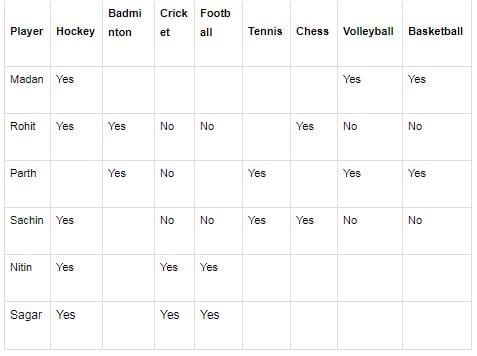
Directions : Read the information given below and answer the questions that follow: Madan and Rohit are in the same team of Hockey. Parth defeated Rohit in badminton but lost to Sachin in tennis. Nitin teams with Sagar in football and with Sachin in hockey. Rohit defeated Sachin in chess. Those who play cricket do not play badminton, volleyball or tennis. Madan and Parth are in opposite teams of basketball. Nitin represents his state in cricket while Sagar does so at the district level. Boys who play chess do not play football, basketball or volleyball. Madan and Parth are together in the volleyball team. Boys who play football also play hockey. Q. Who plays the largest number of games?
Try yourself: Directions : Read the information given below and answer the questions that follow: Madan and Rohit are in the same team of Hockey. Parth defeated Rohit in badminton but lost to Sachin in tennis. Nitin teams with Sagar in football and with Sachin in hockey. Rohit defeated Sachin in chess. Those who play cricket do not play badminton, volleyball or tennis. Madan and Parth are in opposite teams of basketball. Nitin represents his state in cricket while Sagar does so at the district level. Boys who play chess do not play football, basketball or volleyball. Madan and Parth are together in the volleyball team. Boys who play football also play hockey. Q. Which boy plays both badminton and hockey?
Try yourself: Directions : Read the following information carefully and answer the questions given below: (i) Five Professors (Dr. Joshi, Dr. Davar, Dr. Natrajan, Dr. Chaudhary and Dr. Zia) teach five different subjects (Zoology, Physics, Botany, Geology and History) in four universities (Delhi, Gujarat, Mumbai and Osmania), not necessarily in the same order. (ii) Dr. Chaudhary teaches Zoology in Mumbai University. (iii) Dr. Natrajan is neither in Osmania University nor in Delhi University and he teaches neither Geology nor History. (iv) Dr. Zia teaches Physics but neither in Mumbai University nor in Osmania University. (v) Dr. Joshi teaches History in Delhi University. (vi) Two Professors are from Gujarat University. (vii) One Professor teaches only one subject and in one University only. Q. Who teaches Geology?
Try yourself: Directions : Read the following information carefully and answer the questions given below: (i) Five Professors (Dr. Joshi, Dr. Davar, Dr. Natrajan, Dr. Chaudhary and Dr. Zia) teach five different subjects (Zoology, Physics, Botany, Geology and History) in four universities (Delhi, Gujarat, Mumbai and Osmania), not necessarily in the same order. (ii) Dr. Chaudhary teaches Zoology in Mumbai University. (iii) Dr. Natrajan is neither in Osmania University nor in Delhi University and he teaches neither Geology nor History. (iv) Dr. Zia teaches Physics but neither in Mumbai University nor in Osmania University. (v) Dr. Joshi teaches History in Delhi University. (vi) Two Professors are from Gujarat University. (vii) One Professor teaches only one subject and in one University only. Q. Which university is Dr. Zia from?
Try yourself: Directions : Read the following information carefully and answer the questions given below: (i) Five Professors (Dr. Joshi, Dr. Davar, Dr. Natrajan, Dr. Chaudhary and Dr. Zia) teach five different subjects (Zoology, Physics, Botany, Geology and History) in four universities (Delhi, Gujarat, Mumbai and Osmania), not necessarily in the same order. (ii) Dr. Chaudhary teaches Zoology in Mumbai University. (iii) Dr. Natrajan is neither in Osmania University nor in Delhi University and he teaches neither Geology nor History. (iv) Dr. Zia teaches Physics but neither in Mumbai University nor in Osmania University. (v) Dr. Joshi teaches History in Delhi University. (vi) Two Professors are from Gujarat University. (vii) One Professor teaches only one subject and in one University only. Q. Who teaches Botany?
Try yourself: Directions : Read the following information carefully and answer the questions given below: (i) Five Professors (Dr. Joshi, Dr. Davar, Dr. Natrajan, Dr. Chaudhary and Dr. Zia) teach five different subjects (Zoology, Physics, Botany, Geology and History) in four universities (Delhi, Gujarat, Mumbai and Osmania), not necessarily in the same order. (ii) Dr. Chaudhary teaches Zoology in Mumbai University. (iii) Dr. Natrajan is neither in Osmania University nor in Delhi University and he teaches neither Geology nor History. (iv) Dr. Zia teaches Physics but neither in Mumbai University nor in Osmania University. (v) Dr. Joshi teaches History in Delhi University. (vi) Two Professors are from Gujarat University. (vii) One Professor teaches only one subject and in one University only. Q. Who is from Osmania University?
Try yourself: Directions : Read the following information carefully and answer the questions given below: (i) Five Professors (Dr. Joshi, Dr. Davar, Dr. Natrajan, Dr. Chaudhary and Dr. Zia) teach five different subjects (Zoology, Physics, Botany, Geology and History) in four universities (Delhi, Gujarat, Mumbai and Osmania), not necessarily in the same order. (ii) Dr. Chaudhary teaches Zoology in Mumbai University. (iii) Dr. Natrajan is neither in Osmania University nor in Delhi University and he teaches neither Geology nor History. (iv) Dr. Zia teaches Physics but neither in Mumbai University nor in Osmania University. (v) Dr. Joshi teaches History in Delhi University. (vi) Two Professors are from Gujarat University. (vii) One Professor teaches only one subject and in one University only. Q. Which of the following combinations is correct?
Try yourself: Directions : Study the following information carefully and answer the given below. Six students A, B, C, D, E and F wrote an exam and the following is the data regarding their marks (maximum marks is 20). Q. Who is the topper of the class and how much marks did he obtain?
Try yourself: Directions : Study the following information carefully and answer the given below. Six students A, B, C, D, E and F wrote an exam and the following is the data regarding their marks (maximum marks is 20). Q. How much more marks does A have to score to be the topper? (only one person is on 1st position).
Try yourself: Directions : Study the following information carefully and answer the given below. Six students A, B, C, D, E and F wrote an exam and the following is the data regarding their marks (maximum marks is 20). Q. What is the difference between the marks obtained by C and F?
Try yourself: Direction for the question: In the following question, a group of numerals is given followed by four groups of symbol/letter combinations lettered (A), (B), (C) and (). Numerals are to be coded as per the codes and conditions. You have to find out which of the combinations (A), (B), (C) and (D) is correct and indicate your answer accordingly. Following conditions apply: 1. If the first digit as well as the last digit is odd, both are to be coded as ‘X’. 2. If the first digit as well as the last digit is even, both are to be coded as ‘$’. 3. If the last digit is ‘O’, it is to be coded as ‘#’. Q. Find out the combination for : 487692
Try yourself: Direction for the question: In the following question, a group of numerals is given followed by four groups of symbol/letter combinations lettered (A), (B), (C) and (). Numerals are to be coded as per the codes and conditions. You have to find out which of the combinations (A), (B), (C) and (D) is correct and indicate your answer accordingly. Following conditions apply: 1. If the first digit as well as the last digit is odd, both are to be coded as ‘X’. 2. If the first digit as well as the last digit is even, both are to be coded as ‘$’. 3. If the last digit is ‘O’, it is to be coded as ‘#’. Q. Find out the combination for : 713540
Try yourself: Direction for the question: In the following question, a group of numerals is given followed by four groups of symbol/letter combinations lettered (A), (B), (C) and (). Numerals are to be coded as per the codes and conditions. You have to find out which of the combinations (A), (B), (C) and (D) is correct and indicate your answer accordingly. Following conditions apply: 1. If the first digit as well as the last digit is odd, both are to be coded as ‘X’. 2. If the first digit as well as the last digit is even, both are to be coded as ‘$’. 3. If the last digit is ‘O’, it is to be coded as ‘#’. Q. Find out the combination for : 765082
Try yourself: Direction for the question: In the following question, a group of numerals is given followed by four groups of symbol/letter combinations lettered (A), (B), (C) and (). Numerals are to be coded as per the codes and conditions. You have to find out which of the combinations (A), (B), (C) and (D) is correct and indicate your answer accordingly. Following conditions apply: 1. If the first digit as well as the last digit is odd, both are to be coded as ‘X’. 2. If the first digit as well as the last digit is even, both are to be coded as ‘$’. 3. If the last digit is ‘O’, it is to be coded as ‘#’. Q. Find out the combination for : 364819
Try yourself: Direction for the question: In the following question, a group of numerals is given followed by four groups of symbol/letter combinations lettered (A), (B), (C) and (). Numerals are to be coded as per the codes and conditions. You have to find out which of the combinations (A), (B), (C) and (D) is correct and indicate your answer accordingly. Following conditions apply: 1. If the first digit as well as the last digit is odd, both are to be coded as ‘X’. 2. If the first digit as well as the last digit is even, both are to be coded as ‘$’. 3. If the last digit is ‘O’, it is to be coded as ‘#’. Q. Find out the combination for : 546839
Try yourself: From the alternatives given below. Choose the best option that correct classifies the four sentences as a F: Fact : If it relates to a known matter of direct observation, or an existing reality or something known to be true. J: Judgment : If it is an opinion or estimate or anticipation of common sense or intention. I: Inference: If it is a logical conclusion or deduction about something based on the knowledge of facts. Q. A. Everybody social life is impossible without interpersonal relationships. B. The root of many misunderstandings has been cited in poor relations among individuals. C. Assuming the above to be true, social life will be much better if people understand the importance of good interpersonal relations. D. A study reveals that interpersonal relations and hence life in general can be improved with a little effort on the part of individuals.
Try yourself: From the alternatives given below. Choose the best option that correct classifies the four sentences as a F: Fact : If it relates to a known matter of direct observation, or an existing reality or something known to be true. J: Judgment : If it is an opinion or estimate or anticipation of common sense or intention. I: Inference: If it is a logical conclusion or deduction about something based on the knowledge of facts. Q. A. The Cabinet minister definitely took the wrong step in giving the government contract. B. Under the circumstances, he had many other alternatives. C. The Prime Minister is embarrassed due to minister’s decision. D. If he has put the government in jeopardy, the minister must resign.
Try yourself: From the alternatives given below. Choose the best option that correct classifies the four sentences as a F: Fact : If it relates to a known matter of direct observation, or an existing reality or something known to be true. J: Judgment : If it is an opinion or estimate or anticipation of common sense or intention. I: Inference: If it is a logical conclusion or deduction about something based on the knowledge of facts. Q. A. If democracy is to survive, the people must develop a sense of consumerism. B. Consumerism has helped improve the quality of goods in certain countries. C. The protected environment in our country is helping the local manufacturers. D. The quality of goods suffers if the manufacturers take undue advantage of this.
Try yourself: Question consists of five statements followed by options consisting of three statements put together in a specific order. Choose the best option which indicates a valid argument, that is, where the third statement is a conclusion drawn from the preceding two statements. Q. A. Traffic congestion increases carbon monoxide in the environment. B. Increase in carbon monoxide is hazardous to health. C. traffic congestion is hazardous to health. D. Some traffic congestion does not cause increase carbon monoxide. E. Some traffic congestion is not hazardous to health.
Try yourself: Question consists of five statements followed by options consisting of three statements put together in a specific order. Choose the best option which indicates a valid argument, that is, where the third statement is a conclusion drawn from the preceding two statements. Q. A. MBA’s are in great demand. B. Samrat and Akshita are in great demand. C. Samrat is in great demand. D. Akshita is in great demand. E. Samrat and Akshita are MBA’s.
Try yourself: Question consists of five statements followed by options consisting of three statements put together in a specific order. Choose the best option which indicates a valid argument, that is, where the third statement is a conclusion drawn from the preceding two statements. Q. A. All software companies employ knowledge workers. B. Infotech employees are knowledge workers. C. Infotech is a software company. D. Some software companies employ knowledge workers. E. Infotech employs only knowledge workers.
Try yourself: Read the following information carefully to choose best option for the question: A. ‘L % M’ means that M is brother of L. B. ‘L x M’ means that L is mother of M. C. ‘L ÷ M’ means that L is the sister of M. D. ‘L = M’ means that M is father of L. Q. Which of the following means “I is the nephew of Q?” 1. Q % J = I 2. Q ÷ M x B % I 3. C ÷ I = B % Q
Try yourself: Read the following information carefully to choose best option for the question: A. ‘L % M’ means that M is brother of L. B. ‘L x M’ means that L is mother of M. C. ‘L ÷ M’ means that L is the sister of M. D. ‘L = M’ means that M is father of L. Q. If ‘A $ B’ means that A is the father of B, “A * B” means that A is the mother of B, ‘A @ B’ means that A is the wife of B, then which of the following means that M is the grand-mother of N?
Try yourself: The question contains two statements numbered I and II. You have to decide whether the information provided in the statements are sufficient to answer the question. Read both the statements and give your answer as Answer (a) If the information in the statement I alone are sufficient to answer the questions Answer (b) If the information in the statement II alone are sufficient to answer the questions Answer (c) If the information either in the statement I alone or in statement II alone are sufficient to answer the questions Answer (d) If the information even in both statement I and II together are not sufficient to answer the questions Q. Can a democratic system operate without an effective opposition? I. The opposition is indispensable. II. A good politician always learns more from his opponents than from his fervent supporters.
Try yourself: The question contains two statements numbered I and II. You have to decide whether the information provided in the statements are sufficient to answer the question. Read both the statements and give your answer as Answer (a) If the information in the statement I alone are sufficient to answer the questions Answer (b) If the information in the statement II alone are sufficient to answer the questions Answer (c) If the information either in the statement I alone or in statement II alone are sufficient to answer the questions Answer (d) If the information even in both statement I and II together are not sufficient to answer the questions Q. Do habits make men’s life rigid? I. It is out of habit that people envy others. II. Men become slave of habits.
Try yourself: The question contains two statements numbered I and II. You have to decide whether the information provided in the statements are sufficient to answer the question. Read both the statements and give your answer as Answer (a) If the information in the statement I alone are sufficient to answer the questions Answer (b) If the information in the statement II alone are sufficient to answer the questions Answer (c) If the information either in the statement I alone or in statement II alone are sufficient to answer the questions Answer (d) If the information even in both statement I and II together are not sufficient to answer the questions Q. Does intelligence predict the child’s ability to learn? I. Intelligence is unaffected by bad teaching or dull home environment. II. Children from poor home backgrounds do not well in their school-work.
Try yourself: In the following question some capital alphabets are written in a row, below them their coding has been given. In the question, a particular word has been coded in a particular manner using codes as given below the capital letters. You have to understand the pattern of coding and have to answer the question asked subsequently. Q. If DASH is 2a84, then SMASH is?
Try yourself: In the following question some capital alphabets are written in a row, below them their coding has been given. In the question, a particular word has been coded in a particular manner using codes as given below the capital letters. You have to understand the pattern of coding and have to answer the question asked subsequently. Q. If FASHION is z64t7w, then POSITION is?
Try yourself: In the following question some capital alphabets are written in a row, below them their coding has been given. In the question, a particular word has been coded in a particular manner using codes as given below the capital letters. You have to understand the pattern of coding and have to answer the question asked subsequently. Q. If LONDON is 5c62z5, then EUROPE is?
Try yourself: The question contains two statements and two conclusions numbered I and II. You have to take the two given statements to be true even if they seem to be at variance from commonly known facts and decide which of the given conclusion(s) logically follow(s) from the two given statements. Answer (1) If only conclusion I follows. Answer (2) If only conclusion II follows. Answer (3) If neither I nor II follows. Answer (4) If both I and II follows. Q. Statements: I. Some players are singers. II. All singers are tall. Conclusions: I. Some players are tall. II. All players are tall.
Try yourself: The question contains two statements and two conclusions numbered I and II. You have to take the two given statements to be true even if they seem to be at variance from commonly known facts and decide which of the given conclusion(s) logically follow(s) from the two given statements. Answer (1) If only conclusion I follows. Answer (2) If only conclusion II follows. Answer (3) If neither I nor II follows. Answer (4) If both I and II follows. Q. Statements: I. Some vegetable are fruits. II. No fruit is black. Conclusions: I. Some fruits are vegetables. II. No vegetable is black.
Try yourself: Amit first goes in South direction, then he turns towards left and travel for some distance. After that he turns right and moves certain distance. At last he turns left and travels again for some distance. Now, in which direction is he moving?
Try yourself: There are six houses in a row Mr. Aalekh has Mr. Mishra and Mr. Iliyas as neighbours. Mr. Mritynjay has Mr. Sandeep and Mr. Nayak as neigbours. Mr. Sandeep’s house is not next to Mr. Mishra or Mr. Iliyas and Mr. Nayak does not live next to Mr. Iliyas. Who are Mr. Mishra’s next door neighbours?
Try yourself: If is possible to make a meaningful word with the second the fourth, the sixth and the ninth letters of RECTIFICATION, what will be the third letter of the word? If no such word is possible mark X as your answer and if more than one word is possible mark M as your answer.
Try yourself: If Monday falls on 1st of October, which day will fall three days after the 20th in that month?
Try yourself: In the word GRAPHOLOGIST, if 1st and 7th letters, 2nd and 9th letters, 3rd and 11th letters, 4th and 8th letters and 5th and 12th letters are mutually interchanged then which letter will be 6th letter from the left of 10th letter from the left side?
Try yourself: The son of M is the father of N and grandfather (Mother’s father) of R. S is the daughter of N and sister of B. on the basis of this information, how is M related to B?
FAQs on CLAT Previous Year Questions and Answer Key - 2015
| 1. What is the CLAT exam? |  |
| 2. How can I apply for the CLAT exam? | |
| 3. What is the syllabus for the CLAT exam? | |
| 4. How is the CLAT exam conducted? | |
| 5. What is the eligibility criteria for the CLAT exam? | |