Inserting the Missing Character

Introduction
Inserting the missing figure or number problems are common in competitive examinations. A figure or a set of figures is divided into regions; each region contains numbers, letters, or an alphanumeric combination that follows a definite sequence or rule. The task is to discover the rule and select the term that correctly fills the missing region from the given options. The question figure may be a simple geometric shape (rectangle, triangle, circle) or an unusual figure divided into parts. The numbers or letters inside the figure change according to the rule; you must analyse the pattern and deduce the missing element.
Typical inputs in such questions are:
- A diagram or a set of diagrams

- A matrix
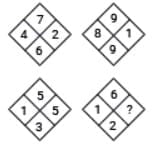
- Any random figure (for example a star)
Each of these has some characters. These characters can be numbers or letters or a combination of number and letters that follow a particular pattern. We need to crack the reasoning or logic behind this pattern so as to find the missing term.
Most common patterns
Different kinds of patterns you are likely to encounter include:
- Sum or difference relations between numbers, sometimes divided by or multiplied by a constant.
- Average of numbers (mean) computed from given neighbouring or opposite cells.
- Alphabetic sequences where letters advance by a constant, by squares, by primes, or by alternating steps.
- Differences formed from products of diametrically opposite numbers.
- Differences of sums of adjacent numbers.
- Differences following the pattern \(1^3 \pm 1\), \(2^3 \pm 1\), \(3^3 \pm 1\), and so on.
- Differences following the pattern \(1^2 \pm 1\), \(2^2 \pm 1\), \(3^2 \pm 1\), and so on.
- Terms equal to perfect powers, e.g. \(1^2, 2^2, 3^2,\dots\) or \(1^3, 2^3, 3^3,\dots\)
- Differences that are prime numbers or squares of prime numbers.
- Expressions of the form \(N^2 \pm N\) or \(N^3 \pm N\).
- Linear patterns such as \(\times N + k\) where \(k\) may change regularly, e.g. \(\times 2 + 1, \times 2 + 2, \times 2 + 3,\dots\)
- Alternating multiplicative patterns, for example \(\times 2 \pm 1\) alternately.
- Simple multiplicative sequences \(\times 1, \times 2, \times 3,\dots\)
Type of questions
Type 1 - Single figure (one-stage pattern)
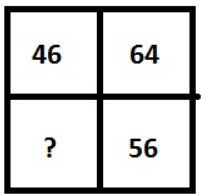
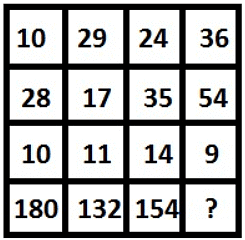
In this type a single figure is given where the numbers or letters within the figure follow a rule. You must decode the rule for the given figure and replace the missing term.
Example 1:
(a) 83
(b) 54
(c) 65
(d) 60
Correct Answer is Option (c)
The digits inside the regions are interchanged according to the rule shown in the figure. Thus the number 56 appears as 65 in the required position and Option (c) 65 is correct.
Example 2:
(a) 150
(b) 145
(c)165
(d) 162
Correct Answer is Option (d)
The bottom-row numbers are obtained by taking the difference of two numbers in the top rows and multiplying by a factor that varies by column. Specifically, \((28 - 10) \times 10 = 180\), \((29 - 17) \times 11 = 132\), \((35 - 24) \times 14 = 154\). Therefore the missing number is \((54 - 36) \times 9 = 162\).
Type 2 - Sequence illustrated by multiple figures
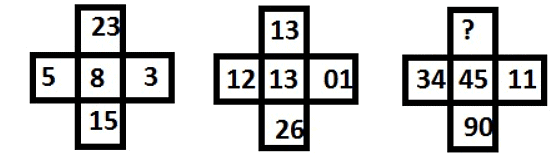
Here two or more figures are given. One or more initial figures show how the transformation works; you must apply the same rule to the final figure to find the missing element.
Example 3:
(a) 36
(b) 40
(c) 45
(d) None of these
Correct Answer is Option (c)
Use the relationship demonstrated by the first two figures. Applying the same arithmetic operations to the numbers in the third figure gives the missing result 45. Hence Option (c) is correct.
Solved examples
Example 1: Insert the missing number in each of the following.
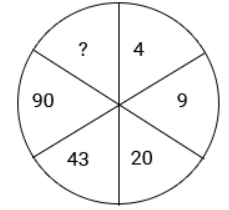
(a) 185
(b) 126
(c) 239
(d) 145
Correct Answer is Option (a)
The pattern progresses by repeatedly doubling the previous term and adding a successively increasing positive integer: \(4 \times 2 + 1 = 9\); \(9 \times 2 + 2 = 20\); \(20 \times 2 + 3 = 43\); \(43 \times 2 + 4 = 90\); \(90 \times 2 + 5 = 185\). Thus the missing number is 185.
Example 2: Insert the missing number in each of the following.
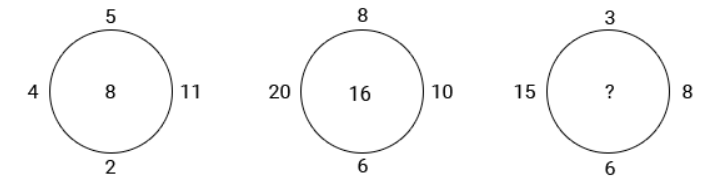
(a) 5
(b) 6
(c) 14
(d) 8
Correct Answer is Option (a)
Observe the local relationships among the numbers in the figure: identify whether the central term is the sum, difference, product, average, or other simple function of surrounding numbers and check which option matches. Applying the same rule to the missing position yields the value 5, therefore Option (a) is correct.
Example 3: Insert the missing number in each of the following.
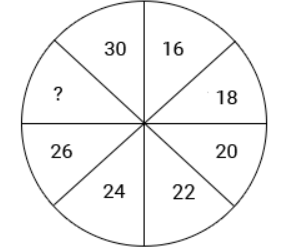
(a) 19
(b) 28
(c) 32
(d) 34
Correct Answer is Option (b)
Starting from 16 and proceeding clockwise, the numbers increase by 2 at each step. Following this pattern gives the missing term 28. Hence Option (b) is correct.
FAQs on Inserting the Missing Character
| 1. What is the purpose of inserting missing characters in an exam? |  |
| 2. What are the common patterns found in inserting missing character questions? | |
| 3. What types of questions can be expected in an inserting missing character section? | |
| 4. How can students effectively prepare for inserting missing character questions? | |
| 5. Can you provide an example of how to solve an inserting missing character question? | |




