SAT Exam > SAT Notes > Mathematics for Digital > How to Score 1500+ in Digital SAT Exam?
How to Score 1500+ in Digital SAT Exam?


What is Digital SAT?
- The Digital SAT is a standardised test administered by the College Board, a private not-for-profit organisation in the United States.
- The test is accepted by many colleges and universities in the United States and by institutions in several other countries.

Why should you take the Digital SAT?
- The Digital SAT is a widely recognised college-admissions assessment that helps you demonstrate academic readiness for college-level work.
- A strong Digital SAT score can strengthen a college application and increase access to merit scholarships and admission opportunities.
Overview of the Digital SAT: What to expect during the exam?
- The test has two sections: Reading and Writing (combined) and Mathematics.
- Timing: 64 minutes for the Reading and Writing section and 70 minutes for the Mathematics section, making the total testing time 2 hours 14 minutes (excluding the scheduled break).
- Each section is divided into two equal-length modules. A scheduled 10-minute break occurs between the Reading and Writing section and the Mathematics section.
- The first module of a section contains a mix of easier, medium and harder questions. The second module's difficulty is adjusted based on performance in the first module (a multistage adaptive design).
- Most questions are multiple choice. Some math items are student-produced responses where you input an answer instead of choosing one.
- There is no penalty for guessing: leave no question unanswered if you can make an educated guess.

Scoring system
- The total score ranges from 400 to 1600.
- Section scores are: Reading and Writing: 200-800, Mathematics: 200-800.
- There is no negative marking for incorrect answers.
- A built-in Desmos calculator is available during the entire Mathematics section.
- Colleges often consider the overall score and may also view section scores; score percentiles explain how your score compares to other test takers.
6 steps to score 1500+ (practical roadmap)
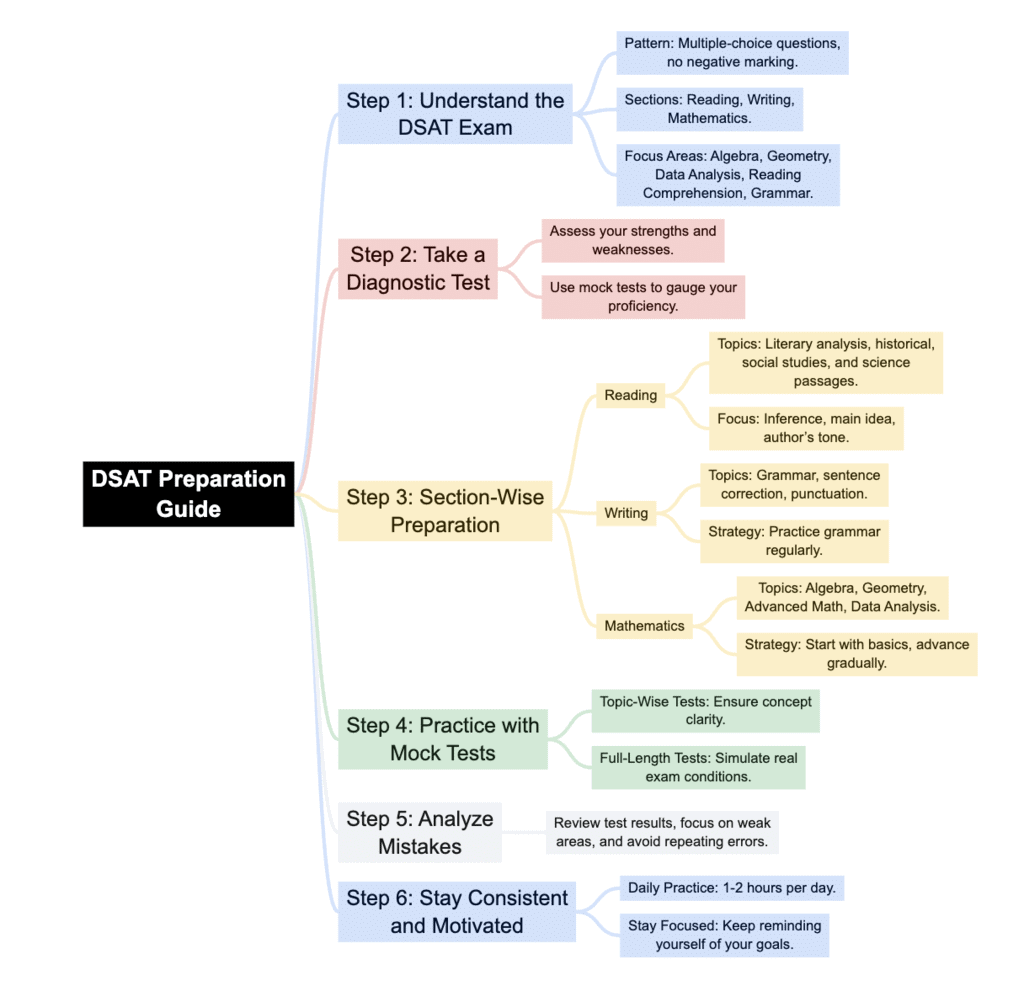
Step 1: Understand the exam pattern and the syllabus
Before you begin focused study, ensure you understand the test format, timing, question types and the topics tested. This knowledge lets you plan practice and timings effectively.
- Exam pattern: Mostly multiple-choice items; a minority are student-produced responses in Math. Two sections: Reading & Writing (combined) and Mathematics. No negative marking.
- Syllabus focus: Reading comprehension and analysis, grammar and writing skills, algebra, geometry, advanced algebra (functions, polynomials, exponential expressions) and data analysis (statistics, probability, interpretation of graphs and tables).
- Familiarise yourself with the adaptive module structure and the presence of an integrated calculator (Desmos) in the Math section.
Step 2: Take a diagnostic test
- Begin by taking a full-length diagnostic test under timed, exam-like conditions. This gives you a baseline score and shows which sections and topics need attention.
- Record your sectional scores, time taken per module, question types missed and recurring error patterns (conceptual gaps, careless mistakes, time pressure).
- Use the diagnostic results to build a focused study schedule: prioritise high-impact topics where improvement will raise your overall score most effectively.
Step 3: Focus on section-wise preparation
3.1 Reading section
- Topics include literary analysis, historical and humanities passages, social studies and science passages.
- Develop the habit of active reading: identify the main idea, passage structure, author's tone and purpose, and the role of each paragraph or sentence.
- Practice inference, evidence-based and vocabulary-in-context questions regularly; learn to find support in the passage rather than rely on memory or assumptions.
- Read editorials, essays and science articles; practise passage-based questions to improve speed and accuracy.
3.2 Writing and Language section
- Topics include grammar, usage, sentence structure, punctuation, and rhetorical skills such as organisation and clarity.
- Master common grammar rules tested: subject-verb agreement, pronoun usage, verb tense consistency, parallelism, modifiers, punctuation (commas, semicolons, colons) and sentence boundary errors.
- Practice editing paragraphs for rhetorical effectiveness: improving cohesion, clarity, and logical flow.
- Timed practice helps you develop the skill of spotting the best concise and contextually appropriate option quickly.
3.3 Mathematics section
- Core topics: Algebra (linear equations, systems, inequalities, quadratics, functions), Geometry (triangles, circles, angles, area, coordinate geometry), Advanced Math (polynomial expressions, rational functions, exponentials), and Data Analysis (statistics, probability, chart and table interpretation).
- Strategy: build strong concept clarity before attempting speed work; practise representative problems from each topic; use the Desmos calculator strategically for graphing, checking algebra and simplifying calculations where allowed.
- Learn common algebraic manipulations and geometry facts (Pythagoras, similar triangles, properties of circles) and translation of word problems into equations.
- For data analysis, focus on interpreting means, medians, ranges, percentages, rates and probability for discrete events; practise reading graphs and tables efficiently.
Step 4: Practice with topic-wise and full-length mock tests
- Start with topic-wise practice to strengthen individual skills and correct misconceptions.
- Transition to timed full-length mock tests to build stamina and to learn pacing for modules and entire sections.
- Simulate test conditions: strict timing, minimal interruptions and the same allowed tools (e.g., Desmos for Math).
- Track progress across mocks: target consistent score improvement and reduce variance in sectional performance.
Step 5: Analyse mistakes and focus on weak areas
- After every practice test, review every incorrect and uncertain answer; identify the root cause - concept gap, misreading, calculation error, or poor time management.
- Create an error log with the question type, your mistake, the correct approach and a short remedial note; review this log weekly.
- Return to foundational topics whenever you find repeated mistakes; practice a targeted set of problems until accuracy improves.
Step 6: Stay consistent and motivated
- A steady daily routine beats last-minute cramming. Aim for regular short sessions focused on weak topics plus one timed full-length mock per week in the run-up to the test.
- Suggested daily commitment: 1-2 hours of focused study, increasing to 3-4 hours as test day approaches if your schedule allows.
- Set realistic score milestones(improving by 50-100 points every 4-6 weeks) and reward progress. Maintain healthy sleep and practice under timed, exam-like conditions to reduce anxiety on test day.
Practical study tools and tips
- Use high-quality practice materials and official College Board practice tests when possible; official tests most closely mirror real test structure and question style.
- Keep a mixed practice routine: vocabulary and reading one day, algebra the next, geometry the next, and a mock test on a fixed day each week.
- Learn time management: allocate time to each module and practice pacing so you finish sections with time to review if possible.
- Make the most of the integrated Desmos calculator: practise using it for quick checks and graphing, but do not become dependent on it for routine algebraic manipulations that you can do faster by hand.
Example: Typical math problem and worked solution
Problem: The area of a rectangle is 40 square units. The length is 3 units more than the width. Find the length and width.
Sol.
Let the width be x units and the length be x + 3 units.
The area equals the product of length and width, so x(x + 3) = 40.
Expand the product: x^2 + 3x = 40.
Bring all terms to one side: x^2 + 3x - 40 = 0.
Factor the quadratic: (x + 8)(x - 5) = 0.
Set each factor to zero and solve: x = -8 or x = 5. Discard negative width, so x = 5.
Therefore width = 5 units and length = x + 3 = 8 units.
Weekly study-plan template (sample)
- Monday: 45-60 minutes Mathematics (topic: Algebra fundamentals) + 15-20 minutes vocabulary/reading practice.
- Tuesday: 45-60 minutes Reading passage practice + 15-20 minutes Writing & Language (grammar drills).
- Wednesday: 60 minutes Mathematics (topic: Geometry) + 15 minutes reviewing error log.
- Thursday: Mixed practice 60 minutes (timed sets of mixed-question practice) + 20 minutes reviewing solutions.
- Friday: Topic drills 60 minutes (Data analysis and probability) + 15-20 minutes speed reading.
- Saturday: Full-length timed mock test or two modules under timed conditions; detailed review afterwards.
- Sunday: Light review, revisit toughest errors from the past week, rest and recharge.
Common pitfalls and how to avoid them
- Over-reliance on the calculator: practise mental arithmetic and algebraic simplification to save time.
- Poor time distribution: regularly practise timed sections and plan minute-by-minute pacing for each module.
- Superficial review: always review why an answer is correct or incorrect; understanding the rationale prevents repeated mistakes.
- Ignoring weak topics: allocate a larger portion of weekly time to topics where you lose most points.
Final summary
- Understand the test structure, timing and adaptive modules; use this to shape study and practice routines.
- Begin with a diagnostic test, follow a disciplined section-wise study plan, and practise with both topic-wise problems and full-length mocks under timed conditions.
- Analyse errors carefully, maintain an error log, and focus training on weak areas while reinforcing strong areas to push your score toward and above 1500.
- Keep consistent daily practice, use official-style materials, and simulate test conditions regularly to build confidence and test-day readiness.
The document How to Score 1500+ in Digital SAT Exam? is a part of the SAT Course Mathematics for Digital SAT.
All you need of SAT at this link: SAT
FAQs on How to Score 1500+ in Digital SAT Exam?
| 1. What is the Digital SAT and how does it differ from the traditional SAT? |  |
Ans. The Digital SAT is an updated version of the SAT exam that is administered on a computer rather than on paper. This version allows for a more streamlined testing experience, with features such as adaptive questioning, where the difficulty of questions adjusts based on the test-taker's performance. Additionally, the Digital SAT may offer a more interactive format and immediate score reporting.
| 2. Why should students take the Digital SAT? | |
Ans. Students should consider taking the Digital SAT because it provides a modern testing experience that aligns with how assessments are increasingly conducted in educational settings. It offers features such as immediate feedback, reduced waiting times for scores, and potentially improved engagement through an interactive interface. Furthermore, colleges and universities recognize the Digital SAT as a valid and reliable assessment tool.
| 3. What can students expect during the Digital SAT exam? | |
Ans. During the Digital SAT exam, students can expect a computer-based format with a user-friendly interface. The exam includes sections on reading, writing, and math, with a total duration similar to the traditional SAT. Students will encounter a mix of question types, including multiple-choice and grid-in questions. The adaptive nature of the exam means that the questions will adjust in difficulty based on their answers, providing a personalized testing experience.
| 4. How did EduRev prepare the guide for the Digital SAT? | |
Ans. EduRev prepared the guide for the Digital SAT by conducting thorough research on the exam format, content, and student needs. They integrated insights from educational experts, analyzed successful preparation strategies, and compiled practical tips to help students navigate the Digital SAT effectively. The guide aims to provide comprehensive support for students to enhance their readiness and confidence.
| 5. What are some effective strategies for preparing for the Digital SAT? | |
Ans. Effective strategies for preparing for the Digital SAT include starting early with a structured study plan, utilizing official practice tests to familiarize oneself with the exam format, and focusing on areas of weakness through targeted practice. Additionally, students should incorporate digital resources, such as online tutoring and interactive learning platforms, to enhance their understanding and retention of key concepts. Regular review and time management during practice sessions are also vital for success.
About this Document

41.9K Views

4.98/5 Rating

Apr 19, 2026 Last updated
Related Exams
Document Description: How to Score 1500+ in Digital SAT Exam? for SAT 2026 is part of Mathematics for Digital SAT preparation. The notes and questions for How to Score 1500+ in Digital SAT Exam? have been prepared according to the SAT exam syllabus. Information about How to Score 1500+ in Digital SAT Exam? covers topics like and How to Score 1500+ in Digital SAT Exam? Example, for SAT 2026 Exam. Find important definitions, questions, notes, meanings, examples, exercises and tests below for How to Score 1500+ in Digital SAT Exam?.
Introduction of How to Score 1500+ in Digital SAT Exam? in English is available as part of our Mathematics for Digital SAT for SAT & How to Score 1500+ in Digital SAT Exam? in Hindi for Mathematics for Digital SAT course. Download more important topics related with notes, lectures and mock test series for SAT Exam by signing up for free. SAT: How to Score 1500+ in Digital SAT Exam?
Description
How to Score 1500+ in Digital SAT Exam? provides you insights & guidance for the best strategy to prepare for the SAT exam. It has been curated by the experts. Helps you prepare for the exam.
Information about How to Score 1500+ in Digital SAT Exam?
In this doc you can find the meaning of How to Score 1500+ in Digital SAT Exam? defined & explained in the simplest way possible. Besides explaining types of How to Score 1500+ in Digital SAT Exam? theory, EduRev gives you an ample number of questions to practice How to Score 1500+ in Digital SAT Exam? tests, examples and also practice SAT tests



Related Searches
Objective type Questions, Extra Questions, MCQs, How to Score 1500+ in Digital SAT Exam?, study material, ppt, pdf , How to Score 1500+ in Digital SAT Exam?, Important questions, How to Score 1500+ in Digital SAT Exam?, Exam, practice quizzes, Semester Notes, Summary, mock tests for examination, Viva Questions, Previous Year Questions with Solutions, past year papers, video lectures, shortcuts and tricks, Free, Sample Paper;