Worksheets With Solutions: Nutrition in Plants

Section A: Multiple Choice Questions
Q. 1. Which of the following is not an autotrophic plant?
(a) Algae
(b) Moss
(c) Mushroom
(d) None of the above
Ans: (c)
Explanation: Mushrooms are fungi and do not contain chlorophyll, so they cannot make their own food by photosynthesis. Instead, they obtain nutrients by breaking down and absorbing organic matter from dead or decaying material.
Algae and mosses contain chlorophyll and are autotrophic because they can make their own food using sunlight, carbon dioxide and water.
Q.2. What is the process of making food by the plants called?
(a) Respiration
(b) Photosynthesis
(c) Transpiration
(d) Reproduction
Ans: (b)
Explanation: Photosynthesis is the process by which green plants make food using sunlight, carbon dioxide and water in the presence of chlorophyll.
Respiration is the process of releasing energy from food, transpiration is the loss of water vapour from plant surfaces, and reproduction is the production of new plants. These are different processes and do not describe food manufacture.
Q.3. Which of the following is not a necessary condition for photosynthesis?
(a) Carbon dioxide
(b) Water
(c) Light
(d) Nitrogen
Ans: (d)
Explanation: The necessary conditions for photosynthesis are carbon dioxide, water, light and chlorophyll. Nitrogen is an important nutrient for plant growth (it is needed to make proteins and other compounds) but it is not directly required for the chemical process of photosynthesis itself.
Q.4. Which type of nutrition do plants that feed on other living organisms have?
(a) Heterotrophic nutrition
(b) Autotrophic nutrition
(c) Omnivorous nutrition
(d) None of the above
Ans: (a)
Explanation: Plants that obtain food from other living organisms are said to have heterotrophic nutrition. These plants cannot prepare their own food by photosynthesis and depend on a host plant for nourishment.
Parasitic plants, such as Cuscuta, are examples of heterotrophic plants. Autotrophic plants make their own food, while omnivorous nutrition is not applicable to plants.
Q.5. Which type of plants obtain their nutrition from dead and decaying matter?
(a) Parasitic plants
(b) Saprophytic plants
(c) Insectivorous plants
(d) Symbiotic plants
Ans: (b)
Explanation: Saprophytic organisms obtain nutrients by decomposing dead and decaying organic matter. They secrete enzymes to break down complex substances and then absorb the simpler products. Parasitic plants feed on living hosts, insectivorous plants trap and digest insects, and symbiotic plants live in a mutually beneficial relationship with other organisms.
Section B: Short Questions
Q.1. Define autotrophic nutrition.
Ans: Autotrophic nutrition is the process by which organisms, such as green plants and some algae, make their own food using simple substances like carbon dioxide and water, with the help of sunlight and the pigment chlorophyll.
Q.2. Write the equation for photosynthesis.
Ans: 6CO2 + 6H2O + light energy → C6H12O6 + 6O2.
This equation shows that carbon dioxide and water, in the presence of light energy, are converted into glucose and oxygen during photosynthesis.
Q.3. Why is photosynthesis important for living organisms on Earth?
Ans: Photosynthesis is important because:
- It produces oxygen, which most living organisms need to breathe.
- It forms the base of food chains by producing glucose and other foods that are used by plants and then by animals that eat plants.
- It helps remove carbon dioxide from the atmosphere, keeping the air balanced.
Q.4. List the necessary conditions for photosynthesis.
Ans: The necessary conditions for photosynthesis are:
- Carbon dioxide from the air (enters through stomata).
- Water from the soil (absorbed by roots).
- Light from the Sun (energy source, absorbed by chlorophyll).
Q.5. What is heterotrophic nutrition?
Ans: Heterotrophic nutrition is when organisms obtain their food by consuming other organisms or organic matter because they cannot make their own food. Examples include animals, fungi and some bacteria.
Section C: Fill in the blanks
Q.1. The process by which plants make their own food is called ____________.
Ans: photosynthesis.
Photosynthesis is the process by which green plants manufacture their own food using carbon dioxide, water and sunlight in the presence of chlorophyll.
Q.2. The pigment responsible for absorbing light in photosynthesis is ____________.
Ans: chlorophyll.
Chlorophyll is the green pigment in leaves that absorbs light energy needed to drive the process of photosynthesis.
Q.3. Plants absorb ____________ from the air and ____________ from the soil during photosynthesis.
Ans: carbon dioxide; water.
Plants take in carbon dioxide through pores called stomata and absorb water from the soil through their roots, both of which are used in photosynthesis.
Q.4. ____________ plants obtain their food from other living organisms.
Ans: Heterotrophic.
Heterotrophic plants cannot make their own food and obtain nutrients from other organisms or organic matter.
Q.5. The process of photosynthesis takes place in the ____________ of a plant cell.
Ans: chloroplasts.
Chloroplasts are the cell organelles that contain chlorophyll and are the sites where photosynthesis occurs.
Section D: Match the column
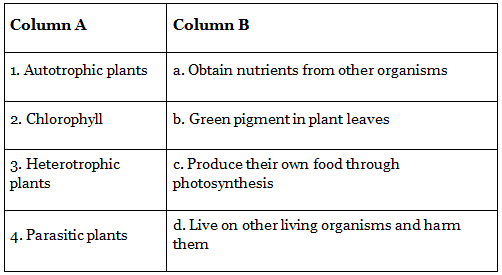
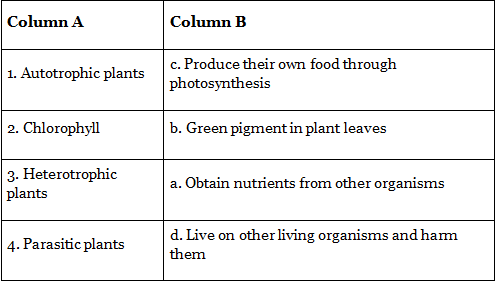
Match the terms in column A with their descriptions in column B.
Section E: True or False
Q.1. Photosynthesis occurs only in the leaves of the plant.
Ans: False
Explanation: Photosynthesis mainly occurs in green leaves but it can also take place in other green parts of a plant, such as green stems and young green fruits, wherever chlorophyll is present to capture light.
Q.2. The primary function of chlorophyll is to provide energy for photosynthesis.
Ans: False
Explanation: The primary function of chlorophyll is to absorb light energy from the Sun. This absorbed light energy is then converted into chemical energy during photosynthesis; chlorophyll itself does not 'provide' energy but acts as the light-absorbing pigment that enables the process.
Q.3. Heterotrophic plants produce their own food through photosynthesis.
Ans: False
Explanation: Heterotrophic plants cannot make their own food by photosynthesis. Instead, they obtain nutrients by feeding on other living organisms or by absorbing organic matter.
Q.4. Insectivorous plants obtain their nutrients from dead organic matter.
Ans: False
Explanation: Insectivorous plants obtain nutrients by trapping and digesting insects and other small animals, not by feeding on dead organic matter. Their adaptation helps them get nutrients (especially nitrogen) when soil is poor.
Q.5. Symbiotic plants have a mutually beneficial relationship with other organisms.
Ans: True
Explanation: Symbiotic plants form mutually beneficial relationships with other organisms. For example, leguminous plants have root nodules containing nitrogen-fixing bacteria; the bacteria fix atmospheric nitrogen for the plant, while the plant supplies carbohydrates to the bacteria.
FAQs on Worksheets With Solutions: Nutrition in Plants
| 1. What are the two main types of nutrition in plants and how do they differ? |  |
| 2. How does photosynthesis work and what are the raw materials plants need? | |
| 3. What's the difference between saprophytic and parasitic nutrition in plants? | |
| 4. Why do plants need minerals and what role do nitrogen and phosphorus play? | |
| 5. What happens during the light-dependent and light-independent reactions in photosynthesis? | |




