Worksheet Solutions: Degrees of Comparison

Instructions
- Attempt all the questions.
- Write your answers in the space provided.
- Marks and word limit for each question are mentioned in the respective sections.
Section - A
Q.1. Choose the correct option for each of the following questions [1 mark each]
(i) Which of the following is the superlative degree of the adjective 'tall'?
(a) taller
(b) tallest
(c) tall
(d) more tall
Ans: (b)
Explanation: The superlative of a one-syllable adjective like 'tall' is formed by adding -est, so 'tallest' is correct. 'Taller' is the comparative form, 'more tall' is not used for one-syllable adjectives, and 'tall' is the positive degree.
(ii) Which of the following is the comparative degree of the adjective 'bad'?
(a) worse
(b) badder
(c) baddest
(d) least bad
Ans: (a)
Explanation: 'Bad' is an irregular adjective. Its comparative form is 'worse' and its superlative is 'worst'. 'Badder' and 'baddest' are incorrect, and 'least bad' is not the standard comparative form.
(iii) What is the correct way to convert 'Rani is the smartest girl in the class' into a positive degree?
(a) Rani is as smart as any girl in the class.
(b) Rani is smarter than all other girls in the class.
(c) Rani is the smartest of all the girls in the class.
(d) No other girl in the class is as smart as Rani.
Ans: (d)
Explanation: Option (d) uses the positive degree with an 'as...as' comparison to show equality: 'No other girl in the class is as smart as Rani' means Rani is as smart as any other girl. Option (a) is similar but less natural; option (b) is comparative; option (c) repeats the superlative.
(iv) Which of the following is the positive degree of the adjective 'heavier'?
(a) heavy
(b) heavier
(c) heaviest
(d) more heavy
Ans: (a)
Explanation: The base or positive form is 'heavy'. 'Heavier' is the comparative and 'heaviest' is the superlative. 'More heavy' is not used for this one-word adjective.
(v) What is the correct way to convert 'Iron is more useful than any other metal' into a superlative degree?
(a) Iron is the most useful metal.
(b) Iron is the most useful of all metals.
(c) Iron is more useful than all other metals.
(d) Iron is the usefullest metal.
Ans: (b)
Explanation: Option (b) clearly places iron at the top among all metals: 'the most useful of all metals' is a proper superlative form. Option (a) is also a superlative in meaning but (b) explicitly compares within the whole group. Option (c) repeats the comparative idea, and option (d) is incorrect spelling and form.
Section - B
Q.2. Short Questions Answer the following questions [2 marks each]
(i) Convert the following sentence into a comparative degree: 'No other fruit is as sweet as mango.'
Ans: Mango is sweeter than any other fruit.
(ii) Convert the following sentence into a positive degree: 'He is the strongest man in the group.'
Ans: He is as strong as any man in the group.
(iii) Convert the following sentence into a superlative degree: 'She is richer than all the other women in the town.'
Ans: She is the richest woman in the town.
(iv) Identify the degree of comparison in the following sentence: 'She is as intelligent as her sister.'
Ans: Positive degree
(v) Identify the degree of comparison in the following sentence: 'This is the least interesting book I have ever read.'
Ans: Superlative degree
Section - C
Q.3. Fill in the blanks with the correct degree of comparison of the adjectives given in the brackets: [1 mark each]
(i) This bag is _______ (light) than that one.
Ans: lighter
(ii) He is the _______ (rich) man in the city.
Ans: richest
(iii) The weather today is _______ (bad) than yesterday.
Ans: worse
(iv) She is _______ (beautiful) girl in the room.
Ans: most beautiful
(v) Mount Everest is the _______ (high) mountain in the world.
Ans: highest
Section - D
Q.4. Match the adjectives in Column A with their correct degrees of comparison in Column B [1 mark each]
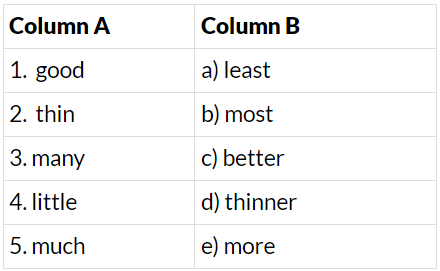
Ans:
1. c) better
2. d) thinner
3. e) more
4. a) least
5. b) most
Section - E
Q.5. State whether the following statements are True or False [1 mark each]
(i) The comparative degree is used to compare two things or persons.
Ans: True
Explanation: The comparative degree (for example, 'taller', 'better') is used to show a comparison between two people or things.
(ii) The superlative degree is used to compare more than two things or persons.
Ans: True
Explanation: The superlative degree (for example, 'tallest', 'best') is used when comparing one among three or more persons or things to show the highest or lowest degree.
(iii) The positive degree is used to compare one thing or person with another.
Ans: False
Explanation: The positive degree is the base form of an adjective (for example, 'tall', 'good') and does not by itself show comparison. Comparisons use the comparative or superlative degrees.
(iv) The adjective 'better' is in the positive degree.
Ans: False
Explanation: 'Better' is the comparative form of 'good', not the positive. The positive form is 'good'.
(v) 'Smallest' is the comparative degree of the adjective 'small'.
Ans: False
Explanation: 'Smallest' is the superlative degree. The comparative degree of 'small' is 'smaller'.
Section - F
Q.6. Choose the right word from within the brackets:
(i) He is cleverer __________ me. (than, to)
Ans: than
(ii) He is senior __________me by five years. (than, to)
Ans: to
(iii) Reeta is the most intelligent __________all the students of the class. (than, of)
Ans: of
(iv) Choose the __________ (better, best) of the two.
Ans: better
(v) Uttar Pradesh is the __________populated state of India. (more, most)
Ans: most
(vi) Make __________ noise. (little, less)
Ans: less
(vii) Shabana is the __________ painter of the two. (good, better)
Ans: better
(viii) You are junior __________ me. (than, to)
Ans: to
(ix) Health is __________ than wealth. (better, best)
Ans: better
(x) The Taj Mahal is one of the __________ beautiful buildings in the world., (more, most)
Ans: most
Q.7. Fill in the blanks with proper form (Comparative or Superlative) of adjectives.
(i) Kavita is the ______ girl in the class. (good)
Ans: best
(ii) Mt. Everest is the ______ mountain peak in the world. (high)
Ans: highest
(iii) Delhi is _______ than Chennai. (hot)
Ans: hotter
(iv) Diamond is the ______ of all gems. (costly)
Ans: costliest
(v) Iron is the ______ of all metals. (heavy)
Ans: heaviest
(vi) My doll is _______ than yours. (pretty)
Ans: prettier
(vii) Sarita is the _______ girl in the class. (popular)
Ans: most popular
(viii) Africa is the _______ of all the five continents. (hot)
Ans: hottest
(ix) My car is ______ than yours. (expensive)
Ans: more expensive
(x) Rachna is _______ than her sister. (tall)
Ans: taller
(xi) This photograph is the _______ of the two. (good)
Ans: better
(xii) The streets of Karachi are _______ than Mumbai (wide)
Ans: wider
(xiii) He is the ______ runner here. (fast)
Ans: fastest
(xiv) Your accent is _______ than mine. (bad)
Ans: worse
(xv) Lead is _______ than any other metal. (heavy)
Ans: heavier
FAQs on Worksheet Solutions: Degrees of Comparison
| 1. What are the degrees of comparison in English grammar? |  |
| 2. How do you form the comparative and superlative degrees of adjectives ending in 'y'? | |
| 3. Can you provide examples of irregular adjectives in degrees of comparison? | |
| 4. What is the importance of using degrees of comparison correctly? | |
| 5. How do you use the degrees of comparison in sentences? | |