Worksheet Solutions: Adverb

Instruction
- Attempt all questions
- Use the given word limit for each section
- Answer the questions with the correct marking scheme as per the latest pattern of the exam.
- Keep a mixed difficulty level of questions from easy to hard
Section - A
Q.1. Multiple Choice Questions (MCQs) (1 mark each)
(i) Which of the following is an adverb of time?
(a) Slowly
(b) Yesterday
(c) Upstairs
(d) Everywhere
Ans: (b)
Explanation: An adverb of time tells us when something happens. Yesterday indicates a past time, so it is an adverb of time. Slowly is manner, upstairs and everywhere tell place.
(ii) Which of the following is an adverb of manner?
(a) Never
(b) Often
(c) Quickly
(d) Here
Ans: (c)
Explanation: An adverb of manner describes how an action is done. Quickly shows the manner of doing something. Never and often are frequency adverbs, and here is a place adverb.
(iii) Identify the adverb in the following sentence: "She will always remember this moment."
(a) She
(b) Will
(c) Always
(d) Remember
Ans: (c)
Explanation: Always is an adverb of frequency; it tells us how often she will remember the moment. The other words are subject or verbs.
(iv) Which of the following is an adverb of place?
(a) Soon
(b) Outside
(c) Loudly
(d) Sometime
Ans: (b)
Explanation: An adverb of place tells us where something happens. Outside indicates a place. Soon and sometime are time adverbs, and loudly is manner.
(v) Identify the adverb in the following sentence: "The teacher spoke too quickly for the students to understand."
(a) Teacher
(b) Spoke
(c) Too
(d) Understand
Ans: (c)
Explanation: Both too and quickly act as modifiers here. Quickly is an adverb of manner (how the teacher spoke) and too is an adverb of degree; it modifies quickly to show excess. The question asks to identify the adverb shown in the options: too is listed and is an adverb of degree.
Section - B
Q.2. Short Questions (2 marks each)
(i) Explain the difference between an adverb of manner and an adverb of time.
Ans: An adverb of manner tells us how an action is done. For example: "She sings beautifully." An adverb of time tells us when an action happens. For example: "He came yesterday." In short, manner = how, time = when.
(ii) Rewrite the following sentence using an adverb of frequency: "He usually goes to the gym."
Ans: He usually goes to the gym. Explanation: Adverbs of frequency (like usually) commonly come before the main verb in a sentence: "He usually goes..."
(iii) Identify the adverb in the following sentence and mention its type: "The flowers bloom everywhere in the spring."
Ans: The adverb is everywhere. It is an adverb of place because it tells us where the flowers bloom.
(iv) Explain the function of adverbs in a sentence.
Ans: Adverbs add information to a sentence. They can modify a verb (how/when/where/frequency), an adjective (degree), or another adverb (degree or manner). Example: "She runs very fast." Here very (adverb) modifies another adverb, and fast (adverb) modifies the verb runs.
(v) Give an example of an adverb of degree and explain its meaning.
Ans: An example is almost. It is an adverb of degree meaning nearly or not quite. Example sentence: "I have almost finished my homework." This shows how close the action is to being complete.
Section - C
Q.3. Fill in the Blanks (1 mark each)
(i) She sang the song ________. (Adverb of manner)
Ans: Beautifully
(ii) The train will arrive ________. (Adverb of time)
Ans: Soon
(iii) The cat is hiding ________. (Adverb of place)
Ans: Under the bed
(iv) They ________ attend the meeting. (Adverb of frequency)
Ans: Rarely
(v) The soup is ________ hot. (Adverb of degree)
Ans: Too
Section - D
Q.4. Match the adverbs in Column A with their type in Column B (1 mark each)
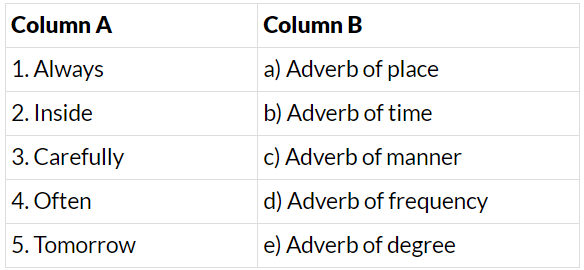
Ans: 1. d) Adverb of frequency
2. a) Adverb of place
3. c) Adverb of manner
4. d) Adverb of frequency
5. b) Adverb of time
Section - E
Q.5. True or False (1 mark each)
(i) Adverbs can only modify verbs.
Ans: False
Explanation: Adverbs can modify verbs, adjectives, and other adverbs. For example: "She sings very well" - very (adverb) modifies the adverb well.
(ii) Adverbs of manner answer the question "how."
Ans: True
Explanation: Adverbs of manner describe how an action is done, for example: "He walked slowly."
(iii) Adverbs of place answer the question "when."
Ans: False
Explanation: Adverbs of place answer where something happens (for example, here, everywhere), not when.
(iv) Adverbs of time answer the question "where."
Ans: False
Explanation: Adverbs of time answer when something happens (for example, now, soon), not where.
(v) Adverbs of degree answer the question "to what extent."
Ans: True
Explanation: Adverbs of degree (for example very, quite, too) tell us how much or to what extent something happens.
Section - F
Q.6. Fill in the blanks with a suitable adverb.
(i) I have _______ been to the USA. (Never / ever)
Ans: I have never been to the USA. (frequency adverb)
(ii) I _______ take a bath before I go to bed. (once / always / ever)
Ans: I always take a bath before I go to bed. (frequency)
(iii) My friends are ______ non-smokers. (Most / mostly)
Ans: My friends are mostly non-smokers. (focusing adverb)
(iv) I ______ go for a walk in the park. (Once / always / sometimes)
Ans: I sometimes go for a walk in the park. (frequency adverb)
(v) They ______ go out. (Rare I once / rarely)
They rarely go out, (frequency adverb)
(vi) I _______ go to bed at 10 o'clock. (Once / ever / usually)
Ans: I usually go to bed at 10 o'clock. (adverb of frequency)
(vii) I have been to Australia just ______ (one / once / ones)
Ans: I have been to Australia just once. (frequency)
(viii) My grandparents live in Kerala. I visited them ______ (once / often)
My grandparents live in Kerala. I visited them often. (frequency)
(ix) I was _____ impressed with her performance. (Too / such / very)
I was very impressed with her performance. (degree adverb)
(x) I watch English films (Once / always / occasionally)
I watch English films occasionally. (frequency adverb)
FAQs on Worksheet Solutions: Adverb
| 1. What are adverbs and how do they function in a sentence? |  |
| 2. Can you give examples of different types of adverbs? | |
| 3. How do adverbs differ from adjectives? | |
| 4. Are adverbs always necessary in a sentence? | |
| 5. How can I identify adverbs in a sentence? | |